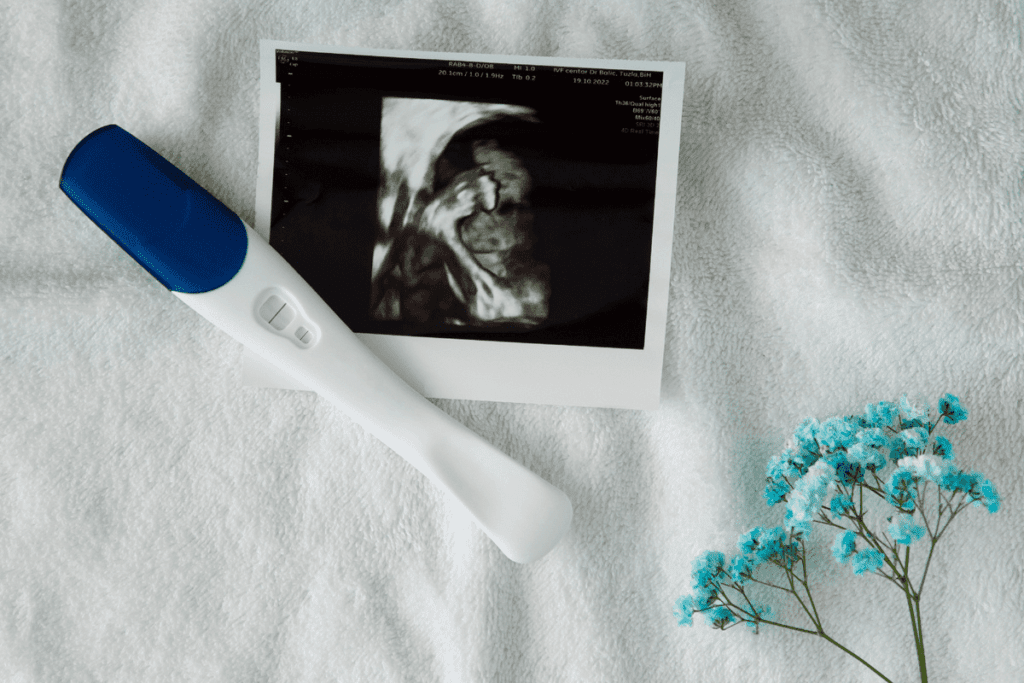
At 10 weeks, you’re excited to see your baby for the first time. An abdominal ultrasound is key. It checks if the pregnancy is healthy and how the baby is growing. Details on what a 10 week ultrasound abdominal scan usually shows and checks for. Prepare for your 10 week ultrasound abdominal examination.
Medical Expert, an obstetrician, says, “Ten weeks is not too soon for an ultrasound.” Your baby is about 3 centimeters long and weighs 4 grams.
Our skilled sonographers use the latest technology for your care. They help you understand and feel comfortable during the scan.
Key Takeaways
- Your baby measures 3 centimeters from crown to rump at 10 weeks.
- An abdominal ultrasound confirms pregnancy viability.
- The scan assesses fetal development and identifies possible issues.
- State-of-the-art imaging technology is used for the ultrasound.
- Expert sonographers provide patient-centered prenatal care.
Understanding the 10 Week Ultrasound

The 10-week ultrasound is a big step in your pregnancy. It checks if the pregnancy is viable, looks at how the fetus is growing, and finds any possible problems. Knowing what this scan does and the types of ultrasounds is key.
Scans early in pregnancy, like at 10 weeks, have many important roles. Confirming pregnancy viability is a main reason for these scans. Medical Expert, “The main reason to conduct an ultrasound this early on is to detect the fetal heartbeat.” This is vital for checking your pregnancy’s health.
Purpose of Early Pregnancy Scans
Early scans are key for watching how the fetus grows and spotting any early problems. They help us see how your baby is doing and if any action is needed. The 10-week ultrasound gives us important info for:
- Confirming the presence of a fetal heartbeat
- Assessing fetal size and development
- Identifying any possible issues or complications
Difference Between Abdominal and Transvaginal Ultrasounds
There are two main types of ultrasounds in early pregnancy: abdominal and transvaginal. An abdominal ultrasound uses a transducer on your belly to get images. A transvaginal ultrasound uses a probe in the vagina for clearer images, mainly in early pregnancy.
Choosing between these depends on your pregnancy stage and needs. Our team will pick the best one for you, making sure you get the best care.
Knowing the difference between these scans helps you get ready for your 10-week scan. It reduces anxiety and makes this important step in your pregnancy journey better.
Fetal Development at 10 Weeks

At 10 weeks, the fetus undergoes significant changes. It is about 3 centimeters long and weighs around 4 grams.
Size and Weight Expectations
The fetus is as small as a prune or fig at 10 weeks. Medical Expert, “At 10 weeks, you can see a round body and the beginning of arms and legs.” It grows fast, and its weight will keep increasing.
Developmental Milestones
By the 10th week, the fetus reaches several important milestones. These include:
- The formation of major organs, such as the heart, lungs, and liver.
- The development of limbs, with the arms and legs becoming more pronounced.
- The beginning of organ function, with the heart beating and blood circulating.
- The formation of digits on the hands and feet.
Visible Organ Development
By the 10th week, several organs are visible during an ultrasound. These include:
- The heart, which is beating and pumping blood.
- The lungs, which are starting to develop and prepare for life outside the womb.
- The liver, which is producing bile and performing other vital functions.
Understanding these developments helps expectant parents appreciate the complex processes in their baby.
Preparing for Your 10 Week Abdominal Ultrasound
To get the most out of your 10-week abdominal ultrasound, we recommend taking a few simple steps to prepare. Being prepared will help ensure that your scan is successful and that you have a comfortable experience.
What to Wear
We advise wearing comfortable clothing that allows easy access to your belly. Loose-fitting clothes are ideal as they can be easily adjusted to expose the abdominal area. This will help our medical team to perform the ultrasound efficiently.
Bladder Requirements
For a transabdominal ultrasound at 10 weeks, you may be required to have a full bladder. According to medical guidelines, “For a transabdominal ultrasound, you may need to have a full bladder.” Having a full bladder helps to lift the intestines out of the way, providing a clearer image of the uterus and the fetus.
Who Can Accompany You
You are welcome to bring a companion to support you during the ultrasound. Having a family member or friend with you can provide emotional support and make the experience more comfortable. Please inform us in advance if you plan to bring someone with you.
To help you better understand the preparation process, here’s a summary of the key points:
Preparation Step | Description |
Comfortable Clothing | Wear loose-fitting clothes for easy access to your belly |
Full Bladder | Arrive with a full bladder to improve ultrasound image quality |
Companions | You can bring a family member or friend for support |
By following these simple steps, you can ensure that your 10-week abdominal ultrasound is a success. If you have any questions or concerns, please don’t hesitate to reach out to our medical team. We’re here to support you throughout your pregnancy journey.
The Procedure: Step by Step
As you prepare for your 10 week abdominal ultrasound, you might wonder what it’s like. Our medical team is here to guide you through each step. We want to make sure you’re comfortable and know what’s happening.
Duration of the Scan
The ultrasound usually takes 30-60 minutes. This time can change a bit. It depends on how clear the images are and if more scans are needed.
Positioning and Comfort
You’ll lie on your back on an exam table for the scan. A gel will be put on your belly to help get clear images. Our technician will move the transducer over your belly to capture pictures of your baby. We’ll make sure you’re comfortable the whole time.
What the Technician Does
Our technician is skilled at getting the best images while keeping you comfortable. They’ll tell you what’s happening and point out your baby’s features on the screen. This is a chance to ask questions and see your baby for the first time.
Procedure Step | Description | Duration |
Preparation | Lying on the exam table, gel application | 5 minutes |
Ultrasound Scan | Technician moves transducer to capture images | 20-40 minutes |
Review and Explanation | Technician explains the images and answers questions | 10-15 minutes |
We know this is a big moment in your pregnancy. We’re here to make it as positive and informative as we can.
What Can Be Seen on a 10 Week Ultrasound
At 10 weeks, an ultrasound shows many important milestones. Your baby grows fast, and big changes occur.
Visible Fetal Structures
By 10 weeks, you can see your baby’s arms and legs. Medical Expert, “At 10 weeks, you can see a round body and the beginning of arms and legs.” These signs show your baby is growing right.
Major limbs and fingers are visible, though they look simple. The ultrasound will show your baby’s body, head, and limbs in different stages.
Cardiac Activity Detection
One key thing seen at 10 weeks is cardiac activity. You might see or hear the heartbeat. This shows your baby is alive and growing.
Finding the heartbeat is a big deal. It means your baby is growing as it should.
Placental Development
The placenta is also seen at 10 weeks. It gives oxygen and nutrients to your baby and takes away waste.
Checking placental development helps doctors know if the placenta is working well. This is important for your baby’s health.
Physiologic Bowel Herniation
At 10 weeks, you might see physiologic bowel herniation. This is when part of the intestine sticks out of the belly.
This is a normal part of growing and usually goes away by 12 weeks. Seeing this on the ultrasound is okay.
Measurements Taken During Your Scan
At your 10-week ultrasound, many important measurements are taken. These help check your baby’s growth and health. They also let your healthcare provider track your pregnancy’s progress.
Crown-Rump Length
The crown-rump length (CRL) is a key measurement. It shows your baby’s gestational age. Medical Expert, “The crown-rump length measurement gives your doctor ‘a gestational age.'” It’s measured from the top of the head to the buttocks, showing your baby’s size and development.
Gestational Age Assessment
Assessing your baby’s gestational age is a big part of the 10-week ultrasound. By looking at the CRL and other factors, your healthcare provider can tell how far along you are. This is important for:
- Confirming your due date
- Monitoring fetal development
- Identifying any growth issues early
Other Important Measurements
Other key measurements are also taken during your 10-week ultrasound. These include:
- Fetal Heart Rate: This checks the baby’s heart activity, making sure it’s normal.
- Nuchal Translucency: This looks at the fluid-filled space at the back of your baby’s neck. It can hint at chromosomal issues.
- Placental Development: This checks the placenta’s size, position, and how well it’s working.
These measurements, along with the CRL, give a full picture of your baby’s development. They help spot any issues early in the pregnancy.
Diagnostic Capabilities at 10 Weeks
At 10 weeks, we can spot early signs of issues. This gives parents a peek into their baby’s health. We look for major fetal anomalies and check on key developmental markers.
Major Fetal Anomalies Detectable
Ultrasound at 10 weeks can spot major fetal anomalies. Not all problems show up this early, but big structural issues might. Our team uses top-notch ultrasound tech to check the baby’s body.
Some of the detectable anomalies include:
- Neural tube defects
- Major cardiac abnormalities
- Certain skeletal malformations
Nuchal Translucency Assessment
The nuchal translucency assessment is key at 10 weeks. It looks at the fluid at the back of the fetus’s neck. If this area is too thick, it might mean a higher risk of Down syndrome.
Medical Expert, “An early screening for fetal anomalies can only be done between 11 and 14 weeks.” Even though the 10-week ultrasound is a bit early, it’s very informative about fetal growth.
Limitations of Early Scans
Early ultrasounds have their limits. Not all issues show up at 10 weeks. Some problems might only be seen later. Our team will talk to you about what we find and suggest more tests if needed.
Detectable Anomalies | Limitations |
Neural tube defects | Some cardiac issues may not be visible |
Major skeletal malformations | Limbs and digits may be difficult to assess |
Nuchal translucency assessment for chromosomal risks | Not all chromosomal abnormalities can be detected |
We’re open about what the 10-week ultrasound can and can’t do. Our team is here to give you the best care and support during your pregnancy.
10 Week Ultrasound Abdominal vs. Transvaginal Approach
Choosing between an abdominal or transvaginal ultrasound at 10 weeks depends on many things. Expectant mothers often wonder which is better for them.
When Each Method Is Preferred
Early in pregnancy, a transvaginal ultrasound is often chosen for its accuracy. But by 10 weeks, an abdominal ultrasound is usually enough. It’s non-invasive and works well for most people.
There are times when one method is better than the other:
- Transvaginal Ultrasound: Great for early pregnancy or when you need a close look at the embryo. It’s good for women with a certain type of uterus or when checking the cervix or placenta is important.
- Abdominal Ultrasound: It’s non-invasive and comfortable. Used when the pregnancy is a bit further along and the fetus is bigger, making it easier to see.
Image Quality Differences
Image quality can vary between abdominal and transvaginal ultrasounds at 10 weeks. Transvaginal ultrasounds give clearer images early on because the probe is closer to the embryo.
Abdominal ultrasounds depend on the equipment, the technician’s skill, and the patient’s body type. They might not be as detailed as transvaginal ultrasounds at 10 weeks. But they’re usually good enough for checking on the fetus and other important things.
Comfort and Accessibility Factors
Comfort and how easy it is to get to the ultrasound are key. Transvaginal ultrasounds might be more detailed but can be uncomfortable. Abdominal ultrasounds are more comfortable and easy to get to, making them a better choice for many.
We think about a few things when choosing the best method:
- How comfortable the patient is and how anxious they are
- What the pregnancy needs
- The doctor’s advice based on the patient’s health and current situation
By looking at these things, we make sure expectant mothers get the best care at their 10-week ultrasound.
Multiple Pregnancies at 10 Weeks
The 10-week ultrasound is a big deal for women expecting twins or more. At this time, we can see how many babies there are and check on their growth. We also look for any early signs of problems.
Determining Number of Fetuses
At the 10-week ultrasound, figuring out how many babies there are is key. Knowing this helps us manage the pregnancy better. Early ultrasounds can also tell us how many babies are coming, giving parents-to-be important info.
Number of Fetuses | Typical Complications | Monitoring Frequency |
Twins | Preterm labor, low birth weight | Every 4 weeks |
Triplets or more | Preterm labor, gestational diabetes | Every 2-3 weeks |
Amnionicity and Chorionicity Assessment
For pregnancies with more than one baby, checking amnionicity and chorionicity is important. Amnionicity is about the number of amniotic sacs. Chorionicity is about the number of placentas. This info helps us understand the pregnancy’s complexity and plan the right care.
Special Considerations for Multiples
Babies in multiple pregnancies need extra care because of the higher risk of problems. We watch each baby’s growth closely and deal with any issues quickly. Our team is skilled in caring for multiple pregnancies, supporting parents every step of the way.
Clinical Significance of Early Ultrasound Screening
Early ultrasound screening is key in modern prenatal care. It helps find possible problems and checks on how the fetus is growing. Research backs up the use of screening at 10 to 13 weeks.
Research on Routine 10-13 Week Screening
Ultrasound screenings between 10 to 13 weeks can greatly improve care. Medical Expert, “Your risk of miscarriage reduces each week.” This time is important for spotting issues early.
Our team sees the value in early screening. It gives parents important info about their baby’s health. The data helps manage the pregnancy well.
Early Detection Benefits
Ultrasound screening early on has many benefits. It finds fetal problems and checks if the fetus is alive. This info is key for parents and doctors to make good choices.
The main benefits are:
Benefit | Description |
Early Identification of Anomalies | Allows for timely intervention and management of detected anomalies. |
Assessment of Fetal Viability | Provides vital info about the fetus’s health and viability. |
Informed Decision Making | Helps parents and doctors make informed decisions about the pregnancy. |
Risk Assessment Capabilities
Early ultrasound screening also helps assess risks. It spots pregnancies at higher risk for problems. This means closer watch and better management plans.
Knowing the risks and benefits of early ultrasound screening helps parents. Our team is dedicated to giving full care and support during this time.
Addressing Potential Concerns
The 10-week ultrasound is key in addressing concerns about your pregnancy. It gives us insights into your baby’s health and growth.
Ruling Out Ectopic Pregnancy
The 10-week ultrasound is vital for checking for ectopic pregnancy. An ectopic pregnancy happens when the embryo grows outside the uterus, often in the fallopian tube. Our team uses the ultrasound to make sure the pregnancy is in the uterus.
“When we see cardiac activity in an embryo, we say the pregnancy is viable,” says Medical Expert. This check is important for knowing your pregnancy’s health.
Assessing Pregnancy Viability
Checking if the pregnancy is viable is another important part of the 10-week ultrasound. We look for cardiac activity to see if the embryo is growing right. This info helps us manage your pregnancy and tackle any issues early.
When Additional Testing May Be Recommended
Sometimes, more tests are needed to check your pregnancy’s health. This could include more ultrasounds or other tests. Our team will talk to you about these options and suggest the best one for you.
We know concerns about your pregnancy can be worrying. But, our team is here to support and care for you during this time.
Conclusion
Reaching the 10-week mark in your pregnancy is a big deal. An ultrasound at this time is key to tracking your baby’s growth. This article has covered how the 10-week ultrasound gives us a peek into your baby’s development.
Medical Expert, “There’s always some nervousness and excitement before the ultrasound. But when everything looks good at 10 weeks, it’s a huge relief.” We’re here to support you, making sure you’re informed and comfortable every step of the way.
Knowing what to expect from your 10-week ultrasound helps you feel more prepared. Our aim is to offer top-notch healthcare and support. We’re committed to helping you through this important time with the care and guidance you need.
FAQ
What is the purpose of a 10-week ultrasound?
The 10-week ultrasound checks if the pregnancy is viable. It also looks at how the fetus is growing and if there are any issues. Our team will help you understand everything and make you feel comfortable.
What is the difference between an abdominal and transvaginal ultrasound?
An abdominal ultrasound uses a transducer on your belly. A transvaginal ultrasound uses a probe in the vagina. Our team will tell you which one is best for you.
How should I prepare for my 10-week abdominal ultrasound?
You might need a full bladder for the best images. Wear comfy clothes that let us see your belly. Bringing someone for support is a good idea too.
What can I expect to see during the 10-week ultrasound?
You’ll see the fetus’s arms and legs. Our team will show you the heartbeat, placenta, and other important details.
How long does the ultrasound procedure take?
It usually takes 30-60 minutes. You’ll lie on your back, and gel will be used on your belly for the images.
What measurements are taken during the scan?
We measure the crown-rump length to check the gestational age. We also look at the heartbeat and placenta.
Can major fetal anomalies be detected during the 10-week ultrasound?
Yes, but early scans have limits. Our team will talk about what we can see and what tests are needed.
What is the clinical significance of early ultrasound screening?
Early scans help find problems and check how the fetus is growing. Our team will explain how this helps and why it’s important.
How is multiple pregnancy diagnosed during the 10-week ultrasound?
This ultrasound helps find out how many babies there are. It also checks if there are any issues. Our team will guide you through it all.
Can an ectopic pregnancy be ruled out during the 10-week ultrasound?
Yes, we can check if the pregnancy is in the right place. If not, we’ll talk about what to do next. We want to make sure you know about your baby’s health.
What if I have concerns about my pregnancy?
We’ll listen to your worries and check the pregnancy. We’re here to help you through your pregnancy journey.
References
National Center for Biotechnology Information. 10-Week Abdominal Ultrasound: Pregnancy Confirmation and Fetal Growth. Retrieved from https://www.ncbi.nlm.nih.gov/pmc/articles/PMC6053670/