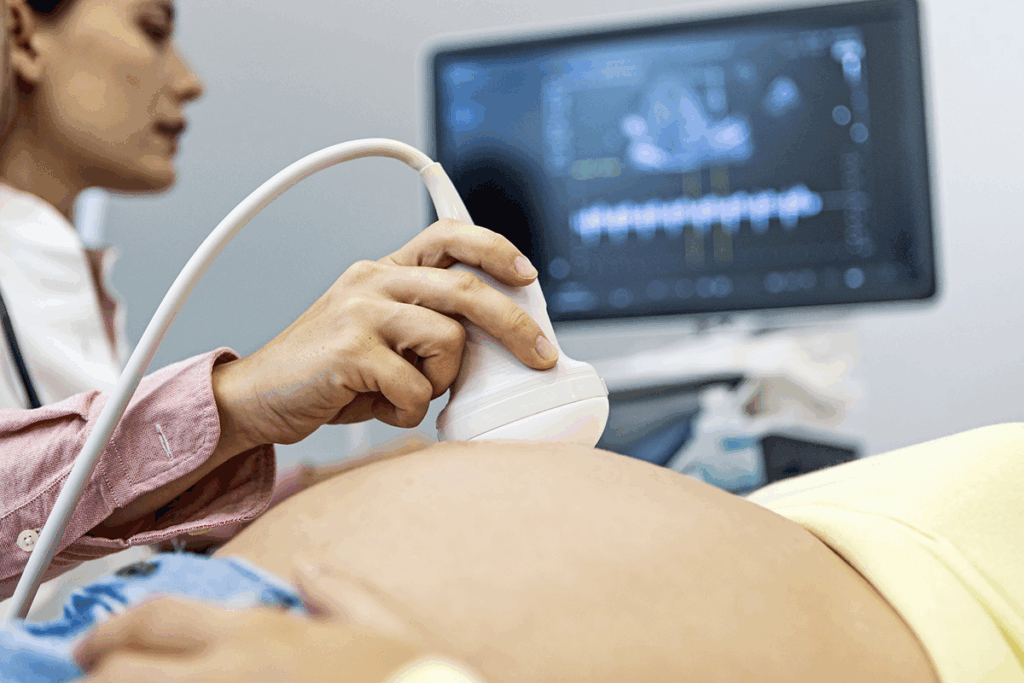
Learning you’re expecting is thrilling, but many wonder when they can see their baby on an ultrasound. At Liv Hospital, we get these early pregnancy concerns. We offer patient-focused care with the latest diagnostic tools.Understand the limitations of a 3 weeks pregnant sonogram. A 3 weeks pregnant sonogram may often be negative or inconclusive.
A pregnancy usually lasts about 40 weeks, starting from the last day of your period. At first, the egg ovulates, then gets fertilized, forms a zygote, and heads to the uterus. By three weeks, an ultrasound can’t spot a pregnancy because the embryo is too small.
Key Takeaways
- Ultrasound detection at 3 weeks is not possible due to the embryo’s microscopic size.
- A pregnancy cycle typically lasts about 40 weeks.
- Early developmental stages include ovulation, fertilization, and zygote formation.
- Liv Hospital provides advanced diagnostic protocols for pregnancy detection.
- Patient-centered care is key during early pregnancy.
Understanding Pregnancy Dating and Early Development

Pregnancy is often measured in weeks. But what does this really mean? Pregnancy dating is key in prenatal care. It helps doctors track the fetus’s growth and spot any problems early.
How Pregnancy Weeks Are Calculated
Pregnancy starts from the first day of the last menstrual period (LMP). This might seem odd, as it’s about two weeks before actual conception. For example, when a woman is considered four weeks pregnant, she was likely conceived about two weeks ago. This method is used because the exact date of conception is often unknown, but the date of the last period is more available.
To clarify, let’s consider a simple table illustrating how pregnancy weeks are counted:
Week | Developmental Stage |
1-2 weeks | Menstruation and preparation for ovulation |
3-4 weeks | Conception and implantation |
What’s Happening at 3 Weeks After Conventions
At three weeks pregnant, the embryo is in the early stages of development. According to
“The fertilized egg implants into the uterine lining, a process known as implantation,”
explains the initial stages of pregnancy. During this time, the embryo grows fast and develops important structures that will become the fetus.
It’s important to note that during the first three weeks after conception, the developing gestational sac is usually too small to see with a transvaginal ultrasound. This is why a three week sonogram is not used for pregnancy detection. Instead, doctors use other methods, like measuring hCG levels, to confirm pregnancy at this early stage.
As we move through pregnancy, knowing the developmental milestones becomes more important. By the time a woman reaches four weeks of pregnancy, the embryo has implanted, and the foundation for further development is laid.
What Is a 3 Weeks Pregnant Sonogram?

Knowing about a 3 weeks pregnant sonogram is key for moms-to-be. At this early time, it’s more about learning about ultrasound tech’s limits and possibilities.
Definition and Purpose of Early Ultrasounds
An early ultrasound, or sonogram, shows the growing embryo or fetus. It’s used to confirm pregnancy, check the age, and spot any problems. But at 3 weeks, the embryo is tiny, and most doctors say wait till 5 to 6 weeks for a good scan.
Ultrasounds are usually done between 6 to 8 weeks. These scans are key to confirm a pregnancy and get the exact due date.
Types of Ultrasounds Used in Early Pregnancy Detection
There are two main types of ultrasounds for early pregnancy: transvaginal and abdominal. Transvaginal ultrasounds give a clearer view because the probe is closer to the uterus. Abdominal ultrasounds are non-invasive and use a probe on the belly to see the uterus.
Doctors often pick transvaginal ultrasounds for early checks because they’re more sensitive. The choice between them depends on the pregnancy stage and the patient’s needs.
Type of Ultrasound | Sensitivity | Typical Use in Early Pregnancy |
Transvaginal | High | Early detection, confirming pregnancy |
Abdominal | Moderate to High | Later stages of first trimester, overview of fetal development |
Even though a 3-week ultrasound is not usually done, knowing about the different types helps moms get ready for their scans. Doctors usually wait until the embryo is bigger before doing an ultrasound.
Can an Ultrasound Detect a 3 Week Pregnancy?
Pregnancy at three weeks is very early and hard to spot with ultrasound. The embryo is tiny and just starting to grow. It’s hard to see it because of the ultrasound’s limits and the embryo’s small size.
Technical Limitations of Ultrasound Technology
Ultrasound tech is great, but it has its limits, like spotting early pregnancies. The quality of the ultrasound image depends on the type used and the person doing it. Transvaginal ultrasounds are better at finding early pregnancies than abdominal ones.
Doctors say that transvaginal sonography makes finding early pregnancies easier. This shows how important the right method is.
“The use of transvaginal ultrasound has revolutionized the field of early pregnancy detection, giving a clearer view of the gestational sac and embryo early on.”
Microscopic Nature of 3-Week Embryos
At three weeks, the embryo is very small, about 0.1 to 0.2 millimeters. It’s hard to see with regular ultrasound tech. At this time, the embryo grows fast and changes a lot.
Detection Thresholds for Gestational Sacs
The first thing ultrasound can spot is the gestational sac, usually around 4.5 to 5 weeks. By 5.5 to 6 weeks, you can see the yolk sac and the fetal pole, showing the embryo is growing.
Gestational Age | Typical Ultrasound Findings |
3 weeks | Embryo not visible; too early for detection |
4.5-5 weeks | Gestational sac visible |
5.5-6 weeks | Yolk sac and fetal pole visible |
In summary, finding a pregnancy at three weeks is tough because of the embryo’s size and ultrasound tech’s limits. Seeing the gestational sac and other parts of the embryo gets easier a bit later.
The Earliest Detectable Signs on Ultrasound
Seeing pregnancy signs on ultrasound early needs knowing about embryo growth and what you can see. There are important steps to finding out if you’re pregnant.
Gestational Sac Visibility Timeline
The first thing you might see on an ultrasound is the gestational sac. It shows up when it’s over 0.4 cm and hCG levels are above 1025 mIU/mL. This usually happens around 4.5 to 5 weeks.
Here’s a quick guide to when you might see these signs:
- At 4 weeks, the sac might not be seen or is too small.
- By 4.5 weeks, a transvaginal ultrasound can spot the sac.
- By 5 weeks, most ultrasounds can see the sac.
Yolk Sac and Fetal Pole Detection Milestones
As pregnancy goes on, more important signs show up. The yolk sac and fetal pole are key signs of growth.
Key detection milestones include:
- The yolk sac shows up around 5-5.5 weeks.
- The fetal pole, or the embryo, is seen around the same time or a bit later.
- By 6 weeks, both the yolk sac and fetal pole are seen on a transvaginal ultrasound.
When Fetal Heartbeat Becomes Visible
Finding the fetal heartbeat is a big step in knowing you’re pregnant. It might be seen as early as 5.5 weeks, but it’s clear by 6-7 weeks.
Here’s when you might hear the heartbeat:
- Around 5.5 weeks, the heartbeat might be seen with advanced tech.
- By 6-7 weeks, the heartbeat is seen on most ultrasounds.
Knowing these early signs and when they appear helps manage your expectations. It’s important to check in with your healthcare provider for accurate checks and advice.
Transvaginal vs. Abdominal Ultrasound in Early Pregnancy
Knowing the differences between transvaginal and abdominal ultrasounds is important for early pregnancy detection. Each method has its own benefits and is best for different stages of pregnancy.
Sensitivity and Resolution Differences
Transvaginal ultrasounds are more sensitive and show clearer images in early pregnancy than abdominal ultrasounds. This is because the probe is closer to the uterus. It gives a better view of the gestational sac and embryo.
Key differences in sensitivity and resolution:
Characteristics | Transvaginal Ultrasound | Abdominal Ultrasound |
Probe Location | Inside the vagina, close to the uterus | On the abdomen, outside the uterus |
Sensitivity in Early Pregnancy | Higher sensitivity for detecting early pregnancy | Lower sensitivity; better after 8 weeks |
Image Resolution | Higher resolution images of the embryo | Lower resolution; dependent on body type |
Comfort and Accessibility Considerations
Transvaginal ultrasounds are more sensitive but might be uncomfortable for some patients. Abdominal ultrasounds are more comfortable but may not show as much detail in early pregnancy.
Comfort considerations include:
- Patient anxiety or discomfort with transvaginal probes
- Accessibility for patients with certain medical conditions
- The need for a full bladder for abdominal ultrasounds, which can be uncomfortable
When Each Type Is Medically Recommended
Doctors recommend transvaginal ultrasounds for early pregnancy detection, mainly before 8 weeks. This is because they are more sensitive.
It’s best to talk to a healthcare provider to find out which ultrasound is right for you.
hCG Levels and Ultrasound Correlation
It’s important to know how hCG levels and ultrasound findings relate in early pregnancy. We need to understand how hCG levels increase at the start of pregnancy. This is key for spotting a pregnancy through ultrasound.
How hCG Levels Rise in Early Pregnancy
Human Chorionic Gonadotropin (hCG) is made by the placenta after the embryo attaches. hCG levels double about every 48 hours in early pregnancy. This fast rise shows a pregnancy is likely healthy. But, the speed of this increase can vary for each person.
Here’s a table showing typical hCG level increases:
Days After Ovulation | Typical hCG Range (mIU/mL) |
14 | 50-500 |
16 | 200-1,000 |
18 | 500-2,500 |
The Discriminatory Zone for Ultrasound Detection
The “discriminatory zone” is when a gestational sac should show up on an ultrasound. This usually happens at 1,025-1,500 mIU/mL for transvaginal ultrasounds. If hCG levels are above this, a sac should be seen. If not, it could mean an ectopic pregnancy or a failed pregnancy.
“The discriminatory zone is a critical concept in early pregnancy assessment, helping healthcare providers determine when an ultrasound should be able to detect a gestational sac.”
Why Blood Tests Are More Reliable at 3 Weeks
At 3 weeks, an ultrasound might not find a pregnancy because the embryo is too small. But, blood tests measuring hCG levels can show pregnancy more reliably. This is because hCG is detectable in blood before it shows up on an ultrasound.
Here’s a quick look at when hCG can be detected and when an ultrasound can see a pregnancy:
Detection Method | Typical Detection Time |
Blood hCG Test | As early as 3-4 weeks |
Transvaginal Ultrasound | Around 4.5-5 weeks |
Transabdominal Ultrasound | Typically 5.5-6 weeks |
In conclusion, knowing how hCG levels and ultrasound findings relate is key for early pregnancy monitoring. By understanding hCG increases and the discriminatory zone, doctors can better track pregnancy progress.
When Is the Ideal Time for a First Pregnancy Ultrasound?
Many women wonder when to schedule their first ultrasound. This scan is key for confirming pregnancy and checking for any issues early.
Medical Recommendations for Timing
Healthcare providers usually suggest waiting until 5 to 6 weeks for the first scan. This time allows for clear views of the gestational sac and sometimes the yolk sac or fetal pole.
Ultrasounds between 6 to 8 weeks are common. Around 6 to 7 weeks, a fetal heartbeat can be detected. The American College of Obstetricians and Gynecologists (ACOG) recommends the first ultrasound between 7 and 10 weeks.
What Can Be Visualized at 5-6 Weeks
At 5 to 6 weeks, an ultrasound can show the gestational sac, a key sign of pregnancy. The yolk sac might also be seen, adding to the confirmation.
Seeing the fetal pole is less common at 5 weeks. The visibility of these structures depends on the ultrasound quality and the practitioner’s skill.
Standard Protocol for 6-7 Week Appointments
A 6 to 7 week ultrasound checks the gestational sac, yolk sac, and looks for a fetal pole with a heartbeat.
Gestational Age | Typical Ultrasound Findings |
5 weeks | Gestational sac, possibly yolk sac |
6 weeks | Gestational sac, yolk sac, potentially fetal pole |
7 weeks | Fetal pole with heartbeat, more defined embryo |
Knowing when to have the first ultrasound helps parents prepare for this important moment.
Alternative Methods for Confirming Early Pregnancy
In the early stages of pregnancy, several methods can be used to confirm pregnancy. Ultrasounds are valuable, but other methods can also give insight into pregnancy status.
Quantitative vs. Qualitative hCG Blood Tests
Human Chorionic Gonadotropin (hCG) blood tests are a reliable way to confirm pregnancy. There are two types: qualitative and quantitative. Qualitative hCG tests just say yes or no to pregnancy. Quantitative hCG tests measure hCG levels, giving a detailed look at the pregnancy’s progress.
Quantitative hCG tests are more accurate than home tests. They can detect hCG as early as 6-8 days after ovulation. These tests are key in monitoring the health and growth of the pregnancy early on.
Home Pregnancy Tests: Sensitivity and Timing
Home pregnancy tests (HPTs) are a common first step in confirming pregnancy. They check for hCG in urine. Some HPTs can detect hCG levels as low as 20-50 mIU/mL. But, the test’s accuracy depends on when you take it and your hCG levels.
For the best results, take an HPT after missing a period. Taking it too early can lead to false negatives. Always follow the test instructions carefully and retest if the first result is negative but you think you might be pregnant.
Clinical Assessment Without Imaging
Clinical assessment without imaging involves a healthcare provider checking symptoms, medical history, and physical findings. It’s not definitive alone but can help confirm pregnancy when combined with lab tests like hCG blood tests.
A healthcare provider might do a pelvic exam to look for signs like a slightly bigger uterus or other early pregnancy changes.
“A thorough clinical assessment, combined with laboratory tests, can provide a complete understanding of early pregnancy.”
These methods show how healthcare providers use different tools to diagnose and monitor pregnancy. Knowing about these tools helps individuals understand the early stages of pregnancy better.
Special Circumstances Requiring Early Ultrasounds
Some pregnancies need extra attention from the start. While regular ultrasounds come later, some situations call for an early scan. This is to keep both mom and baby safe and healthy.
Monitoring After Fertility Treatments
Women who’ve had fertility treatments, like IVF, need early ultrasounds. These scans check if the pregnancy is in the right place and if it’s viable. Early checks can really help these high-risk pregnancies succeed.
Evaluating Potencial Ectopic Pregnancy
Early signs like belly pain or bleeding might mean an ectopic pregnancy. An ectopic pregnancy happens when the embryo grows outside the uterus. An early ultrasound is key to find out where the pregnancy is and if it needs urgent care.
History of Pregnancy Complications
Women who’ve had problems in past pregnancies might also need early ultrasounds. These scans can spot issues early. This lets doctors act fast to help manage any problems.
Special Circumstance | Reason for Early Ultrasound | Benefits |
After Fertility Treatments | Confirm pregnancy location and viability | Improved pregnancy outcomes |
Suspected Ectopic Pregnancy | Determine pregnancy location | Timely medical intervention |
History of Pregnancy Complications | Early detection of possible issues | Reassurance and timely management |
Healthcare providers can give better care when they know about these special cases. This way, they can help ensure the best health for both mom and baby.
Managing Expectations with 3 Week Ultrasound Results
Waiting for a 3-week ultrasound can be exciting but also raises high hopes. It’s important to know what to expect. At this early stage, the main goal is to confirm pregnancy and check for any immediate issues.
Understanding Inconclusive Findings
Many times, a 3-week ultrasound shows unclear results. The embryo is tiny, and the gestational sac might not be seen yet. Often, a second scan is needed to confirm pregnancy.
There are several reasons why an early ultrasound might not show clear results:
- The embryo is too small to be detected.
- The gestational sac is not yet visible.
- The ultrasound technology or technique used may not be sensitive enough.
Follow-up Protocols and Timing
If the first ultrasound is unclear, doctors usually suggest a follow-up scan. This scan is usually set for 1-2 weeks later.
At the follow-up, several important things are checked:
- The presence and size of the gestational sac.
- The visibility of the yolk sac and fetal pole.
- The detection of a fetal heartbeat.
Emotional Aspects of Early Pregnancy Confirmation
The wait between the first and follow-up scans can be tough for parents-to-be. It’s normal to feel anxious or unsure about the pregnancy.
To deal with these feelings, try these tips:
- Learn about the pregnancy process.
- Talk openly with your healthcare provider.
- Get support from family, friends, or groups.
Knowing what to expect and how to handle uncertainty can help parents-to-be through the early stages of pregnancy confirmation.
Conclusion: The Timeline of Pregnancy Detection
Knowing when you can detect pregnancy is key for moms-to-be and doctors. We’ve looked into how early ultrasounds can spot pregnancy and their limits.
A fetal heartbeat is usually found around 6–7 weeks, marking the first ultrasound. This time is vital as it confirms the pregnancy and gives insights into the embryo’s growth.
The timing for ultrasound detection varies based on several factors. For example, transvaginal ultrasounds can spot pregnancy sooner than abdominal ones. This is because they are more sensitive and detailed.
So, when can you tell if you’re pregnant? Some tests can find hCG levels early, but ultrasounds are more reliable around 6 weeks. Knowing this helps manage hopes and ensures timely prenatal care.
To wrap up, detecting pregnancy by ultrasound is complex. It depends on many factors. By grasping these and the early ultrasound’s limits, expectant moms can better understand their journey.
FAQ
How early can an ultrasound detect pregnancy?
An ultrasound can spot pregnancy around 5-6 weeks after your last period. At 3 weeks, it’s too early because the embryo is tiny.
Can a 3-week pregnancy be detected by ultrasound?
No, a 3-week pregnancy is too small to see on an ultrasound. It’s in the early stages of growth.
What type of ultrasound is used for early pregnancy detection?
Transvaginal ultrasounds are used early. They give a clearer view of the reproductive organs.
How are pregnancy weeks calculated?
Pregnancy weeks start from the first day of your last period. This is not the same as when you conceived, which is about two weeks later.
What is the discriminatory zone for ultrasound detection?
The discriminatory zone is when hCG levels are high enough to see a pregnancy on an ultrasound. This is usually around 1,500-3,000 mIU/mL.
When can a gestational sac be seen on an ultrasound?
You can see a gestational sac on an ultrasound around 4.5 to 5 weeks of pregnancy.
What are the earliest signs detectable on an ultrasound?
The earliest signs are the gestational sac, yolk sac, and fetal pole. The fetal heartbeat is visible a bit later, around 6 weeks.
How do hCG levels correlate with ultrasound findings?
hCG levels rise fast in early pregnancy. They help show if the pregnancy is healthy and where it is.
Are blood tests more reliable than ultrasounds at 3 weeks?
Yes, blood tests are more reliable at 3 weeks. They can detect pregnancy sooner than ultrasounds.
When is the ideal time for a first pregnancy ultrasound?
The best time for a first ultrasound is around 6-7 weeks. This is when the embryo’s growth can be seen more clearly.
What are the alternative methods for confirming early pregnancy?
Other ways to confirm early pregnancy include hCG blood tests, home pregnancy tests, and clinical checks without imaging.
Why are transvaginal ultrasounds preferred for early detection?
Transvaginal ultrasounds are better for early detection. They have higher resolution and can see the gestational sac and embryo sooner.
What are special circumstances that may require early ultrasounds?
Special cases include monitoring after fertility treatments, suspected ectopic pregnancy, and past pregnancy issues. Early ultrasounds are key to check if the pregnancy is viable and where it is.
How should I manage expectations with 3-week ultrasound results?
Remember, 3 weeks is too early for a clear ultrasound result. Follow-up plans and the emotional side of early pregnancy confirmation are important for managing your hopes.
References
National Center for Biotechnology Information. Early Ultrasound Detection of Pregnancy at Three Weeks. Retrieved from https://pubmed.ncbi.nlm.nih.gov/28010005/