Last Updated on November 25, 2025 by Ugurkan Demir

At Liv Hospital, we know how vital it is to correctly diagnose third degree AV block. This is when electrical signals from the atria can’t reach the ventricles. Explore complete heart block ECG findings and learn how to interpret 3rd degree AV block.
This issue, also called complete heart block, can cause severe slow heart rate. It can even be life-threatening if not treated quickly.
It’s key to spot the main ECG signs of this problem. We’ll look at the seven main ECG signs of 3rd degree heart block. This helps doctors give the right care fast.
Key Takeaways
- Understanding the significance of third degree AV block diagnosis.
- Recognizing the critical ECG findings associated with this condition.
- The importance of prompt treatment to prevent complications.
- Liv Hospital’s approach to diagnosing and managing heart block conditions.
- The role of ECG in diagnosing third degree AV block.
Understanding Complete Heart Block: Pathophysiology and Mechanism
It’s key to understand how complete heart block works to diagnose and treat it. This condition, also known as third-degree atrioventricular (AV) block, severely disrupts the heart’s electrical system.
Definition and Conduction System Anatomy
Complete heart block means the heart’s electrical signals don’t reach the ventricles. This makes the atria and ventricles beat on their own. The heart’s electrical system, including the SA node, AV node, and ventricles, is vital for a coordinated heartbeat.
The SA node in the right atrium is the heart’s natural pacemaker. It sends electrical impulses that start heartbeats. These impulses then go to the AV node, where they’re delayed before reaching the ventricles. In complete heart block, this pathway is severely disrupted.
Causes of Complete Heart Block
Several things can cause complete heart block, including:
- Degenerative diseases like Lev’s or Lenègre’s disease that harm the conduction system.
- Ischemic heart disease where poor blood flow damages the conduction system.
- Medications that affect heart rhythm, like certain antiarrhythmics or beta-blockers.
- Electrolyte imbalances, like hyperkalemia, which can severely affect heart conduction.
- Congenital heart defects that impact the heart’s structure and electrical system.
Knowing these causes is vital for managing complete heart block. We’ll look at ECG findings for complete heart block next, giving a full view of this serious condition.
Complete Heart Block ECG: The Fundamental Characteristics
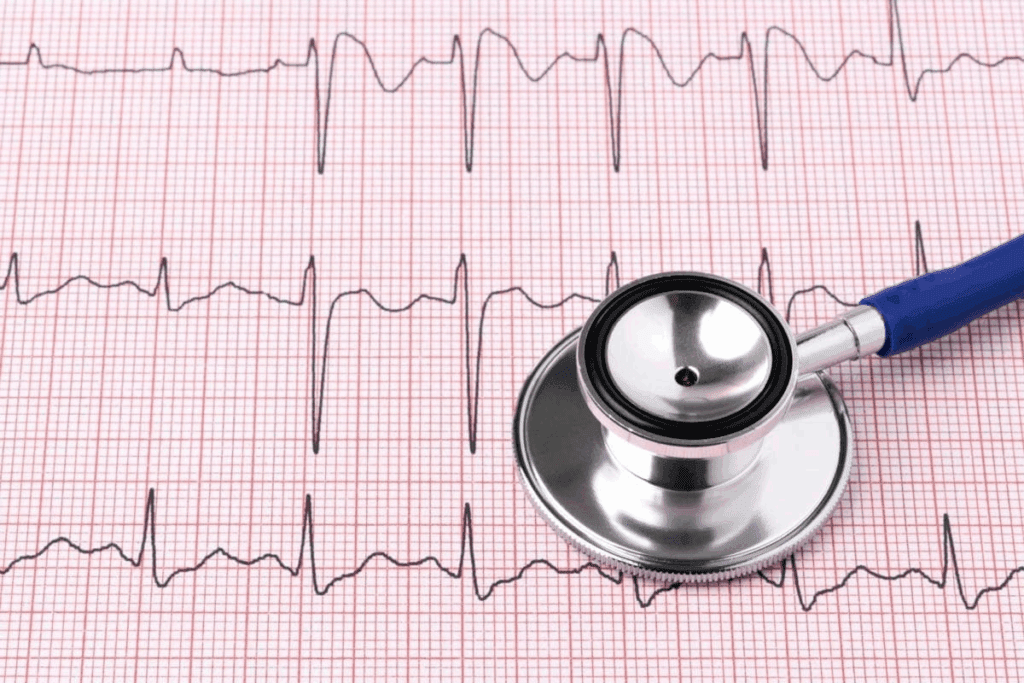
In complete heart block, the ECG shows unique signs that doctors must spot and understand. The ECG is key for diagnosing this condition. It gives vital info about the heart’s electrical activity.
“The ECG is a window into the heart’s electrical system, giving us critical insights into complete heart block,” say cardiology experts. Knowing these signs is essential for treating patients with this condition.
Complete AV Dissociation
One key sign of complete heart block on ECG is complete AV dissociation. This means the heart’s upper and lower chambers beat independently. The upper chambers beat faster, controlled by the SA node, while the lower chambers beat slower, controlled by an escape pacemaker.
This dissociation is shown by no clear link between P waves and QRS complexes on the ECG. It’s a main sign that helps doctors tell complete heart block apart from other AV block types.
Escape Rhythms in Complete Heart Block
In complete heart block, the ventricles beat due to an escape rhythm from a pacemaker below the block. There are two main types: junctional and ventricular escape rhythms.
Junctional rhythms start from the AV junction and beat between 40-60 bpm. They show a narrow QRS complex on the ECG, unless there’s a bundle branch block.
Ventricular rhythms start in the ventricular myocardium and beat between 20-40 bpm. They show a wide QRS complex on the ECG, showing abnormal ventricular activation.
Key characteristics of escape rhythms in complete heart block include:
- Independence from atrial activity
- Variable rates depending on the origin of the escape rhythm
- Different QRS morphologies based on the site of the escape pacemaker
Spotting these signs on an ECG is key for diagnosing complete heart block and understanding its causes.
Key Finding #1: Regular P-P and R-R Intervals
In diagnosing complete heart block, regular P-P and R-R intervals are key ECG findings. This is vital in telling complete heart block apart from other AV block types.
Significance of Regular Atrial Activity
The regular P-P intervals show the atria are working as they should, thanks to the SA node. This regularity is a key feature. It means the atria are okay, even with a block at the AV node.
- The SA node fires at a steady rate.
- The P waves on the ECG are consistent in shape and timing.
- This regularity helps tell complete heart block apart from other arrhythmias with irregular atrial activity.
Interpreting Ventricular Regularity
The R-R intervals’ regularity shows the ventricles have a stable, consistent rhythm. This is usually thanks to an escape rhythm, either junctional or ventricular.
The escape rhythm can be junctional, with a rate of 40-60 bpm, or ventricular, with a rate of 20-40 bpm. The regular R-R intervals are key for diagnosing complete heart block. They show the ventricles are paced by a consistent, though abnormal, rhythm.
When looking at ventricular regularity, consider:
- The rate of the escape rhythm.
- The width and shape of the QRS complexes.
- The presence of any fusion or capture beats.
By looking at both atrial and ventricular regularity, doctors can accurately diagnose complete heart block on an ECG. They can also tell it apart from other conduction problems.
Key Finding #2: More P Waves Than QRS Complexes
Third-degree AV block is marked by the atria and ventricles beating on their own. This leads to more P waves than QRS complexes on an ECG. The block stops electrical impulses from moving from the atria to the ventricles, causing two separate rhythms.
In a normal ECG, each P wave is followed by a QRS complex. This shows the atria and ventricles working together. But in Complete Heart Block, the atria and ventricles beat independently. The atria are paced by the SA node, making regular P waves. The ventricles have their own rhythm, often from the AV junction or ventricles.
P:QRS Ratio in Complete Heart Block
The P:QRS ratio is key in diagnosing Complete Heart Block. There are more P waves than QRS complexes because the atrial rate is usually faster. For example, if the atrial rate is 80 bpm and the ventricular rate is 40 bpm, you’ll see more P waves.
Here’s an example to help understand this:
| Atrial Rate (bpm) | Ventricular Escape Rate (bpm) | P:QRS Ratio |
| 80 | 40 | 2:1 |
| 100 | 30 | 3.33:1 |
| 60 | 40 | 1.5:1 |
Differentiating from Other Bradyarrhythmias
More P waves than QRS complexes is a key sign of Complete Heart Block. It helps tell it apart from other bradyarrhythmias. For instance, in second-degree AV block, there’s a consistent ratio of P waves to QRS complexes. But in Complete Heart Block, there’s no predictable pattern.
Complete Heart Block shows a complete break between P waves and QRS complexes. This is important for diagnosing Complete Heart Block and differentiating it from other heart block or bradycardia types.
Key Finding #3: Variable PR Intervals Without Consistent Association
One of the key ECG findings in complete heart block is the variability in PR intervals. This happens because the atrial and ventricular activities are not linked.
The “Marching Through” Phenomenon
The “marching through” phenomenon shows when P waves seem to march through the QRS complexes. This shows that atrial and ventricular depolarizations are not connected.
Measuring PR Intervals in Complete AV Block
Measuring PR intervals is key in diagnosing complete heart block. We see that PR intervals change a lot. There’s no steady link between P waves and QRS complexes.
To correctly diagnose complete heart block, we need to measure the PR intervals over many beats. This confirms there’s no steady PR interval, a key sign.
Key Finding #4: QRS Morphology in Different Escape Rhythms
In complete heart block, the shape of the QRS complex is key to figuring out where the escape rhythm starts. The shape of the QRS can change a lot, depending on if the rhythm starts in the junction or the ventricle.
Narrow QRS in Junctional Escape Rhythm
A junctional escape rhythm usually has a narrow QRS complex, which is less than 120 ms wide. This happens because the electrical signal starts at the AV junction and goes through the normal His-Purkinje system. This results in quick and synchronized heartbeats.
The narrow QRS complex in junctional escape rhythms is marked by:
- A width of less than 120 ms
- A shape similar to the normal sinus rhythm QRS complex
- No big changes or widening
Wide QRS in Ventricular Escape Rhythm
On the other hand, a ventricular escape rhythm has a wide QRS complex, which is over 120 ms wide. This is because the electrical signal starts in a ventricular focus and goes through the ventricular muscle. This makes the heartbeats slower and less synchronized.
The wide QRS complex in ventricular escape rhythms is marked by:
- A width of greater than 120 ms
- A shape that is often strange or abnormal
- Possible big changes or widening
Distinguishing between narrow and wide QRS complexes is key to figuring out where the escape rhythm starts. The table below shows the main differences:
| Characteristic | Junctional Escape Rhythm | Ventricular Escape Rhythm |
| QRS Width | Less than 120 ms | Greater than 120 ms |
| QRS Morphology | Normal or similar to sinus rhythm | Bizarre or abnormal |
| Origin of Impulse | AV Junction | Ventricular Focus |
Key Finding #5: Rate Characteristics of Escape Rhythms
It’s key to know the rate of escape rhythms to diagnose complete heart block on an ECG. These rhythms happen when the heart’s normal pacemaker is blocked. Then, another part of the heart takes over to keep the heart beating.
The rate of an escape rhythm tells us a lot about it. There are mainly two types: junctional and ventricular escape rhythms.
Junctional Escape Rate
Junctional escape rhythms start from the AV junction. They beat between 40 to 60 times per minute. This rate is usually faster than ventricular rhythms and helps keep the heart stable.
“The junctional escape rhythm, with its rate of 40-60 bpm, often serves as a reliable backup pacemaker when the sinoatrial node is compromised.”
Cardiac Rhythm Expert
Ventricular Escape Rate
Ventricular escape rhythms start in the ventricles and beat slower, from 20 to 40 times per minute. These rhythms often show a more serious heart problem.
| Escape Rhythm Type | Rate Range (bpm) | Origin |
| Junctional | 40-60 | AV Junction |
| Ventricular | 20-40 | Ventricles |
The rate of escape rhythms helps doctors diagnose and treat complete heart block. A slower ventricular rate might mean a more serious block and a worse outlook.
In summary, knowing the rate of escape rhythms is essential for diagnosing and treating complete heart block. By understanding the differences between junctional and ventricular rhythms, doctors can better care for their patients.
Key Finding #6: Analyzing 3rd Degree Block ECG Strips
Looking at 3rd degree block ECG strips needs careful attention. We must be detailed and systematic to get the right diagnosis.
Step-by-Step Approach to Rhythm Strip Analysis
To check a rhythm strip for 3rd degree AV block, we take certain steps. First, we spot the P waves and QRS complexes. We look for AV dissociation, a sign of complete heart block.
Then, we check if the P and ventricular rhythms are regular. Next, we measure the PR intervals to see if they vary. This is a key sign of 3rd degree block. We also look at the QRS shape to figure out the rhythm’s source.
| Step | Description | Key Features to Identify |
| 1 | Identify P waves and QRS complexes | AV dissociation, P wave regularity |
| 2 | Assess atrial and ventricular regularity | Regular P-P and R-R intervals |
| 3 | Measure PR intervals | Variable PR intervals |
| 4 | Examine QRS morphology | Narrow QRS (junctional) or wide QRS (ventricular) |
Common Pitfalls in Interpretation
When we look at 3rd degree block ECG strips, we must watch out for common mistakes. One error is mistaking AV dissociation for other heart block types. Another is missing the escape rhythm, which can lead to wrong diagnoses.
To avoid these errors, we need to thoroughly examine the rhythm strip. We should also be careful of any artifacts or conditions that might look like 3rd degree AV block.
By using a systematic method and knowing the common mistakes, we can accurately spot 3rd degree AV block on ECG strips.
Key Finding #7: Clinical Manifestations and Emergency Recognition
Complete heart block can cause serious problems like syncope and sudden cardiac death. It’s vital to spot it early. This condition affects how well the heart pumps blood to important organs.
Hemodynamic Consequences and ECG Clues
Complete heart block messes up how the heart beats. This can lower blood flow, which is bad during stress or exercise. On an ECG, we look for signs of ventricular escape rhythms. These rhythms can be fast or slow, depending on where they start.
Key ECG clues include:
- Regular P-P intervals with dissociated P waves
- Variable PR intervals without consistent association
- Escape rhythms with rates between 20-60 bpm
Identifying Patients at Risk for Syncope and Sudden Cardiac Death
People with complete heart block might faint because of slow heartbeats. They also face a higher risk of sudden cardiac death, if they have heart problems. We need to watch for signs like dizziness or fainting spells.
Risk factors for adverse outcomes include:
- History of syncope or near-syncope
- Presence of structural heart disease
- Wide complex ventricular escape rhythms
Knowing these signs and ECG patterns helps us find at-risk patients fast. We can then take steps to avoid serious problems.
Clinical Management of Complete Heart Block
Managing complete heart block needs a detailed plan. This includes quick actions and pacing decisions. It’s key to avoid problems and help patients get better.
Acute Management Strategies
In urgent cases, the main goal is to keep the patient stable and the heart pumping well. Doctors might give atropine to boost the heart rate. They also use temporary pacing and watch the patient’s heart closely.
- Administering medications such as atropine to increase heart rate
- Using temporary pacing to maintain an adequate ventricular rate
- Monitoring the patient’s hemodynamic status closely
Temporary pacing is often needed in urgent cases. This is true if the patient is showing symptoms or has a very slow heart rate.
Indications for Temporary and Permanent Pacing
Choosing the right pacing is vital in managing complete heart block. Permanent pacing is usually needed for those with symptoms or very slow heart rates.
| Indication | Type of Pacing | Clinical Context |
| Symptomatic Complete Heart Block | Permanent Pacing | Patients with symptoms such as syncope or near-syncope |
| Significant Bradycardia | Permanent Pacing | Patients with heart rate |
| Acute Management | Temporary Pacing | Bridge to permanent pacing or until condition resolves |
We must carefully decide if pacing is needed. We also need to choose the right type of pacing for each patient.
Conclusion: Mastering the Interpretation of Complete Heart Block ECG
Learning to read ECGs is key to diagnosing and treating complete heart block. We’ve looked at what makes a complete heart block ECG, like complete AV dissociation and escape rhythms. We’ve also covered important ECG signs.
Signs of complete heart block include regular P-P and R-R intervals. There are more P waves than QRS complexes. And, PR intervals vary without a consistent pattern. Knowing these signs helps us tell complete heart block apart from other heart rhythm problems.
Being good at reading complete heart block ECGs helps us manage patient care. This includes using temporary and permanent pacemakers. By improving at ECG interpretation, we can give better care to those with complete heart block. This can lead to better health outcomes and fewer complications.
As cardiology advances, knowing how to read ECGs is more important than ever. By using what we’ve learned, we can better understand complete heart block ECGs. This helps us give our patients the best care possible.
FAQ:
What is complete heart block, and how does it affect the heart’s electrical conduction system?
Complete heart block, or third-degree atrioventricular (AV) block, stops electrical signals from the atria from reaching the ventricles. This disrupts the heart’s rhythm. It happens when the AV node or the bundle of His doesn’t work right.
What are the characteristic ECG findings in complete heart block?
ECG findings for complete heart block include complete AV dissociation and regular P-P and R-R intervals. There are more P waves than QRS complexes. The PR intervals vary without a consistent pattern. The QRS morphologies depend on the escape rhythm.
How do you differentiate complete heart block from other bradyarrhythmias on an ECG?
To tell complete heart block apart from other bradyarrhythmias, look for complete AV dissociation. Also, check for more P waves than QRS complexes and no consistent PR interval. These signs point to complete heart block.
What is the significance of the P:QRS ratio in diagnosing complete heart block?
The P:QRS ratio is key in diagnosing complete heart block. It shows more P waves than QRS complexes. This means the atrial activity isn’t being passed to the ventricles.
What are the different types of escape rhythms seen in complete heart block, and how do they affect the QRS morphology?
In complete heart block, there are junctional and ventricular escape rhythms. Junctional rhythms have a narrow QRS complex. Ventricular rhythms have a wide QRS complex. This shows where the ventricular activation starts.
What are the rate characteristics of junctional and ventricular escape rhythms in complete heart block?
Junctional escape rhythms have a rate of 40-60 bpm. Ventricular rhythms have a rate of 20-40 bpm. These rates are slower than normal and can change based on the condition.
How do you analyze a rhythm strip for complete heart block, and what are the common pitfalls to avoid?
To analyze a rhythm strip for complete heart block, follow a step-by-step approach. Check the P-P and R-R intervals, the P:QRS ratio, and the PR intervals for variability. Avoid mistakes like short strip lengths or missing atrial-ventricular dissociation.
What are the clinical manifestations and hemodynamic consequences of complete heart block?
Complete heart block can cause serious problems like reduced cardiac output. This may lead to symptoms like dizziness, syncope, and even sudden death. Quick action and treatment are vital to manage these issues.
What are the management strategies for complete heart block, including the role of temporary and permanent pacing?
Managing complete heart block includes immediate care to stabilize the patient. Then, consider temporary or permanent pacing. Permanent pacing is often needed to restore a stable rhythm and improve heart function.
What is the importance of mastering the interpretation of complete heart block ECG for healthcare professionals?
Healthcare professionals need to master interpreting complete heart block ECGs. This skill helps them accurately diagnose and manage this serious condition. It improves patient outcomes.