
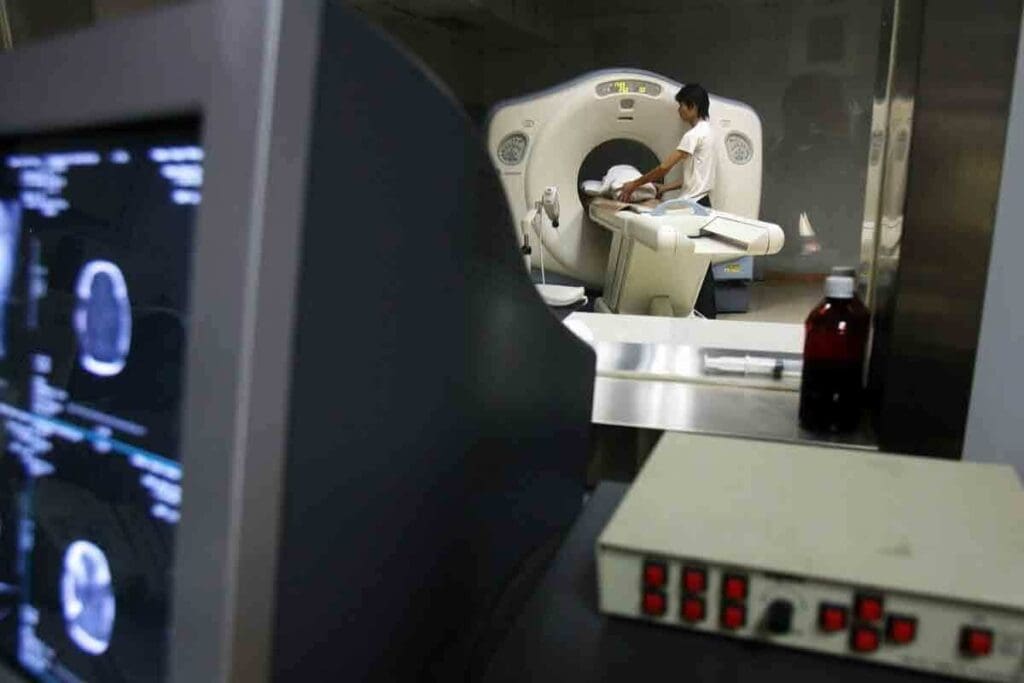
A CT scan, or computed tomography scan, is a tool that uses X-rays to show detailed images of the brain and its structures. It helps doctors check for problems and find brain tumors.
To get these images, you lie on a table that moves through a doughnut-shaped machine. It takes X-ray pictures from many angles. Then, these pictures are put together to show a clear picture of the brain.
While a CT scan can spot brain tumors, it’s not as good at finding small or slow-growing ones. MRI scans are better for these cases.
Key Takeaways
- A CT scan uses X-ray technology to create detailed images of the brain.
- It is useful for detecting larger tumors and acute conditions like hemorrhage.
- The ability of a CT scan to detect smaller or slow-growing tumors is limited.
- MRI scans may be recommended for more detailed information.
- A CT scan is a valuable diagnostic tool for assessing neurological symptoms.
The Fundamentals of CT Scanning Technology
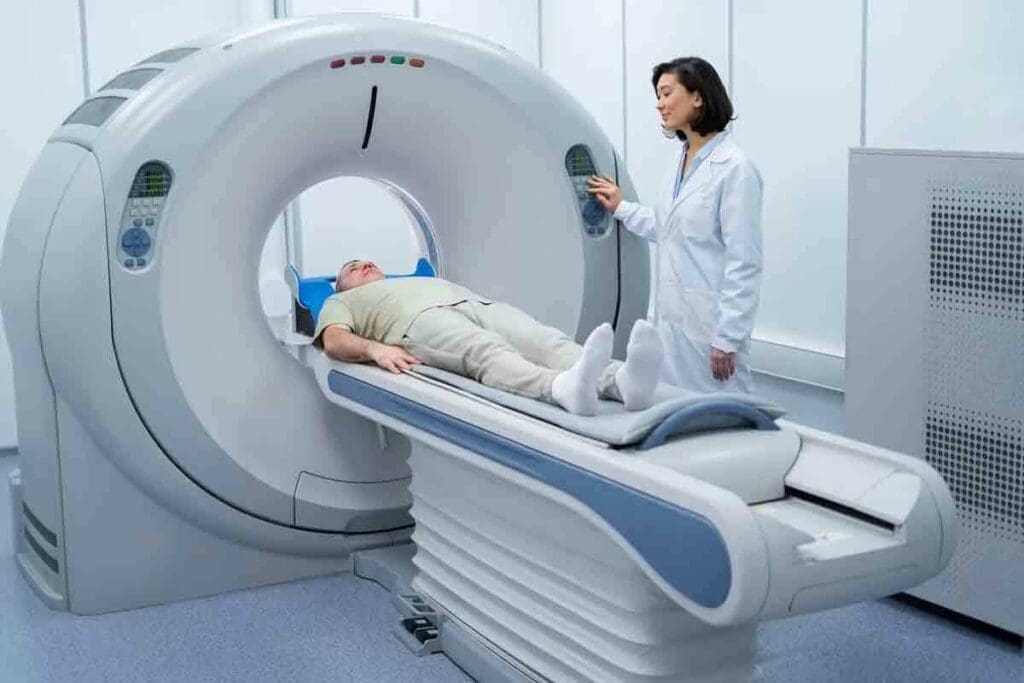
Computed Tomography (CT) scans are key in medical imaging, helping spot brain tumors. They use X-rays and a computer to make detailed images of the head. This helps doctors diagnose conditions more accurately.
How CT Scanners Create Cross-Sectional Images
CT scanners make images by rotating an X-ray tube around the head. They capture many images, then put them together into detailed pictures. A contrast agent is used to make some areas or structures in the brain stand out more.
The X-ray tube sends beams through the head. Detectors on the other side collect this data. A computer then turns this into images of thin slices of the brain.
The Role of X-ray Technology in CT Imaging
X-ray technology is key in CT imaging. It gives the raw data needed for detailed images. The X-ray tube rotates around the head, sending beams through the brain tissue.
Different tissues absorb X-rays at varying levels. This allows for detailed images to be made. A study inNature shows how X-ray tech has improved CT image quality, helping spot brain tumors better.
CT Scan Resolution and Image Quality
The quality of CT images depends on several factors. These include the technology used and the scan settings. Higher resolution images can spot smaller issues, but some tumors might not be seen if they’re small or blend in with the surrounding tissue.
| Factor | Impact on Image Quality | Clinical Significance |
| X-ray Tube Voltage | Affects the penetration and contrast of the image | Influences the visibility of different tissue types |
| Detector Sensitivity | Determines the amount of data collected | Impacts the overall quality and detail of the image |
| Reconstruction Algorithm | Influences the final image quality and noise levels | Affects the diagnostic accuracy and confidence |
Brain Tumor CT: The Detection Process
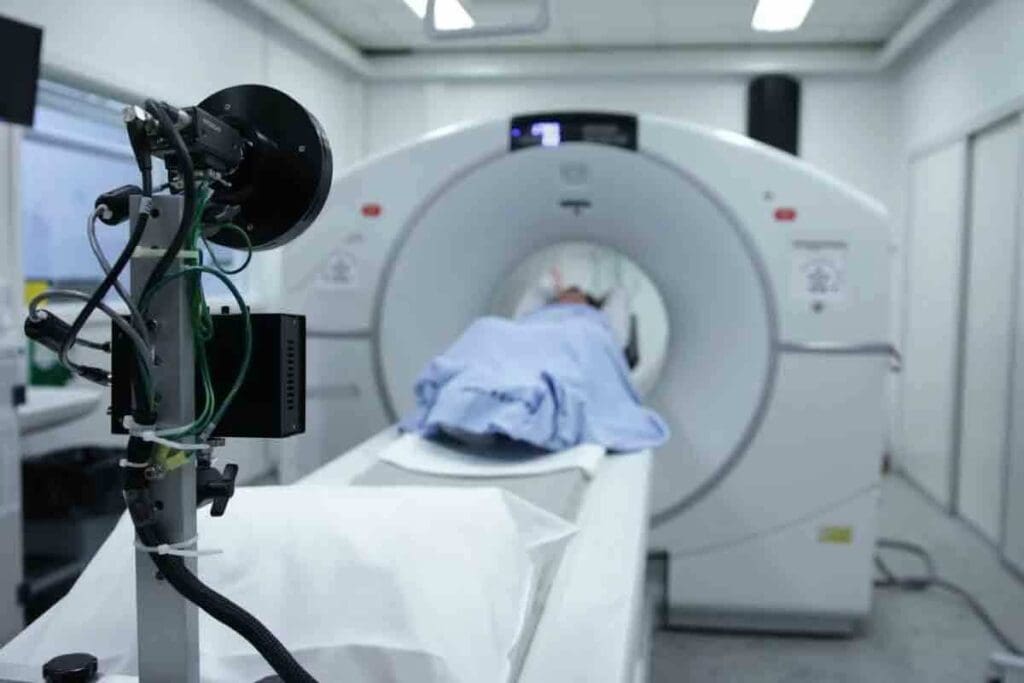
CT scans are key in finding brain tumors by showing detailed images of the brain. They are very useful in emergency cases and when quick action is needed.
How Tumors Appear on CT Images
On CT scans, brain tumors look like masses or lesions. They often have a different density than normal brain tissue. The look of a tumor on a CT scan can change based on its type, size, and where it is.
For example, some tumors might look hyperdense (brighter), while others might look hypodense (darker).
Density Differences Between Tumor and Normal Brain Tissue
The differences in density between tumors and normal brain tissue are important for finding tumors. Tumors can change the density of brain tissue in many ways, like through calcification, necrosis, or edema. These changes can be seen on CT scans, helping doctors find and understand the tumor.
The Use of Contrast Agents to Enhance Tumor Visibility
Contrast agents are very important for making brain tumors stand out on CT scans. When a contrast agent is used, the tumor’s edges become clearer. This helps doctors see how the tumor relates to nearby structures.
This info is key for planning surgeries and checking how treatments are working. Contrast agents help find tumors, even when they are isodense (the same density as normal tissue) and hard to spot.
Knowing how tumors show up on CT scans and using contrast agents well are key parts of finding and treating brain tumors. These steps help doctors find tumors more accurately and plan better treatments.
Types of Brain Abnormalities Visible on CT Scans
CT scans are great at finding different brain problems. They help doctors see tumors, swelling, bleeding, and changes in brain structure. This info is key for treating patients.
Mass Lesions and Space-Occupying Tumors
CT scans are top-notch for spotting tumors and other growths in the brain. These can be harmless or serious and affect brain tissue. Knowing the size and where they are helps doctors decide how to treat them.
Cerebral Edema Detection
CT scans can also spot brain swelling, or edema. This swelling can happen for many reasons, like injury, infection, or tumors. The scans show how bad the swelling is and help doctors figure out the best treatment.
Hemorrhage and Bleeding Identification
Bleeding in the brain is a serious issue that needs quick action. CT scans are very good at finding fresh blood in the brain. They help doctors tell if a stroke is caused by a blockage or bleeding, which is important for treatment.
Structural Changes and Midline Shifts
Changes in brain structure, like midline shifts, show serious problems. CT scans can find these changes, which happen when swelling or tumors push brain parts out of place. Spotting these shifts helps doctors understand how serious the problem is and plan treatment.
In short, CT scans are a powerful tool for finding many brain problems. They quickly and accurately spot tumors, swelling, bleeding, and structural changes. This makes them essential for both urgent and routine brain checks.
Clinical Scenarios Where CT Scans Excel for Brain Tumor Detection
CT scans are very useful in emergency settings for finding brain tumors. They give quick and accurate results, which are key in urgent brain issues.
Emergency Situations and Acute Neurological Symptoms
In emergencies like head trauma or sudden brain symptoms, CT scans are first. They spot bleeding, tumors, or other urgent problems fast. Their speed and easy access make them essential in these critical times.
Initial Assessment of Suspected Brain Tumors
For those suspected of having brain tumors, CT scans give a fast first look. They check if a tumor is there, where it is, and if it’s causing problems. This info helps decide what to do next, like more tests or surgery.
Post-Surgical Monitoring and Follow-up
After brain tumor surgery, CT scans help keep an eye on things. They check for complications like bleeding or swelling and watch for tumor return. CT scans are good for regular checks because they’re easy to use and quick.
Patients Unable to Undergo MRI
Some people can’t have an MRI because of pacemakers, fear of tight spaces, or size. For them, CT scans are a good choice for looking at brain issues, like tumors. CT scans might not show as much detail as an MRI, but they’re useful for seeing tumor size and location.
In summary, CT scans are great for finding brain tumors in many situations. They’re reliable and quick, making them key in emergencies, first checks, after surgery, and for those who can’t have an MRI. Their role in brain tumor care is big.
Key Limitations of CT Scans in Brain Tumor Detection
CT scans have their limits when it comes to finding brain tumors. They are useful for diagnosing, but they can’t always tell tumors apart or find them early. This is due to technical and anatomical issues.
Detecting Small Tumors
One big problem with CT scans is spotting small tumors. They can’t see tiny growths well. Early detection is key for treatment, and CT scans often fall short here.
Challenges with Slow-Growing Tumors
Slow-growing tumors are also hard to find with CT scans. They don’t change the brain much, making them hard to spot. These tumors can be missed until they’re big, leading to delayed diagnosis.
Limited Soft Tissue Contrast
CT scans struggle to show differences in soft tissues. This makes it tough to tell tumors from the normal brain. It’s a big issue when trying to figure out what kind of tumor it is or how far it’s spread.
Posterior Fossa and Brain Stem Visualization Issues
The brain’s back parts, like the posterior fossa and brain stem, are hard to see with CT scans. Bone artifacts can hide important details. This shows why MRI might be better for checking brain tumors.
- Limited resolution for small tumors
- Difficulty detecting slow-growing tumors
- Limited soft tissue contrast
- Challenges in visualizing the posterior fossa and brain stem
In summary, CT scans are useful but have their limits in finding brain tumors. Knowing these limits helps doctors choose the best imaging method. This ensures accurate diagnosis and treatment plans.
Comparing CT and MRI for Brain Tumor Imaging
It’s important to know the differences between CT scans and MRI for brain tumor diagnosis. Each has its own strengths and weaknesses. These are key in picking the right tool for different situations.
Sensitivity and Specificity Differences
CT scans and MRI show brain tumors in different ways. MRI is better at finding and identifying soft tissue tumors. A study found MRI is the top choice for brain tumor checks because it’s very sensitive and specific.
“MRI has become the imaging modality of choice for the evaluation of brain tumors due to its high sensitivity and specificity.”
Tissue Characterization Capabilities
MRI is better at showing what tissues are like compared to CT scans. It can tell apart different soft tissues. This is key to figuring out tumor types and where they are.
Radiation Exposure Considerations
MRI doesn’t use radiation, unlike CT scans. CT scans use X-rays, which can be a worry for people needing many scans or who are sensitive to radiation. MRI uses magnetic fields and radio waves, making it safer for long-term use.
Cost and Accessibility Factors
Even though MRI has many benefits, it’s pricier and not as common in some places. CT scans are faster and more available, which is good for emergencies or places without MRI machines. The choice between CT and MRI depends on the situation and what’s available.
In summary, both CT scans and MRI are useful for brain tumor imaging. The right choice depends on many things, like how sensitive and specific they are, what they can show, radiation concerns, cost, and access.
MRI Brain Tumor Features Versus Normal Tissue
MRI is top-notch at spotting brain tumors and telling them apart from normal tissue.
Superior Soft Tissue Contrast in MRI
MRI shines when it comes to soft tissue contrast. This is key for seeing brain tumors clearly. It lets doctors pinpoint tumors and see how big they are.
Compared to CT scans, MRI’s soft tissue contrast is way better. It makes it easier to tell apart tumor growth and swelling around it. This is super important for planning surgery and treatment.
Multiplanar Imaging Advantages
MRI’s multiplanar imaging is a big plus. It lets doctors take pictures from different angles without moving the patient.
This is great for checking how tumors relate to nearby important parts of the brain. It helps with planning surgery and administering radiation therapy.
Advanced MRI Techniques for Tumor Characterization
Advanced MRI methods like fMRI, DWI, and MRS make brain tumor analysis even better.
- fMRI shows where brain functions like speech and movement are happening.
- DWI tells us about the tumor’s cell density and health.
- MRS looks at the tumor’s metabolic activity.
Functional Assessment Capabilities
MRI’s ability to assess brain function is super useful before and after surgery. fMRI and PWI help understand how tumors affect brain function and blood flow.
| Technique | Application |
| fMRI | Mapping brain function, identifying critical areas |
| DWI | Assessing cellular density and integrity |
| MRS | Evaluating metabolic activity within the tumor |
When Doctors Choose CT Over MRI for Brain Assessment
The choice between CT and MRI for brain scans depends on several factors. These include how urgent the situation is and the patient’s specific health conditions. While MRI is better for soft tissue, CT scans have their own benefits in certain situations.
Time-Critical Situations
In emergencies like head trauma or stroke, CT scans are often the first choice. They are quick and widely available. CT scans can quickly show important details about injuries, helping doctors act fast.
For example, in stroke cases, CT scans can tell if it’s an ischemic or hemorrhagic stroke. This helps doctors make quick treatment decisions. The speed of CT scans can be very important in saving lives.
Patient-Specific Contraindications to MRI
Some patients can’t have an MRI due to metal implants, pacemakers, or severe fear of small spaces. In these cases, CT scans are a safe choice for brain imaging. They help doctors assess brain issues in patients who can’t have an MRI.
Availability and Cost Considerations
CT scanners are more common and cheaper than MRI machines. This makes them easier to access for many hospitals. They are also good for places with limited resources or when an MRI isn’t available.
CT scans are also cost-effective for initial checks or follow-ups. They can get the needed information without the high cost of an MRI.
Complementary Use of Both Imaging Modalities
Often, doctors use both CT and MRI together for a full brain assessment. For example, a CT scan might first check for trauma. Then, an MRI might look closely at any found issues.
This way, doctors can use the best of both worlds. It leads to more accurate diagnoses and better treatment plans.
Artificial Intelligence Advancements in Brain Tumor CT Analysis
Artificial intelligence (AI) has changed how we use CT scans to find brain tumors. AI tools, like computer-aided detection systems and machine learning, help make CT scans better. They improve how well we can spot brain tumors.
Computer-Aided Detection Systems
Computer-aided detection (CAD) systems help doctors find tumors on CT scans. These systems use smart algorithms to look at images and point out possible tumors. This helps doctors avoid mistakes and find tumors more often.
A study in PLOS ONE showed how well CAD systems work. They found that these systems can really help doctors get better at finding brain tumors.
Machine Learning Algorithms for Tumor Classification
Machine learning algorithms are being made to sort tumors based on what they look like on CT scans. These algorithms look at things like the tumor’s size, shape, and density. This helps doctors know what kind of tumor it is and how serious it is.
Improving CT Sensitivity Through AI
Using AI with CT scans can make them better at finding brain tumors. AI helps analyze images better and cuts down on false negatives. This makes CT scans more reliable for doctors.
Future Directions in AI-Enhanced Imaging
As AI gets better, we’ll see even more progress in using it for brain tumor detection. We might see more advanced machine learning and AI working with other imaging methods. This could give us a clearer picture of brain tumors.
| AI Application | Description | Potential Impact |
| Computer-Aided Detection | Assists in identifying possible tumors on CT scans | More accurate detection and less room for error |
| Machine Learning Algorithms | Sorts tumors based on their features | Better understanding of tumors and treatment plans |
| AI-Enhanced Imaging | Makes CT scans more sensitive and accurate | Improved diagnosis and care for patients |
Patient Experience During a Brain CT Scan
Understanding what to expect during a brain CT scan can make it easier. The process includes preparation, the scan itself, and analyzing the results.
Preparation and Procedure Steps
Before the scan, patients must remove metal objects like jewelry and glasses. This is to get clear images. The scan is quick, lasting just a few minutes.
Patients lie on a table that slides into the CT scanner, a large machine. “The CT scan procedure is generally painless and straightforward,” says a radiology expert. “But, patients must stay very quiet to avoid blurry images.”
Contrast Administration Considerations
Some scans use a contrast agent, a dye that highlights brain areas. It’s given through an IV line. While safe, it can cause side effects like allergic reactions or a metallic taste.
Radiation Exposure and Safety Measures
CT scans use X-rays, exposing patients to radiation. Though the risk is low, it’s not zero. Safety steps are taken to keep the dose as low as possible while getting good images.
“The radiation from a CT scan is like a few years of natural background radiation,” notes a study. “But, the benefits of a correct diagnosis often outweigh the risks.”
What to Expect After the Scan
After the scan, patients can usually go back to their normal activities right away. The images are reviewed by a radiologist. Then, the results are shared with the patient’s healthcare provider.
Depending on the findings, more tests or treatment plans might be suggested. In summary, knowing what to expect can make the brain CT scan less intimidating. Being prepared helps patients go through the process smoothly.
Conclusion
CT scans are key in finding brain tumors, very important in urgent cases. They are fast and easy to get, making them a top choice for doctors. But, they can miss small or slow-growing tumors.
Knowing what CT scans can and can’t do is important. This helps doctors understand what the scans mean and what to do next. CT scans work best when used with other tests like MRI to get a clearer picture.
Using artificial intelligence could make CT scans even better for finding brain tumors. As technology gets better, using CT and MRI together will help doctors more. This will give a deeper look at brain tumors and help decide on treatments.
FAQ
Will a CT scan show a brain tumor?
A CT scan can spot brain tumors, but it depends on the tumor’s size and location. Larger tumors are easier to see. Smaller or slow-growing ones might be harder to find.
Can a brain tumor be detected with a CT scan?
Yes, CT scans can find brain tumors by showing differences in brain tissue. Tumors appear as masses or lesions. Contrast agents can help make them stand out.
Does a CT scan show brain tumors better than other imaging modalities?
CT scans are good, but MRIs are better for brain tumors. MRI is more sensitive and can show tissue details better.
What are the limitations of CT scans in detecting brain tumors?
CT scans have some limits. They struggle with small tumors and slow-growing ones. They also have trouble with soft tissue contrast and seeing the posterior fossa and brain stem.
How do CT scans compare to MRI in terms of brain tumor detection?
CT scans are quicker and easier to get, but MRIs is more accurate. The choice between CT and MRI depends on the patient’s situation and the tumor type.
Can artificial intelligence improve the accuracy of CT scans in detecting brain tumors?
Yes, artificial intelligence can help with CT scans for brain tumors. AI systems and machine learning can spot tumors and classify them.
What can patients expect during a brain CT scan?
Patients might need to remove metal objects and get contrast agents. The scan is fast, lasting just a few minutes. It uses a controlled amount of radiation.
Are CT scans safe for brain tumor detection?
CT scans use radiation, but safety measures reduce exposure. The benefits of using CT scans for brain tumors are often greater than the risks, even in emergencies.
Can CT scans detect other brain abnormalities beside tumors?
Yes, CT scans can find many brain issues, like cerebral edema and hemorrhage. They are a key tool in many medical situations.
When are CT scans preferred over MRI for brain assessment?
CT scans are better in urgent situations and for those who can’t have an MRI. They’re also used when an MRI is not available or too expensive.
References
- Torlincasi, A. M., & Waseem, M. (2025). Cervical injury. StatPearls.https://www.ncbi.nlm.nih.gov/books/NBK448146/
- Shaharudin, N. A. S., & Razak, A. H. A. (2025). The initial assessment and management of cervical spine injuries. Malaysian Orthopaedic Journal, 19(2), 1–7. https://pmc.ncbi.nlm.nih.gov/articles/PMC12376935/
- Stiell, I. G., Clement, C. M., McKnight, R. D., et al. (2003). The Canadian C-spine rule versus the NEXUS low-risk criteria in patients with trauma. JAMA, 290(5), 645–652. https://pubmed.ncbi.nlm.nih.gov/12902275/



 Departments
 Related Videos
 Our Doctors
 News
News