Last Updated on November 26, 2025 by Bilal Hasdemir

Diagnosing colon cancer is key to effective treatment. A CT scan is a top tool for spotting colorectal cancer. It is very good at finding cancer, with accuracy rates between 76 and 100 percent.
Besides CT scans, blood tests also help in diagnosis. While CT scans give clear views of the colon and rectum, blood tests offer more clues about the patient’s health.
Key Takeaways
- CT scans are effective in detecting colon cancer, with high sensitivity rates.
- CT colonography can identify abnormal areas like polyps or tumors.
- Blood tests complement CT scans in the diagnostic process.
- Early detection is key to successful colon cancer treatment.
- CT scans provide detailed images of the colon and rectum.
Understanding Colon Cancer and the Need for Accurate Diagnosis

Diagnosing colon cancer needs a detailed approach for accuracy. It’s a common health issue. Knowing about colon cancer helps in better treatment and results for patients.
What is Colon Cancer and Who is at Risk?
Colon cancer starts in the large bowel or rectum. Many factors increase the risk of getting colon cancer. These include age, family history, and lifestyle choices.
People with inflammatory bowel disease are also at higher risk.
Risk Factors:
- Age: The risk goes up after 50.
- Family History: Having relatives with colon cancer or polyps.
- Lifestyle Factors: Diet, exercise, and smoking.
The Importance of Early Detection and Diagnostic Accuracy
Finding colon cancer early is key to good treatment. Being accurate in diagnosis helps find the disease early. This can lead to better survival rates.
Blood tests, like a Complete Blood Count (CBC), might show anemia. But, they can’t confirm colon cancer. Anemia can mean many things, not just colon cancer.
The Importance of Accurate Diagnosis: Accurate diagnosis is vital for early colon cancer detection. It also helps rule out other diseases with similar symptoms. New diagnostic tools, like imaging and endoscopy, are important for cancer confirmation and stage determination.
Knowing the risks and the need for early detection can greatly affect colon cancer management. By spotting high-risk individuals and screening them regularly, doctors can improve diagnosis and patient care.
The Role of CT Scans in Colon Cancer Detection
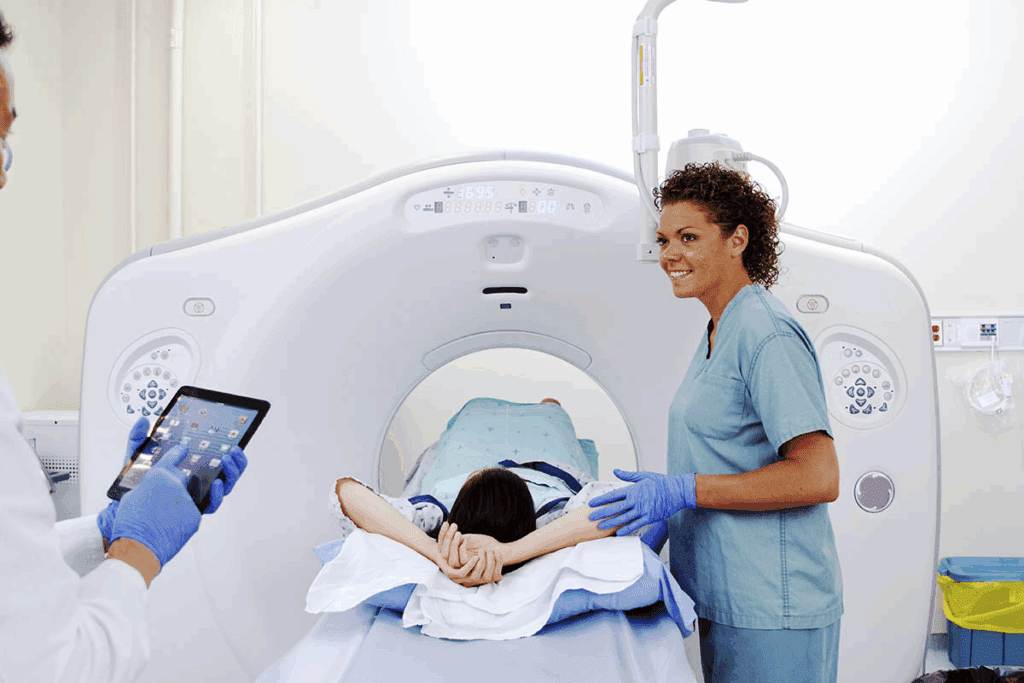
CT scans are key in finding colon cancer early. They use X-rays and a computer to show the colon and rectum’s inside. This helps doctors spot problems that might mean cancer.
How CT Scanning Technology Works for Colorectal Assessment
CT scanning takes many X-ray images of the colon and rectum from different sides. These images are mixed into a 3D model. This lets doctors see inside the colon and find any odd shapes, like polyps or tumors.
This tech is great for people who can’t have a regular colonoscopy or have health issues that make it hard.
Doctors say CT colonography is a top tool for finding colon cancer early. It’s backed by many studies. It helps find patients at high risk.
CT Scan Preparation and Protocol for Optimal Imaging
To get the best images, patients must prepare well. They eat only clear liquids the day before. They also clean their bowels and get a contrast agent to show the colon and rectum. Good prep is key to clear images for accurate diagnosis.
- Bowel cleansing to remove fecal matter
- Clear liquid diet the day before the exam
- Use of a contrast agent to highlight the colon and rectum
What CT Scans Can Reveal About Colon Abnormalities
CT scans can spot many colon issues, like polyps, tumors, and inflammation. But, they might miss small problems. Their accuracy depends on the tech, the doctor’s skill, and prep.
Even with these limits, CT scans are a big help in finding colon cancer.
“CT colonography has emerged as a reliable diagnostic tool for detecting colon cancer, a non-invasive alternative to traditional colonoscopy.”
In summary, CT scans are very important in finding colon cancer. They give a detailed look at the colon and rectum. Knowing how they work, the need for good prep, and what they can show helps everyone make better choices about health.
Can a CT Scan Diagnose Colon Cancer? Effectiveness and Limitations
CT scans can help find colon cancer, but they have limits. They are a key tool for doctors to see if cancer is present and how far it has spread.
Sensitivity Rates: Understanding the 76-100% Detection Range
Research shows CT scans can spot colorectal cancer 76 to 100 percent of the time. This range changes based on the scan technology and the doctor’s skill.
Detection rates also depend on the cancer’s stage and size. It’s easier to find big, advanced cancers than small, early ones.
| Cancer Stage | Typical Detection Rate | Factors Influencing Detection |
| Early Stage | Lower detection rate | Size of the lesion, technology used |
| Advanced Stage | Higher detection rate | Size and spread of the cancer |
Factors Affecting CT Scan Accuracy: Technology and Expertise
The tech used and the doctor’s skill greatly affect CT scan accuracy. Newer CT tech gives clearer images, helping doctors make better diagnoses.
Expertise is key in reading CT scans. Doctors with lots of experience can spot problems and understand how far the disease has spread better.
Limitations in Detecting Small or Early-Stage Lesions
CT scans struggle to find small or early cancer. These tiny cancers might not show up well on scans, leading to missed diagnoses or delays.
Improving the detection of these small cancers is a focus for researchers. New CT tech and better image analysis could help doctors spot these cancers sooner.
CT Scans for Cancer Staging and Metastasis Detection
Cancer staging is key in managing colon cancer. CT scans are a major tool in this process. Accurate staging shows how far cancer has spread, guiding treatment choices.
CT scans give detailed images of the abdomen and pelvis. They help doctors see the tumor’s size, how far it has grown, and if it has spread to lymph nodes or other organs.
How CT Imaging Helps Determine Cancer Stage
CT imaging is vital in finding out the cancer stage. It shows the tumor’s size, where it is, and how far it has spread. The TNM staging system uses CT scan findings to classify the tumor, check lymph nodes, and look for distant metastasis.
Medical Expert, a radiologist at a top cancer center, says, “CT scans are key in staging because they give a full view of the tumor and its spread.”
“The use of CT scans in cancer staging has changed how we treat colon cancer. It allows for more precise and personal care plans.”
Detecting Metastatic Disease in Liver, Lungs, and Other Organs
CT scans play a big role in finding metastatic disease in colon cancer. They can spot lesions in the liver and lungs. Finding metastasis early is key to planning treatment.
CT scans can also find metastasis in other places, like the peritoneum, bones, and adrenal glands. The detailed images help doctors understand how far the disease has spread. This is important for planning treatment.
The American Cancer Society says, “CT scans are very useful in finding metastatic disease. They help identify patients who might need special treatments.”
CT Colonography: Virtual Colonoscopy as a Diagnostic Tool
CT colonography, also known as virtual colonoscopy, is changing how we find colorectal cancer. It uses CT scans to show detailed images of the colon and rectum. This helps spot problems that might mean cancer.
How CT Colonography Differs from Standard CT and Traditional Colonoscopy
CT colonography is different from regular CT scans and traditional colonoscopies. It’s made to show the colon and rectum clearly. The colon is filled with air or carbon dioxide for better views.
It’s not like a traditional colonoscopy, where a tube with a camera is inserted. CT colonography is non-invasive. This makes it easier for people who are nervous about colonoscopies.
Benefits and Limitations of Virtual Colonoscopy for Cancer Detection
Virtual colonoscopy has many benefits. It’s non-invasive, has fewer risks, and can see the whole colon. It’s great for those who can’t have a regular colonoscopy or have had one that wasn’t complete.
But it’s not perfect. It might miss small polyps or lesions that traditional colonoscopy can find. If it finds something, a follow-up colonoscopy might be needed for a biopsy or to remove polyps.
Even with its flaws, CT colonography is a key tool for finding colorectal cancer. Its detailed images of the colon and rectum make it a valuable choice for both patients and doctors.
Blood Tests for Colon Cancer: What They Can Reveal
Blood tests are key in finding colon cancer. They show signs that help doctors make a diagnosis. These tests are not the only way to find cancer, but they give important clues.
Complete Blood Count (CBC): Identifying Anemia and Other Indicators
A Complete Blood Count (CBC) test can show signs of colon cancer. It can find anemia caused by blood loss from a tumor. Anemia makes you feel tired and weak.
The CBC also checks other blood parts. These are not just for colon cancer. They help doctors see if you’re healthy or need more tests.
Carcinoembryonic Antigen (CEA) and Other Tumor Markers
Carcinoembryonic Antigen (CEA) is a protein found in some cancers, like colon cancer. High CEA levels might mean cancer is present. But it can also be high in other conditions.
CEA is mainly used to check if treatment is working. It helps see if cancer comes back. It’s not used to first find cancer, but it’s useful later on.
Emerging Blood-Based Biomarkers for Colorectal Cancer Detection
Scientists are working on new blood tests for colon cancer. These tests aim to find cancer early. They could make diagnosing cancer better than today.
These new tests look for special DNA or protein changes in the blood. They’re not ready yet, but they might help doctors more in the future.
Will Colon Cancer Show Up in Blood Work? Understanding Test Limitations
It’s important to know if blood tests can find colon cancer. Doctors use many tests to find colon cancer, like imaging and endoscopy. Blood tests are common, but they can’t find colon cancer alone.
Why Most Colon Cancers Don’t Show Definitive Markers in Routine Labs
Most colon cancers don’t show up in blood tests. Routine tests, like a Complete Blood Count (CBC), might show signs of anemia. But these signs don’t mean you have colon cancer.
Some blood tests can find tumor markers, like Carcinoembryonic Antigen (CEA). But CEA can be high in many cancers and conditions. So, it’s not a sure sign of colon cancer.
Using Blood Tests for Monitoring Instead of Primary Detection
Blood tests are better for watching colon cancer, not finding it first. They help see how the disease is doing and if treatment is working. For example, changes in CEA levels can show if the cancer is getting better or worse.
| Test Type | Purpose | Limitations |
| Complete Blood Count (CBC) | Identify anemia, infection, or other abnormalities | Not specific to colon cancer |
| Carcinoembryonic Antigen (CEA) | Monitor colorectal cancer | Not specific to colon cancer; can be elevated in other conditions |
| Other Tumor Markers | Potential for early detection or monitoring | Limited specificity and sensitivity |
The table shows blood tests have their uses, but they’re not enough to diagnose colon cancer. Tests like CT scans and endoscopy are key to a correct diagnosis.
In summary, blood tests help manage colon cancer, but they’re not used to find it first. This is because they’re not always accurate.
Comparing Diagnostic Methods: CT Scans vs. Other Procedures
Diagnosing colon cancer requires knowledge of different tests. CT scans are helpful, but not the only way to find colon cancer.
CT Scans vs. Colonoscopy: When Each is Most Appropriate
CT scans and colonoscopy help find colon cancer, but in different ways. Colonoscopy is the top choice for screening. It lets doctors see and take samples from the colon. But it’s more invasive and needs bowel prep.
CT scans are less invasive. They show how far the disease has spread and if it has moved to other parts. They’re great for checking how serious the cancer is and the patient’s overall health.
CT Scans vs. Stool-Based Tests: Sensitivity and Specificity Differences
Stool tests, like fecal occult blood tests (FOBT), are simple and done at home. They look for hidden blood in stool, which might mean colon cancer. But, they’re not as good as CT scans or colonoscopy at finding cancer.
CT scans are better at finding bigger tumors or those that have spread. But they use radiation and might miss small tumors.
CT Scans vs. MRI and PET Scans for Colorectal Cancer
MRI and PET scans also help diagnose and stage colon cancer. MRI shows soft tissues well and helps see how big the tumor is. PET scans are great for finding cancer that has spread.
CT scans are quicker and more common than MRIs. PET scans are often paired with CT scans (PET-CT) to get detailed info about the tumor.
Knowing what each test does best helps pick the right one for each patient. This depends on their risk, medical history, and how far the disease might have spread.
Comprehensive Diagnostic Approach to Colorectal Cancer
Managing colorectal cancer well needs a detailed diagnostic plan. This plan uses many different ways to check for the disease. It helps doctors give the right treatment to each patient.
The Diagnostic Pathway: From Screening to Confirmation
The steps to diagnose colorectal cancer start with screening. Screening tests like fecal occult blood tests (FOBT) and colonoscopy help find problems early. If these tests show something odd, more tests are done to confirm cancer.
Tests to confirm cancer might include CT scans, CT colonography, and biopsy. The right test depends on the patient’s health, how advanced the cancer might be, and any other health issues.
Diagnostic Protocols for Different Patient Populations
How doctors check for colorectal cancer changes based on who the patient is. For example, people with a family history of the disease or certain genetic conditions might need to start screening earlier.
For most people, screening starts at 45. But those at higher risk might need to start sooner and get checked more often. Personalized diagnostic protocols mean each patient gets care that fits their specific situation.
Using a detailed diagnostic approach and customizing tests for different patients helps doctors diagnose colorectal cancer more accurately and effectively.
Conclusion: Integrating CT Scans and Blood Tests in Colon Cancer Care
Effective colon cancer care starts with an accurate diagnosis and a detailed treatment plan. CT scans and blood tests are key to this. CT scans show detailed images of the colon and nearby tissues. They help find tumors and see if cancer has spread.
Blood tests, like those for Carcinoembryonic Antigen (CEA), give insights into the disease’s progress and how well it’s responding to treatment. Together, CT scans and blood tests help doctors stage colon cancer well. This allows for targeted treatment plans and tracking of patient results.
By using both CT scans and blood tests, patients get the best care possible. This approach boosts their chances of successful treatment and recovery. In short, combining CT scans and blood tests is critical for top-notch colon cancer care. As technology advances, these tools will keep playing a big part in fighting colon cancer.
FAQ
Can colon cancer be detected with a CT scan?
Yes, CT scans can find colon cancer. Studies show they are very good at spotting colon problems, with accuracy rates from 76-100%.
Will colon cancer show up in blood work?
Most colon cancers don’t show up in routine blood tests. But blood tests can spot anemia and CEA levels. They can also hint at colon cancer.
How accurate is a CT scan in diagnosing colon cancer?
A CT scan’s accuracy in finding colon cancer varies. It depends on the technology and the doctor’s skill. Rates range from 76-100%.
Can a CT scan detect metastatic disease in colon cancer?
Yes, CT scans can find cancer spread to other organs like the liver and lungs. This is key to knowing how far the cancer has spread.
What is the difference between CT colonography and traditional colonoscopy?
CT colonography, or virtual colonoscopy, is a non-invasive test using CT scans. Traditional colonoscopy uses a tube with a camera inserted into the colon.
Can blood tests diagnose colon cancer?
Blood tests aren’t the main tool for diagnosing colon cancer. But, they can check CEA levels, spot anemia, and suggest colon cancer.
How does CT colonography compare to other diagnostic methods?
CT colonography has its own strengths and weaknesses. It’s often used alongside other tests like colonoscopy and MRI. It’s part of a bigger diagnostic plan.
What are the benefits of a diagnostic approach to colorectal cancer?
Using CT scans, blood tests, and other methods together helps get a clear diagnosis. It can catch cancer early and improve treatment results.
Can colon cancer be detected with a blood test?
New blood tests are being developed for colon cancer. But blood tests alone can’t usually diagnose colon cancer.
How do CT scans help determine cancer stage?
CT scans help figure out cancer stage by showing how big the tumor is, if lymph nodes are involved, and if cancer has spread to other organs.
References
- Kijima, S., et al. (2014). Preoperative evaluation of colorectal cancer using CT colonography. Journal of the National Cancer Institute. Molecular and Clinical Oncology, PMC4258565. Retrieved from https://pmc.ncbi.nlm.nih.gov/articles/PMC4258565/