Last Updated on November 14, 2025 by
A low-grade fever in children is a common worry for parents. Knowing what a low-grade fever is helps decide what to do next.
Normal body temperature is between 36.5 °C and 37.5 °C (97.7 ° to 99.5 °F). A low-grade fever is when the body temperature is between 37.5 °C (99.5 °F) and 38.4 °C (101.1 °F). Knowing the conversion from celsius to fahrenheit is helpful for understanding these ranges clearly, especially when using different temperature measurement systems.
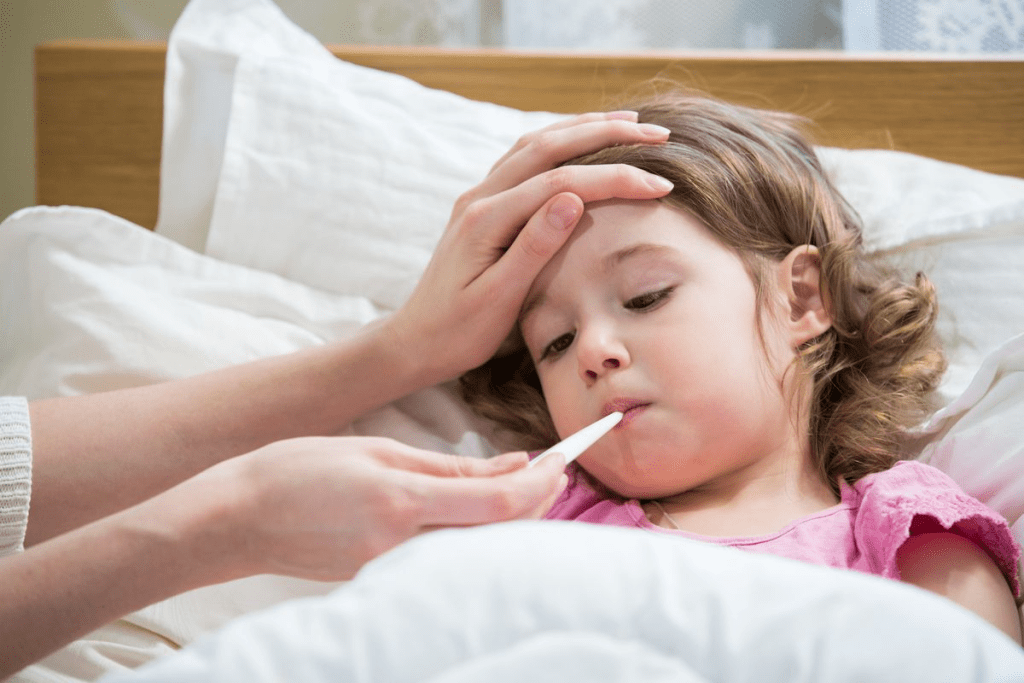
For babies under 3 months, a fever is any rectal temperature over 38.0 °C (100.4 °F). It’s important to measure the temperature to know if it’s a low-grade fever and when to see a doctor.
Key Takeaways
- A low-grade fever is typically between 37.5 °C (99.5 °F) and 38.4 °C (101.1 °F).
- Normal body temperature ranges from 36.5 °C to 37.5 °C (97.7 °F to 99.5 °F).
- Infants under 3 months have a fever if their rectal temperature exceeds 38.0 °C (100.4 °F).
- Accurate temperature measurement is vital.
- Understanding low-grade fever helps parents respond confidently.
Understanding Normal Body Temperature in Children
Knowing what a normal body temperature is is key for parents to check their child’s health. It usually falls between 36.5“37.5 °C (97.7“99.5 °F).

Baseline Temperature Ranges by Age
Body temperature changes with age. Infants have a higher normal range than older kids. It’s vital to know these ranges to judge a child’s health correctly.
- Infants (0-12 months): 36.5“37.5 °C (97.7“99.5 °F)
- Toddlers (1-5 years): 36.5“37.5 °C (97.7“99.5 °F)
- School-age children (6-12 years): 36.0“37.0 °C (96.8“98.6 °F)
Daily Temperature Fluctuations in Children
Body temperature changes throughout the day. It’s usually lowest in the morning and highest in the late afternoon or evening. Knowing these changes helps parents understand what’s normal for their child.
- Morning temperature: usually at its lowest
- Late afternoon/Evening temperature: can be slightly higher
Factors That Affect Normal Temperature
Many things can change a child’s normal body temperature, including:
- Activity level: More activity can raise the temperature
- Environmental conditions: very hot or cold can affect it
- Clothing: too much or too little can change it
Knowing these factors helps parents make better health choices. For example, knowing that 20 degrees Celsius is 68 degrees Fahrenheit is useful.
Defining Low-Grade Fever: Celsius to Fahrenheit Conversion Guide
Learning to convert Celsius to Fahrenheit is key for parents to check their child’s fever correctly. Knowing how to switch between these scales helps spot low-grade fevers.
Temperature Scale Comparison Chart
A temperature scale comparison chart is a great tool for parents. It makes it easy to switch between Celsius and Fahrenheit. Here’s a simple chart to show the difference:
| Celsius ( °C) | Fahrenheit ( °F) |
| 36.0 | 96.8 |
| 37.0 | 98.6 |
| 38.0 | 100.4 |
| 40.0 | 104.0 |

Converting Between Celsius and Fahrenheit
To change Celsius to Fahrenheit, use this formula: °F = ( °C × 9/5) + 32. For example, 38 °C is (38 × 9/5) + 32 = 100.4 °F. To go the other way, use: °C = ( °F – 32) × 5/9.
With these formulas, parents can easily switch scales. For instance, 100.4 °F is 38 °C.
Low-Grade Fever Thresholds in Both Scales
A low-grade fever is between 37.5 °C and 38.5 °C (99.5 °F to 101.3 °F). Knowing these ranges in both Celsius and Fahrenheit helps parents keep an eye on their child’s temperature. For example, 38.2 °C is 100.6 °F, which is a low-grade fever.
By understanding these temperature ranges and how to convert between scales, parents can better care for their child. This knowledge helps them make informed decisions about their child’s health.
Age-Specific Fever Guidelines for Parents
Knowing how to handle fever in kids is key for parents. The way to manage fever changes with age. It’s important to know how to act to avoid serious issues.
Infants Under 3 Months
Infants under 3 months need extra care when they have a fever. A rectal temperature over 100.4 °F (38 °C) is a fever in this age. Their young immune systems make them more at risk for serious infections.
If your baby is under 3 months and has a fever, get medical help right away.
Toddlers and Preschoolers (1-5 Years)
Toddlers and preschoolers have a fever if their temperature is over 102 °F (39 °C). At this age, they often get viral infections that cause fever. Keep a close eye on their temperature and use acetaminophen (for kids over 3 months) or ibuprofen (for kids over 6 months) to lower the fever, as advised by a doctor.
School-Age Children (6-12 Years)
School-age kids can use over-the-counter meds like acetaminophen or ibuprofen to manage fever. Always follow the dosage based on their weight and age. If the fever doesn’t go away or they have other symptoms, see a doctor.
Teenagers (13-18 Years)
Teenagers can handle fever like adults. Use over-the-counter meds and drink plenty of water. They should rest and not do too much. If the fever is very high or they have bad symptoms, they need to see a doctor.
In summary, knowing how to handle fever in kids depends on their age. By following these guidelines, parents can take good care of their children when they have a fever.
Accurate Temperature Measurement Methods
Parents need to know how to measure their child’s temperature correctly. This is key to making good health decisions. Accurate temperature measurement helps figure out how sick a child is and what to do next.
Rectal Temperature Readings
For babies, rectal temperature readings are the most accurate. This means gently putting a thermometer into the baby’s rectum. Rectal temperature measurement is best for kids under three because it shows the body’s core temperature well.
Oral and Axillary Measurements
As kids get older, oral temperature measurements become easier. This means putting a thermometer under the tongue. But it’s not as good for younger kids who can’t keep it in place. Axillary measurements, taken in the armpit, are less accurate than rectal or oral ones.
Temporal and Tympanic Thermometers
Temporal thermometers measure the forehead temperature, and tympanic thermometers measure the eardrum temperature. They are quick and easy to use. But their accuracy can be affected by earwax or sweat on the forehead.
Digital vs. Mercury Thermometers
Choosing between digital thermometers and mercury thermometers is important. Digital thermometers are safer and give quick readings, making them popular. Mercury thermometers are accurate but can be dangerous if broken because mercury is toxic.
When picking a thermometer, think about the child’s age and how easy it is to use. For babies, digital rectal thermometers are best. For older kids, oral or temporal thermometers work well.
- For infants under 3 months, rectal temperature measurement is recommended.
- For children over 3 years, oral or temporal thermometers can be used.
- Always follow the manufacturer’s instructions for the thermometer.
- Ensure the thermometer is clean before use.
When to Seek Medical Attention for a Child’s Fever
Fever in children can worry parents. Knowing when to get medical help is key. Low-grade fevers are common and usually not serious. But some situations need quick medical check-ups.
Warning Signs Beyond Temperature
There are signs beyond just the fever that might mean a child needs to see a doctor. These include:
- Severe headache or stiff neck
- Difficulty breathing or rapid breathing
- Severe abdominal pain or vomiting
- Rash or other skin symptoms
- Confusion or irritability
- Seizures or convulsions
If a child shows any of these signs, parents should get medical help right away.
Age-Based Medical Guidelines
The child’s age is important when deciding if a fever needs medical attention. For example:
- Infants under 3 months: Fever over 100.4 °F (38 °C) needs immediate medical help.
- Infants 3-6 months: Fever over 102 °F (39 °C) should see a doctor.
- Children over 6 months: Fever over 103 °F (39.4 °C) might need a doctor’s check, with other symptoms.
Common Causes of Low-Grade Fevers
Low-grade fevers can come from many things. These include:
- Viral infections, such as the common cold or flu
- Bacterial infections, like ear infections or urinary tract infections
- Immunizations or vaccinations
- Teething
Finding out what’s causing the fever helps manage it better.
Distinguishing Between Serious and Minor Conditions
Telling if a fever is serious or not can be hard. But, looking at the child’s behaviour, other symptoms, and the height helps. This way, parents can decide if they need to see a doctor.
A child with a low-grade fever who is active and not showing distress is likely okay. But a child who is very tired, upset, or shows severe illness needs a doctor.
A temperature of 40 degrees Celsius is 104 degrees Fahrenheit. This is a high fever that needs careful checking.
Conclusion: Managing Low-Grade Fevers at Home
Managing low-grade fevers in children is possible with the right care. Most fevers can be handled at home. With the right guidance, parents can care for their child effectively.
Keeping your child hydrated is key. Encourage them to drink lots of water or Pedialyte. You can also use acetaminophen (Tylenol) or ibuprofen (Advil or Motrin) as directed.
Watch your child’s temperature and overall health closely. If they show signs of distress or if the fever gets worse, get medical help. Learning how to manage fevers at home helps your child recover comfortably.
FAQ’s:
What is considered a low-grade fever in children?
A low-grade fever is when a child’s body temperature is between 37.5 °C and 38.4 °C. This is between 99.5 °F and 101.1 °F.
How does normal body temperature vary in children?
Normal body temperature changes with age in children. Infants usually have a higher average temperature than older kids. It also changes throughout the day. It’s often lower in the morning and higher in the late afternoon.
How do I convert Celsius to Fahrenheit?
To convert Celsius to Fahrenheit, use this formula: °F = ( °C × 9/5) + 32. For example, 38 °C is 100.4 °F.
What are the age-specific guidelines for fever in children?
Infants under 3 months need immediate medical help if they have a fever over 38 °C. For older kids, the rules change with age. Toddlers and preschoolers need closer watch.
What is the most accurate method for measuring temperature in children?
Rectal temperature readings are the most accurate for infants. Oral and axillary measurements work for older kids. Temporal and tympanic thermometers can be used, but might not be as accurate.
When should I seek medical attention for my child’s fever?
Seek medical help if your child shows signs like trouble breathing, severe headache, or stiff neck. Infants under 3 months should get immediate attention for any fever.
How can I manage a low-grade fever at home?
To manage a low-grade fever at home, keep your child hydrated. You can use fever medication as directed. Watch their temperature closely and get medical help if it gets worse.
What is a normal body temperature range for children?
The normal body temperature range for kids is between 36.5 °C and 37.5 °C. This is 97.7 °F to 99.5 °F. It can vary by age and individual.
How can I distinguish between a serious and a minor condition causing a low-grade fever?
To tell if a fever is serious or minor, look for warning signs. These include trouble breathing, severe headache, or stiff neck. If your child seems unwell or has severe symptoms, get medical help.
Reference:
Canadian Paediatric Society. (2021, December 31). Fever and temperature taking. Caring for Kids. https://caringforkids.cps.ca/handouts/health-conditions-and-treatments/fever_and_temperature_taking
Medical News Today. (2023, January 5). Normal body temperature: adults, babies, pregnancy, and children. https://www.medicalnewstoday.com/articles/323819NHS Fife. (2021, October 7). High temperature (fever) in children. https://www.nhsfife.org/services/all-services/common-childhood-illnesses/childfever/