Last Updated on November 26, 2025 by Bilal Hasdemir

The colon is a key part of our digestive system. It helps absorb water and electrolytes from food we can digest. It’s found in the lower abdomen and is about 1.5 meters long, wrapping around our belly.
Starting at the right lower abdomen, it goes up to the upper right. Then, it moves to the left side, goes down, and ends in the pelvis. Knowing how the colon works helps us understand its importance for our health.
Key Takeaways
- The colon is a major segment of the large intestine.
- It is approximately 1.5 meters long and circles the abdominal cavity.
- The colon absorbs water and electrolytes from digestible food.
- It houses beneficial bacteria essential for digestive health.
- Understanding the colon’s function is key for our overall health.
The Colon in Medical Terms: Definition and Overview

It’s important to know what the colon is and its role in our body. The colon is a key part of the large intestine. It helps absorb water and salts from the food we eat.
Medical Definition of the Colon
The colon is the main part of the large intestine. It goes from the cecum to the rectum. It’s split into four sections: the ascending, transverse, descending, and sigmoid colon.
The colon’s main job is to soak up water and salts. This makes the waste material thick and turns it into feces.
| Colon Section | Description |
| Ascending Colon | Starts at the cecum and moves upward |
| Transverse Colon | Crosses the abdominal cavity from right to left |
| Descending Colon | Moves downward on the left side of the abdomen |
| Sigmoid Colon | Connects to the rectum, forming an S-shape |
The Colon as Part of the Digestive System
The colon is a key part of our digestive system. It works with other organs to break down food. Dr. John Smith, a gastroenterologist, says, “The colon absorbs water and has good bacteria, which is essential for digestion.”
The colon gets food from the small intestine. It absorbs more nutrients and turns the food into feces. This is then expelled from our body.
The colon’s structure helps it do its job in digestion. Knowing about the colon’s role in our body is important for staying healthy.
Colon Location: Mapping Its Position in the Human Body
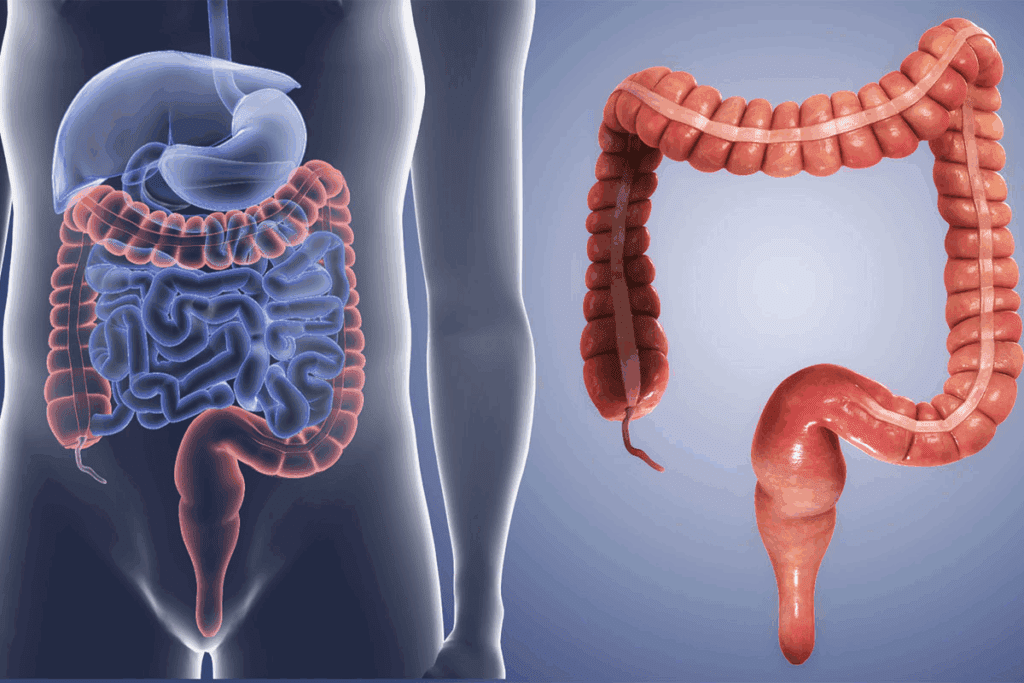
The colon is key to our digestive system. Knowing where it is helps us understand its role. It’s located in the abdominal cavity, with complex connections to other organs.
The Colon’s Path Through the Abdominal Cavity
The colon starts in the right lower abdomen. It then moves up to the upper right, crosses over to the left, goes down, and ends in the pelvis. Along the way, it touches important landmarks and organs like the liver and spleen.
The ascending colon is near the right kidney. The descending colon is near the left kidney. Knowing this path is key for diagnosing and treating colon problems.
Anatomical Landmarks and Adjacent Organs
The colon’s path is tied to several key landmarks and organs. The hepatic flexure is close to the liver, and the splenic flexure is near the spleen. These connections are important for understanding the colon’s function and any possible health issues.
Visualizing the Colon’s Position
Medical imaging like CT scans and barium enemas help us see the colon’s location. These tools allow doctors to study the colon’s anatomy and spot any problems.
Grasping the colon’s location and its connections to other organs is essential for accurate diagnosis and treatment.
Anatomy and Structure of the Colon
The colon is a key part of our digestive system, measuring about 1.5 meters long. It has unique features and functions that are vital for digestion. These include omental appendices, teniae coli, and haustra.
The colon’s blood supply and nerves are connected to its early development. Knowing about the colon’s anatomy helps us understand its importance in health and disease. Its complex structure allows it to work well in the digestive process.
To grasp the colon’s role in health, we must dive into its anatomy. The colon’s structure is essential for digestion. Understanding its functions helps us keep our bodies healthy.
FAQ
What is the colon, and where is it located in the body?
The colon, also known as the large intestine, is key to our digestive system. It’s in the abdominal cavity. It goes from the cecum to the rectum, making up the ascending, transverse, descending, and sigmoid colons.
What is the main function of the colon?
The colon’s main job is to absorb water and electrolytes from food. It also houses good bacteria and turns waste into feces.
What are the different parts of the colon, and what are their functions?
The colon has parts like the ascending, transverse, descending, and sigmoid colons. Each part helps with water and electrolyte absorption, storing feces, and elimination.
What is the medical definition of the colon?
Medically, the colon is the gut part from the cecum to the rectum. It absorbs water and electrolytes, hosts good bacteria, and makes feces.
How does the colon’s anatomy relate to its function?
The colon’s anatomy lets it do its job well. It absorbs, stores, and eliminates thanks to its structure and blood supply.
What is the significance of the colon in overall health?
The colon is vital for health. It absorbs nutrients, hosts good bacteria, and gets rid of waste.
What are some common misspellings or misconceptions about the colon?
People often misspell the colon as “colen,” “colom,” or “colan.” Knowing the right spelling helps us understand its role in digestion.
How does the colon’s location relate to other anatomical structures?
The colon’s path in the abdominal cavity is important. It has flexures and touches other organs, which helps us understand its function and health issues.
References
- National Cancer Institute. (2023). Colon and Rectal Cancer Prevention. Cancer.gov.
https://www.cancer.gov/types/colorectal/patient/colon-prevention-pdq