

Your body has a complex network that controls every action, from thinking to breathing. Knowing about the nervous system and its diagram is key. It shows how your brain, spinal cord, and nerves work together to keep you alive and active define nervous system.
At Liv Hospital, we believe in empowering patients through education about their bodies. We offer reliable medical advice based on the latest science. The nervous system is a complex network of nerve cells. It sends signals between the brain and the rest of the body.
A simple diagram of the nervous system can show its main parts. This includes the central nervous system (CNS) and peripheral nervous system (PNS).
The nervous system controls our body’s functions. It lets us interact with our world, respond to things around us, and keep our body balanced. Its complex structure and functions are key to our health and happiness.
The nervous system has two main parts: the Central Nervous System (CNS) and the Peripheral Nervous System (PNS). The CNS includes the brain and spinal cord, acting as the body’s control centers. The PNS has nerves and ganglia that link the CNS to the rest of the body, helping the brain talk to other parts of the body.
It’s made of different cells, like neurons and glial cells. Neurons send information through electrical and chemical signals. Glial cells support and protect neurons.
|
Component |
Description |
Function |
|---|---|---|
|
Central Nervous System (CNS) |
Includes the brain and spinal cord |
Controls the body’s functions, interprets sensory information |
|
Peripheral Nervous System (PNS) |
Comprises nerves and ganglia |
Connects CNS to the rest of the body, facilitates communication |
|
Neurons |
Specialized cells for signal transmission |
Transmit information through electrical and chemical signals |
|
Glial Cells |
Supportive cells for neurons |
Provide support, protection, and maintenance for neurons |
The nervous system controls our movements, actions, and senses. It helps us react to our surroundings, keep our posture, and manage body functions like heart rate and digestion.
Its main jobs are sensory input, integration, and motor output. Sensory input is getting and sending sensory info from the environment. Integration is processing and understanding this info. Motor output is responding to it through movement or actions.
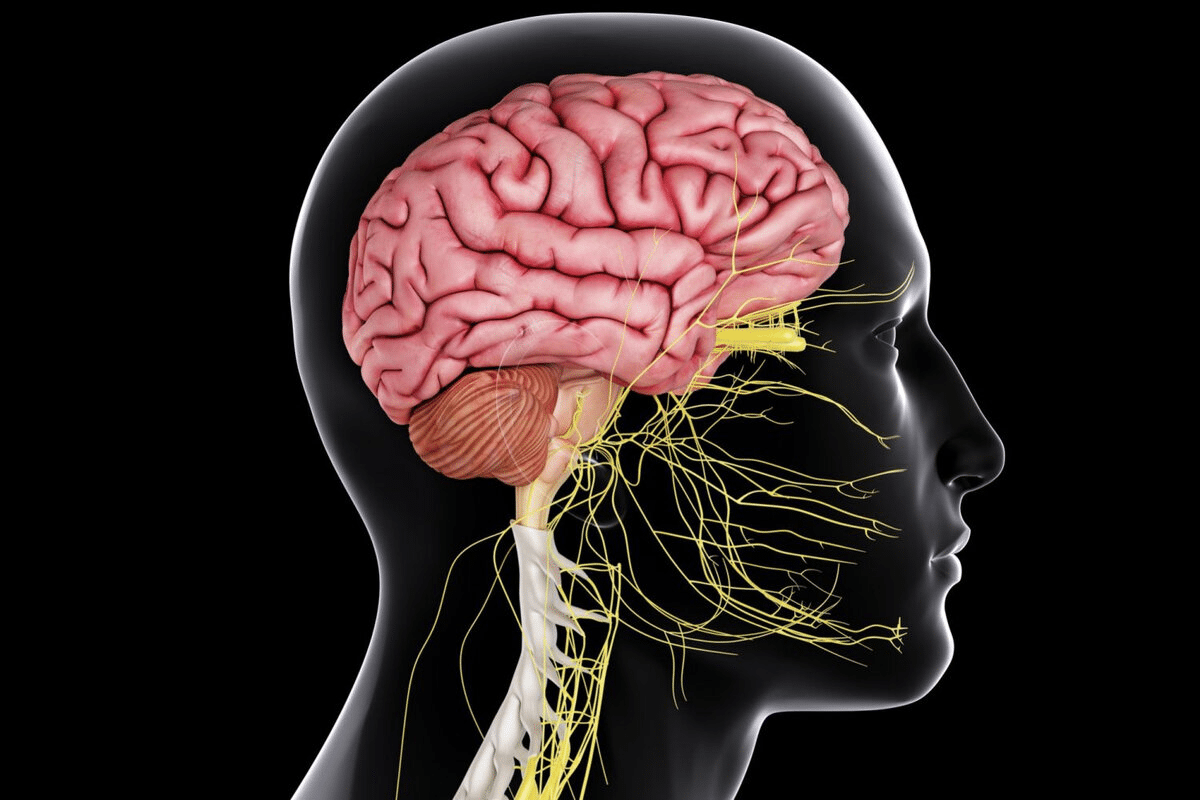
To understand the nervous system, we need to know its main parts and what they do. It’s a complex network that helps the body react to things, control movements, and think.
The nervous system is made up of neurons and glial cells. These work together to send nerve signals.
Neurons, or nerve cells, send information all over the body. They have three main parts: the cell body, dendrites, and axon. The cell body has the nucleus, dendrites get signals, and the axon sends signals to other neurons or muscles.
Glial cells, or glia, support and maintain neurons. They don’t send nerve impulses but are vital for the nervous system’s health and function.
Nerve signals are sent through electrical and chemical signals. When a neuron is stimulated, it creates an action signal that travels down its axon. At the axon terminals, neurotransmitters are released, helping communicate with other neurons or muscles.
Knowing these parts and how they work is key to understanding nerve system diagrams and neural system diagrams. By labeling the nervous system’s parts, we can see its complex structure and function.
It’s important to know how the brain and spinal cord work together. They control our body and help us interact with the world. The CNS is a complex system that processes information from our senses.
The brain is the body’s control center. It handles our thoughts, feelings, and memories. It also controls basic functions like breathing and heart rate.
Key Brain Regions and Their Functions:
|
Region |
Function |
|---|---|
|
Cerebrum |
Controls higher mental functions, including thought and emotion. |
|
Cerebellum |
Coordinates movements and maintains posture. |
|
Brainstem |
Regulates vital functions such as breathing and heart rate. |
The spinal cord is a pathway for signals between the brain and the body. It’s a long, thin tube made of nervous tissue. It runs from the brain to the lower back.
The spinal cord’s main job is to send messages between the brain and the rest of the body. It also helps control reflexes and some autonomic functions.
Spinal Cord Structure:
Knowing about the CNS is key to understanding how our bodies work. A simple diagram of the nervous system can make these complex structures easier to see.
It’s important to know about the Peripheral Nervous System (PNS) to understand how our body talks to itself. The PNS is a network of nerves and ganglia outside the brain and spinal cord. It helps send sensory info and control our actions.
The PNS has cranial and spinal nerves that link the Central Nervous System (CNS) to the rest of the body. Cranial nerves come from the brain, and spinal nerves come from the spinal cord. They control movement, sensation, and autonomic functions.
Cranial Nerves: There are 12 pairs of cranial nerves, each with its own job. For example, the olfactory nerve handles smell, and the optic nerve handles sight.
Spinal Nerves: There are 31 pairs of spinal nerves, divided into different groups. These nerves help with movement, send sensory info, and help with reflexes.
Ganglia are groups of neurons that help nerve signals pass through. Nerve plexuses are networks of nerves from the spinal cord. They are key in the PNS, helping signals reach different parts of the body.
Nerve fibers in the PNS are grouped by their functions and traits. The main types are:
|
Type |
Function |
Characteristics |
|---|---|---|
|
Sensory Fibers |
Transmit sensory information |
Afferent, carrying signals towards the CNS |
|
Motor Fibers |
Control motor functions |
Efferent, carrying signals away from the CNS |
|
Autonomic Fibers |
Regulate involuntary functions |
Both afferent and efferent, controlling autonomic functions |
Knowing about the PNS and its parts helps us understand how our body works. By studying the PNS, we learn how our body responds to stimuli and how to keep our nervous system in top shape.
Understanding the Somatic Nervous System is key to how we interact with the world. It’s part of the peripheral nervous system. It controls voluntary muscle movements and sends sensory info to the central nervous system.
This system lets us do many things, like walking or playing music. It helps us respond to things and make intentional movements.
Sensory pathways in the Somatic Nervous System are vital for detecting our environment. They start with sensory receptors that pick up touch, temperature, and pain.
The info from these receptors goes to the spinal cord and then to the brain. There, it’s processed and understood. This lets us see and understand our surroundings.
Motor pathways send signals from the brain to muscles, enabling us to move on purpose. They involve the brain, spinal cord, and nerves.
When we want to do something, like pick up an object, the brain sends a signal. This signal tells the muscles to move, leading to the action we want.
Reflex arcs are a key part of the Somatic Nervous System. They allow for quick, automatic responses to certain stimuli. A reflex arc includes a sensory neuron, a motor neuron, and sometimes an interneuron.
For example, touching something hot triggers a reflex arc. The sensory neurons detect the heat and send a signal to the spinal cord. The spinal cord then tells the muscles to pull your hand back, all without needing the brain’s input.
The autonomic nervous system controls many body functions without our conscious effort. It is a key part of our nervous system. It handles actions like heart rate, digestion, and breathing.
This system has three main parts: the sympathetic division, the parasympathetic division, and the enteric nervous system. Each part has its own role. They work together to keep the body balanced.
The sympathetic division is known as the “fight or flight” response. It gets the body ready for intense activity when we’re stressed or in danger. It makes the heart beat faster, opens airways, and gets energy ready.
Some key functions of the sympathetic division include:
The parasympathetic division helps us relax and digest. It works against the sympathetic division to save energy and support rest. It helps the body recover when we’re not active.
Key functions of the parasympathetic division include:
The enteric nervous system is called the “second brain” because it can work on its own. It controls the digestive system.
Some of the key roles of the enteric nervous system include:
The way these divisions work together is key to keeping the body balanced. Knowing how they interact helps us understand many health issues.
|
Division |
Primary Function |
Key Effects |
|---|---|---|
|
Sympathetic |
“Fight or Flight” |
Increased heart rate, dilated airways, energy mobilization |
|
Parasympathetic |
“Rest and Digest” |
Decreased heart rate, stimulated digestion, energy conservation |
|
Enteric |
Gastrointestinal control |
Regulation of gut motility, secretion, and blood flow |
To understand the nervous system’s complexity, we use various diagrams. These diagrams help us see the system’s structures and functions clearly.
Anatomical diagrams show the nervous system’s physical parts, like neurons and nerves. Functional diagrams explain how these parts work together for body functions.
An anatomical diagram might detail a neuron’s parts, like dendrites and axons. A functional diagram would show how neurons send signals.
Macro-level diagrams give a big picture of the nervous system’s structure. Micro-level diagrams focus on the tiny details, like neuron structure and interactions.
|
Level |
Description |
Example |
|---|---|---|
|
Macro |
Overview of the nervous system |
Brain and spinal cord connection |
|
Micro |
Detailed structure of neurons |
Synaptic transmission between neurons |
Cross-sectional diagrams show the nervous system’s inside parts. 3D diagrams give a full view of the system’s complexity.
“The use of 3D representations in neuroscience has revolutionized our understanding of the brain’s structure and function.” – Medical Expert
Using different diagrams helps us understand the nervous system better. Each type, from anatomical to 3D, offers unique views into how the system works.
To really get how our body works, we need to learn about nervous system diagrams. These diagrams show us the complex parts and functions of this important system. By understanding these diagrams, we can see how our nervous system works.
Nervous system diagrams use special symbols and colors to share information. Different colors might show different types of nerves or important paths. Knowing these symbols helps us read the diagrams right.
Some symbols mean nerve impulses go in one direction. Others show different nerve fibers. Learning these symbols makes it easier to understand nervous system diagrams.
Color coding is a big help in nervous system pictures. For example, sensory nerves might be blue, and motor nerves red. This makes it easy to see and understand the different parts of the nervous system.
When looking at a diagram, always check the color key. It helps us know what each color means. This way, we can understand the diagram better.
Learning to follow neural pathways is key to understanding the nervous system. By tracing these paths, we can see how signals move around the body.
To trace a pathway, first find where it starts and ends. Then, follow it through the diagram, noting any important stops. This helps us see how the nervous system works together.
Making a nervous system diagram can help you understand the body’s complex workings. It shows how different parts work together. This can deepen your knowledge of the nervous system.
When making a nervous system diagram, include key parts. These are the main components that make up the system. They are vital for grasping its structure and function.
With these elements, you can create a detailed diagram. It will show the complex interactions in the nervous system.
To make a precise and useful nervous system diagram, follow these steps:
By following these steps, you can create a detailed diagram. It will show your understanding of the nervous system.
|
Component |
Description |
Function |
|---|---|---|
|
Central Nervous System (CNS) |
Includes the brain and spinal cord |
Processes and integrates information |
|
Peripheral Nervous System (PNS) |
Comprises cranial and spinal nerves |
Transmits information between CNS and the rest of the body |
|
Neurons |
Basic neural units |
Transmit and process information |
There are many digital tools for making nervous system diagrams. Some popular ones include:
These tools offer features for creating clear diagrams. They have customizable templates and advanced drawing tools.
Understanding the nervous system is key. It helps us see its complexity and how it works. A simple diagram is vital for learning about its parts and how they’re organized.
A labeled diagram makes it easy to spot important structures and how they connect. This knowledge helps us understand the nervous system better. It also improves our ability to find and treat problems related to it.
Learning to read nervous system diagrams opens up a new world. It lets us see how our bodies work in detail. With simple and labeled diagrams, we can truly appreciate the amazing workings of our bodies.
The nervous system controls and coordinates the body’s functions. It handles movement, sensation, perception, and cognition.
The nervous system has two main parts. The Central Nervous System (CNS) and the Peripheral Nervous System (PNS).
The CNS includes the brain and spinal cord. The PNS has nerves that connect the CNS to the body.
A simple diagram shows the CNS and PNS. It includes the brain, spinal cord, and nerves.
There are many types of diagrams. They range from anatomical to functional, and include macro and micro views. You’ll also find cross-sectional and 3D diagrams.
To read a diagram, look for color coding and symbols. They help show different structures.
Neurons are special cells. They send and process information through electrical and chemical signals.
The Autonomic Nervous System controls involuntary actions. It manages heart rate, digestion, and blood pressure through its divisions.
Start by adding the brain, spinal cord, and nerves to your diagram. Use digital tools to draw and label it.
Diagrams help you see the nervous system’s complexity. They improve your understanding of its structure and function.
National Center for Biotechnology Information. Nervous System: Diagram and Function of Brain, Spine, Nerves. Retrieved from https://www.ncbi.nlm.nih.gov/books/NBK542179/
