Last Updated on December 1, 2025 by Bilal Hasdemir

Can a CT scan skull base tumor be seen? Get the critical, fast answer on how CTs are essential for detecting bone and large tumors. Diagnosing skull base tumors is tough because of the area’s complex structure. But, imaging tests are key in finding them.
A CT scan is often the first test to spot these tumors. It gives clear pictures of the skull base. This helps doctors find any oddities.
The role of CT scans in tumor diagnosis has made finding skull base tumors more accurate.
Key Takeaways
- Skull base tumors are challenging to diagnose due to complex anatomy.
- Imaging tests like CT scans are critical for detection.
- CT scans provide detailed images of the skull base.
- CT scans improve the accuracy of tumor diagnosis.
- Early detection is key to effective treatment.
Understanding Skull Base Tumors

Skull base tumors are abnormal growths at the base of the skull. This area is complex and houses important neurovascular structures. These tumors can be benign or malignant and have different symptoms and risk factors.
Definition and Types of Skull Base Tumors
Skull base tumors include various types, such as meningiomas, schwannomas, and chordomas. Meningiomas are usually benign and come from the meninges. On the other hand, chordomas are rare and malignant, coming from the notochord.
Common Symptoms and Warning Signs
Symptoms of skull base tumors include headaches, hearing loss, and problems with cranial nerves. The symptoms depend on the tumor’s location and size.
Prevalence and Risk Factors
Skull base tumors are relatively rare. Some types are more common in certain age groups or genders. Risk factors include genetic predisposition and radiation exposure.
Tumor Type | Prevalence | Common Symptoms |
Meningioma | Common, benign | Headaches, seizures |
Chordoma | Rare, malignant | Pain, cranial nerve deficits |
Anatomy of the Skull Base
The skull base is a complex area with many regions and important structures. It is made of several bones that join together during growth. This forms a protective structure for vital parts of the body.
Complex Structure and Regions
The skull base has three main parts: the anterior, middle, and posterior cranial fossae. Each part has special openings and paths for important nerves and blood vessels. The complex structure of the skull base makes it hard to study and diagnose.
Critical Neurovascular Structures
Inside the skull base are key nerves and blood vessels. These are vital for controlling facial movements, sending sensory information, and supplying blood to the brain. Precise imaging is needed to see these structures and find any problems.
Why the Skull Base Presents Imaging Challenges
The skull base is hard to image because of its complex design and the presence of vital structures. Advanced imaging, like CT scans, is key for seeing this area.
Knowing the skull base anatomy is key for correct diagnosis and treatment plans. The area’s complexity requires high-quality images to show its detailed features.
The Basics of CT Scan Technology
Computed Tomography (CT) scans have changed medical imaging a lot. They give detailed pictures of the body’s inside parts. This tech is key for finding and treating many health issues, like tumors in the skull base.
How CT Scans Work
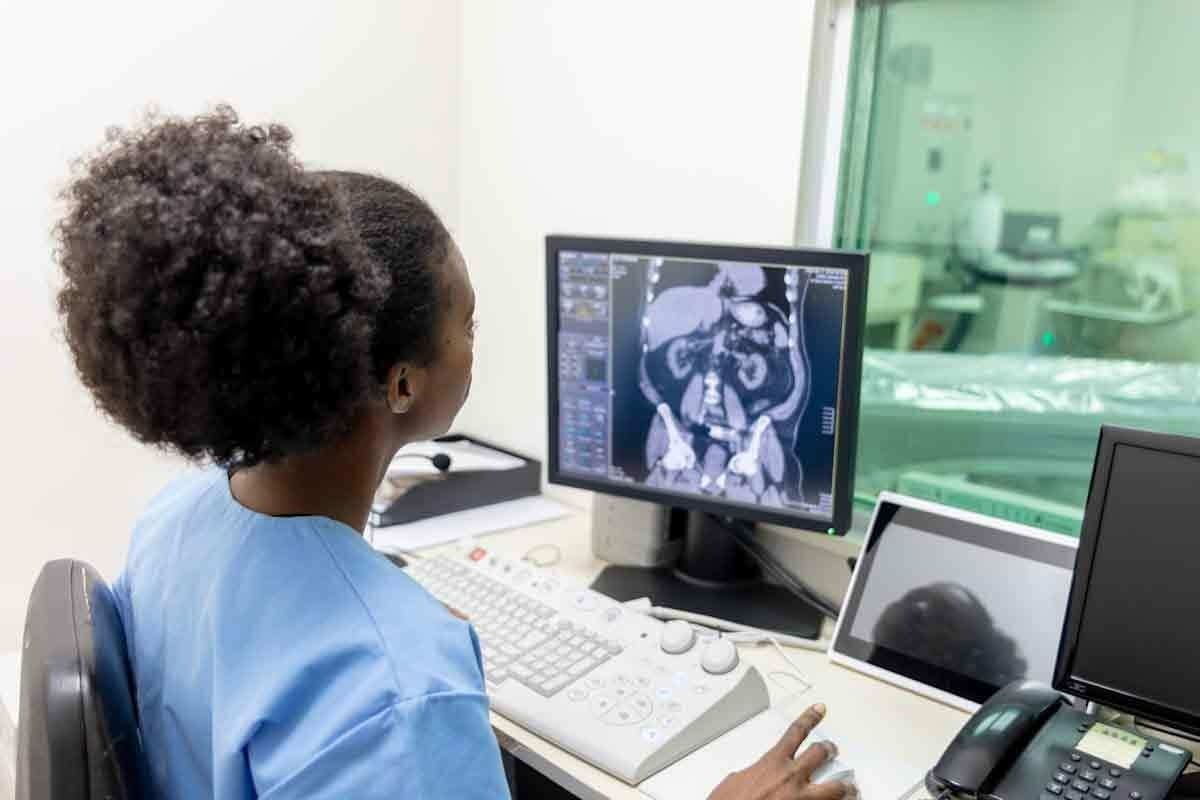
CT scans use X-rays to make clear images of organs and tissues inside the body. A CT scanner, shaped like a doughnut, moves around the patient. It takes X-ray shots from different angles. Then, a computer makes detailed pictures from these shots.
“CT scans are a vital tool in medical imaging,” experts say. “They offer speed, resolution, and detail needed for complex diagnoses.”
Differences Between CT and Other Imaging Methods
CT scans are different from other imaging methods like MRI. MRI uses magnetic fields and radio waves, while CT scans use X-rays. This makes CT scans great for seeing bones and finding calcifications, which are important for diagnosing skull base tumors.
Advancements in CT Technology
New CT tech has made it even better. Modern scanners have higher resolution, scan faster, and use less radiation. New techniques like CT angiography and dual-energy CT help see blood vessels better and tell tissues apart.
As CT scan tech keeps getting better, it will help more with diagnosing and treating skull base tumors and other tough health issues.
CT Scan for Skull Base Tumor Detection
CT scans are key in finding tumors at the skull base. They show the tumor’s size, where it is, and how it affects nearby areas.
What CT Scans Can Reveal About Skull Base Tumors
CT scans are great for spotting certain skull base tumors. They show the tumor’s bony involvement and calcifications. This info is vital for figuring out the best treatment.
CT scans help see how tumors affect the bones around them. This is key for planning surgery and treatment.
Types of Tumors Best Detected by CT
Some skull base tumors are easier to spot with CT scans. These include:
- Meningiomas
- Chordomas
- Chondrosarcomas
These tumors often show up on CT scans because of their unique features like calcifications or bone erosion.
Resolution and Detail in CT Imaging
Today’s CT scanners make very detailed images. They can spot small tumors and tiny changes in the skull base.
Imaging Modality | Resolution | Bony Detail |
CT Scan | High | Excellent |
MRI | High | Limited |
CT scans’ high detail and resolution make them a must-have for diagnosing and treating skull base tumors.
The CT Scan Procedure for Skull Base Imaging
Getting a CT scan for skull base imaging has several steps. These steps are key for getting accurate results. The whole process aims to make patients comfortable while getting the best images for diagnosis.
Patient Preparation
Before the scan, patients must remove metal objects and jewelry. They might need to change into a hospital gown. Sometimes, fasting for a few hours is required, mainly if a contrast agent is used.
The Scanning Process
The CT scanner looks like a large doughnut. It moves around the patient to take images. The whole process usually takes just a few minutes.
Use of Contrast Agents
Contrast agents are used to make certain areas clearer. They can be given orally or through an IV, depending on the scan’s needs.
Duration and Comfort Considerations
The whole CT scan takes about 15 to 30 minutes. It’s important for patients to stay very quiet to get clear images. While it’s usually painless, some might feel uncomfortable from staying so long or from the contrast agents.
Procedure Step | Description | Duration |
Patient Preparation | Removing metal objects, changing into a gown, possibly fasting | 15-30 minutes |
Scanning Process | Lying on the table, being scanned by the CT machine | 2-5 minutes |
Use of Contrast Agents | Administering contrast agents orally or intravenously | Variable |
Limitations of CT Scans in Skull Base Tumor Detection
CT scans have some big drawbacks when it comes to finding skull base tumors. They are useful, but knowing their limits is key for good diagnosis and treatment plans.
Size and Location Constraints
One big problem with CT scans is they can’t always spot tumors based on size and where they are. Small tumors or those in tricky spots are hard to find right.
Tissue Differentiation Challenges
CT scans also struggle to tell different tissues apart. This makes it tough to tell if a tumor is benign or malignant.
Radiation Exposure Concerns
Another big worry with CT scans is radiation exposure. Even though they’re often worth it, looking for other imaging options is smart.
Limitation | Description | Impact on Diagnosis |
Size and Location | Difficulty in detecting small tumors or those in complex areas | Potential for missed diagnoses |
Tissue Differentiation | Challenges in distinguishing between tissue types | Inaccurate tumor characterization |
Radiation Exposure | Risk associated with radiation | Consideration for alternative imaging |
In short, CT scans are great for medical imaging, but they have limits when it comes to finding skull base tumors. Understanding these limits helps doctors make better choices for diagnosis and treatment.
CT Scan vs. MRI for Skull Base Tumor Diagnosis
When it comes to diagnosing skull base tumors, we must weigh the pros and cons of CT scans and MRI. Both are key in the diagnostic journey. Yet, they cater to different needs and offer unique advantages.
Comparative Strengths and Weaknesses
CT scans are top-notch for showing bony structures and spotting calcifications in tumors. They give clear views of the skull base, helping doctors see bone damage or erosion. MRI, on the other hand, shines with soft tissue contrast. It helps doctors see how tumors spread and affect nearby nerves and blood vessels.
CT Scan Strengths: – Great for bony details – Fast scanning – Good at finding calcifications
MRI Strengths: – Best for soft tissue – No radiation – Shows tumor size and soft tissue impact
When CT is Preferred Over MRI
CT scans are often the first choice for bony details. This is true for tumors that affect bones or are in complex bone areas. They’re also quicker, making them easier for patients who can’t stay very long in one spot, like for MRI.
Combined Approach Benefits
Using both CT and MRI together can give a full picture of a tumor. This mix of strengths helps doctors understand the tumor’s nature, size, and how it interacts with nearby tissues. This approach boosts accuracy and helps plan treatments better.
Imaging Modality | Strengths | Weaknesses |
CT Scan | Bony detail, quick scanning | Radiation exposure, less soft tissue detail |
MRI | Superior soft tissue contrast, no radiation | Longer scanning time, less bony detail |
Interpreting CT Scan Results for Skull Base Tumors
Radiologists carefully look at CT scan images to spot skull base tumors. They then suggest the next steps. This involves a detailed check of the CT scan to find any tumors in the skull base area.
Analysis of Skull Base CT Images
When checking CT scans for skull base tumors, radiologists focus on the tumor’s size, shape, and where it is. They also figure out if the tumor is benign or malignant based on its look and other signs.
Key factors radiologists consider include:
- The tumor’s dimensions and its impact on surrounding structures
- The presence of any calcifications or bony erosions
- The tumor’s relationship with critical neurovascular structures
Common Findings and Their Meanings
CT scans often show a mass lesion, bone destruction, or structures being pushed out of place. These signs can mean there’s a tumor, which might be benign or malignant.
Examples of common findings and their implications:
Finding | Implication |
Mass lesion | Possible tumor presence |
Bone destruction | Aggressive tumor behavior |
Displacement of structures | Tumor growth and possible impact on surrounding tissues |
Follow-up Recommendations After Initial CT
After the first CT scan, radiologists might suggest more tests like MRI, biopsy, or regular CT scans. The next steps depend on what the first scan showed and what kind of tumor it might be.
By carefully looking at CT scan results and suggesting the right next steps, radiologists are key in diagnosing and managing skull base tumors.
Advanced CT Techniques for Improved Tumor Detection
New CT technology has made diagnosing skull base tumors better. It uses advanced techniques to spot and understand tumors in this tricky area.
CT Angiography
CT angiography is great for seeing how blood vessels connect with skull base tumors. It shows the blood flow around the tumor, which is key for surgery planning. This method also shows how the tumor links with big blood vessels.
Dual-Energy CT
Dual-energy CT uses two X-ray energies to better see what tissues are. It helps tell different tumors apart from normal tissues, making diagnoses more accurate.
CT Perfusion Imaging
CT perfusion imaging looks at how blood moves through tumors. Knowing this helps doctors understand how tumors grow and react to treatments.
3D Reconstruction Techniques
3D reconstruction from CT scans gives a full view of tumors and their surroundings. It’s super helpful for planning surgeries and teaching patients about their conditions.
Technique | Application | Benefit |
CT Angiography | Vascular assessment | Detailed vascular mapping |
Dual-Energy CT | Tissue characterization | Improved diagnostic accuracy |
CT Perfusion Imaging | Tumor perfusion assessment | Understanding tumor behavior |
3D Reconstruction | Surgical planning and education | Comprehensive anatomical view |
Conclusion: The Future of Skull Base Tumor Imaging
The future of skull base tumor imaging looks bright. Advances in CT technology and other imaging methods are on the horizon. These improvements will make it easier to spot and diagnose tumors in the skull base.
Imaging techniques are getting better at showing what tumors are like and how they behave. This means doctors will have more information to help plan treatments.
Skull base cancer imaging will keep being key in finding and treating cancers. New CT methods, like CT angiography and dual-energy CT, will help see tumors better. They will also help doctors understand complex areas of the skull base.
With these new technologies, patient care is set to get even better. The future of skull base tumor imaging is full of hope. Ongoing research aims to make diagnoses more accurate and treatments more effective.
FAQ
Can a CT scan detect a skull base tumor?
Yes, a CT scan can find skull base tumors. It shows detailed images of the skull base. This helps identify tumors, their size, and how they relate to other structures.
What are the advantages of using a CT scan for skull base tumor detection?
CT scans give clear images quickly. CT scans provide rapid, detailed images, highlighting calcifications and bone erosion.
How does a CT scan differ from an MRI in diagnosing skull base tumors?
CT scans are better for seeing bone details and finding calcifications. MRI, on the other hand, shows soft tissue better. This makes MRI perfect for seeing how soft tissues are involved and their relation to nerves and blood vessels.
Are there any limitations to using CT scans for skull base tumor imaging?
Yes, there are. CT scans use radiation, which is a concern. They can also struggle to tell certain tissues apart. Plus, they might miss small tumors or those in hard-to-reach spots.
What is the role of contrast agents in CT scans for skull base tumors?
Contrast agents make tumors stand out more. They highlight areas with more blood flow or where the blood-brain barrier is broken. This helps doctors see tumors better and understand their nature.
How do advanced CT techniques improve skull base tumor detection?
New CT methods like CT angiography and dual-energy CT offer more info. They show tumor blood flow, composition, and how it’s being supplied with blood. This helps doctors plan treatments better.
Can CT scans be used for follow-up assessments after initial skull base tumor diagnosis?
Yes, CT scans are used for follow-ups. They help check how tumors are responding to treatment, spot any new growths, or see changes after surgery. This guides ongoing care.
How do radiologists interpret CT scan results for skull base tumors?
Radiologists look at CT images to find tumors and see how big they are. They also check how tumors relate to important structures. This helps doctors make informed decisions.
What are the benefits of a combined CT and MRI approach for skull base tumor diagnosis?
Using both CT and MRI gives a full view of the skull base. This combines the best of both worlds, improving how accurately tumors are diagnosed and treated.
Are there any concerns regarding radiation exposure from CT scans for skull base tumor imaging?
Yes, there’s a worry about radiation from CT scans. This is more of a concern for young patients or when scans are repeated. Efforts are made to keep doses low while keeping image quality high.
How does the anatomy of the skull base impact CT scan imaging?
The skull base’s complex anatomy makes imaging tough. It has detailed bones and important nerves and blood vessels. This requires careful imaging and interpretation to accurately spot and describe tumors.
What is the significance of tumor size and location in CT scan detection of skull base tumors?
Tumor size and location matter a lot. Smaller tumors or those in hard-to-reach spots can be harder to find. This shows the importance of high-quality images and skilled radiologists.
References
National Center for Biotechnology Information. Evidence-Based Medical Insight. Retrieved from https://www.ncbi.nlm.nih.gov/pmc/articles/PMC10366931/