Last Updated on November 27, 2025 by Bilal Hasdemir

Understanding the human brain is key for diagnosis and research. At Liv Hospital, we use MRI and fMRI scans. These tools give us deep insights into brain function.
MRI scans show us the brain‘s structure. On the other hand, fMRI scans measure brain activity. They do this by looking at blood flow and oxygen levels. This info helps us find the root of neurological problems and create better treatments.
Key Takeaways
- Advanced imaging like MRI and fMRI gives us important brain function insights.
- MRI scans let us see the brain‘s structure.
- fMRI scans track brain activity by looking at blood flow and oxygen.
- Knowing about brain activity is essential for diagnosing and treating brain disorders.
- Liv Hospital is dedicated to top-notch healthcare with the latest imaging tech.
Understanding MRI Technology: The Basics
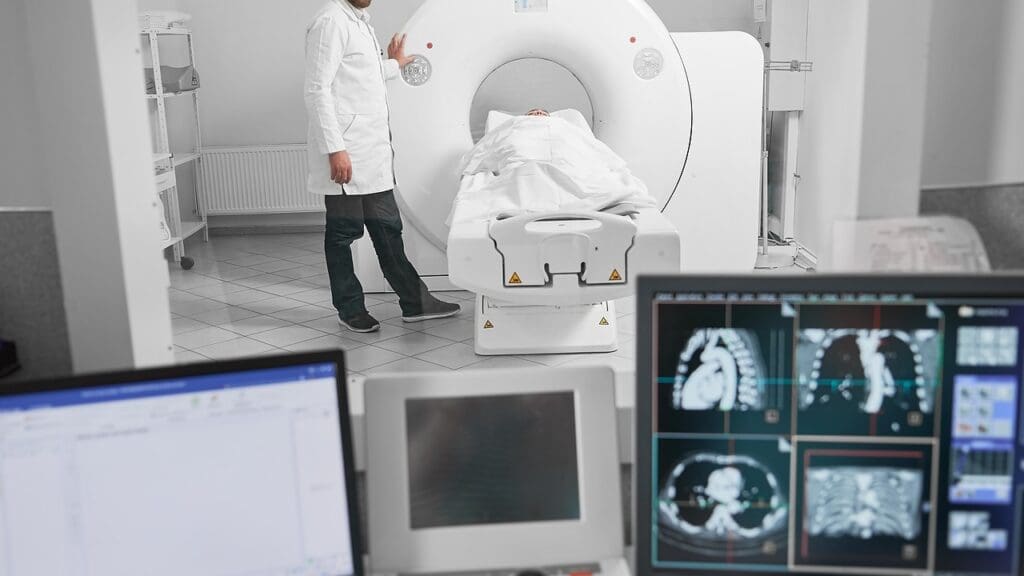
MRI uses strong magnetic fields and radio waves to show the body’s inside. It’s a key tool in medicine, letting doctors see inside without surgery. This way, they can see organs and tissues clearly.
What is Magnetic Resonance Imaging?
MRI is a way to see inside the body without harmful radiation. It uses special technology to make detailed pictures. This makes it safer for patients than other imaging methods.
Physics Behind MRI
MRI works by aligning hydrogen nuclei in the body with a strong magnetic field. Then, radio waves disturb these nuclei. As they return to their aligned state, they send out signals. These signals help make the images.
MRI Equipment Components
The main parts of MRI machines are the main magnet, gradient coils, and radiofrequency coils. The main magnet creates the strong magnetic field. Gradient coils change this field to encode the signals. Radiofrequency coils send and receive the signals for the images.
| Component | Function |
|---|---|
| Main Magnet | Generates the strong magnetic field |
| Gradient Coils | Modify the magnetic field for spatial encoding |
| Radiofrequency Coils | Transmit and receive signals |
Knowing about these parts helps us understand MRI technology. It shows how it’s used in medical care.
Does MRI Show Brain Activity?
Standard MRI is great for seeing brain structures. But it doesn’t show brain activity directly. This is key to knowing what MRI can and can’t do in brain checks.
Limitations of Standard MRI
Standard MRI gives clear images of the brain’s shape. It helps find problems like tumors or injuries. But it doesn’t show how the brain works in real time.
Key limitations include:
- Static imaging: MRI takes pictures of the brain at one moment.
- Lack of functional data: It doesn’t show brain activity as it happens.
Structural vs. Functional Imaging
Structural and functional imaging are two different things. Structural imaging, like standard MRI, looks at the brain’s shape. Functional imaging shows how brain areas talk to each other and work together.
What Standard MRI Actually Reveals
Standard MRI is good at showing the brain’s shape in detail. It can spot problems like lesions or unusual shapes. These are important for diagnosing brain issues.
| Feature | Structural MRI | Functional MRI |
|---|---|---|
| Primary Focus | Brain Anatomy | Brain Activity |
| Information Provided | Detailed structural images | Real-time neural activity |
Why Structure Doesn’t Equal Function
Having a structure is important for brain function. But just because a part looks normal on an MRI doesn’t mean it works right. Some brain areas might look fine but not work as they should because of other issues.
Experts say,
“Functional MRI (fMRI) has revolutionized the field of neuroscience by allowing us to map brain activity non-invasively.” – Source
Knowing the difference between structural and functional imaging is key for correct diagnosis and treatment plans in neurology. We’ll look into how fMRI measures brain activity next.
Introduction to Functional MRI (fMRI)
Functional MRI (fMRI) has changed how we study the brain. It lets us see brain activity as it happens. This technology is key for research and helping patients.
What is fMRI?
fMRI is a way to see the brain without hurting it. It looks at how blood and oxygen flow change. This is different from regular MRI, which shows the brain’s structure.
History and Development of fMRI
The start of fMRI was in the early 1990s. It built on MRI technology. The first studies came out in 1992. Now, fMRI can show more details than ever before.
Key Differences Between MRI and fMRI
MRI and fMRI serve different purposes. MRI shows the brain’s structure. fMRI looks at how the brain works.
Technical Distinctions
fMRI needs special equipment to see tiny changes in blood. This is more than MRI needs.
Output and Data Comparison
MRI gives detailed images of the brain. fMRI shows how the brain changes over time. This is shown in activation maps, which highlight brain areas involved in tasks.
| Feature | MRI | fMRI |
|---|---|---|
| Purpose | Structural Imaging | Functional Imaging |
| Output | High-resolution structural images | Activation maps showing brain activity |
| Technical Requirements | Standard MRI hardware and software | Advanced hardware and software to detect changes in blood oxygenation |
Knowing the differences between MRI and fMRI helps us see fMRI’s value. It’s great for studying the brain and helping in psychology and neuroscience.
The Science Behind fMRI: BOLD Signal
The BOLD signal is key in fMRI. It shows changes in blood oxygen levels to measure brain activity. This signal comes from how neural activity, blood flow, and oxygen work together.
Blood-Oxygen-Level Dependent (BOLD) Signal
The BOLD signal is a hemodynamic response that shows oxygen levels in blood. When neurons are active, they use more oxygen. This leads to more oxygen in the blood, which fMRI can detect.
Hemodynamic Response
The hemodynamic response is what makes the BOLD signal work. It’s when blood vessels open up and blood flow increases in active areas. This response takes a few seconds to happen.
Oxygen Metabolism in Neural Activity
Oxygen is vital for neural activity. Active neurons need more oxygen to work. The increase in blood flow and oxygen to these areas is what the BOLD signal measures.
Neurovascular Coupling
Neurovascular coupling links neural activity to the hemodynamic response. It’s how the brain controls blood flow based on activity. Knowing this is key to understanding fMRI results.
Temporal and Spatial Resolution in fMRI
fMRI has limits in time and space. It can only capture changes every few seconds. The smallest details it can show depend on the scanner’s resolution, which can be very small.
- Temporal Resolution: Limited by the hemodynamic response time (seconds)
- Spatial Resolution: Determined by voxel size (as low as 1-2 mm)
Knowing these limits helps researchers use fMRI better. It lets them explore brain function and behavior more effectively.
How Does fMRI Measure Brain Activity
fMRI scanning is a complex method that tracks brain activity by looking at blood flow and oxygen levels. It’s key in neuroscience and medical diagnosis.
The fMRI Scanning Process
The fMRI scanning process has several important steps for accurate brain activity measurement. Patient preparation is the first step.
Patient Preparation
Before scanning, patients remove metal objects and wear earplugs for hearing protection. They then lie on the MRI table, which moves into the scanner.
Task-Based vs. Resting-State fMRI
fMRI scans can be done in two ways: task-based and resting-state. Task-based fMRI asks patients to do tasks like tapping fingers or answering questions. Resting-state fMRI, on the other hand, looks at brain activity when patients are relaxed.
Creating Activation Maps
During scanning, data is collected to make detailed activation maps. These maps show which brain areas are active during tasks or stimuli.
Interpreting fMRI Results
Understanding fMRI results involves complex analysis and visualization. Researchers use special software to spot brain activity patterns.
Statistical Analysis Methods
Statistical analysis is key to finding brain activity changes. Methods like general linear modeling are used to analyze fMRI data.
Visualization Techniques
Visualization, like 3D rendering and color mapping, helps make fMRI data easy to understand. It shows where brain activity happens.
As noted by
“The development of fMRI has revolutionized the field of neuroscience, enabling researchers to non-invasively map brain function with high spatial resolution.”
This quote highlights fMRI’s role in understanding brain activity.
Applications of fMRI in Psychology
fMRI in psychology has opened new doors for understanding the brain. It helps us see how we think, feel, and behave. Researchers use fMRI to explore the brain’s inner workings.
Cognitive Function Studies
Cognitive studies with fMRI have given us new insights. fMRI in psychology lets us see which brain parts handle different tasks.
Memory and Learning
Studies show memory and learning use different brain areas. The hippocampus helps create new memories. The prefrontal cortex is key for working memory.
Attention and Decision-Making
Research on attention and decision-making has found important brain areas. The anterior cingulate cortex and prefrontal cortex play big roles. This helps us understand how we make choices and control our minds.
Emotional Processing Research
Emotional processing is another area where fMRI has made big strides. The amygdala and insula are key in processing emotions.
Behavioral and Clinical Applications
fMRI also helps in studying behavior and mental health. It looks into mental health issues and neurological conditions.
Mental Health Disorders
fMRI research has uncovered how mental health disorders work. For example, people with depression show changes in the amygdala and prefrontal cortex.
Neurological Conditions
fMRI is also used for neurological conditions like Alzheimer’s and stroke. These studies help us understand these conditions better and find new treatments.
In conclusion, fMRI in psychology has many uses. It helps us understand thinking, feeling, and behavior. As fMRI technology gets better, we’ll learn even more about the brain.
MRI and Psychology: A Powerful Partnership
MRI technology has changed how we study the brain and behavior. It lets us see how brain activity and behavior are linked. This is thanks to MRI and psychological tests working together.
Neuropsychological Assessment
Neuropsychological assessment uses MRI to look at the brain. MRI scans show detailed brain images. This helps doctors spot problems linked to brain and mental health issues.
For example, MRI can spot Alzheimer’s, brain injuries, and strokes. Functional MRI (fMRI) also lets us see brain activity live. This helps in making better treatment plans.
Brain-Behavior Relationships
Understanding how the brain and behavior connect is key in psychology. fMRI is a top tool for studying these connections. It helps researchers link brain activity to thoughts and feelings.
Case Studies in Neuropsychology
Case studies have greatly helped us understand brain and behavior links. For instance, studying people with brain damage has taught us a lot. We’ve learned about language, memory, and decision-making.
Mapping Psychological Processes
fMRI has helped map brain areas to psychological processes. This has revealed how complex behaviors work. It’s shown us about decision-making, emotions, and social thinking.
Advancing Psychological Theories
MRI and psychology together have improved our theories. MRI and fMRI have helped refine and test these theories. They give us a clearer view of the brain and behavior.
In summary, MRI and psychology have changed how we see the brain and behavior. As we keep improving, we’ll learn even more about brain and behavior links.
Limitations and Challenges of fMRI
fMRI has changed the game in neuroscience, but it’s not perfect. As we dive deeper into its use in psychology, we must face its challenges head-on.
Technical Limitations
fMRI has some technical hurdles that can mess with its data quality. Two big ones are signal-to-noise ratio and motion artifacts.
Signal-to-Noise Ratio
The signal-to-noise ratio (SNR) is key in fMRI studies. A low SNR can make brain activity measurements off. Boosting SNR is key for solid data.
Motion Artifacts
Motion artifacts happen when subjects move during scans, messing with the signal. Keeping subjects steady is key for precise results.
Interpretation Challenges
Deciphering fMRI data is tough, with challenges like the reverse inference problem and brain function differences.
Reverse Inference Problem
The reverse inference problem makes us guess what cognitive process is happening based on brain activity. But, this guesswork can be wrong because one brain area can handle many tasks.
Individual Differences
Everyone’s brain is different, affecting fMRI results. It’s important to account for these differences for accurate readings.
Ethical Considerations
fMRI research also brings up ethical issues, like privacy and misuse of brain scan data. We must uphold ethical standards to safeguard participants.
In summary, fMRI is a valuable tool for studying the brain, but we must recognize its limitations. By tackling these challenges, we can enhance the accuracy and trustworthiness of fMRI research in psychology.
Conclusion: The Future of Brain Imaging in Psychology
Looking ahead, brain imaging in psychology will see big changes. Techniques like functional MRI (fMRI) will help us understand the brain better. This will lead to new ways to diagnose and treat mental health issues.
These imaging tools will also boost research in psychology. They will help us study how we think, feel, and behave. As fMRI gets better, we’ll see more uses in hospitals, helping patients and learning more about the brain.
The mix of MRI and psychology will bring us closer to solving mental health problems. By exploring new ways to image the brain, we’ll make progress in treating mental health issues. This is an exciting time for both fields.
“FAQ
Does an MRI show brain activity?
Standard MRI doesn’t show brain activity directly. It mainly shows brain structure. But, functional MRI (fMRI) can measure brain activity by looking at blood flow changes.
What is the difference between MRI and fMRI?
MRI is for looking at brain structure. fMRI, on the other hand, looks at brain activity by checking blood flow. It’s key in psychology for studying how we think and feel.
How does fMRI measure brain activity?
fMRI uses the BOLD signal to measure brain activity. This signal comes from changes in blood oxygen in the brain. When an area is active, it needs more oxygen, causing blood flow to increase.
What are the applications of fMRI in psychology?
fMRI helps in psychology by studying how we think and feel. It’s used to understand brain functions and has implications for mental health.
What are the limitations of fMRI?
fMRI faces technical challenges like signal resolution and noise. It indirectly measures brain activity, which can be hard to interpret. There are also ethical issues with using fMRI data.
Can fMRI be used for neuropsychological assessment?
Yes, fMRI can assess brain function for neuropsychology. It helps understand how our brain and behavior are connected.
How is fMRI scanning performed?
fMRI scanning involves several steps. First, the patient is prepared. Then, data is collected during tasks or at rest. Lastly, activation maps are created to show brain activity.
What is the role of neurovascular coupling in fMRI?
Neurovascular coupling links neural activity to blood flow changes. It’s key for understanding fMRI data, as it’s behind the BOLD signal.
What are the future prospects of brain imaging in psychology?
Brain imaging in psychology is set to grow, with new technologies like fMRI. These advancements will help us better understand the brain and improve mental health treatments.
FAQ
Does an MRI show brain activity?
Standard MRI doesn’t show brain activity directly. It mainly shows brain structure. But, functional MRI (fMRI) can measure brain activity by looking at blood flow changes.
What is the difference between MRI and fMRI?
MRI is for looking at brain structure. fMRI, on the other hand, looks at brain activity by checking blood flow. It’s key in psychology for studying how we think and feel.
How does fMRI measure brain activity?
fMRI uses the BOLD signal to measure brain activity. This signal comes from changes in blood oxygen in the brain. When an area is active, it needs more oxygen, causing blood flow to increase.
What are the applications of fMRI in psychology?
fMRI helps in psychology by studying how we think and feel. It’s used to understand brain functions and has implications for mental health.
What are the limitations of fMRI?
fMRI faces technical challenges like signal resolution and noise. It indirectly measures brain activity, which can be hard to interpret. There are also ethical issues with using fMRI data.
Can fMRI be used for neuropsychological assessment?
Yes, fMRI can assess brain function for neuropsychology. It helps understand how our brain and behavior are connected.
How is fMRI scanning performed?
fMRI scanning involves several steps. First, the patient is prepared. Then, data is collected during tasks or at rest. Lastly, activation maps are created to show brain activity.
What is the role of neurovascular coupling in fMRI?
Neurovascular coupling links neural activity to blood flow changes. It’s key for understanding fMRI data, as it’s behind the BOLD signal.
What are the future prospects of brain imaging in psychology?
Brain imaging in psychology is set to grow, with new technologies like fMRI. These advancements will help us better understand the brain and improve mental health treatments.
References
- National Institute of Biomedical Imaging and Bioengineering (NIBIB) (Magnetic Resonance Imaging – MRI) : https://www.nibib.nih.gov/science-education/science-topics/magnetic-resonance-imaging-mri
- University of Oxford – Centre for Functional MRI of the Brain (FMRIB) (What is fMRI?) : https://www.ndcn.ox.ac.uk/divisions/fmrib/what-isfmri/introduction-to-fmri
- Wikipedia (Functional magnetic resonance imaging) : https://en.wikipedia.org/wiki/Functional_magnetic_resonance_imaging
- The Open University (How fMRI works) : https://www.open.edu/openlearn/body-mind/health/health-sciences/how-fmri-works
- RadiologyInfo.org (fMRI – Brain) : https://www.radiologyinfo.org/en/info/fmribrain