Last Updated on November 14, 2025 by Ugurkan Demir
At Liv Hospital, we understand that getting diagnosed with Acute Lymphoblastic Leukemia (ALL) can completely change your life. This cancer affects the blood and bone marrow and is caused by the rapid growth of immature lymphocytes. Knowing what happens in acute lymphoblastic leukemia helps patients and families better understand the disease and its treatment.
The terms acute lymphoblastic leukemia and acute lymphocytic leukemia refer to the same condition. According to the American Cancer Society, “Acute lymphocytic leukemia (ALL) is a cancer that starts in your bone marrow.” We make sure patients clearly understand that these names describe the same illness.
At Liv Hospital, our goal is to provide clear information and advanced care for those diagnosed with or in acute lymphoblastic leukemia, helping each patient feel informed, supported, and confident throughout their treatment journey.
Key Takeaways
- Acute Lymphoblastic Leukemia (ALL) is a cancer affecting the blood and bone marrow.
- ALL is characterized by the rapid production of immature lymphocytes.
- The terms ‘acute lymphoblastic leukemia’ and ‘acute lymphocytic leukemia’ are used interchangeably.
- ALL diagnosis requires thorough care and advanced treatment.
- Liv Hospital is dedicated to top-notch healthcare with support for international patients.
Understanding Acute Lymphoblastic Leukemia (ALL)
Acute Lymphoblastic Leukemia (ALL) is a cancer that affects the blood and bone marrow. It’s caused by the fast growth of immature white blood cells. Knowing about ALL helps us see how it affects the body and why quick medical help is key.
Definition and Basic Characteristics
ALL is marked by the buildup of lymphoblasts in the bone marrow and blood. These cells can’t fight off infections well. This buildup stops normal blood cells from being made, causing health problems. If not treated fast, the disease can get worse quickly.
Key characteristics of ALL include:
- Rapid onset and progression
- Overproduction of lymphoblasts
- Impact on both children and adults, though it’s more common in children
Clinical experts say, “Acute lymphocytic leukemia is a type of cancer of the blood and bone marrow… It’s more common in children and teens than in adults.” This shows why it’s important to know about ALL in all age groups.
“Acute lymphocytic leukemia is a type of cancer of the blood and bone marrow… It’s more common in children and teens than in adults.”
Prevalence and Demographics
ALL is the most common cancer in kids, making up a big part of childhood cancer cases. While it’s more common in kids, adults can also get it. Adults often face different challenges and treatment outcomes than kids.
| Age Group | Prevalence | Characteristics |
| Children | More common | Generally better prognosis with appropriate treatment |
| Adults | Less common | Often associated with poorer outcomes and more complex treatment protocols |
Knowing about ALL’s demographics and how common it is helps us spread awareness. It also guides research to find better treatments for everyone.

Terminology Explained: Lymphoblastic vs. Lymphocytic Leukemia
Getting a diagnosis of Acute Lymphoblastic Leukemia (ALL) means learning about certain words. We need to know the difference and similarity between ‘lymphoblastic’ and ‘lymphocytic’ leukemia. This will help both patients and doctors understand the disease better.
Origin of the Terms
The words ‘lymphoblastic’ and ‘lymphocytic’ come from the cells affected by the disease. ‘Lymphoblastic’ talks about immature cells (lymphoblasts) that grow too much. ‘Lymphocytic’ leukemia is about lymphocytes, important white blood cells for our immune system.
Key differences in terminology:
- Lymphoblastic highlights the presence of immature cells.
- Lymphocytic points to the type of cells involved.
Why Both Terms Are Used Interchangeably
Even though they seem different, ‘lymphoblastic’ and ‘lymphocytic’ describe the same disease, ALL. This is because ALL is about the growth of lymphoblasts, which are young lymphocytes. So, both terms talk about the same thing but from different angles.
The American Cancer Society explains that “the main difference between lymphocytic (lymphoblastic) leukemias like ALL and lymphomas: Leukemias mainly affect the bone marrow and blood.” This shows why both terms are used for ALL.
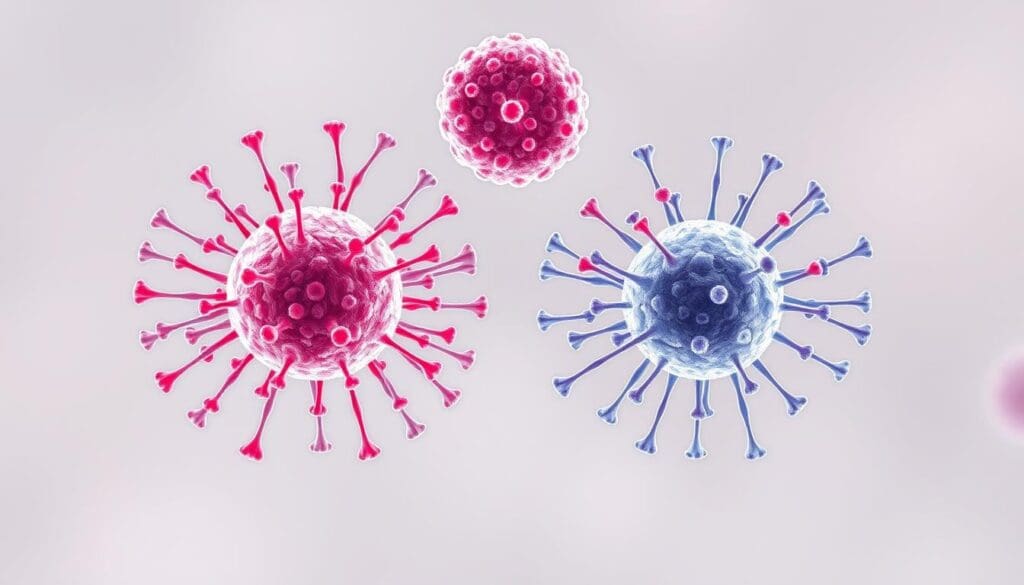
Knowing that ‘lymphoblastic’ and ‘lymphocytic’ leukemia both mean ALL can clear up confusion. It makes talking about the disease easier for doctors and patients. We stress the need for clear and correct words when dealing with this complex illness.
Common Clinical Manifestations in Acute Lymphoblastic Leukemia
It’s important to know the signs of Acute Lymphoblastic Leukemia (ALL) for early treatment. ALL is a cancer that affects the blood and bone marrow. It happens when there’s too many immature white blood cells.
Early Warning Signs and Symptoms
The first signs of ALL can be hard to spot because they’re similar to other illnesses. Common early symptoms include:
- Persistent fatigue and weakness due to anemia.
- Fever and infections that recur or won’t go away.
- Bleeding or bruising easily, including nosebleeds or bleeding gums.
- Bone pain or tenderness, mainly in the legs and hips.
Advanced Symptoms and Complications
As ALL gets worse, symptoms get more serious. These can include:
- Enlarged lymph nodes, spleen, or liver.
- Petechiae which are small red spots on the skin.
- Shortness of breath due to anemia.
- Weight loss and loss of appetite.
Advanced ALL can cause serious problems like infections, organ failure, and bleeding disorders.
How Symptoms Differ Between Children and Adults
ALL symptoms can look different in kids and adults. Kids often have more severe symptoms, like:
| Symptom | Children | Adults |
| Bone Pain | Common, often severe | Less common, may be mild |
| Fever and Infections | Frequent and recurring | Occasionally, it may be less severe |
| Bleeding or Bruising | Often present | May be present, varies |
Adults might notice symptoms more slowly, making it harder to diagnose. Knowing these differences helps doctors treat patients faster and better.
Types and Classification of ALL
It’s important to know the types and classifications of ALL for good diagnosis and treatment. Acute Lymphoblastic Leukemia is a complex disease with many subtypes. These subtypes vary in their cell origin, genetic makeup, and how they behave clinically.
B-cell (B ALL) Characteristics and Subtypes
B-cell ALL comes from B lymphocyte precursors that have turned cancerous. It’s the most common ALL type, mainly in kids. B-cell ALL is marked by specific surface antigens and genetic issues. Doctors use flow cytometry and genetic tests to spot these markers.
B-cell ALL breaks down into subtypes based on when the leukemia starts in B-cell development. The main types are:
- Early precursor B-cell ALL
- Pre-B-cell ALL
T-cell (T ALL) Characteristics and Subtypes
T-cell ALL starts from T lymphocyte precursors. It’s more common in teens and young adults. T-cell ALL often has a higher risk of affecting the brain and spinal cord. Doctors identify T-cell ALL by looking for specific markers.
T-cell ALL is split into subtypes based on T-cell development stages. These include:
- Early T-cell precursor ALL
- Cortical T-cell ALL
Molecular and Genetic Markers in ALL
Molecular and genetic markers are key in diagnosing, predicting, and treating ALL. Genetic issues like chromosomal changes and mutations affect how the disease acts and responds to treatment. For example, the Philadelphia chromosome in B-cell ALL and NOTCH1 mutations in T-cell ALL.
Spotting these markers helps doctors understand the risk and choose the right treatment. New treatments targeting specific genetic flaws are being tested in trials.
Diagnosis and Treatment Approaches in Acute Lymphoblastic Leukemia
It’s important for patients and doctors to know about Acute Lymphoblastic Leukemia (ALL). The diagnosis involves several tests. Treatment options have changed over time, giving patients more choices.
Diagnostic Procedures and Tests
Diagnosing ALL means looking at the blood and bone marrow. The process includes:
- Complete Blood Count (CBC)
- Bone Marrow Biopsy
- Lumbar Puncture
- Imaging Tests
These tests confirm leukemia cells and show how far the disease has spread.
Standard Treatment Protocols
ALL treatment often includes chemotherapy, targeted therapy, or a bone marrow transplant. The choice depends on the patient’s age and health.
Common treatments are:
- Induction Therapy
- Consolidation Therapy
- Maintenance Therapy
Emerging Therapies and Clinical Trials
New treatments like immunotherapy and CAR-T cell therapy are being tested. They show great promise for ALL patients.
Some new therapies are:
- Targeted Therapy
- Immunotherapy
- CAR-T Cell Therapy
Treatment Considerations for Different Age Groups
Treatment plans differ by age. Children, adults, and the elderly have unique needs and responses.
| Age Group | Treatment Considerations |
| Children | More intensive chemotherapy regimens |
| Adults | Combination of chemotherapy and targeted therapy |
| Elderly | Less intensive treatment due to comorbidities |
Conclusion
Acute Lymphoblastic Leukemia (ALL) is a complex disease that needs a deep understanding and careful management. It has unique chromosomal and genetic changes that affect lymphoid cells. The way it shows up can differ a lot between kids and adults, with a peak in both age groups.
Our look at ALL shows how vital it is to know its types and how genetic markers help in treatment. Diagnosing it involves several tests. Treatment often includes chemotherapy and sometimes stem cell transplants. For more info, check out the National Center for Biotechnology Information.
In summary, our overview of ALL stresses the importance of correct diagnosis and treatment plans. These plans should fit each patient’s unique needs.
FAQ
What is Acute Lymphoblastic Leukemia (ALL)?
Acute Lymphoblastic Leukemia (ALL) is a blood and bone marrow cancer. It’s caused by too many immature lymphocytes.
Is Acute Lymphoblastic Leukemia the same as Acute Lymphocytic Leukemia?
Yes, ‘Acute Lymphoblastic Leukemia’ and ‘Acute Lymphocytic Leukemia’ mean the same thing.
What are the symptoms of Acute Lymphoblastic Leukemia?
Symptoms include feeling very tired, pale skin, and getting sick often. You might also bruise easily and have bone pain. Symptoms can differ in kids and adults.
How is Acute Lymphoblastic Leukemia diagnosed?
Doctors use blood tests, bone marrow biopsies, and other tests to find ALL. They also check the type of ALL.
What are the different types of Acute Lymphoblastic Leukemia?
ALL is mainly B-cell (B-ALL) or T-cell (T-ALL). Each type has its own features and subtypes.
How is Acute Lymphoblastic Leukemia treated?
Treatment includes chemotherapy and targeted therapy. Sometimes, a bone marrow transplant is needed. New treatments and trials are being looked into.
Are there different treatment approaches for children and adults with Acute Lymphoblastic Leukemia?
Yes, treatment plans differ by age. They consider the patient’s health, ALL type, and other factors.
What are the molecular and genetic markers associated with Acute Lymphoblastic Leukemia?
ALL is linked to genetic and molecular markers. These affect how it’s classified, its outlook, and treatment.
Can Acute Lymphoblastic Leukemia be cured?
Many patients with ALL can be cured with the right treatment. Cure chances depend on age, treatment response, and disease details.
What is the prevalence of Acute Lymphoblastic Leukemia?
ALL is more common in kids, but it also affects adults. Its occurrence varies by age and population.
References
Rücker, F. G., & Brückner, H. (2019). Survival in adult acute lymphoblastic leukemia: A report from the German multicenter trials. Clinical Hematology & Oncology https://pmc.ncbi.nlm.nih.gov/articles/PMC6851994/