Last Updated on November 27, 2025 by Bilal Hasdemir
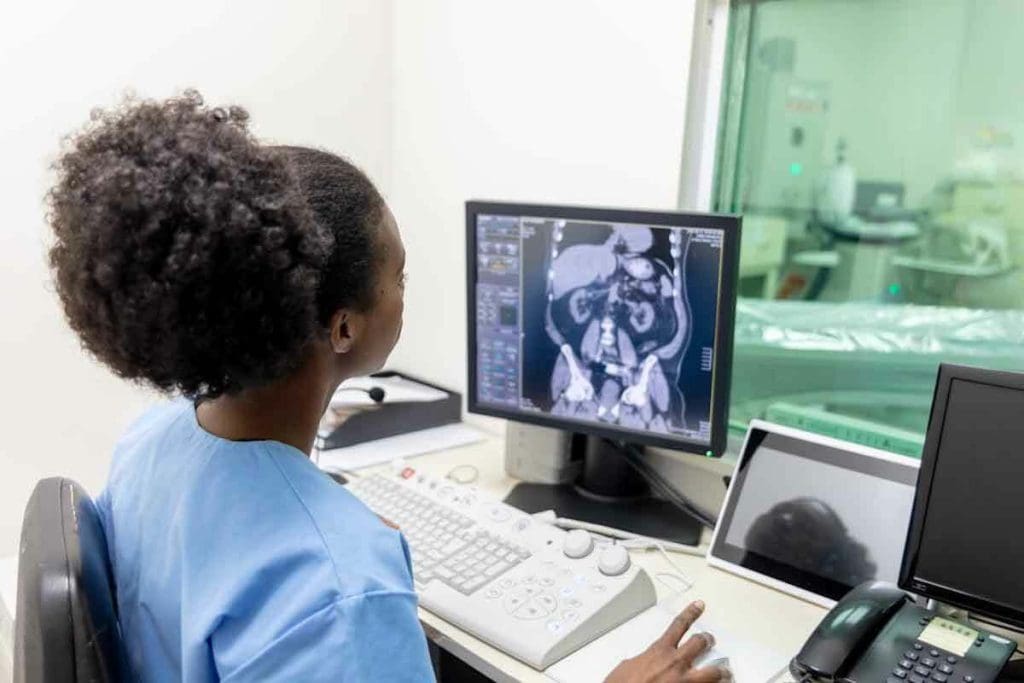
Knowing what a healthy thyroid gland looks like is key to rthe ight diagnosis and treatment. A CT scan of the thyroid gland shows the gland clearly. This lets doctors check its shape and how it works.
At Liv Hospital, we stress the need for a normal thyroid CT scan to check thyroid health. Our skilled team uses the latest imaging to spot a healthy thyroid’s main features. This is important for keeping metabolism, energy, and hormone balance in check. Studies show that a CT scan can spot thyroid nodules and what they’re made of.
Key Takeaways
- A normal thyroid CT scan is essential for evaluating thyroid health.
- A CT scan provides clear visualization of the thyroid gland’s structure and function.
- Understanding the key features of a healthy thyroid gland is vital for accurate diagnosis and treatment.
- Liv Hospital’s experts use advanced imaging techniques for thyroid assessment.
- A CT scan can help identify thyroid nodules and their characteristics.
The Role of CT Imaging in Thyroid Assessment
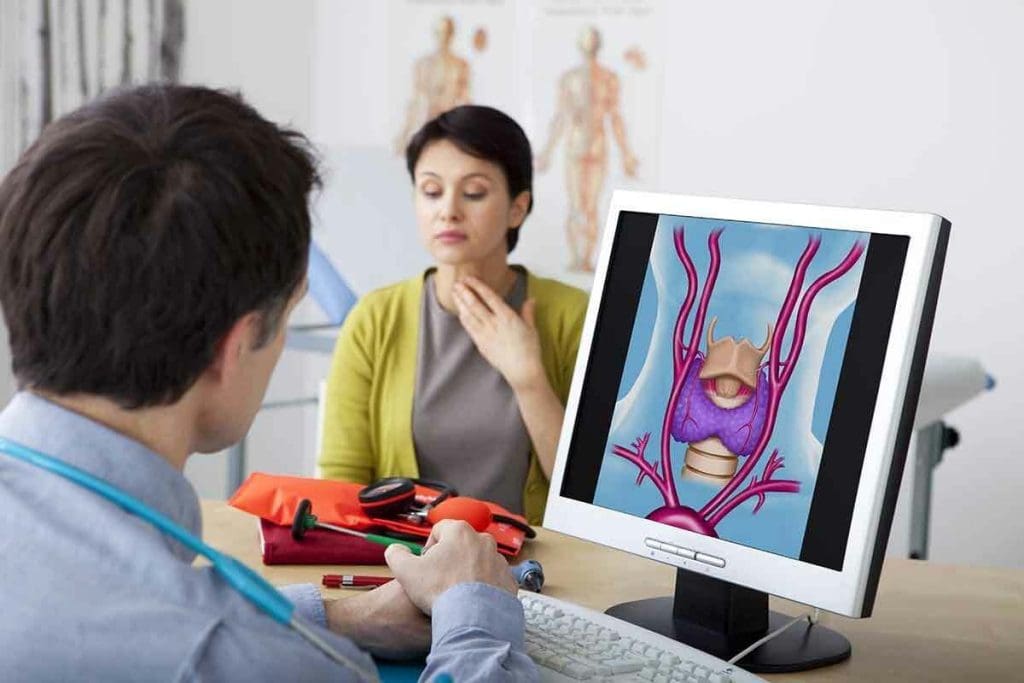
CT imaging gives a detailed look at the thyroid gland’s structure. It’s a common tool in medicine for many diagnoses. We use it to check the gland’s size, position, and for nodules, a key for diagnosis and treatment.
When CT Scans Are Indicated for Thyroid Evaluation
CT scans are needed for thyroid checks in several cases. This includes when nodules or cancer are suspected, or when we need to see how far thyroid disease has spread. A study on PMC shows CT scans are very helpful for this.
Here are the main reasons for a thyroid CT scan:
- Evaluating thyroid nodules or masses
- Assessing thyroid gland size and position
- Investigating symptoms such as difficulty swallowing or breathing
- Monitoring thyroid disease progression or treatment response
Advantages and Limitations of Thyroid CT
Thyroid CT scans have many benefits, like clear images of the gland and nearby areas. But, they also have downsides, like radiation exposure and possible reactions to contrast agents.
| Advantages | Limitations |
| High-resolution imaging | Radiation exposure |
| Detailed view of surrounding structures | Potential contrast agent reactions |
| Useful for assessing large thyroid glands | May not be suitable for all patients (e.g., those with kidney disease) |
Preparation for a Thyroid CT Scan
Getting ready for a thyroid CT scan means removing metal items, wearing a hospital gown, and possibly getting a contrast agent. We tell patients to follow their doctor’s instructions closely for a smooth scan.
In summary, CT imaging is key for thyroid checks, giving a full view of the gland and nearby tissues. Knowing when to use CT scans, their benefits and drawbacks, and how to prepare helps us make accurate diagnoses and effective treatments for thyroid issues.
Key Feature #1: Normal Thyroid CT Scan Density and Homogeneity
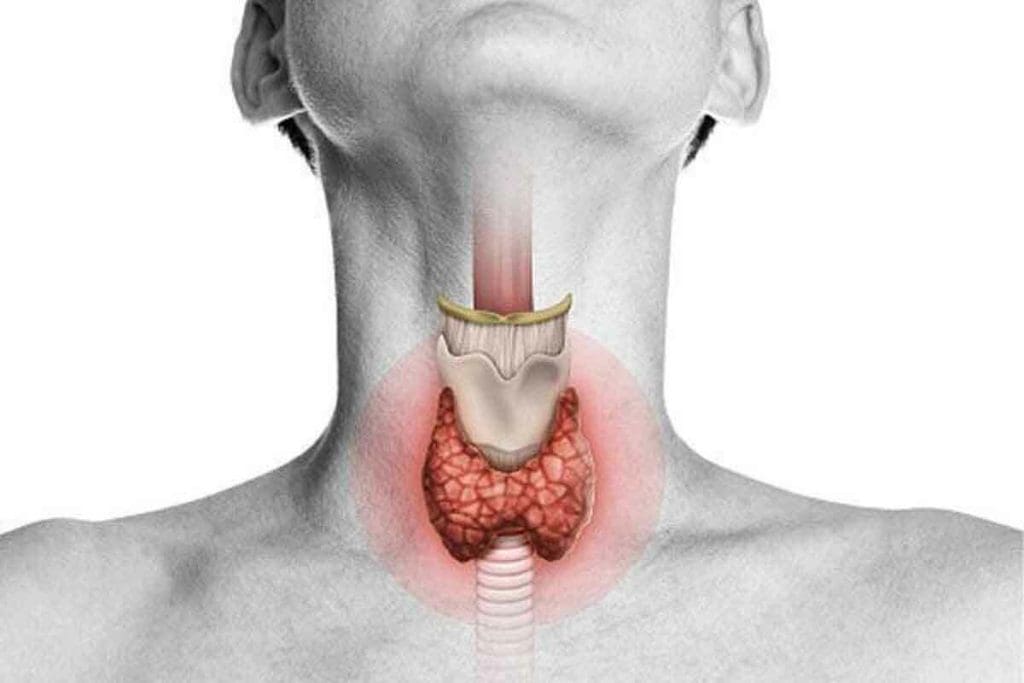
A normal thyroid CT scan shows the gland as a clear, uniform structure. It has a specific soft tissue density. This helps doctors tell a healthy thyroid gland from one with problems.
Typical Hounsfield Unit Range (60-80 HU)
The thyroid gland’s density is usually between 60 to 80 Hounsfield Units (HU) on CT scans. This is much higher than muscles and other soft tissues. The gland’s high iodine content is key to making thyroid hormones.
Homogeneous Tissue Characteristics
A healthy thyroid gland looks the same all over on CT scans. It doesn’t have big changes or spots that look different. This uniform look shows the gland is working right.
Differentiating Normal from Abnormal Density
It’s important to tdistinguishnormal from abnormal density in thyroid CT scans. Abnormal densities can mean problems like nodules or inflammation. By checking the gland’s density and if it’s uniform, doctors can spot issues that need further looking.
Key Feature #2: Size and Shape Parameters of a Healthy Thyroid
Knowing the normal size and shape of the thyroid gland helps spot thyroid problems. A CT scan, with or without contrast, looks at several important points to check the gland’s health.
Normal Dimensions of Thyroid Lobes
The thyroid gland has two lobes joined by an isthmus. Each lobe is usually 4-5 cm long, 1.5-2 cm wide, and 1-2 cm thick. These sizes can vary, but big changes might mean there’s a problem. We check these sizes closely on a thyroid gland CT scan to find any issues.
Isthmus Appearance and Measurement
The isthmus, which links the lobes, is usually under 5 mm thick. A thicker isthmus could mean thyroid disease. We look at the isthmus’s thickness and any odd shapes that might show thyroid disease. A healthy thyroid CT scan shows a thin, even isthmus.
Age and Gender Variations in Thyroid Size
Thyroid size changes with age and gender. Women’s thyroids are often larger than men’s, and size can shift with age. It’s key to know these changes for accurate diagnosis. When we look at a thyroid CT scan, we consider these factors to spot real problems.
In summary, checking the thyroid gland’s size and shape is vital for thyroid health through CT scans. By knowing the normal sizes and how they change, we can find and diagnose problems more accurately.
Key Feature #3: Position and Anatomical Relationships
Knowing where the thyroid gland is and its connections to other parts is key to reading CT scans right. It sits in the neck, in front of the trachea. Its connections with other structures are important for checking its health.
Normal Thyroid Location Relative to Adjacent Structures
The thyroid gland is usually found in the front of the neck, around the trachea. It’s close to the trachea, esophagus, and big blood vessels. On a cCTscan of the thyroid gland, it looks like a two-part structure with its middle part in front of the trachea.
Relationship to Trachea and Esophagus
The thyroid gland is very close to the trachea and esophagus. The trachea is behind the thyroid’s middle part, and the esophagus is behind the trachea, leaning a bit to the left. On a thyroid CT scan with contrast, these connections are easy to see, helping spot any issues.
Vascular Relationships in the Neck
The thyroid gland also has close ties to neck vessels like the carotid arteries and jugular veins. These vessels are key to a CT thyroid gland scan. They help show where the thyroid is and its connections.
| Structure | Relationship to Thyroid Gland | Relevance of CT Scan |
| Trachea | Posterior to the thyroid isthmus | Assessing thyroid size and position |
| Esophagus | Posterior to the trachea, often leftward | Evaluating esophageal deviation or compression |
| Carotid Arteries and Jugular Veins | Lateral to thyroid lobes | Defining thyroid boundaries and vascular relationships |
Key Feature #4: Enhancement Patterns with Contrast
Contrast enhancement is key in thyroid CT scans. It helps us see blood vessels and tell different types of lesions apart. Contrast agents make the thyroid gland and its surroundings clearer to see.
Normal Contrast Enhancement Characteristics
Normal thyroid tissue gets homogeneous enhancement after contrast. It looks denser than before. The enhancement pattern is usually symmetric. It can change based on the contrast timing and type.
- The thyroid gland usually enlarges more than the surrounding muscles.
- The enhancement is generally uniform throughout the gland.
- Optimal enhancement is typically achieved during the late arterial or early venous phase.
Vascular Visualization Techniques
Contrast-enhanced CT scans are great for seeing blood vessels around the thyroid gland. Contrast makes arteries and veins stand out. This is important for surgery planning and checking for blood vessel problems in thyroid issues.
Distinguishing Cystic from Solid Structures
Contrast helps tell cystic from solid structures in thyroid CT scans. Cystic lesions have peripheral enhancement with a non-enhancing center. Solid lesions enhance more evenly. But some cystic lesions might have solid parts or complications like hemorrhage or infection, changing their CT look.
- Cystic lesions: Peripheral enhancement with a non-enhancing center.
- Solid lesions: Uniform enhancement throughout.
- Complex lesions: May show mixed enhancement patterns.
Key Feature #5: Absence of Pathological Features
The fifth key feature of a normal thyroid CT scan is the lack of signs of disease. When we check a thyroid CT scan, we look for no signs of thyroid problems. This lack shows that the thyroid is healthy.
No Abnormal Masses or Nodules
A normal thyroid CT scan should not show any unusual growths. Such growths could mean thyroid issues, like thyroid cancer or thyroid adenoma. We look closely at the thyroid gland for any odd sizes, shapes, or textures that might mean trouble.
Absence of Calcifications
It’s also important to see no calcifications in the thyroid gland. Calcifications can be linked to thyroid problems, including cancer. A normal CT scan for the thyroid should not show many calcifications, showing the gland is clear of these issues.
Normal Margins and Boundaries
The edges and boundaries of the thyroid gland are key to its health on a CT scan. A healthy thyroid has clear edges and boundaries, separate from other tissues. Any unclear or fuzzy edges could mean a problem, like inflammation or a disease.
In short, a normal thyroid CT scan lacks signs of disease, like unusual growths, calcifications, and unclear edges. These signs, when not present, help us understand thyroid health through CT scans.
Key Feature #6: Surrounding Tissue Assessment
The sixth key feature of a normal thyroid CT scan is checking the tissues around the thyroid. It’s important to look at these tissues closely for a full thyroid check.
Normal Appearance of Perithyroidal Structures
The tissues around the thyroid, like muscles and fat, are key to checking thyroid health. On a CT scan, these should look normal. The sternothyroid and sternohyoid muscles should be even and not squished by the thyroid.
Lymph Node Evaluation
Lymph nodes in the neck are important to check during a thyroid CT scan. Normally, they are not big. We look at their size, shape, and density for any signs of trouble. Big lymph nodes might mean there’s something wrong that needs more looking into.
Parathyroid Glands on CT
Parathyroid glands might show up on a CT scan, but only if they’re big or if special settings are used. Usually, they’re too small to see on a CT. But if they do show up, they’re usually behind the thyroid.
| Structure | Normal Appearance on CT | Abnormal Signs |
| Perithyroidal Muscles | Symmetrical, without invasion | Asymmetry, invasion |
| Lymph Nodes | Small, uniform density | Enlargement, necrosis |
| Parathyroid Glands | Not typically visible | Visibility, enlargement |
By looking closely at the tissues around the thyroid, like lymph nodes, we can understand thyroid health better. This helps us spot problems early.
Key Feature #7: Incidental Findings and Clinical Significance
The seventh key feature of a normal thyroid CT scan is about incidental findings. These are common because CT scans are often done for reasons not related to the thyroid. They can affect how we care for patients.
Common Incidental Thyroid Findings on CT
CT scans can show thyroid nodules, cysts, and changes in size or density. These are seen in patients getting CT scans for other reasons, like trauma or checking the spine.
Some common findings include:
- Thyroid nodules, which may be solid or cystic
- Diffuse thyroid enlargement
- Calcifications within the thyroid gland
- Asymmetric thyroid lobe size
When to Further Investigate Incidental Findings
Not every incidental finding needs more study. But, some features might need a closer look, such as:
- Nodule size greater than 1 cm
- Suspicious features like microcalcifications or irregular margins
- Rapid growth on follow-up imaging
- Symptoms related to the thyroid gland
We need to think about the patient’s overall health, family history, and past radiation when deciding on further tests for thyroid findings on CT.
Standardized Reporting Criteria for Thyroid Lesions
It’s important to report thyroid lesions on CT scans in a standard way. This helps doctors and patients understand the findings clearly. We should describe the size, location, and details of any abnormalities found.
| Feature | Description | Clinical Significance |
| Nodule Size | Measurement in lthe argest dimension | Nodules >1 cm may require further evaluation |
| Nodule Characteristics | Solid, cystic, or mixed composition | Solid nodules may have a higher risk of malignancy |
| Calcifications | Presence and pattern of calcifications | Microcalcifications may indicate papillary thyroid carcinoma |
Using standard reporting for thyroid lesions on CT scans helps improve patient care. It also makes sure patients get the right follow-up for any thyroid findings.
Conclusion: Integrating CT Findings into Thyroid Care
We’ve looked at what a normal thyroid CT scan shows. It’s key to use CT scans in thyroid care. A normal scan has a certain density and looks even, with a Hounsfield Unit range of 60-80. It also has a specific size and shape.
CT scans are very helpful in diagnosing and treating thyroid issues. Knowing what a normal scan looks like helps doctors spot problems. This leads to better treatment plans.
Using CT scans is vital for managing thyroid health. They help us check thyroid nodules, goiters, and other issues. A thyroid CT scan also shows how the gland relates to nearby structures like the trachea and esophagus.
By mixing CT scan results with clinical checks and other tests, we get accurate diagnoses. This approach leads to better care for thyroid patients. It improves how we manage thyroid health overall.
FAQ
What is a normal thyroid CT scan?
A normal thyroid CT scan shows a gland that looks right. It has the right density and is the right size and shape. There are no signs of disease.
What is the typical Hounsfield Unit range for a normal thyroid gland on a CT scan?
A normal thyroid gland has a Hounsfield Unit (HU) range of 60-80 HU. This shows its dense tissue.
How is a thyroid CT scan with contrast performed?
To do a thyroid CT scan with contrast, a contrast agent is injected into a vein. This makes the gland and nearby structures clearer, like blood vessels.
What are the normal dimensions of the thyroid lobes?
The thyroid lobes are usually 4-5 cm long, 1.5-2 cm wide, and 1-2 cm deep. Their size can change with age and gender.
What does the isthmus of the thyroid gland look like on a CT scan?
The isthmus is a thin band connecting the lobes,in front of the trachea. On a CT scan, it looks like a thin, even structure. Its thickness is checked to see if it’s normal.
How does the thyroid gland’s position relate to adjacent structures?
The thyroid gland wraps around the trachea, with lobes on each side and the isthmus in front. It’s near the esophagus and major neck blood vessels.
What is the significance of enhancement patterns on a contrast-enhanced thyroid CT scan?
Enhancement patterns on a contrast-enhanced CT scan help spot thyroid problems. A normal gland shows even enhancement. Abnormalities might show different patterns.
How are cystic and solid thyroid nodules differentiated on a CT scan?
Cystic nodules are low-density areas with clear boundaries on a CT scan. Solid nodules are denser and may show contrast enhancement. These differences help tell them apart.
What are incidental findings on a thyroid CT scan, and what is their clinical significance?
Incidental findings are unexpected abnormalities found on a CT scan. Their importance varies. Some may need more study or treatment, while others are likely harmless.
How are lymph nodes evaluated on a thyroid CT scan?
Lymph nodes are checked for size, shape, and density on a thyroid CT scan. Large or abnormal nodes might mean disease, like cancer or inflammation. They’re key in diagnosing thyroid and neck diseases.
Can parathyroid glands be visualized on a thyroid CT scan?
Yes, parathyroid glands can be seen on a CT scan, f they’re big. They’re near the thyroid gland an,d contrast can help show them better.
What is the role of CT scans in assessing thyroid disease?
CT scans are vital for checking thyroid disease. They give detailed images of the gland and nearby areas. This helps diagnose and plan treatment for conditions like nodules and goiters.
References:
- Lee, J. Y., Baek, J. H., Ha, E. J., Sung, J. Y., Shin, J. H., Kim, J. H., ¦ & Jung, S. L. (2021). 2020 Imaging Guidelines for Thyroid Nodules and Differentiated Thyroid Cancer. https://pmc.ncbi.nlm.nih.gov/articles/PMC8076832/
- Kikuchi, T., Hanaoka, S., Nakao, T., Nomura, Y., Yoshikawa, T., Alam, M. A., Mori, H., & Hayashi, N. (2023). Relationship between thyroid CT density, volume, and future TSH elevation: A 5-year follow-up study. Life, 13(12), 2303. https://www.mdpi.com/2075-1729/13/12/2303