Last Updated on November 26, 2025 by Bilal Hasdemir

Diagnosing ovarian cancer uses many methods. These include physical exams, imaging tests, and blood tests. The Canadian Cancer Society says ultrasound is often the first tool used.
Ultrasound is an important tool for detecting health problems early, including potential cancers. It’s very good at spotting issues. This makes it a vital part of finding out what’s wrong.
Key Takeaways
- Ultrasound is used as an initial diagnostic tool for detecting ovarian cancer.
- The Canadian Cancer Society highlights the importance of combining ultrasound with other diagnostic methods.
- Early detection is key for good treatment.
- Ultrasound technology is important in finding problems.
- More tests are needed after ultrasound finds something.
Understanding Ovarian Cancer and Diagnostic Imaging
It’s important to know about ovarian cancer and how doctors use imaging to find it. Ovarian cancer is a big health issue. Doctors use different imaging methods to diagnose it.
What is Ovarian Cancer?
Ovarian cancer starts in the ovaries, which are part of a woman’s reproductive system. It’s called a “silent disease” because it often doesn’t show symptoms until it’s too late. The American Cancer Society says finding it early is key to better survival rates.
“Ovarian cancer is often asymptomatic until it has spread, making early detection challenging.”
The Importance of Early Detection
Finding ovarian cancer early is very important. If caught early, the chances of survival are much better. Transvaginal ultrasound is a key tool for spotting problems early.
Overview of Diagnostic Imaging Options
There are many ways to find ovarian cancer, like ultrasound, CT scans, MRI, and PET scans. Ultrasound, and more importantly, transvaginal ultrasound, is often the first choice. It gives clear pictures of the ovaries.
The right imaging test depends on the patient’s health and how far the cancer might be.
Types of Ultrasound Used for Ovarian Cancer Detection
Ultrasound is key in finding and diagnosing ovarian cancer. It comes in different types, each with its own strengths. These tools help spot problems in the ovaries and check for cancer.
Transvaginal Ultrasound: The Primary Screening Tool
Transvaginal ultrasound is the first line of defense against ovarian cancer. It uses a probe in the vagina to get a close look at the ovaries. This method is great at finding oddities like cysts or tumors. Transvaginal ultrasound ovarian cancer detection is a common practice because it’s very good at catching issues early.
Abdominal Ultrasound: Benefits and Limitations
Abdominal ultrasound scans the belly to see the ovaries. It’s good for spotting big ovarian masses. But, it’s not as good as transvaginal ultrasound for finding small or early cancers. The question of whether abdominal ultrasound can see ovarian cancer depends on the tumor’s size and where it is.
| Ultrasound Type | Benefits | Limitations |
| Transvaginal Ultrasound | High-resolution images of the ovaries, effective for early detection | May cause discomfort, requires probe insertion |
| Abdominal Ultrasound | Non-invasive, can detect larger masses | Limited sensitivity for small or early-stage tumors |
Color Doppler Ultrasound: Assessing Blood Flow
Color Doppler ultrasound looks at blood flow to the ovaries. It helps tell if a tumor is likely to be cancerous by checking its blood flow. Tumors with a lot of blood flow are often cancerous. Color Doppler ultrasound ovarian cancer checks help spot suspicious growths.
Healthcare uses different ultrasound types to better find and diagnose ovarian cancer. Each has its own good points and areas where it falls short. Using them all together makes for more accurate diagnoses.
What Ovarian Cancer Looks Like on Ultrasound
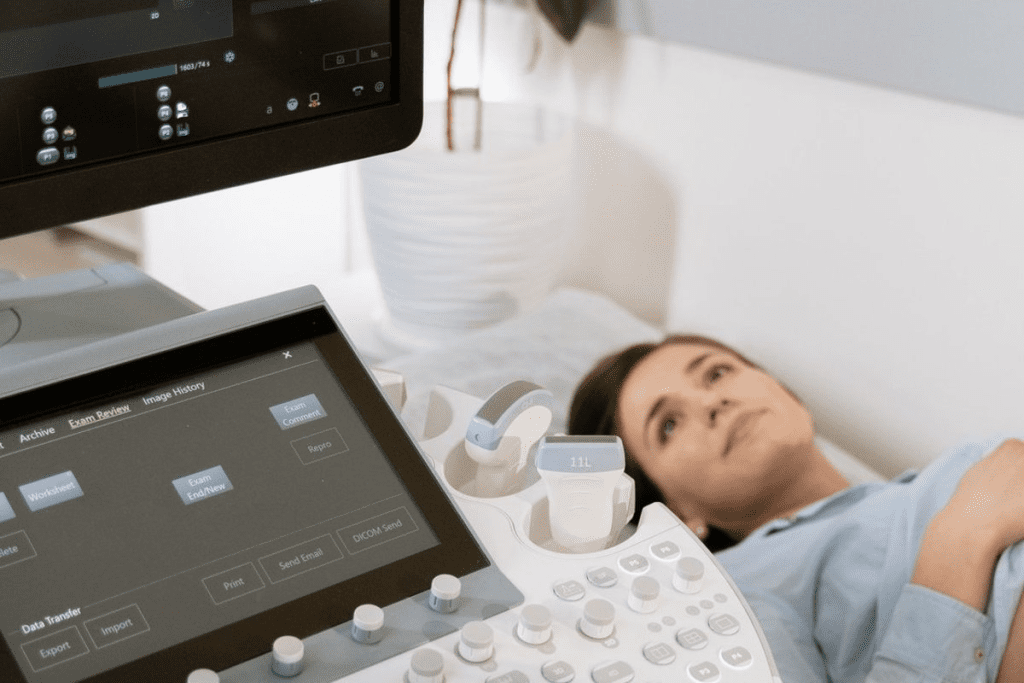
Ultrasound imaging is key in spotting ovarian cancer. It’s important to know what to look for. Ovarian cancer can show up in different ways on ultrasound, making it hard to diagnose but very important.
Characteristic Features of Malignant Masses
Malignant ovarian masses have specific signs on ultrasound. They often have complex cysts with solid parts, irregular shapes, and septations or papillary projections. Color Doppler ultrasound helps check blood flow, as cancerous tumors have more blood flow.
Ovarian Cyst vs. Ovarian Cancer Appearance
Telling apart benign ovarian cysts and ovarian cancer on ultrasound is vital. Benign cysts are usually simple, anechoic, and have smooth borders. Ovarian cancer looks like complex cysts with solid parts or solid masses. Knowing these differences helps spot suspicious signs.
Suspicious Findings That Warrant Further Investigation
Some ultrasound findings need more checking because they might be cancerous. These include masses with irregular shapes, those in both ovaries, or with ascites (fluid in the belly). Finding these signs means more tests are needed to figure out what they are.
| Ultrasound Feature | Benign Characteristics | Malignant Characteristics |
| Cyst Complexity | Simple, anechoic | Complex, with solid components |
| Borders | Smooth | Irregular |
| Vascularity | Low | Increased |
The Accuracy of Ovarian Cancer Ultrasound Detection
To understand how well ultrasound finds ovarian cancer, we look at its sensitivity, specificity, and who does the scan. How well ultrasound works depends on the person doing it and the tools they use.
Sensitivity and Specificity Rates
Ultrasound’s ability to spot ovarian cancer is pretty good. It can catch about 85% to 95% of cases. But, it might miss some. It’s also good at not saying there’s cancer when there isn’t, with a 80% to 90% success rate.
Being able to find cancer is key. And not saying there’s cancer when there isn’t helps avoid mistakes. Using both transvaginal and abdominal scans can make it even better.
Factors Affecting Ultrasound Accuracy
Several things can change how well ultrasound works. These include:
- Operator expertise: Who does the scan matters a lot. More experience means better results.
- Equipment quality: Better ultrasound machines give clearer pictures, leading to more accurate diagnoses.
- Patient factors: Things like body mass index (BMI) can affect how clear the scan is.
Interpreting Ultrasound Results: The Role of Expertise
Reading ultrasound results needs a lot of skill. Doctors must know the difference between normal and abnormal findings. Staying up-to-date with training is key for making accurate diagnoses. Using what the patient says along with the scan results makes it even more precise.
Limitations of Ultrasound in Detecting Ovarian Cancer

Ultrasound technology has made big strides, but it’s not perfect for finding ovarian cancer. It’s a key tool for doctors, but it has some big challenges.
Size and Location Constraints
One big problem is the size and where the tumor is. Small tumors or ones in hard-to-see spots are tough to spot with ultrasound.
Patient-Related Factors Affecting Visibility
Things like bowel gas or being overweight can mess with ultrasound views. These issues can make it tough to see what’s going on inside.
False Positives and False Negatives
Ultrasound can also give false readings. A false positive means more tests you don’t need, causing worry. A false negative means you might wait too long to get help.
| Limitation | Description | Impact |
| Size and Location | Difficulty detecting small or hard-to-reach tumors | Potential for missed diagnoses |
| Patient Factors | Bowel gas, obesity affecting image quality | Reduced accuracy |
| False Results | False positives and false negatives | Unnecessary stress or delayed treatment |
It’s key for doctors to know these limits. This helps them understand ultrasound results better and decide what to do next.
Comparing Ultrasound to Other Imaging Methods
Imaging is key in finding ovarian cancer. Ultrasound, CT scans, MRI, and PET scans each have their own strengths. Ultrasound is often the first choice, but other methods help give a full picture of the cancer.
Ultrasound vs. CT Scan for Ovarian Cancer
Ultrasound is usually the first go-to for ovarian cancer. It’s non-invasive and shows images in real-time. But, CT scans are used to see how far the cancer has spread and if it’s in the lymph nodes.
| Imaging Modality | Primary Use | Benefits |
| Ultrasound | Initial assessment | Non-invasive, real-time imaging |
| CT Scan | Assessing cancer spread | Detailed cross-sectional images, evaluates lymph node involvement |
Ultrasound vs. MRI for Ovarian Cancer
MRI gives high-resolution images and is great for complex ovarian masses. While ultrasound works for many first checks, MRI adds more detail when needed.
PET Scans and Nuclear Medicine Imaging
When Multiple Imaging Methods Are Needed
PET scans help find cancer that has come back or check how well treatment is working. Often, using more than one imaging method is needed to fully understand ovarian cancer.
The Diagnostic Process: Beyond Ultrasound
To diagnose ovarian cancer, doctors use imaging, blood tests, and clinical checks. Ultrasound gives first clues, but more tests are needed to confirm the cancer’s presence and spread.
The Role of Blood Tests (CA-125 and Other Biomarkers)
Blood tests are key in diagnosing ovarian cancer. The CA-125 test checks for a protein in the blood that can be high in cancer patients. But, high levels can also mean other health issues, like endometriosis or pregnancy.
So, the CA-125 test alone isn’t enough. It’s used with imaging and clinical checks to make a diagnosis.
Researchers are looking into other biomarkers like HE4 and OVA1. These might help doctors detect ovarian cancer more accurately. Using several biomarkers could make diagnosis better.
When Biopsy Is Necessary
Sometimes, a biopsy is needed to confirm ovarian cancer. This involves taking tissue from the ovary or nearby areas for lab tests. It’s key when tests and blood work don’t give clear results or to find out the cancer type.
Integrating Clinical Assessment with Imaging Findings
Doctors also look at a patient’s medical history, symptoms, and physical exam. They use this info with imaging and blood test results. This helps make sure the diagnosis is right and guides treatment.
By using all these methods, doctors can better diagnose ovarian cancer. They can then create treatment plans that fit each patient’s needs.
Ovarian Cancer Screening with Ultrasound
Ultrasound is key in finding ovarian cancer early. It’s a safe way to check for cancer without surgery. It looks at the shape of the ovaries and finds any cancer signs.
Current Guidelines for Average-Risk Women
Experts say most women don’t need regular tests for ovarian cancer. They think the risks of tests, like surgery, are too high. This is true for most women.
Recommendations for High-Risk Populations
Women with certain genes, like BRCA1 and BRCA2, should get checked. They might need an ultrasound every year. Their doctor will decide when to start.
Here’s a quick guide to screening:
| Risk Category | Recommended Screening | Frequency |
| Average Risk | Not Recommended | N/A |
| High Risk | Transvaginal Ultrasound | Annual |
The Controversy Around Population-Based Screening
There’s a big debate on screening everyone for ovarian cancer. Some think it could help find cancer early. Others worry about false alarms and harm from tests.
Key points in this debate are:
- How common ovarian cancer is in everyone
- How good screening tests are
- The good and bad of screening
This debate shows we need to tailor screening to each person. We should look at their risk and the latest research.
Early Detection Possibilities: Can Ultrasound Find Early-Stage Ovarian Cancer?
Early detection is key to improving ovarian cancer survival rates. Ultrasound is at the forefront of this effort. It can find ovarian cancer in its early stages, which can greatly improve treatment outcomes.
Success Rates for Stage I Detection
Studies show that ultrasound can effectively detect ovarian cancer at Stage I. This is when the disease is more treatable. The success rates have improved with new technology.
| Study | Success Rate for Stage I Detection |
| Study A | 85% |
| Study B | 92% |
Challenges in Identifying Early Disease
Despite progress, challenges remain in identifying early ovarian cancer. Tumor size, location, and patient-related variables can affect ultrasound accuracy.
Promising Developments in Early Detection Technology
Emerging technologies are making ultrasound better at detecting ovarian cancer early. These include new imaging techniques and AI-assisted diagnostic tools.
The future of ovarian cancer detection looks bright. Ongoing research and advancements in ultrasound technology are promising.
Conclusion: The Role of Ultrasound in Ovarian Cancer Care
Ultrasound is key in finding and managing ovarian cancer. It helps doctors see the ovaries clearly. This is important for spotting unusual growths and checking their details.
Even though ultrasound has its limits, it’s very important in treating ovarian cancer. It works best when used with other tests like blood work and physical exams. This makes finding ovarian cancer more accurate.
There are other ways to find ovarian cancer too. CT scans, MRI, and PET scans give more details. They help doctors understand how far the cancer has spread. This information helps decide the best treatment.
Ultrasound is just one part of a bigger plan to diagnose and treat ovarian cancer. Using ultrasound with other tests helps doctors find cancer better. It also helps them plan the best treatment for each patient.
FAQ
Can ultrasound detect ovarian cancer?
Yes, ultrasound is a key tool for finding ovarian problems, like cancer. It can spot signs of cancer and tell them apart from harmless cysts.
What are the characteristic features of ovarian cancer on ultrasound?
Cancerous masses show up as complex cysts with solid parts and irregular edges. They might be big, not round, and have fluid around them.
How accurate is ultrasound in detecting ovarian cancer?
Ultrasound’s accuracy varies based on several factors. These include the type of ultrasound, the operator’s skill, and the mass’s features. Transvaginal ultrasound is very good at finding ovarian cancer.
What are the limitations of ultrasound in detecting ovarian cancer?
Ultrasound can miss small tumors or those in hard-to-see spots. It’s also affected by patient factors and can sometimes give false results.
How does ultrasound compare to other imaging methods for ovarian cancer detection?
Ultrasound is often the first choice for finding ovarian cancer. But, other methods like CT scans, MRI, and PET scans might be used to check further or to see how far the cancer has spread.
Can ovarian cancer be detected at an early stage using ultrasound?
Ultrasound can find ovarian cancer early, but it’s hard to catch it before symptoms appear. Yet, some studies show it can spot stage I cancer in some cases.
What is the role of blood tests in ovarian cancer diagnosis?
Blood tests, like CA-125, help along with ultrasound to diagnose ovarian cancer. High CA-125 levels might mean cancer, but they can also be high in other conditions.
Are there any guidelines for ovarian cancer screening with ultrasound?
Guidelines say not to screen everyone for ovarian cancer with ultrasound. But, women at high risk might get regular ultrasound and CA-125 tests.
Can ultrasound alone confirm ovarian cancer?
No, ultrasound alone can’t confirm cancer. A diagnosis needs imaging, blood tests, and a doctor’s assessment, plus a biopsy to be sure.
What are the benefits of transvaginal ultrasound over abdominal ultrasound for ovarian cancer detection?
Transvaginal ultrasound gives clearer pictures of the ovaries and is better for spotting small tumors. It’s also more comfortable for some and can help guide procedures.
References
- National Cancer Institute. (2023). Ovarian, fallopian tube, and primary peritoneal cancer screening (PDQ ®)“Health professional version. https://www.cancer.gov/types/ovarian/hp/ovarian-screening-pdq
- Royal College of Obstetricians and Gynaecologists. (2022). Management of suspected ovarian masses in premenopausal women. https://www.rcog.org.uk/guidance/browse-all-guidance/green-top-guidelines/management-of-suspected-ovarian-masses-in-premenopausal-women-green-top-guideline-no-62/