Every year, over 1.8 million new cancer cases are found worldwide. Lymph node metastasis is key in cancer staging and treatment planning. Cancerous lymph nodes can greatly affect patient outcomes, making it important to detect them accurately.
We use PET scans to see metabolic activity in the body. This helps find cancerous cells in lymph nodes. This technology is essential for diagnosing and staging different cancers.
Understanding how PET scans work is key. They help us see cancerous lymph nodes better. This is important for cancer diagnosis and treatment.
Key Takeaways
- PET scans are key for finding cancerous lymph nodes.
- The technology uses a radioactive tracer to see metabolic activity.
- Cancerous lymph nodes can greatly affect cancer staging and treatment.
- Finding lymph node metastasis accurately is vital for patient outcomes.
- PET scans play a big role in diagnosing and staging various cancers.
Understanding PET Scan Technology
PET scans are advanced tools that use radioactive tracers to see how the body works. They are key in modern medicine, mainly in fighting cancer.
What is a PET Scan?
A PET scan is a test that shows how your body’s tissues and organs work. It uses a special drug that lights up on the scan. PET scans are great for finding cancer because they spot areas that are very active, which often means cancer.
How PET Scans Work
Getting a PET scan involves a few steps. First, a special drug, like fluorodeoxyglucose (FDG), is given. This drug goes to places in the body that are very active, like cancer. Then, the PET scanner picks up signals from this drug, making detailed pictures of how the body works.
Radioactive Tracers in PET Imaging
Radioactive tracers are key in PET scans. They go to certain parts of the body based on their design. For example, FDG goes to cells that use a lot of sugar, which is a sign of cancer.
| Tracer | Application | Characteristics |
| Fluorodeoxyglucose (FDG) | Cancer detection, assessing metabolic activity | Accumulates in areas of high glucose metabolism |
| Fluorodopa | Neuroendocrine tumors, brain disorders | Assesses dopamine metabolism |
| Flutemetamol | Alzheimer’s disease diagnosis | Binds to amyloid plaques in the brain |
Knowing how PET scans work and the role of radioactive tracers helps us see their power. They are vital in finding and treating many health issues, like cancer.
PET Scan Detection of Cancerous Lymph Nodes
PET scans are great at showing where cancerous lymph nodes are. They do this by highlighting areas with high activity. This helps doctors know how far the cancer has spread and plan treatment.
Mechanism of Cancer Detection
PET scans use special tracers to find cancerous lymph nodes. These tracers, like Fluorodeoxyglucose (FDG), stick to cancer cells. This makes cancer cells show up on the scan.
Glucose Metabolism in Cancer Cells
Cancer cells use more glucose than normal cells because they grow fast. PET scans spot this by using FDG. They find areas where glucose is being used a lot, which means cancer is present.
SUV Values and Their Significance
The Standardized Uptake Value (SUV) shows how much FDG is taken up by tissues. Higher SUV values mean the cancer is more aggressive. Knowing SUV values helps doctors understand PET scan results and plan treatments.
To understand SUV values better, let’s look at a table:
| SUV Value Range | Interpretation |
| 0-2.5 | Typically considered normal or benign |
| 2.5-4.0 | May indicate low-grade malignancy or inflammation |
| >4.0 | Often associated with high-grade malignancy |
PET scans are key in finding cancerous lymph nodes. They do this by looking at how cells use glucose and SUV values. This helps doctors diagnose and treat cancer more accurately.
Accuracy of PET Scans for Lymph Node Assessment
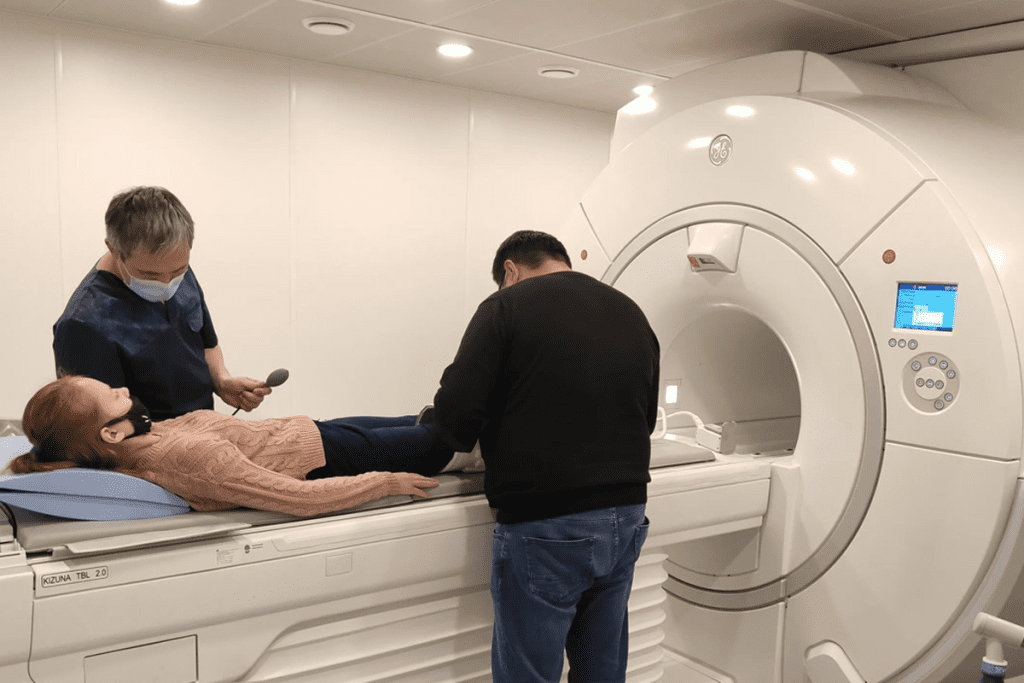
PET scans are very good at finding cancer in lymph nodes. But, their results can be affected by the size of the nodes and if they are inflamed. Knowing this helps doctors understand PET scan results better.
Sensitivity and Specificity Rates
PET scans are great at spotting cancer in lymph nodes. They are good at finding true positives. But, they can sometimes miss true negatives. Studies show sensitivity rates between 80% to 90%. Specificity rates are a bit lower, from 70% to 85%. This means PET scans are very useful but should be looked at with other tests too.
Factors Affecting Accuracy
Many things can change how accurate PET scans are. For example, smaller lymph nodes are harder to find. Also, inflammation can lead to false positives because it also increases glucose metabolism. Doctors need to think about these things when they look at PET scan results.
“The accuracy of PET/CT in detecting lymph node metastases is influenced by the size of the lymph nodes and the presence of inflammatory changes.” A Nuclear Medicine Specialist
Size Limitations in Detection
The size of lymph nodes is key for PET scans to detect cancer. They can miss nodes smaller than 5-7 mm. New technologies like PET-CT or PET-MRI help a bit, but size is a big problem. This shows why doctors use PET scans with other tests for a full picture.
Knowing how accurate PET scans are helps doctors make better choices for patients. This knowledge also helps set patient expectations and plan next steps.
PET Scan vs. Other Imaging Techniques
PET scans are special because they can spot cancer cells that are active. They are different from CT scans and MRI because they show how tissues work, not just what they look like. This makes PET scans great for finding cancer early.
Comparison with CT Scans
CT scans are good at showing the body’s structure. But they don’t show how active tissues are. PET scans, on the other hand, find areas that are very active, which is often a sign of cancer. When you use PET and CT together, you get the best of both worlds.
Here’s a comparison of PET and CT scans:
| Imaging Modality | Primary Focus | Strengths |
| PET Scan | Metabolic Activity | Detects cancerous cells based on metabolic activity |
| CT Scan | Anatomical Detail | Provides detailed structural images |
Comparison with MRI
MRI is great for soft tissue contrast, which helps in some cancer diagnoses. But it mainly looks at body structure. PET scans, though, show how tissues work, which is key in finding cancer in lymph nodes.
PET scans have some big advantages over MRI:
- They can find cancer cells that are active
- They can scan the whole body
- They help see how well treatments are working
Benefits of PET/CT Fusion Imaging
PET/CT fusion imaging combines PET’s function with CT’s structure. This mix makes diagnosis more accurate. It helps pinpoint where cancer is and guides treatment plans.
This fusion of PET and CT images helps us understand disease better. It’s a key tool in fighting cancer today.
Preparing for a Lymph Node PET Scan
To get the best results from your lymph node PET scan, you need to prepare well. We know it might seem tough, but with the right help, you’ll feel ready.
Pre-Scan Instructions
We’ll give you clear instructions before your PET scan. You’ll need to arrive at least 60 minutes early to fill out paperwork and get ready. Make sure to wear comfy clothes and avoid anything with metal, as it could mess with the scan.
Dietary Restrictions
Your diet is important when preparing for a PET scan. Try to avoid sugary foods and drinks for 24 hours before. On the day of the scan, fast for 4-6 hours, but you can drink water.
Medication Considerations
Some medicines can affect your PET scan results. Tell your doctor about all your meds, including supplements and vitamins. They’ll tell you if you need to change or stop any before the scan.
By following these steps, you’ll make sure your PET scan is accurate. If you’re unsure or have questions, always ask your healthcare team for help.
The PET Scan Procedure for Lymph Node Assessment
Getting a PET scan for lymph nodes is easy when you’re ready. It might seem scary, but knowing what to expect helps a lot.
What to Expect During the Scan
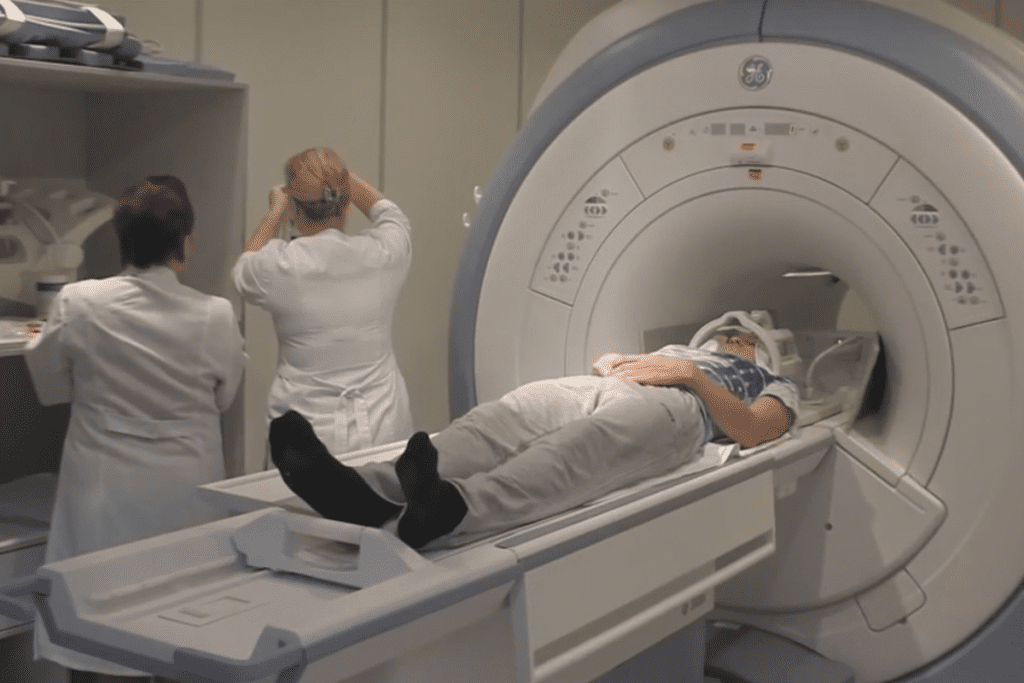
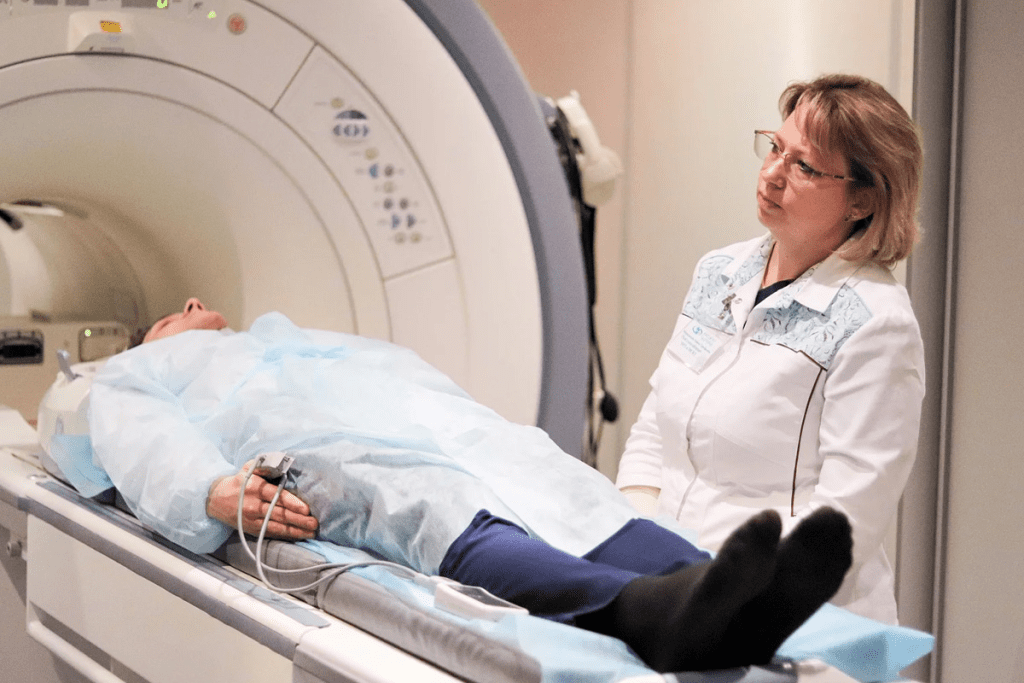
You’ll lie on a table that slides into a big, doughnut-shaped scanner. The scan is painless and you can breathe freely. Our team will make sure you’re in the right spot for the best images.
The PET scan uses a tiny bit of radioactive tracer to show active areas in your body. This tracer goes through an IV line. You’ll wait a bit for it to spread before the scan starts.
Duration and Positioning
A PET scan usually takes 30 to 60 minutes. You must stay very quiet to get clear images. Our team will tell you all about how to get ready and what to do during the scan.
Getting in the right position is key for good images. You’ll be placed on the table to capture the needed views of your lymph nodes. Sometimes, you might need to change positions to get all the necessary shots.
Post-Scan Care
Once the scan is done, you can go back to your usual activities unless your doctor says not to. The tracer leaves your body in a few hours. You’ll be told how to avoid exposing others, like pregnant women and kids, to radiation.
Our team will give you instructions for after the scan to help you recover well. It’s a good idea to have someone with you for the scan and to drive you home. You might feel a bit tired or need help.
Interpreting PET Scan Results for Lymph Nodes
PET scan results give us important clues about cancer, like if it’s in the lymph nodes. When we look at these results, we consider a few key things.
Understanding SUV Readings
The Standardized Uptake Value (SUV) is a key part of PET scan results. It shows how much of the radioactive tracer is taken up by tissues. This helps find areas that are very active, which might mean cancer. SUV readings above a certain level might show cancerous activity, but we must look at the whole picture.
An SUV value of 2.5 or more is often seen as important. But, how we see SUV values can change based on the cancer type, the patient’s health, and the PET scan technology used.
Hot Spots and Their Significance
“Hot spots” on a PET scan show up as areas with more tracer uptake, meaning they’re more active. These spots can help find cancer and check on lymph nodes. Not every hot spot is cancer; some might be from inflammation or other non-cancerous reasons.
To understand hot spots, doctors look at how active they are, where they are, and the patient’s overall health. It’s important to carefully check these spots to tell if they’re cancerous or not.
False Positives and Negatives
False positives happen when a PET scan says there’s cancer in a lymph node that’s not. False negatives occur when it misses cancer. Knowing about these false results is key for correct diagnosis.
- False positives can be caused by inflammation, infection, or some non-cancerous conditions.
- False negatives might be due to small tumors, low-grade cancers, or the PET scan’s limits.
To deal with these problems, doctors often use PET scans along with other tools like CT scans or MRI. They also look at the patient’s symptoms. This way, they can make sure the diagnosis is right and plan the best treatment.
PET Scans in Lymphoma Diagnosis and Staging
We use PET scans to diagnose and stage lymphoma. They help us plan treatment accurately. PET scans are key in finding both Hodgkin and non-Hodgkin lymphoma. They give doctors the info they need.
Role in Hodgkin Lymphoma Detection
Hodgkin lymphoma affects the lymphatic system. PET scans are great at finding Hodgkin lymphoma. They show where cancer cells are by highlighting active areas.
PET scans are very good at finding Hodgkin lymphoma. This helps doctors stage the disease and plan treatment.
“PET scans have become an essential tool in the management of Hodgkin lymphoma, providing valuable information on disease extent and response to treatment.” – NCCN Guidelines
Assessment of Non-Hodgkin Lymphoma
Non-Hodgkin lymphoma is a group of cancers. PET scans help see how far the disease has spread. This helps doctors plan the right treatment.
The sensitivity of PET scans varies with the type and aggressiveness of non-Hodgkin lymphoma.
| Lymphoma Type | PET Scan Sensitivity | Clinical Utility |
| Hodgkin Lymphoma | High | Accurate staging and assessment |
| Aggressive Non-Hodgkin Lymphoma | High | Effective in detecting disease extent |
| Indolent Non-Hodgkin Lymphoma | Variable | Useful for assessing treatment response |
Deauville Criteria for Response Assessment
The Deauville criteria help evaluate how well lymphoma treatment is working. This system looks at the remaining activity in lymphoma sites after treatment. It compares this to liver and mediastinum activity.
The Deauville score ranges from 1 to 5. Scores 1-3 mean the treatment is working well. Scores 4 or 5 suggest there might be more disease, needing more treatment.
PET Imaging for Breast Cancer Lymph Node Metastasis
PET imaging is playing a big role in checking axillary lymph nodes for breast cancer spread. This is changing how we stage and treat breast cancer thanks to new PET technology.
Axillary Lymph Node Evaluation
PET imaging is a key tool for checking axillary lymph nodes in breast cancer patients. It spots cancer by looking at glucose metabolism. This is key for accurate staging.
Research shows PET imaging is very good at finding lymph node metastasis. This might mean fewer invasive surgeries like axillary lymph node dissection.
Impact on Surgical Planning
PET imaging changes how surgeons plan surgery for breast cancer patients. It helps them know how much surgery is needed.
This leads to more tailored treatment plans. It might mean less lymph node removal, which lowers the risk of complications like lymphedema.
| Surgical Planning Aspect | Impact of PET Imaging |
| Extent of Lymph Node Removal | More accurate assessment reduces unnecessary removal |
| Treatment Personalization | Tailored surgical plans based on lymph node involvement |
| Risk of Complications | Reduced risk of lymphedema due to less invasive procedures |
Comparison with Sentinel Node Biopsy
Sentinel node biopsy is a common way to check axillary lymph nodes in breast cancer. But PET imaging is a non-invasive option that can give similar info in some cases.
Sentinel node biopsy is very accurate. But PET imaging is great for patients who can’t have invasive procedures or need a wider look at lymph nodes.
Using PET imaging with other tools can make lymph node assessment more accurate. This might mean we don’t need sentinel node biopsy as much in some cases.
PET Scans for Head and Neck Cancer Nodal Involvement
PET scans have changed how we check for cancer in the head and neck. They help doctors plan the best treatment and care for patients.
Cervical Lymph Node Assessment
Checking cervical lymph nodes is key in staging head and neck cancer. PET scans are very good at finding cancer in these nodes, even if they’re not big. This is important because cancer in lymph nodes can change treatment plans and how well a patient will do.
Research shows PET scans can find cancer in lymph nodes very accurately. This helps doctors:
- See how far the cancer has spread
- Plan the right treatment, like surgery or radiation
- Check if treatment is working
Detection of Occult Metastases
PET scans are great at finding cancer that’s not seen on other scans. This is very helpful in head and neck cancer. Finding hidden cancer can change treatment plans and help patients do better.
Experts say, “Using PET scans in diagnosing head and neck cancer has made finding cancer in lymph nodes better. This leads to more accurate treatment plans.”
Treatment Planning Applications
PET scans play a big role in planning treatment for head and neck cancer patients. They help doctors know how much cancer is in lymph nodes. This lets them tailor treatments to each patient, which can lead to better results.
Here are some ways PET scans help in treatment planning:
- Helping plan radiation therapy by finding active tumor sites
- Guiding surgery on lymph nodes
- Watching how well chemotherapy and other treatments work
By using PET scans, doctors can give patients more personalized and effective care for head and neck cancer.
Lung Cancer Lymphatic Spread Detection with PET
PET scans are key in finding where lung cancer spreads, like to lymph nodes in the chest. This helps doctors know how far the cancer has spread. It’s a big help in deciding how to treat the cancer.
Mediastinal Lymph Node Evaluation
The lymph nodes in the chest are often where lung cancer spreads. PET scans are very good at checking these nodes. They show if the nodes are active, which helps doctors tell if the cancer is there.
PET scans are very good at finding cancer in these nodes. This helps doctors plan the best treatment. It could be surgery, chemo, or radiation.
Impact on Staging and Treatment
What PET scans find about cancer spread affects how doctors stage and treat it. Getting the staging right is key to knowing how to treat. It helps doctors choose the best treatment for each patient.
Often, what PET scans find changes how doctors plan to treat a patient. This makes treatment more personal and can improve how well patients do.
Limitations in Small Cell Lung Cancer
PET scans are helpful for lung cancer that’s not small cell, but they have limits with small cell lung cancer (SCLC). SCLC is usually staged as either limited or extensive. PET scans can help, but it’s hard to tell cancer from normal cells in SCLC.
Even with these challenges, PET scans are important for SCLC. They help see how well treatment is working and if cancer comes back. We’re always looking for ways to use PET scans better in SCLC to help patients more.
PET Scan Limitations in Lymph Node Cancer Detection
PET scans are useful but have some big limitations. These issues are important for both patients and doctors to know when looking at scan results.
Challenges Related to Size Thresholds
PET scans have a size threshold problem. They can’t always spot cancer in tiny lymph nodes. This is because their technology isn’t that precise. Lymph nodes under 5-7 mm might not show up right.
This size issue can cause problems when figuring out how far cancer has spread. Sometimes, we need more tests or biopsies to be sure about small lymph nodes.
Inflammatory Conditions and False Positives
PET scans can also give false positives because of inflammation. Swelling in lymph nodes can make them look like cancer on a scan. This can cause a lot of worry and extra tests.
- Infections
- Autoimmune diseases
- Granulomatous diseases
These issues can make lymph nodes seem active, even if they’re not cancer. Doctors must look at the whole picture, not just the scan, to make sure they’re right.
Difficulties in Detecting Low-Grade Malignancies
PET scans also struggle with low-grade malignancies. Some cancers don’t show up well because they don’t use much glucose. This is a big problem for certain cancers.
We have to know these limits when using PET scans. Sometimes, we need other tests or to watch closely for changes.
In short, PET scans are very helpful but we must understand their limits. Knowing these helps us use them better in treating cancer.
Patient Safety and Radiation Exposure
When we use PET scans to check cancerous lymph nodes, we must think about radiation exposure. PET scans use small amounts of radioactive tracers to see cancer. They are very helpful for diagnosis but do involve some radiation.
Radiation Dose from PET Scans
The radiation from a PET scan is considered low. But, it’s important to remember that any radiation carries some risk. A typical PET scan’s radiation dose is about 7-10 millisieverts (mSv).
This dose is similar to what you’d get from a CT scan of your chest or abdomen. To understand it better, the average yearly background radiation in the U.S. is 3.1 mSv. So, a PET scan’s dose is like 2-3 years of natural background radiation.
| Procedure | Typical Radiation Dose (mSv) |
| PET Scan | 7-10 |
| CT Scan (Chest/Abdomen) | 8-18 |
| Annual Background Radiation | 3.1 |
Risk-Benefit Analysis
When thinking about a PET scan, we must balance its benefits against the risks of radiation. For most, the benefits of detecting and staging cancer with PET scans are worth the risks.
“The use of PET scans has revolutionized the field of oncology, enabling more accurate diagnosis and staging of cancer, which in turn facilitates more effective treatment planning.” -An Oncologist
Special Considerations for Certain Patients
Some patients need extra care when getting PET scans. Pregnant women and children are more at risk because their bodies are more sensitive to radiation.
For these groups, doctors might use other imaging methods or adjust PET scan protocols to lower radiation exposure. This way, they can get the needed information safely.
By carefully deciding when to use PET scans and trying to reduce radiation, we can protect patients. This ensures they get the benefits of the scans while staying safe.
Advanced PET Technologies for Improved Lymph Node Assessment
Advanced PET technologies are making it easier to find and understand cancer. They help doctors see cancer in lymph nodes better. This is a big step in fighting cancer, giving doctors better tools for treatment.
Time-of-Flight PET
Time-of-flight (TOF) PET is a big step up in PET tech. It measures how long it takes for gamma photons to arrive. This makes tracer uptake more accurate, improving images and confidence in diagnosis.
TOF PET is great for people with bigger bodies. It keeps image quality high.
Digital PET Systems
Digital PET systems are another big improvement. They turn signals to digital right away. This boosts spatial resolution and sensitivity, spotting small lesions and lymph nodes better.
Digital PET scans faster and might use less radioactive tracers.
Novel Radioactive Tracers
New radioactive tracers are changing PET imaging. Tracers like Ga-PSMA for prostate cancer and F-FDG for many cancers help see lymph nodes well. New tracers are being made to target cancer in new ways, making diagnosis and treatment better.
These advanced PET technologies are changing how we fight cancer. They help doctors diagnose and treat cancer more accurately. As these technologies get better, we’ll see even better results for patients.
Future Developments in PET Imaging for Cancer Detection
PET imaging is changing fast. It’s getting better with artificial intelligence and targeted molecular imaging. These changes will make finding and treating cancer much better.
Artificial Intelligence Integration
AI is making PET imaging even more accurate. AI can look at PET scan data in ways humans can’t. It finds patterns that might be missed.
AI in PET imaging brings many benefits:
- It spots small tumors better
- It’s more accurate in reading PET scans
- It makes radiologists’ work easier
Targeted Molecular Imaging
Targeted molecular imaging is another big step in PET technology. It uses special tracers to find cancer cells. These tracers are made to match cancer’s unique signs.
Targeted molecular imaging has many advantages:
| Feature | Benefit |
| Specificity | It finds cancer cells that are similar |
| Sensitivity | It can find cancer early |
| Personalization | It helps make treatment plans that fit each person |
Theranostic Applications
Theranostics combines treatment and diagnosis. PET imaging is perfect for this. It helps find the right treatment for each patient and checks if it’s working.
We’re on the edge of a new time in fighting cancer. Thanks to PET imaging’s growth, we’ll see big improvements in how we diagnose and treat cancer.
Conclusion: The Value of PET Scans in Lymph Node Cancer Detection
PET scans are a key tool in finding cancer in lymph nodes. They help a lot in diagnosing and understanding cancer. We’ve looked at how PET scans work, their accuracy, and their use in different cancers.
PET scans spot cancerous lymph nodes by seeing how active cancer cells are. This is because cancer cells use more energy than normal cells. This makes it easier to find cancer, even if it’s small. We’ve also seen how PET scans are better than CT and MRI scans for planning treatment.
In short, PET scans are very good at finding cancer in lymph nodes. They give detailed information and help doctors decide on the best treatment. As PET technology gets better, we’ll see even more progress in fighting cancer.
FAQ
What is a PET scan and how does it work?
A PET (Positron Emission Tomography) scan is a medical test. It uses a radioactive tracer to see how active cells are in the body. This helps find cancer cells.
The tracer goes to areas with lots of activity, like cancer. This lets doctors spot cancerous lymph nodes
How do PET scans detect cancerous lymph nodes?
PET scans find cancerous lymph nodes by looking at how cells use glucose. Cancer cells use more glucose, so they take up more of the tracer.This shows up on the scan, helping doctors find cancer.
What are SUV values, and what is their significance in PET scans?
SUV (Standardized Uptake Value) shows how much tracer a cell takes in. It helps doctors see how serious the cancer is. Higher SUV values mean more aggressive cancer.
How accurate are PET scans in assessing lymph nodes?
PET scans are good at finding cancerous lymph nodes. But, how well they work can depend on the size of the nodes and if there’s inflammation. They’re very sensitive but can sometimes show false positives.
What are the benefits of combining PET with CT (PET/CT fusion)?
PET/CT fusion combines metabolic info from PET scans with CT scan details. This gives a clearer picture of cancer spread to lymph nodes.
How should I prepare for a PET scan?
To prepare for a PET scan, you might need to fast and avoid certain meds. Your doctor will give you specific instructions. This ensures the scan is accurate.
What can I expect during a PET scan procedure?
During a PET scan, you’ll lie on a table and stay very quiet. The scan time and position might change based on what’s being scanned.
How are PET scan results interpreted, specially regarding lymph nodes?
PET scan results are checked by looking at SUV values and finding “hot spots.” But, it’s important to remember that these results can sometimes be wrong. Doctors need to look at the whole picture to make a correct diagnosis.
What is the role of PET scans in lymphoma diagnosis and staging?
PET scans are key in diagnosing and staging lymphoma. They help see how far the disease has spread to lymph nodes. The Deauville criteria help assess how well treatment is working.
Are there any limitations to using PET scans for detecting lymph node cancer?
Yes, PET scans have some limits. They can struggle with small nodes, show false positives, and miss low-grade cancers. Knowing these limits helps doctors understand the results better.
What are the patient safety considerations related to PET scans?
PET scans involve some radiation, so safety is important. Doctors weigh the benefits against the risks. Pregnant women and children need extra care to avoid harm.
What advancements have been made in PET technology for lymph node assessment?
New tech includes time-of-flight PET, digital systems, and new tracers. These advancements improve image quality and help find cancerous lymph nodes better.
What future developments are expected in PET imaging for cancer detection?
Future trends include using artificial intelligence and new molecular imaging. These could lead to better detection and treatment of cancerous lymph nodes.
References
- Kim, S. J., et al. (2019). Diagnostic accuracy of F-18 FDG PET or PET/CT for detection of lymph node metastasis in clinically node-negative head and neck squamous cell carcinoma: A systematic review and meta-analysis. American Journal of Otolaryngology, 40(2), 297“305. https://pubmed.ncbi.nlm.nih.gov/30473166/