Last Updated on November 27, 2025 by Bilal Hasdemir
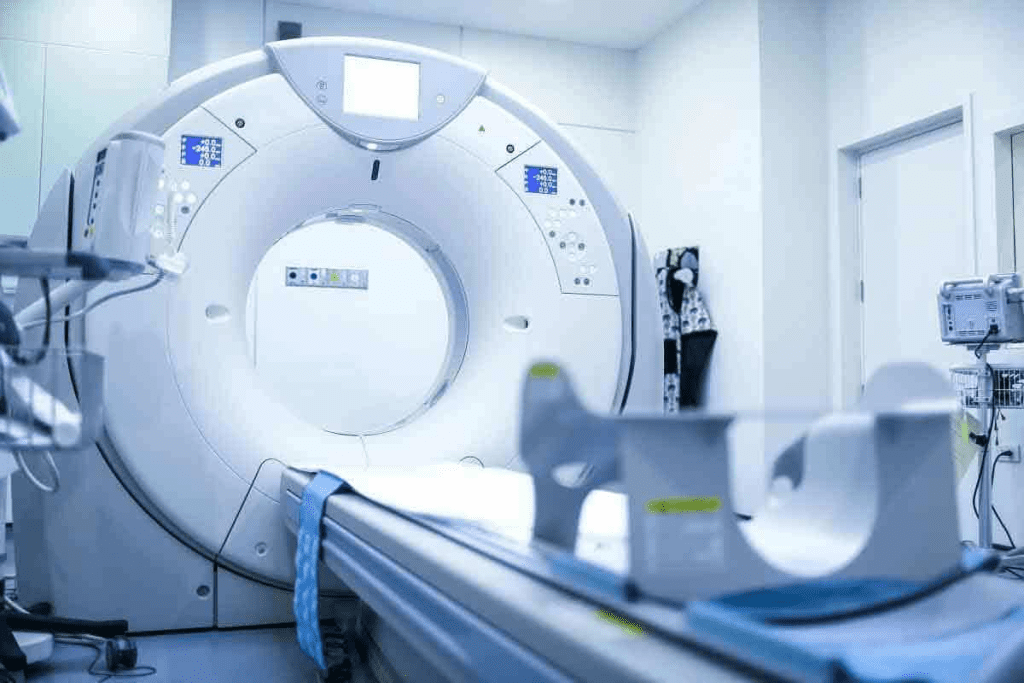
Computed Tomography (CT) scans are a key medical imaging tool. They show detailed pictures of what’s inside our bodies. CT scanners use X-rays to make these images. They help doctors see inside us to diagnose and treat diseases.
The process starts with a moving X-ray tube and detector arrays. They measure how X-rays pass through different tissues. Then, special algorithms turn these measurements into clear images. Want to see a picture of CT scan machine? Get an essential guide explaining the computed tomography technology and how it functions.
Liv Hospital focuses on patient care and new technology. They make sure CT scans are accurate and reliable for everyone.
Key Takeaways
- CT scans use X-rays to create detailed images of internal organs and structures.
- The technology involves a rotating X-ray tube and detector arrays.
- Tomographic reconstruction algorithms process the X-ray measurements to produce images.
- Liv Hospital ensures high standards in computed tomography for accurate diagnosis.
- CT scans are critical for diagnosing and planning treatments.
The Evolution of Computed Tomography in Medical Imaging
Medical imaging has seen a big change with Computed Tomography technology. This change has made CT scans a key tool in modern medicine.
From Conventional X-rays to Tomography X-ray Technology
Old X-rays were good but had limits. Tomography X-ray technology brought a big leap. It allowed for detailed cross-section images that X-rays couldn’t.
This move to tomography X-ray was a big step forward. It helped doctors see inside the body better. This made diagnoses more accurate.
Historical Development of CT Systems
The first CT scanner came out in the early 1970s. Godfrey Hounsfield and Allan McLeod Cormack created it. They won the Nobel Prize for it.
CT technology has grown a lot over the years. We’ve seen spiral CT and multi-slice CT. These updates have made CT scans essential for many medical checks.
The Complete Picture of a CT Scan Machine: Components and Design
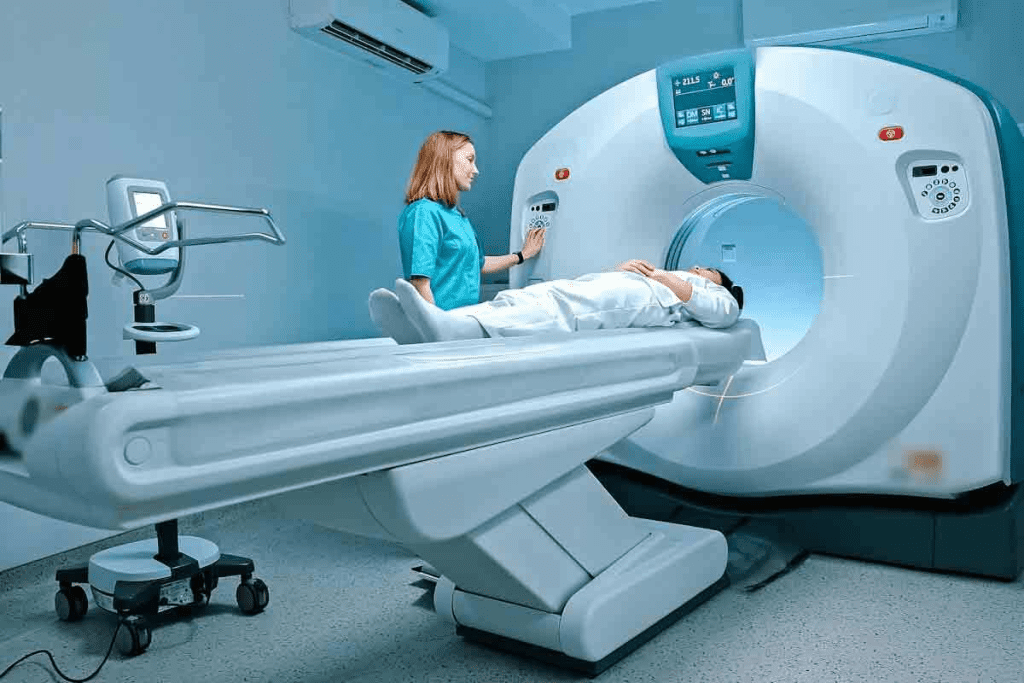
Understanding a CT scan machine’s parts and design is key to seeing its importance in medical imaging. This device uses several important parts to create detailed images inside the body.
The Gantry: Housing the Core Components
The gantry is a vital part of the CT scan machine. It holds the X-ray tube, detector arrays, and other key parts. It moves around the patient, taking pictures from different angles. The gantry’s stability and precision are vital for ensuring high-quality images. As one expert notes, “The gantry’s mechanical accuracy directly impacts the resolution of the CT images.”
X-ray Tube and Generator System
The X-ray tube makes the X-rays that go through the patient’s body. The generator system powers the X-ray tube, giving it the energy needed to create images. The quality of the X-ray beam is critical for clear, diagnostic images.
Detector Arrays and Data Acquisition Systems
Detector arrays catch the X-rays that go through the patient’s body, turning them into electrical signals. These signals are then processed by the data acquisition system, which is key to making images. Advances in detector technology have greatly improved CT image quality.
Patient Table and Positioning Mechanism
The patient table moves smoothly through the gantry, keeping the patient in the right spot during the scan. The positioning mechanism helps align the patient precisely, which is essential for accurate images. Proper patient positioning is critical for getting diagnostic-quality images.
“The design of modern CT scan machines has evolved to prioritize patient comfort and safety, while maintaining the highest standards of image quality.”
Fundamental Principles of Computed Tomography Technology
Knowing the basics of X-ray absorption is key to understanding CT technology. CT scans use the fact that different tissues absorb X-rays at different rates. This allows for detailed images of cross-sections of the body.
X-ray Attenuation and Tissue Density Measurement
X-ray attenuation is when X-rays lose intensity as they go through the body. This happens because of absorption and scattering by tissues. The amount of absorption depends on the tissue’s density and the X-ray’s energy. Denser materials like bone absorb more X-rays, causing higher attenuation. Softer tissues absorb fewer X-rays, leading to lower attenuation.
Measuring X-ray attenuation is vital for CT technology. By quantifying the X-ray absorption through different tissues, CT scans can distinguish various tissues and structures. Detectors measure the X-ray intensity after it goes through the patient.
Computerized Tomography: Definition and Basic Physics
Computerized tomography is a medical imaging method that uses computer-processed X-rays to create detailed images of body parts. The basic physics of CT scans involves rotating an X-ray source and detectors around the patient. They capture data from many angles. Then, computer algorithms reconstruct this data into images.
- The X-ray tube emits X-rays that pass through the patient’s body.
- Detectors capture the X-rays that are not absorbed by the body.
- Data acquisition systems record the attenuation data from multiple angles.
- Reconstruction algorithms process the data to create detailed images.
Hounsfield Units and CT Number Scale
The Hounsfield unit (HU) scale is a standard measure in CT scans. It shows how much X-rays are absorbed by tissues compared to water. Water is 0 HU, and air is around -1000 HU. This scale helps differentiate tissues based on their absorption. For example, bone has a high HU value because it’s dense, while fat has a lower value.
- Bone: +1000 HU or more
- Soft tissue: +40 to +80 HU
- Water: 0 HU
- Fat: -60 to -100 HU
- Air: -1000 HU
Understanding Hounsfield units is key to interpreting CT images. They give quantitative information about tissue composition and any abnormalities.
How a CT Scan is Performed: The Complete Process
A CT scan uses advanced technology and careful preparation. It’s key for diagnosing many health issues. Knowing the process can make patients feel less anxious.
Patient Preparation and Positioning Protocols
Before the scan, patients must prepare. They might remove jewelry, wear loose clothes, and drink a contrast agent. Then, they lie on a table that slides into a big, doughnut-shaped machine.
Proper positioning is critical for clear images. The radiologic technologist will guide the patient. They’ll tell you to stay very quiet during the scan.
Data Acquisition During Scanning
The table moves into the machine, and the X-ray tube starts to rotate. It sends out X-rays that detectors catch. This captures detailed data from all sides.
The scan’s length varies by type and body area. Modern scanners can finish quickly, in just a few minutes.
Image Processing and Reconstruction Techniques
After the scan, the data is processed into detailed images. These images can be viewed in different ways and even in 3D. This gives a full view of the body’s structures.
Advanced image processing techniques improve image quality. They help doctors see specific areas better. The images are then used to diagnose, plan treatments, or track disease progress.
Inside the CT Scanning Equipment: Technical Operation
CT scanning equipment works through a mix of hardware and software. The quality of the images it makes depends on how well each part works.
X-ray Beam Collimation and Slice Thickness
X-ray beam collimation is key in CT scanning. It controls the X-ray beam’s thickness and the image slice thickness. Precise collimation helps focus the X-ray beam, reducing radiation exposure.
The slice thickness is important for image quality. Thinner slices offer more detail but may need more time and radiation.
CT Detector Technology and Configuration
CT detector technology has improved a lot. Modern scanners use advanced detector arrays. These detectors turn X-ray energy into electrical signals for image creation.
The way detectors are set up affects scanner performance. Multi-slice CT scanners use many detectors at once. This makes scanning faster and more efficient.
Rotation Mechanisms and Scan Modes
The rotation mechanism moves the X-ray tube and detectors around the patient. Modern scanners use continuous rotation for quicker scans and better images.
Scan modes like axial and helical scanning offer flexibility. Helical scanning creates 3D images from volumetric data.
Computing Systems and Image Processing
The computing systems of a CT scanner are essential for image processing. Advanced algorithms and strong computing hardware quickly create high-quality images.
Image processing techniques like filtering improve image quality. These systems also handle image storage and transfer, making it easy to share with other systems.
Types of CT Scanning Techniques and Protocols
CT scanning techniques have grown, providing many protocols for various needs. These advancements in CT technology have led to better images, quicker scans, and more comfort for patients.
Spiral/Helical CT Scanning Methodology
Spiral or helical CT scanning is a big step forward in CT technology. It’s different from old methods because it keeps moving while scanning. This means faster scans and clearer images.
This method also lets us get volumetric data. This means we can make images in many planes.
The benefits of spiral CT include:
- Quicker scans, helping more patients
- Better image quality from continuous scanning
- It finds small problems and blood vessels better
Multi-Slice CT Technology Evolution
Multi-slice CT technology has changed CT scanning a lot. It uses multiple detector rows to scan more at once. This makes complex studies faster and clearer.
The growth of multi-slice CT has brought:
- More detector rows for better coverage and detail
- Quicker scans, less motion blur
- It’s better for heart imaging
Dual-Energy and Spectral CT Imaging
Dual-energy CT (DECT) and spectral CT imaging are the newest in CT tech. They scan at multiple energy levels, giving more info on tissue. DECT helps tell materials apart, making diagnoses more accurate.
The perks of DECT and spectral CT include:
- It’s better at identifying kidney stones and other materials
- It shows contrast agents clearly
- It can tell different tissues apart better
In summary, today’s CT scanning techniques and protocols have greatly improved diagnostics. From spiral and multi-slice CT to dual-energy and spectral imaging, each has its own benefits for different needs.
Advanced Computed Tomography System Innovations
The world of computed tomography (CT) technology is changing fast. New innovations are making images clearer and safer for patients. These changes are helping doctors diagnose and treat diseases better.
High-Resolution Detector Systems
High-resolution detector systems are a big step forward in CT technology. These detectors help capture detailed images inside the body. High-resolution detectors make it easier to see small details and complex structures.
“The introduction of high-resolution detectors has been a game-changer in CT imaging,” says a radiologist at a leading medical institution. “It has significantly enhanced our ability to detect and diagnose conditions at an early stage.”
Dose Reduction Technologies
CT technology has also seen advancements in dose reduction. These innovations aim to lower radiation exposure while keeping image quality high. Iterative reconstruction and automatic exposure control are key techniques.
- Iterative Reconstruction: Improves image quality at lower doses
- Automatic Exposure Control: Adjusts radiation dose based on patient size and anatomy
- Spectral Imaging: Enhances tissue characterization and reduces the need for multiple scans
Artificial Intelligence in CT Image Reconstruction
Artificial intelligence (AI) is now part of CT image reconstruction. AI algorithms improve image quality and reduce noise. They can even predict patient outcomes. Deep learning techniques make CT imaging more accurate and efficient.
“AI is revolutionizing the field of medical imaging, enabling us to extract more information from CT scans than ever before,” notes a leading researcher in AI applications in radiology.
Real-time 3D and 4D Imaging Capabilities
The newest CT systems can do real-time 3D and 4D imaging. This lets doctors see how organs work and move. It’s very useful for heart imaging and procedures.
As CT technology keeps getting better, we’ll see even clearer images and better patient care. The use of AI and high-resolution detectors will change medical imaging a lot in the future.
Clinical Applications of Modern CT Technology
CT technology is key in today’s medicine, used in many ways. It’s accurate and versatile, making it vital for diagnosing and treating patients.
Diagnostic Applications Across Body Systems
CT systems are used all over the body for diagnosis. They’re great for neuroimaging, helping spot strokes and brain tumors. In the abdominal region, they help find liver and pancreatic problems.
They’re also used in musculoskeletal imaging to check for fractures and soft tissue injuries. The clear images help doctors make the right diagnosis and treatment plans.
CT Angiography and Perfusion Studies
CT angiography has changed vascular imaging, showing blood vessels in detail. It’s key for spotting coronary artery disease and planning treatments like stenting.
Perfusion studies show how well tissues are getting blood. They help with stroke and myocardial perfusion assessments. This helps doctors know how severe the problem is and what treatment to use.
Interventional CT-Guided Procedures
CT imaging is precise, making it great for guiding procedures. CT-guided biopsies get tissue samples accurately, lowering risks. CT-guided drainage procedures help manage abscesses and fluid collections.
These methods improve diagnosis and treatment, leading to better patient outcomes and faster recovery.
Specialized Applications in Oncology and Trauma
In oncology, CT is vital for cancer staging and tracking treatment success. It checks tumor size and spread. CT-guided ablation therapies are a non-invasive way to treat some tumors.
In trauma care, CT scans quickly assess injuries, guiding immediate care. They’re essential in emergency medicine for fast, detailed imaging.
Conclusion: The Future of CT Scanning Technology
CT technology is getting better, and we’re looking forward to big changes in medical imaging. The future of CT scanning will see better images, lower doses, and new uses, all helping patients more.
New CT tech will aim for safer and smarter scans. This means using artificial intelligence to improve images and making detectors that capture more detail.
CT scans are becoming key for doctors to see inside the body. They help spot heart problems and tumors. As tech gets better, we’ll see even clearer and more precise images.
The future of CT scanning looks bright, with big steps in reducing doses and improving images. These advances will be key in making medical imaging better and helping doctors diagnose more accurately.
FAQ
What is computed tomography?
Computed tomography (CT) is a medical imaging technique. It uses X-rays and computers to make detailed images of the body.
How does a CT scan machine work?
A CT scan machine rotates an X-ray tube and detector around the patient. It captures data from many angles. Then, a computer makes images from this data.
What is the difference between a CT scan and a conventional X-ray?
CT scans show detailed 3D images. They capture data from many angles. This is different from X-rays, which show only 2D images.
What are Hounsfield units used for in CT scans?
Hounsfield units (HU) measure how X-rays are blocked by different tissues. This helps doctors see different parts of the body.
How is a CT scan performed?
First, the patient lies on a table that moves into the scanner. Then, the scanner captures X-ray data while moving. After that, the computer makes the images.
What are the benefits of spiral or helical CT scanning?
Spiral or helical CT scanning is faster. It moves the patient through the scanner continuously. This makes scans quicker, clearer, and safer for patients.
What is the role of artificial intelligence in CT image reconstruction?
Artificial intelligence (AI) helps make CT images better. It reduces noise and improves accuracy. AI also helps make scans faster and safer for patients.
What are the clinical applications of modern CT technology?
Modern CT technology is used in many ways. It helps diagnose diseases in different parts of the body. It’s also used for CT angiography, perfusion studies, and more.
How has CT technology evolved over time?
CT technology has changed a lot. New detectors, X-ray tubes, and computers have improved it. Now, scans are faster, clearer, and safer.
What is the future of CT scanning technology?
The future of CT scanning looks bright. We’ll see even better images, lower doses, and more uses. New tech like real-time 3D imaging is coming.
What is the full form of CT?
CT stands for Computed Tomography.
What is a CT detector?
A CT detector is part of a CT scanner. It captures X-ray data to make body images.
How does a CT scan machine measure tissue density?
A CT scan machine uses X-ray data to measure tissue density. This data is turned into Hounsfield units to show different tissues.
References:
- Song, E. J., Hack, L. M., & Williams, L. M. (2024). Brain Circuit“Derived Biotypes for Treatment Selection in Major Depressive Disorder. Biological Psychiatry, 96(5), 391“402. https://www.sciencedirect.com/science/article/pii/S0006322324011752