Last Updated on November 25, 2025 by Ugurkan Demir

At Liv Hospital, we know how vital it is to check your heart’s fitness with a stress test procedure. This test shows how well your heart handles exercise. It’s key to knowing how your heart performs when you’re active. Follow this stress test procedure guide to understand how cardiac fitness and heart function are evaluated.
We stick to international standards and keep improving our care. In this guide, we’ll show you how a stress test works. You’ll learn what to expect and why it’s good for your heart.
Key Takeaways
- A stress test evaluates how your heart responds to physical exertion.
- Liv Hospital follows international standards for cardiac diagnostics.
- A cardiac fitness test provides insights into your cardiovascular performance.
- Our multidisciplinary care ensures you get the best support during the test.
- Knowing your heart health is important for your overall well-being.
Understanding Cardiac Stress Testing

Cardiac stress testing is a key tool for doctors to check how well the heart works when it’s under stress. We’ll look into what it is, why it’s used, and how it checks the heart’s health.
Definition and Diagnostic Purpose
A cardiac stress test, or exercise stress test, checks how the heart handles work. When we exercise, our body needs more oxygen, and the heart must pump more blood. This test helps find heart problems and see how well the heart is working.
The main goal of cardiac stress testing is to spot issues like reduced blood flow to the heart. This could mean coronary artery disease. By watching how the heart reacts to stress, we learn a lot about its health and find any problems.
How Stress Tests Evaluate Heart Function
Stress tests check the heart’s function by seeing how it handles more work, usually through exercise or medicine. This shows us how well the heart can handle stress and finds any issues. The test looks at heart rate, blood pressure, and ECG readings.
By looking at these, we can see how healthy the heart is and find signs of heart disease. The test tells us a lot about the heart’s stress handling ability. This helps us create a good treatment plan.
Types of Cardiac Stress Test Procedures
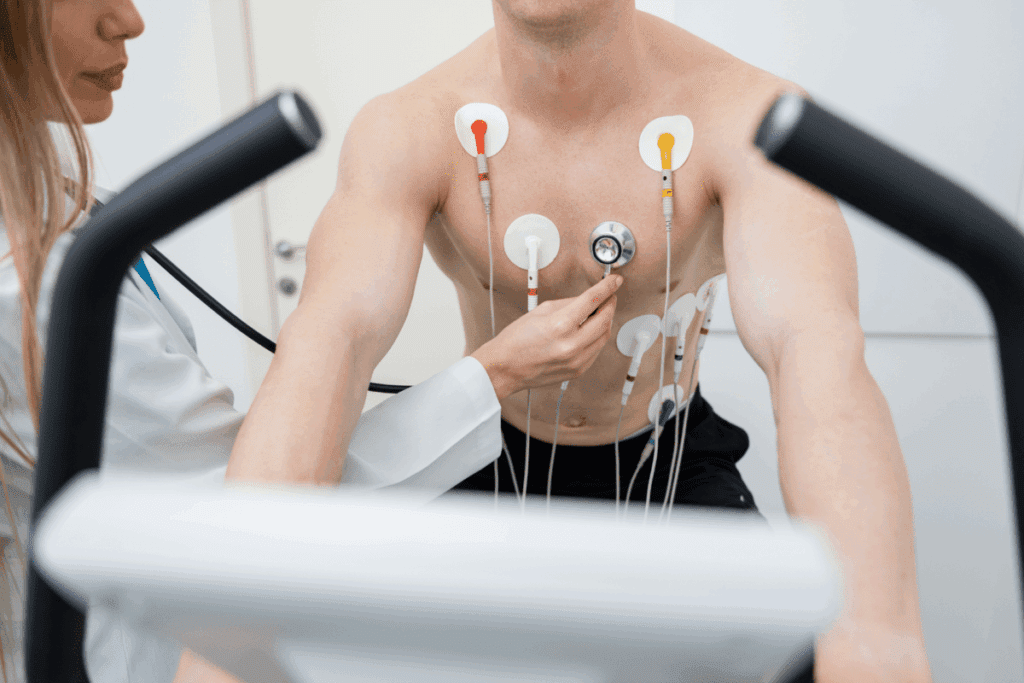
It’s important for patients and doctors to know about cardiac stress tests. These tests check how well the heart works when it’s stressed. This stress can come from exercise or medicine.
Exercise Stress Tests
Exercise stress tests are the most common. Patients walk on a treadmill or bike while their heart is watched. The workout gets harder to see how the heart handles it.
Key aspects of exercise stress tests include:
- Monitoring heart rate and blood pressure
- Assessing electrocardiogram (ECG) readings
- Evaluating symptoms such as chest pain or shortness of breath
Pharmacological Stress Tests
Pharmacological stress tests are for those who can’t exercise. Medicine is given to make the heart work hard, like exercise. This lets doctors check the heart’s function.
Pharmacological stress tests are useful for:
- Patients with mobility issues
- Those who are unable to perform physical exercise
- Assessing heart function in a controlled environment
Nuclear Stress Tests
Nuclear stress tests use a tiny bit of radioactive material. They take pictures of the heart before and after stress. This shows how well blood flows to the heart muscle.
The benefits of nuclear stress tests include:
- Detailed imaging of the heart’s blood flow
- Identifying areas of reduced blood flow
- Assessing the effectiveness of treatments
Echocardiogram Stress Tests
Echocardiogram stress tests use ultrasound and stress to check the heart. They show how the heart works and its structure. This helps spot problems during stress.
Echocardiogram stress tests are valuable for:
- Evaluating heart valve function under stress
- Assessing wall motion abnormalities
- Monitoring the heart’s overall function during stress
Each cardiac stress test gives unique insights into the heart. This helps doctors diagnose and treat heart issues well.
Medical Reasons for Undergoing a Stress Test
A stress test is a key medical check-up. It shows how well the heart works when we’re active. Doctors use it to spot and treat heart problems.
Diagnosing Coronary Artery Disease
Coronary artery disease happens when the coronary arteries get damaged. A stress test can spot this by watching the heart’s work under stress. It shows if the heart muscle isn’t getting enough blood, a sign of the disease.
Evaluating Cardiac Rehabilitation Progress
For those in cardiac rehabilitation, stress tests are key. They check if the heart is getting better with the program. This helps doctors adjust the plan to fit the patient’s needs.
Assessing Exercise Capacity
Stress tests also check how well a person can exercise. This info is important for safe and effective workout plans.
Determining Treatment Effectiveness
Stress tests also check if treatments are working. Doctors can then change plans if needed. This helps keep care on track.
Stress tests are vital for heart health. They help in many ways, including:
- Diagnosing coronary artery disease
- Evaluating cardiac rehabilitation progress
- Assessing exercise capacity
- Determining treatment effectiveness
Knowing why we need stress tests helps us understand their importance in our health care.
Preparing for Your Stress Test
To get the most out of your stress test, proper preparation is key. We guide you through the necessary steps. This ensures your test is smooth and results are accurate.
Dietary Restrictions Before Testing
Before your stress test, know the dietary restrictions. You might not eat or drink for a while before. Also, avoid caffeine for at least 24 hours before, as it can affect your heart rate.
Avoid heavy meals before the test. Eating a big meal can make you uncomfortable during the exercise. Instead, have a light meal or snack if you need to eat.
Medication Adjustments
Tell your healthcare provider about all your medications. Some, like beta-blockers, can change stress test results. They might ask you to stop taking certain medications before the test for accurate results.
“It’s essential to follow your healthcare provider’s instructions regarding medication adjustments before your stress test to avoid any complications or inaccurate test results.”
Appropriate Clothing and Footwear
Wear comfortable clothing and the right shoes for your stress test, if it’s an exercise test. Choose clothes that let you move freely and shoes for exercise or sports.
Items to Bring to Your Appointment
Bring important items on the day of your stress test. These include:
- A list of your current medications
- Comfortable clothing and shoes for exercise
- A water bottle to stay hydrated
- Any relevant medical records or test results
Being well-prepared helps make your stress test efficient and effective.
What to Expect on Test Day
On test day, you’ll go through simple steps to check your heart health. We know stress tests can seem scary, but we’re here to help. We’ll guide you through every step.
Check-in Procedures
First, you’ll check in. Our team will welcome you and ask for your ID and insurance info. Then, you’ll wait in a comfy area until it’s time for your test.
Initial Assessments
A healthcare pro will review your medical history and check you’re ready for the test. You can ask any questions you have about the test.
Equipment Setup and Attachment
We’ll put electrodes on your chest and sometimes arms and legs. These sensors track your heartbeat. Our team will make sure everything is set up right for accurate readings.
Pre-Test Instructions
After setting up the equipment, you’ll get instructions for the test. Our pro will tell you what to do on the treadmill or bike. We’ll also answer any final questions you have.
| Pre-Test Preparation | Description |
| Check-in | Arrive and provide necessary information |
| Initial Assessments | Brief medical history review and examination |
| Equipment Setup | Attachment of electrodes to monitor heart activity |
| Pre-Test Instructions | Guidance on the test procedure and expectations |
The Complete Stress Test Procedure Step by Step
The stress test procedure is carefully planned to get accurate results. It checks how well the heart works when it’s under stress.
Pre-Test Baseline Measurements
First, we take baseline measurements. These include the heart rate, blood pressure, and an ECG reading. This gives us a starting point for the test.
Our team makes sure these measurements are correct. This helps us get reliable results from the stress test.
Exercise Protocol Initiation
The test starts with a gentle exercise, like walking on a treadmill or cycling. The intensity increases slowly as the test goes on.
Patients are told to hold onto the railing for balance. But they shouldn’t hold too tight, as it can skew the results.
| Exercise Stage | Treadmill Speed | Incline | Duration |
| Stage 1 | 1.7 mph | 10% | 3 minutes |
| Stage 2 | 2.5 mph | 12% | 3 minutes |
| Stage 3 | 3.4 mph | 14% | 3 minutes |
Continuous Monitoring Techniques
Throughout the test, we keep a close eye on the heart and blood pressure. This includes ECG monitoring and blood pressure checks.
Our team watches over the patient closely. This ensures their safety and the test’s accuracy.
Cool-Down Phase Implementation
The test ends with a cool-down phase. This helps the heart rate return to normal safely and comfortably.
During this phase, we keep an eye on the patient’s vital signs. This helps them smoothly return to a resting state.
Understanding Stress Test Heart Rate Targets
Stress tests use heart rate targets to check how well the heart works. This is key to see how the heart handles stress.
Calculating Your Maximum Heart Rate
To find the heart rate goal for a stress test, we first calculate the maximum heart rate. A simple way is to subtract your age from 220. For instance, a 40-year-old’s maximum heart rate is 180 beats per minute (bpm).
Maximum Heart Rate Formula: 220 – Your Age = Maximum Heart Rate (bpm)
Target Heart Rate in Stress Test (85% Rule)
The target heart rate for a stress test is 85% of the maximum heart rate. Using the example above, a 40-year-old’s target would be 153 bpm (85% of 180 bpm). This makes sure the heart works hard enough to give useful data.
| Age | Maximum Heart Rate (bpm) | Target Heart Rate (85% of Max) |
| 30 | 190 | 161.5 |
| 40 | 180 | 153 |
| 50 | 170 | 144.5 |
| 60 | 160 | 136 |
Age-Adjusted Heart Rate Considerations
It’s important to consider age when setting heart rate targets for stress tests. Older people or those with health issues might need different targets or test adjustments.
Heart Rate Recovery Assessment
Watching how fast the heart rate goes back down after a stress test is key. A quicker recovery usually means better heart health.
By hitting the right heart rate targets during a stress test, doctors can better understand a patient’s heart health.
Treadmill Stress Test Protocol Details
The treadmill stress test protocol checks how well the heart works when stressed. It’s a key tool for checking heart health and fitness levels.
Bruce Protocol Explained
The Bruce protocol is a standard method for treadmill stress tests. It makes the treadmill speed and incline go up slowly to stress the heart. This protocol is widely used because it’s good at finding heart disease and checking heart function.
The test starts off easy and gets harder as it goes on. This slow increase helps check how well the heart handles stress.
Stress Test Speed and Incline Progression
During a treadmill stress test, the treadmill’s speed and incline change to make the exercise harder. The pace starts off easy but gets tougher as the test goes on. This change is key for checking heart fitness.
The treadmill might also tilt to make it feel like walking uphill. This makes the workout even harder. It helps see how the heart reacts to different levels of effort.
Modified Protocols for Different Fitness Levels
Everyone is different, and that’s why there are modified protocols. These changes make sure the test is safe and works for everyone.
For people who are less fit or have health issues, there are special Bruce protocols or other changes. These help make the test more personal and accurate for each person.
Maximum Heart Rate Stress Test Treadmill Settings
The highest heart rate reached during a test shows how fit the heart is. The treadmill settings are set to help reach this heart rate safely. This happens as the exercise gets harder until the heart rate hits the goal.
Knowing the maximum heart rate is key to understanding the test results. It helps with advice on exercise and staying active.
Alternative Stress Test Methods
There are other ways to do stress tests if you can’t do the usual ones. These options help more people get tested for heart issues. It’s key for diagnosing and treating heart problems.
Bicycle Ergometer Tests
Bicycle ergometer tests use a stationary bike to check heart health. It’s great for those who prefer biking over walking on a treadmill.
Benefits of bicycle ergometer tests include precise control over resistance. This makes the test more accurate for checking fitness.
Arm Ergometry for Limited Mobility
Arm ergometry is for people with mobility issues. It uses the arms to create stress, like turning a handle.
It’s very useful for those with mobility problems. It lets them check their heart health without needing to exercise their legs.
Pharmacological Stress Agents
Pharmacological stress agents are used when exercise is not possible. They’re given through an IV to make blood flow to the heart like exercise does.
This is good for people who can’t exercise because of health issues or physical problems.
Specialized Protocols for Athletes
Athletes need special stress test protocols because they’re in better shape. These tests are more intense or last longer.
Specialized protocols make sure the test is safe and works for athletes. They give important info about their heart health under stress.
Safety Considerations and Potential Risks
Stress tests are generally safe but come with some risks. We take these seriously to ensure a safe experience for all. This includes everyone who goes through this diagnostic procedure.
Common Side Effects
Some people may feel dizzy, have chest pain, or breathe short during a stress test. Our healthcare team watches these symptoms closely. They make sure they don’t get worse.
When to Stop a Stress Test
It’s important to know when to stop a stress test if symptoms get bad. Immediate cessation is needed for severe chest pain, trouble breathing, or other serious signs. Our medical team is ready to act fast in such cases.
Emergency Protocols
We have emergency protocols for any bad reactions during a stress test. These plans are made to give quick care and lower risks. Our staff is trained to use these protocols well.
Risk Minimization Strategies
We use several strategies to lower risks. These include checking patients before the test, watching them closely during it, and having emergency gear ready. These steps help a lot in avoiding problems.
While serious problems from stress tests are rare, knowing the risks and having strong safety steps is key. We aim to keep a safe space for all patients during stress tests.
After Your Stress Test: Recovery and Results
After your stress test, you’ll start a recovery phase. Your healthcare team will watch your heart rate and breathing closely. This is key to see how your heart handles stress and recovers.
Immediate Post-Test Monitoring
Right after your test, you’ll stand and then lie down for a bit. Our team will keep an eye on your heart rate and breathing. This post-test monitoring is vital for your safety and to learn about your heart’s recovery.
How Results Are Interpreted
Our experienced healthcare pros will look over your test results. They’ll check for signs of heart issues or ischemia. They’ll examine your electrocardiogram (ECG) readings, heart rate, and blood pressure from the test. Then, they’ll make a detailed report for you.
Timeline for Receiving Results
When you’ll get your results can vary. Usually, it’s a few days. Sometimes, your doctor might talk about the initial findings right after. But, a full report might take a bit longer.
Follow-Up Recommendations
After seeing your results, our team will give you follow-up recommendations. This could mean more tests, lifestyle changes, or treatment plans. We’ll work with you to create a plan that’s right for you and improves your health.
Conclusion
A stress test is a key tool for checking how well the heart works during exercise. At Liv Hospital, we use these tests to find heart problems like blocked arteries and irregular heartbeats. This helps us give our patients the care they need.
Knowing what happens during a stress test helps patients feel more ready. Our team works hard to offer top-notch healthcare. We make sure our patients get the best care and advice during the test.
Stress tests help doctors see how well the heart is working. This information helps them decide the best treatment for each patient. We aim to give personalized care that meets each patient’s needs and helps keep their heart healthy.
FAQ
What is a cardiac stress test?
A cardiac stress test checks how well the heart works when it’s under stress. This stress can come from exercise or medicine. It helps find heart problems and see how healthy the heart is.
How do I prepare for a stress test?
Before a stress test, you might need to avoid certain foods and drinks. You should also stop taking some medicines. Wear comfy clothes and shoes for the test.
What happens during a stress test?
During a stress test, you’ll go through a few steps. First, you’ll get some baseline measurements. Then, you’ll start exercising. Your heart will be watched closely during this time. After, you’ll cool down slowly.
What is the target heart rate during a stress test?
The heart rate goal is 85% of your maximum. This is based on your age and how fit you are.
What are the different types of cardiac stress tests?
There are many types of stress tests. These include exercise tests, tests with medicine, nuclear tests, and echocardiogram tests. Each one looks at different parts of heart health.
Are there alternative stress test methods for patients who cannot exercise?
Yes, there are other tests for people who can’t exercise. These include tests on a bike, tests for those with mobility issues, and tests with medicine to mimic exercise.
What are the possible risks and complications of a stress test?
Stress tests are usually safe, but there are risks. These can include feeling dizzy, chest pain, or shortness of breath. There are emergency plans in place for any bad reactions.
How are stress test results interpreted?
A doctor will look at your stress test results. They’ll give you a detailed report. This helps figure out if you have heart problems and how well your heart is doing.
When can I expect to receive my stress test results?
You’ll usually get your results a few days after the test. This can vary, though.
What follow-up recommendations are made after a stress test?
Based on your results, you might need more tests, to make lifestyle changes, or to start treatment. This is all to help keep your heart healthy.
References
- Martinez-Lemus, L. A. (2012). The dynamic structure of arterioles. Basic & Clinical Pharmacology & Toxicology, 110(1), 5-11. https://pubmed.ncbi.nlm.nih.gov/21989114/