Last Updated on November 25, 2025 by Ugurkan Demir

Spotting third degree heart block on an ECG is key for quick, life-saving care. At Liv Hospital, we stick to proven methods and focus on our patients. This ensures we diagnose and treat this serious heart issue effectively.
Third-degree AV block means there’s no connection between the heart’s upper and lower chambers. Doctors use ECG findings to spot this, looking for signs of no link between atrial and ventricular activity.
Knowing the ECG signs of third degree heart block is vital for quick action. We’ll look at the main ECG signs of this condition. These include a complete break in the connection between the heart’s upper and lower parts.
Key Takeaways
- Third-degree AV block is a serious condition needing fast medical help.
- ECG findings are key for diagnosing third-degree AV block.
- Dissociated atrial and ventricular activity is a main sign of third-degree AV block.
- Quick treatment is critical for the best results.
- Liv Hospital is dedicated to proven methods and patient care.
What Is Third Degree Heart Block?
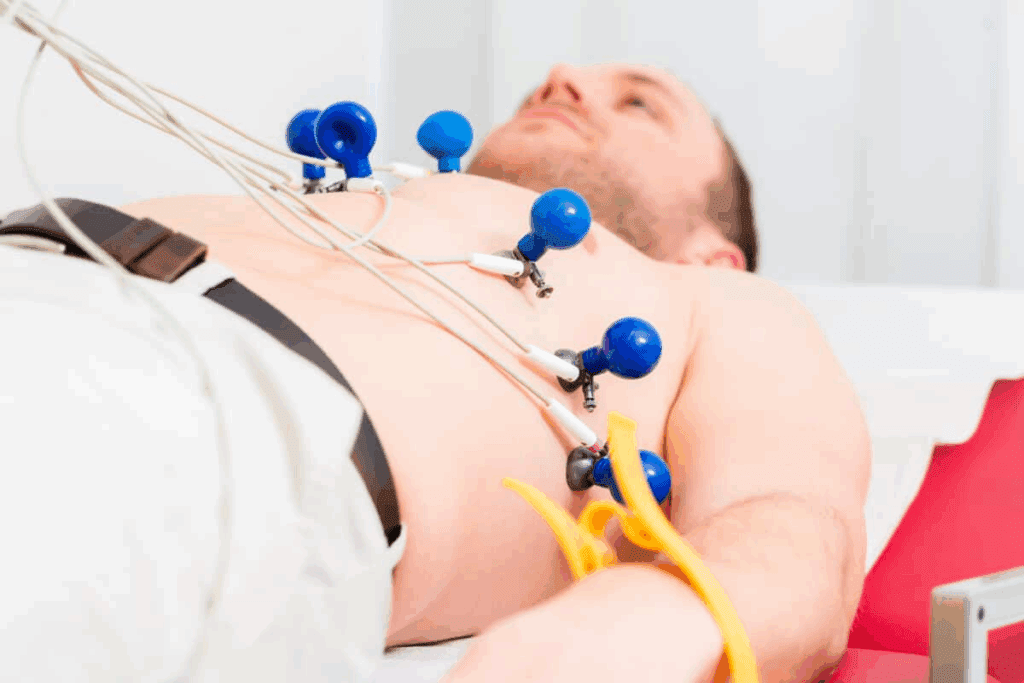
Third degree heart block, also known as complete heart block, is a serious condition. It happens when electrical signals from the atria can’t reach the ventricles. This means the atria and ventricles beat on their own, not together.
Definition and Pathophysiology
This condition occurs when electrical signals are completely blocked between the atria and ventricles. This block can happen at different points, like the AV node or below. On an electrocardiogram (ECG), it shows more P waves than QRS complexes. There’s no clear link between them.
Causes and Risk Factors
Third degree heart block can be caused by several things. These include congenital heart defects, infections like Lyme disease, and some medications. Other factors include coronary artery disease, cardiac surgery, and heart inflammation or scarring.
| Causes | Risk Factors |
| Congenital heart defects | Coronary artery disease |
| Infections (e.g., Lyme disease) | Cardiac surgery |
| Certain medications | Conditions causing inflammation or scarring |
Knowing the causes and risk factors is key to diagnosing and treating third degree heart block.
The Cardiac Conduction System
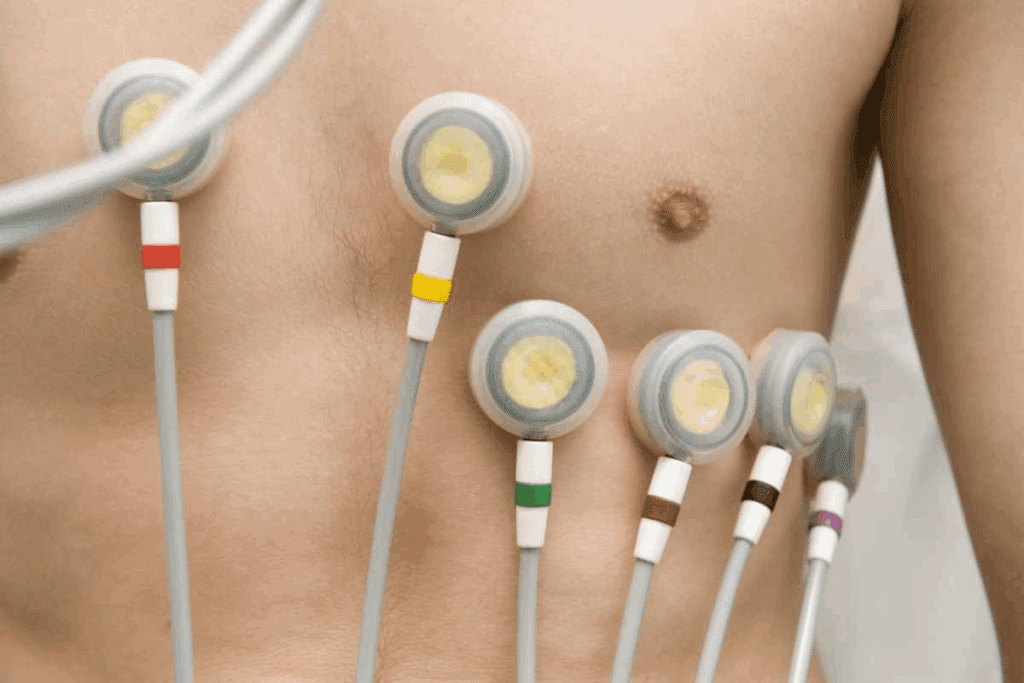
The heart’s electrical system, known as the cardiac conduction system, is key to a normal heartbeat. It generates and sends electrical impulses that control our heart rate.
Normal Electrical Pathways
The system starts with the sinoatrial (SA) node, our heart’s natural pacemaker. The impulse then goes to the atrioventricular (AV) node. It then moves to the ventricles through the bundle of His, bundle branches, and Purkinje fibers.
This process ensures the heart’s chambers contract in sync.
Disruption in Complete Heart Block
In third-degree heart block, the normal pathway is broken. This causes a complete split between atrial and ventricular activity. The atrial rate is usually faster, while the ventricular rate drops to 30-40 beats per minute.
This disruption can cause serious problems, showing why understanding the cardiac conduction system is vital for diagnosing and treating third-degree heart block.
Third Degree Heart Block ECG: Core Characteristics
The ECG diagnosis of third-degree heart block looks for specific signs. These include complete AV dissociation and independent rhythms of the atria and ventricles. These traits help tell third-degree heart block apart from other heart rhythm problems.
Complete AV Dissociation
Complete AV dissociation is a key sign of third-degree heart block. It means the atria and ventricles beat on their own. The P waves and QRS complexes don’t follow each other, showing no fixed link between them.
This leads to variable PR intervals. There’s no set pattern between atrial and ventricular beats.
Independent Atrial and Ventricular Rhythms
In third-degree heart block, the atria and ventricles have their own pacemakers. The atria are usually controlled by the SA node. The ventricles are led by a different pacemaker, often in the AV junction or ventricles.
This setup means the atria and ventricles beat at their own rates. They have consistent P-P and R-R intervals. But, there’s no sync between the P waves and QRS complexes.
Knowing these ECG signs is key to spotting third-degree heart block. The presence of complete AV dissociation and independent atrial and ventricular rhythms are essential for this diagnosis.
Finding #1: Complete P Wave and QRS Complex Dissociation
Third-degree heart block shows up on ECG as P waves and QRS complexes that don’t match. This means the electrical signals from the atria can’t reach the ventricles. So, the atria and ventricles beat on their own.
Identifying AV Dissociation Patterns
To spot AV dissociation on an ECG, look for P waves that don’t line up with QRS complexes. These P waves might show up before, during, or after the QRS complexes. But, there’s no steady PR interval.
| ECG Feature | Description |
| P Waves | Independent of QRS complexes |
| QRS Complexes | May be narrow or wide, depending on the escape rhythm |
| PR Interval | No consistent PR interval |
Clinical Significance
Seeing complete AV dissociation on an ECG means you have third-degree heart block. This condition often needs permanent pacing to manage symptoms and avoid serious problems. Spotting this pattern early is key for timely treatment.
Finding #2: P:QRS Ratio Discrepancy
Third-degree heart block is marked by more P waves than QRS complexes. This happens because the atrial rate is faster than the ventricular rate. This leads to a clear discrepancy in the P:QRS ratio.
More P Waves Than QRS Complexes
In third-degree AV block, the atrial and ventricular activities are completely separate. This means we see more P waves than QRS complexes on the ECG. This is a key feature that sets third-degree heart block apart from other AV blocks.
The atrial rate, shown by the P waves, is usually quicker than the ventricular rate, shown by the QRS complexes. This difference is a key sign of the condition and is vital for making a diagnosis.
Diagnostic Importance
The P:QRS ratio discrepancy is very important for diagnosing third-degree heart block. It not only confirms the diagnosis but also shows how severe the condition is.
| ECG Feature | Significance |
| More P waves than QRS complexes | Indicates complete AV dissociation |
| P:QRS ratio discrepancy | Confirms diagnosis of third-degree AV block |
| Faster atrial rate than ventricular rate | Characteristic of third-degree heart block |
By looking at the P:QRS ratio discrepancy on an ECG, we can accurately diagnose third-degree heart block. This helps us tell it apart from other heart rhythm disorders.
Finding #3: Regular P-P and R-R Intervals
In third-degree heart block, an ECG shows regular P-P and R-R intervals. This means both the atrial and ventricular rhythms have their own pacemakers. This is a key sign of complete atrioventricular (AV) dissociation.
Rhythm Pattern Recognition
It’s important to spot regular P-P and R-R intervals on an ECG to diagnose third-degree heart block. The atrial rhythm, shown by P waves, and the ventricular rhythm, shown by QRS complexes, work on their own. This makes the P-P and R-R intervals constant, but P waves and QRS complexes are not linked.
Differentiating from Second-Degree Blocks
Regular P-P and R-R intervals help tell third-degree heart block apart from second-degree AV blocks. Second-degree AV blocks show some connection between P waves and QRS complexes. This can be seen in dropped beats (Mobitz I or II) or a fixed ratio of P waves to QRS complexes. But third-degree heart block shows a complete break, making the regularity of both rhythms a key sign.
A cardiology expert notes, “The ECG finding of regular P-P and R-R intervals in the context of AV dissociation is pathognomonic for third-degree heart block.” This highlights the need to recognize this pattern for correct diagnosis.
Finding #4: Variable PR Intervals on ECG
In third-degree heart block, the PR intervals on an ECG vary. This happens because the heart’s upper and lower chambers don’t work together.
The PR interval is the time from the start of the P wave to the QRS complex. In third-degree heart block, this time changes because P waves and QRS complexes don’t follow each other. This change is a key sign, helping doctors tell it apart from other heart block types.
PR Interval Inconsistency
The PR intervals change because the atria and ventricles beat on their own. P waves and QRS complexes happen at different times, making the PR interval different each time. This change is seen on an ECG by looking at the distance between P waves and QRS complexes.
Measurement Techniques
To measure PR intervals, we look for the start of the P wave and the QRS complex. We use ECG calipers or digital tools to find the time between them. In third-degree heart block, this time changes with each heartbeat, showing the chambers don’t work together.
By spotting and measuring these changing PR intervals, doctors can diagnose third-degree heart block. This finding is key for figuring out how serious the condition is and what treatment to use.
Finding #5: Escape Rhythms in 3rd Degree Heart Block
When AV conduction is severely impaired, as in third-degree heart block, escape rhythms become key. They help keep the heart pumping. Without normal AV conduction, the heart uses these rhythms to contract.
Junctional Escape Rhythms
Junctional escape rhythms start from the AV junction. They show up as a narrow QRS complex on the ECG. These rhythms are faster than ventricular escape rhythms but slower than normal heart rhythm.
The presence of a junctional escape rhythm suggests the block is above the ventricles.
Ventricular Escape Rhythms
Ventricular escape rhythms start from the ventricular myocardium. They have a wide QRS complex on the ECG. These rhythms are slower than junctional escape rhythms.
They may show a more severe disease in the conduction system. The features of ventricular escape rhythms help understand the block level and its clinical implications.
The characteristics of escape rhythms in third-degree heart block are summarized in the following table:
| Characteristics | Junctional Escape Rhythm | Ventricular Escape Rhythm |
| QRS Complex Width | Narrow | Wide |
| Rate | Typically 40-60 bpm | Typically 20-40 bpm |
| Origin | AV Junction | Ventricular Myocardium |
Understanding escape rhythms is vital for diagnosing and managing third-degree heart block. By looking at the ECG for signs of junctional or ventricular escape rhythms, doctors can better understand the problem. This helps guide the right treatment.
Finding #6: Bradycardia with Ventricular Rates of 30-40 BPM
In third-degree heart block, the ventricular rate drops to 30-40 beats per minute. This is due to a complete block in the electrical pathway from the atria to the ventricles. This block causes an independent ventricular rhythm.
Heart Rate Calculation Methods
To find the ventricular rate on an ECG, we use a few methods. One way is to count R-R intervals in a 6-second strip and multiply by 10. This gives us the beats per minute (BPM). We can also measure the interval between two R waves and calculate the rate from that.
In third-degree heart block, the rate is usually 30-40 BPM. This shows severe bradycardia.
Clinical Implications of Severe Bradycardia
Severe bradycardia from third-degree heart block can cause problems. It can lead to dizziness, fainting, and even heart failure. Patients need quick medical help because complete AV block affects their heart’s function.
Knowing the effects of severe bradycardia is key. It helps doctors act fast to manage the condition.
Finding #7: QRS Complex Width and Morphology
Understanding QRS complex width and shape is key to grasping third-degree AV block. The QRS complex tells us a lot about where the escape rhythm starts.
Narrow vs. Wide QRS Complexes
In third-degree AV block, the QRS complex width is important. Narrow QRS complexes point to a junctional escape rhythm. On the other hand, wide QRS complexes suggest a ventricular escape rhythm. Knowing this helps us understand the heart’s conduction system.
Determining the Origin of Escape Rhythm
The shape of the QRS complex also gives hints about the escape rhythm’s origin. A junctional escape rhythm has narrow QRS complexes, like normal heartbeats. But, a ventricular escape rhythm shows wide, abnormal QRS complexes. Spotting these patterns on a 3rd degree AV block ECG strip is essential for correct diagnosis and treatment.
By looking at the QRS complex width and shape, doctors can understand third-degree AV block better. This helps them make better decisions for patient care.
Finding #8: Signs of Hemodynamic Compromise
It’s key to spot signs of hemodynamic compromise on an ECG to handle third-degree heart block well. This condition blocks electrical signals from the atria to the ventricles. It causes severe bradycardia and can be life-threatening.
ECG Indicators of Poor Perfusion
Signs of poor perfusion in third-degree heart block include very slow heart rates, usually 30-40 bpm. This slow rate can cause the heart to not pump enough blood. Symptoms include dizziness, fainting, and even heart arrest.
| ECG Indicator | Clinical Significance |
| Severe Bradycardia | Inadequate cardiac output |
| Ventricular Rate | Increased risk of cardiac arrest |
Urgent Intervention Criteria
When there’s a sign of hemodynamic compromise, like low blood pressure or decreased consciousness, quick action is needed. Look for a heart rate under 40 bpm, symptoms like chest pain, or ECG signs of heart damage.
Conclusion: Management and Prognosis
Third degree heart block, also known as 3rd degree AV block, is a serious condition. It needs quick and right management. The ECG findings are key for diagnosing and guiding treatment. We talked about the main ECG signs, like complete AV dissociation and independent atrial and ventricular rhythms.
Managing third degree heart block often means getting a permanent pacemaker. This is very important for patients with severe bradycardia and heart problems. A stable heart rate from pacing improves life quality and lowers the risk of more problems.
Knowing the management and prognosis is key for caring for patients with third degree heart block. We’ve seen that early pacing can greatly help outcomes. Most patients see better heart function and fewer symptoms.
In short, third degree AV block needs careful diagnosis and management. By spotting ECG signs and knowing treatments, healthcare can give top-notch care to these patients.
FAQ
What is third degree heart block?
Third degree heart block, also known as complete heart block, is a serious condition. It happens when electrical signals from the atria can’t reach the ventricles. This means the atria and ventricles beat on their own, not together.
What are the ECG findings in third degree heart block?
ECG findings for third degree heart block include complete AV dissociation. This means the atria and ventricles beat independently. You’ll see more P waves than QRS complexes and regular P-P and R-R intervals. The ventricular rate is usually between 30-40 beats per minute.
How is third degree heart block diagnosed on an ECG?
To diagnose third degree heart block on an ECG, look for complete AV dissociation. This is when P waves and QRS complexes don’t follow each other. The atrial rate is usually higher than the ventricular rate.
What is the significance of the P:QRS ratio discrepancy in third degree heart block?
The P:QRS ratio discrepancy is a key sign of third degree heart block. It shows the atrial rate is faster than the ventricular rate. This is seen when there are more P waves than QRS complexes.
How do you differentiate third degree heart block from second-degree AV block on an ECG?
To tell third degree heart block from second-degree AV block on an ECG, look at the P-P and R-R intervals. Third degree heart block shows complete AV dissociation and regular intervals.
What is the clinical significance of severe bradycardia in third degree heart block?
Severe bradycardia in third degree heart block can cause serious problems. It can lead to decreased cardiac output and hemodynamic compromise. This is a life-threatening situation that needs urgent medical help.
How is the origin of the escape rhythm determined in third degree heart block?
To find where the escape rhythm comes from in third degree heart block, look at the ECG. Narrow QRS complexes mean it’s from the junction. Wide QRS complexes suggest a ventricular origin.
What are the management strategies for third degree heart block?
Management for third degree heart block includes using permanent pacing. This keeps the heart rate stable and prevents complications. It’s also important to address the underlying causes and risk factors.
What is the prognosis for patients with third degree heart block?
The prognosis for third degree heart block patients depends on several factors. These include the underlying cause, any heart disease, and how well management strategies work. Pacing therapy is a key part of treatment.
References
- O’Rourke, M. F. (2018). Structure and function of systemic arteries: reflections on the vascular wall and blood flow. Vascular Medicine, 23(4), 316-323. https://pubmed.ncbi.nlm.nih.gov/30016416/