
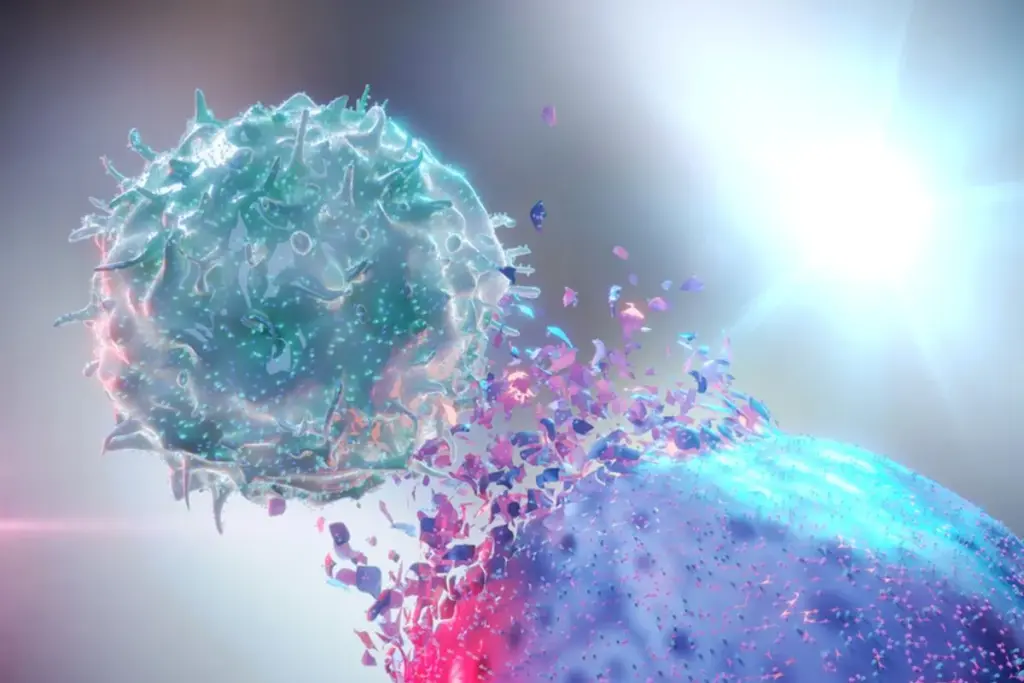
Your body has a high-tech security system inside. Special cells called innate lymphocytes are the first line of defense. They quickly find and remove harmful threats.
Natural killer cell receptors are like sentinels in your body. They look for signs of stress or “missing-self” signals. These signals often mean there’s cancer or a virus.
Our team uses bioinformatics software updates to learn more about these cells. By studying how they talk to each other, we offer empathetic and precise medical advice to our patients.
The way your body fights off health problems is very delicate. We use this knowledge to give top-notch care to people all over the world.
Key Takeaways
- Innate lymphocytes identify threats without previous sensitization.
- Sophisticated sensors detect missing-self signals on possible targets.
- Activating and inhibitory signals keep the immune system in balance.
- Bioinformatics tools help us understand defense mechanisms better.
- Our patient-focused approach relies on the latest immune research.
- Targeted treatments need precise signaling for the best results.
The Sophisticated Balance of NK Cell Receptor Systems
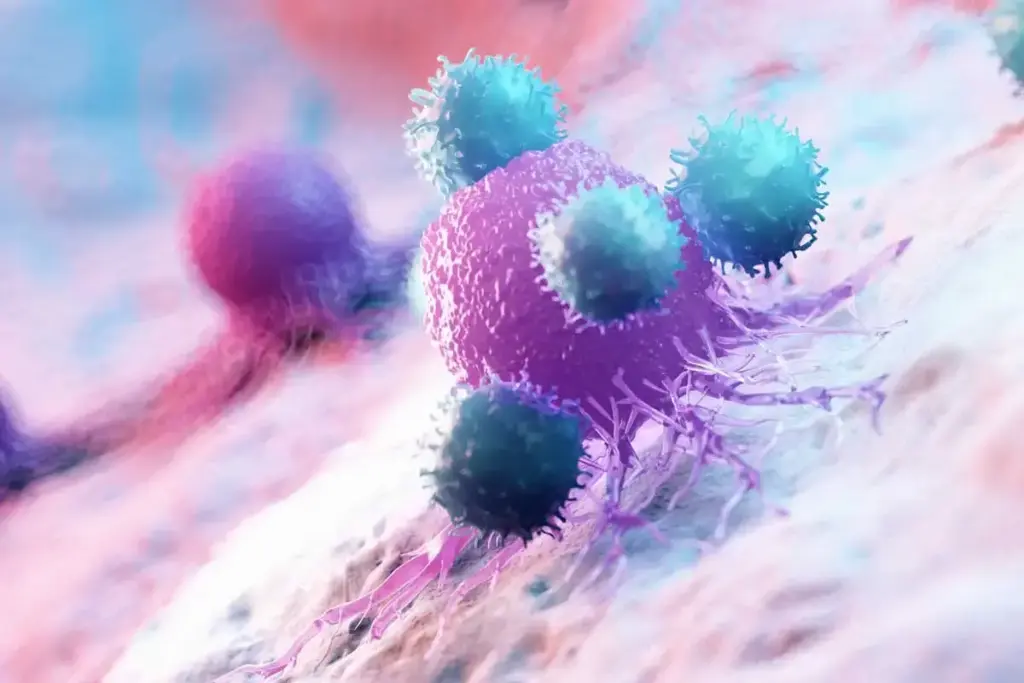
NK cell receptor systems work through a delicate balance. This balance is key for Natural Killer (NK) cells to function right. They are a big part of our immune system.
NK cells have many activating receptors that spot stressed cells. These include NKG2D, Natural Cytotoxicity Receptors (NCRs), and DNAM-1. But, inhibitory receptors like Killer Immunoglobulin-Like Receptors (KIRs) and NKG2A check for normal cells. This stops NK cells from attacking healthy cells.
The mix of these signals decides how NK cells act. If activating signals win, NK cells can kill stressed or cancer cells. But, if inhibitory signals are stronger, NK cells won’t attack healthy cells.
| Receptor Type | Function | Examples |
| Activating Receptors | Recognize stress-induced ligands on target cells | NKG2D, NCRs, DNAM-1 |
| Inhibitory Receptors | Survey for normal self-markers, preventing NK activation against healthy cells | KIRs, NKG2A |
It’s important to understand how NK cell receptor systems work. This helps us see their role in keeping us healthy. It also shows how they could be used to fight diseases.
5 Key Natural Killer Cell Receptors and Their Functions

NK cell receptors are key in controlling NK cell activity. They help these cells tell healthy from diseased cells. The mix and match of different receptors on NK cells is what makes them good at finding and killing target cells.
1. NKG2D Activating Receptor
The NKG2D receptor is a major player in finding stressed or changed cells. It connects with eight different ligands on infected or tumor cells. This connection starts the process of NK cell activation and the killing of target cells.
2. Killer Immunoglobulin-Like Receptors (KIRs)
KIRs are a group of receptors that spot MHC class I molecules on cells. When KIRs meet MHC class I, they send a signal to NK cells to stop attacking. This is important for keeping NK cells from harming healthy cells.
| Receptor | Function | Ligand(s) |
| NKG2D | Activating | MICA, MICB, ULBP1-6 |
| KIRs | Inhibitory/Activating | MHC class I molecules |
| NKG2A | Inhibitory | HLA-E |
| NCRs | Activating | Viral ligands, tumor ligands |
3. NKG2A Inhibitory Receptor
The NKG2A receptor is an inhibitory receptor that works with CD94. It spots HLA-E, a special MHC class I molecule, on cells. This interaction stops NK cells from attacking healthy cells.
4. Natural Cytotoxicity Receptors (NCRs)
NCRs, like NKp30, NKp44, and NKp46, are key in fighting tumor cells and virus-infected cells. They find specific ligands on target cells, though what these ligands are is not fully known.
Knowing how these NK cell receptors work is key to understanding how NK cells help protect us from disease. It shows the complex ways NK cells keep us safe.
Clinical Significance in Disease and Therapy
NK cell receptors have a big impact on many diseases and treatments. They help the immune system fight off sick cells. This makes them key in finding new ways to treat diseases.
NK Cell Receptors in Cancer Immunotherapy
Cancer immunotherapy is a new way to fight cancer, and NK cells are at the heart of it. Researchers are looking into using NK cells and CAR-NK cell therapy to treat different cancers.
CAR-NK cell therapy changes NK cells to find and attack cancer cells. Early tests look promising, and it’s being tested in people.
| Cancer Type | Therapeutic Approach | Status |
| Leukemia | CAR-NK cell therapy | Clinical Trials |
| Lymphoma | Adoptive NK cell transfer | Preclinical Studies |
| Solid Tumors | CAR-NK cell therapy | Preclinical Studies |
Research on NK cell receptors in cancer is very active. Scientists are looking into how they can help fight cancer better.
Infectious Disease and Transplantation Medicine
NK cells also help with some viral infections and are important in transplant medicine. They can spot and get rid of infected cells or foreign transplants. This is key to the immune system’s work.
In infectious diseases, NK cells help control viruses like HIV and hepatitis. Their actions can change how these infections turn out. This makes them a focus for new treatments.
In transplant medicine, NK cells can affect how well a transplant works and if it causes GVHD. Knowing how NK cell receptors work here is vital for better transplant results.
Conclusion
Natural killer cell receptors are key to our body’s defense against cancer and other diseases. We’ve looked into how these receptors work together. This includes NKG2D, KIRs, NKG2A, and NCRs.
These receptors have big implications for fighting cancer and other illnesses. Knowing how they function helps us see their role in keeping our immune system balanced.
More studies on NK cell receptors will lead to new ways to treat diseases. This will help us use our immune system more effectively against illness.
FAQ
How do Natural Killer (NK) cells distinguish between healthy cells and malignant targets?
NK cells detect abnormal cells by sensing reduced MHC class I expression or the presence of stress-induced ligands on target cells, allowing them to selectively kill virus-infected or cancerous cells while sparing healthy tissue.
What is the specific role of the NKG2D activating receptor in immune surveillance?
NKG2D binds to stress-induced ligands on infected or transformed cells, triggering NK cell activation and cytotoxicity, making it a key receptor for detecting and eliminating abnormal cells.
How do Killer Immunoglobulin-Like Receptors (KIRs) and NKG2A maintain immune balance?
KIRs and NKG2A are inhibitory receptors that recognize MHC class I molecules on healthy cells, preventing unwanted NK cell activation and ensuring immune tolerance while allowing responses to abnormal targets.
What are Natural Cytotoxicity Receptors (NCRs) and why are they important?
NCRs, such as NKp30, NKp44, and NKp46, are activating receptors that detect stress or tumor ligands on target cells, playing a central role in NK cell-mediated cytotoxicity and early immune defense.
How are NK cell receptors being utilized in modern cancer immunotherapy?
Therapies are being developed to enhance activating signals or block inhibitory receptors, engineer NK cells, or use receptor-targeting antibodies to improve tumor recognition and killing in cancer patients.
How do bioinformatics software updates assist in the study of NK cell receptors?
Updated bioinformatics tools enable high-throughput analysis of NK receptor genes, ligand interactions, structural modeling, and multiomic integration, accelerating the discovery of therapeutic targets and personalized immunotherapy strategies.
References
Nature. Evidence-Based Medical Insight. Retrieved from https://www.nature.com/articles/ni1582



 Departments
 Related Videos
 Our Doctors
 News
News