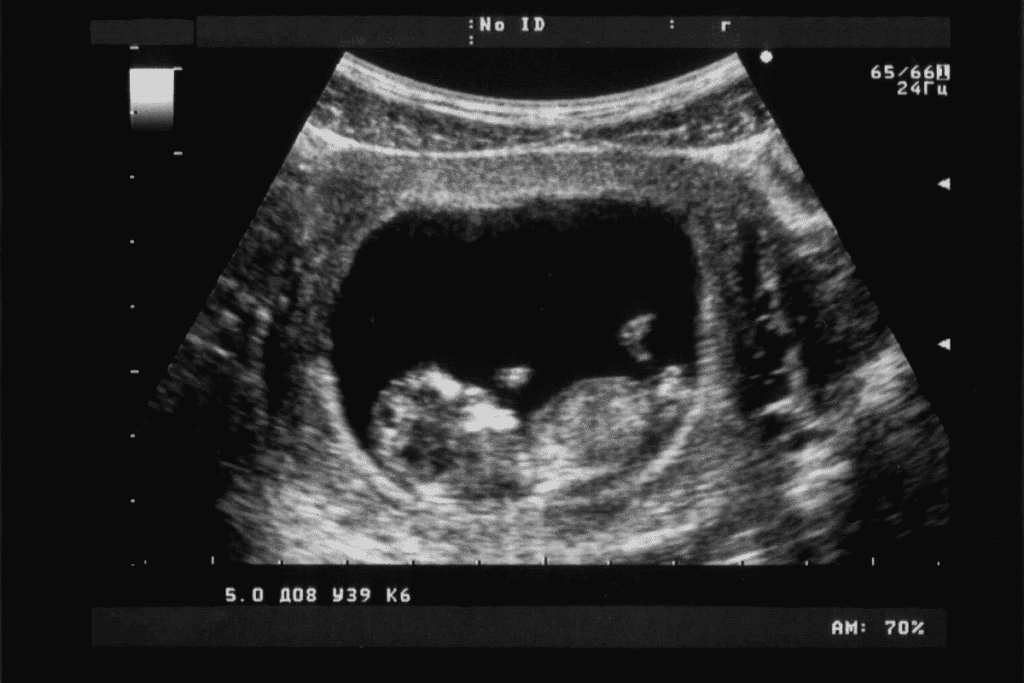
At 8 weeks, pregnancy is a big deal, and an 8 week ultrasound shows the baby’s first images. This scan lets us see important signs of a healthy pregnancy 8 week embryo ultrasound.
Medical Expert, an expert in obstetrics, says, “Eight weeks is perfect for checking if the pregnancy is going well.” We offer caring and skilled ultrasound assessment with the latest tech.
At this time, we can see the gestational sac, the baby’s outline, and its heartbeat. These details help us understand how the baby is growing. We measure the crown-rump length to figure out the exact due date.
Key Takeaways
- An 8 week ultrasound confirms dating and viability.
- Key features visible at 8 weeks include the gestational sac and fetal heartbeat.
- Crown-rump length measurement determines gestational age.
- Advanced imaging technology ensures accurate results.
- Compassionate care is provided during the ultrasound assessment.
The Significance of Your First Trimester Ultrasound

The first trimester ultrasound, around the 8-week mark, is very important. It checks how the fetus is growing. It also confirms if the pregnancy is viable and when it started.
Why the 8-Week Mark Is Important
At 8 weeks, the embryo is growing fast. Doctors look for the gestational sac, fetal pole, and the fetal heartbeat. These signs show if the pregnancy is healthy.
Medical Expert, “Dating scans are most accurate at 7 weeks and 0 days or later.” This is key for setting a due date and tracking growth.
What Medical Professionals Are Looking For
At the 8-week ultrasound, doctors check several important things. These include:
- The presence and size of the gestational sac
- The visibility of the fetal pole
- The detection of the fetal heartbeat
The table below shows what doctors look for at an 8-week ultrasound:
Feature | Significance |
Gestational Sac | Confirms pregnancy and its location |
Fetal Pole | Indicates embryonic development |
Fetal Heartbeat | Confirms viability of the pregnancy |
These signs are key to checking the health and growth of the fetus. The 8-week ultrasound is a big part of prenatal care. It gives important insights into fetal development.
Fetal Development at 8 Weeks

At 8 weeks, the embryo grows fast. It’s about 1.22 inches long and weighs 0.14 ounces. This period sees many important developments.
Size and Appearance of Your Baby
The embryo is about crown-rump length at 8 weeks. This helps doctors figure out when you’ll give birth. On an ultrasound, the fetus looks bean-like or gummy bear-shaped.
Major Developmental Milestones at This Stage
By the eighth week, many key milestones are reached. Organs like the heart, lungs, and liver start forming. The fetus also begins to take shape.
Developmental Feature | Description |
Organ Formation | Major organs like the heart, lungs, and liver start to develop. |
Body Structure | The basic body structure begins to take shape, including limb buds. |
Cardiovascular System | The heart starts to divide into chambers and begins to beat. |
These milestones show the fetus is growing well. The ultrasound helps doctors know when you’ll have your baby.
Key Features Visible on an 8 Week Embryo Ultrasound
At 8 weeks, an ultrasound shows important signs of a healthy pregnancy. We see key milestones that show how your baby is growing.
Gestational Sac and Yolk Sac
The gestational sac is seen early, around 4.5 to 5 weeks. By 8 weeks, it’s clear and holds the yolk sac. The yolk sac gives nutrients to the embryo before the placenta is ready.
The yolk sac is a key sign of the embryo’s health. Its size and presence tell us about the pregnancy’s chances.
Fetal Pole Identification
By 8 weeks, the fetal pole is clear, showing the embryo. It’s a thickened area on the yolk sac’s edge. It’s important for checking how the embryo is doing.
Amniotic Sac Formation
The amniotic sac is also seen at 8 weeks. It’s a fluid-filled space around the embryo. It protects the embryo as it grows.
Early Placental Development
Early placental development is seen at 8 weeks too. The placenta starts to attach to the uterus. It’s key for giving oxygen and nutrients to the embryo.
Feature | Description | Significance |
Gestational Sac | First visible structure, contains yolk sac | Indicator of pregnancy location |
Yolk Sac | Provides nutrients before placenta development | Critical for embryonic nutrition |
Fetal Pole | Represents the embryo, visible by 8 weeks | Marker for embryonic development |
Amniotic Sac | Encloses embryo in fluid-filled cavity | Protective environment for growth |
Placenta | Attaches to uterine wall, supplies oxygen and nutrients | Crucial for fetal development |
Detecting the Heartbeat
Seeing the baby’s heartbeat on an 8-week ultrasound is exciting for parents. It’s also a key sign of the baby’s health. The 8-week ultrasound is important for checking the baby’s development and if the pregnancy is going well.
When the Heartbeat Becomes Visible
The fetal heartbeat can be seen as early as 6 weeks. But it’s clearer and more visible at the 8-week ultrasound. Medical Expert, “When we see cardiac activity in an embryo, we say the pregnancy is viable.” This early check is key for watching the health and growth of the pregnancy.
Normal Heart Rate Ranges at 8 Weeks
At 8 weeks, a fetus’s heart rate is usually between 100-160 beats per minute. This range can change a bit, but it’s a basic guide for doctors. Watching the heart rate helps spot any early problems.
Gestational Age | Normal Heart Rate Range (bpm) |
6 weeks | 80-120 |
8 weeks | 100-160 |
12 weeks | 120-180 |
The table shows how the heart rate changes as the pregnancy goes on. It’s important for doctors to keep an eye on these changes to make sure the fetus is growing right.
“The detection of a fetal heartbeat is a reassuring sign for expectant parents, indicating a healthy progression of the pregnancy.”
Finding the heartbeat is a big deal, both emotionally and medically. It shows the pregnancy is likely to be successful and gives a starting point for future checks.
Measuring Your Baby: Crown-to-Rump Length
The 8-week ultrasound measures your baby’s crown-to-rump length. This tells us about your baby’s growth. It helps figure out when your baby is due.
How Measurements Are Taken
At the 8-week ultrasound, we measure from the top of your baby’s head to their bottom. We don’t count the legs. This is done in a straight line for accuracy.
Accurate measurement is key for tracking your baby’s growth. It helps spot any problems early. At this stage, it’s a good way to check how far along you are.
Calculating Due Date Accuracy
With the crown-to-rump length, we can guess your baby’s age and due date. This is very important in the first three months.
- The crown-to-rump length confirms your baby’s age.
- It helps guess when your baby will be born.
- This info is important for your prenatal care and watching your baby grow.
Healthcare experts say the crown-to-rump length is key for early pregnancy dating. It’s vital for setting up the right prenatal care and tracking your baby’s growth.
“The crown-to-rump length is a key measurement for checking on your baby’s growth and age.”
— Obstetrics & Gynecology Journal
Knowing your baby’s crown-to-rump length helps us keep an eye on their growth. This ensures the best start for your pregnancy.
Transvaginal vs. Transabdominal Ultrasound Techniques
Ultrasound techniques are key in early pregnancy. There are two main methods: transvaginal and transabdominal ultrasounds. Knowing the difference helps expectant parents understand their prenatal care.
Benefits of Transvaginal Ultrasound in Early Pregnancy
Transvaginal ultrasounds are used early in pregnancy. They give clear, detailed images of the embryo or fetus. This method uses an ultrasound probe inserted into the vagina, getting closer to the uterus.
The benefits of transvaginal ultrasounds in early pregnancy include:
- Earlier detection of pregnancy and fetal heartbeat
- More accurate dating of pregnancy
- Better visualization of the embryo or fetus, even in early gestation
Transvaginal ultrasounds are great in the first trimester. They help see the embryo’s small details well.
When Transabdominal Ultrasound Is Used
Transabdominal ultrasounds are used later in pregnancy. This method uses a gel on the abdomen and a probe to capture images through the wall.
Transabdominal ultrasounds are used:
- Later in the first trimester or in the second and third trimesters
- For monitoring fetal growth and development over time
- For assessing the placenta and amniotic fluid levels
A comparison of the two techniques can be seen in the following table:
Characteristics | Transvaginal Ultrasound | Transabdominal Ultrasound |
Stage of Pregnancy | Primarily first trimester | Later in pregnancy (second and third trimesters) |
Image Clarity | Clearer, more detailed images in early pregnancy | Less detailed in early pregnancy, more suitable for later stages |
Method of Imaging | Probe inserted into the vagina | Probe used on the abdominal surface |
Understanding the differences between transvaginal and transabdominal ultrasounds helps expectant parents. It shows how these tools monitor their baby’s growth and ensure a healthy pregnancy.
What Parents Can Expect to See
The 8-week ultrasound scan offers a unique look at the fetus’s growth. At this time, the fetus is about 1.22 inches long. It has reached many important developmental milestones.
The “Gummy Bear” or Bean-Shaped Appearance
One exciting thing parents see at 8 weeks is the “gummy bear” or bean-like shape of their fetus. The fetus looks like a bean, with a big head compared to its body. Early signs of limbs are also visible, showing the baby’s future growth.
Detecting Early Movement Patterns
Another amazing part of the 8-week ultrasound is seeing early movement patterns. These movements are small but show the baby is active and growing. It’s a special moment for parents to see their baby’s first movements.
To understand the 8-week milestones better, here’s a quick summary:
Feature | Description |
Size | Approximately 1.22 inches in length |
Appearance | Bean-like or “gummy bear” shape |
Head Size | Proportionally large compared to the body |
Limb Development | Early limb buds are visible |
Movement | Subtle movements may be observable |
Knowing these milestones helps parents see how much their baby has grown by 8 weeks.
Potential Variations and Concerns
The 8-week ultrasound can show many things that parents should know. It’s a big moment, but it’s also when doctors might find things that need more watching or tests.
Multiple Pregnancies at 8 Weeks
One big thing the 8-week ultrasound can show is multiple pregnancies. This means there are two or more babies growing at the same time. The scan can spot multiple gestational sacs or fetal poles, showing twins, triplets, or more.
Medical Expert, “Finding out about multiple pregnancies early helps doctors give better care for each pregnancy.”
When Additional Scans Might Be Needed
At times, the first 8-week ultrasound might not show everything or might raise worries that need additional scans. For example, if there’s bleeding or pain, Medical Expert, “your doctor might want to check with an ultrasound.” More scans can keep an eye on how the babies are growing and solve any problems early.
Understanding Inconclusive Results
Now and then, the ultrasound results might be inconclusive. This means some parts of the baby’s growth or pregnancy health are hard to see or measure. This could be because of the baby’s position or the quality of the ultrasound images.
In these cases, doctors might suggest another scan. This is to get more info and give a clearer view of how the pregnancy is going.
Preparing for Your 8-Week Ultrasound Appointment
Getting ready for your 8-week ultrasound? There are a few things to know to make it comfortable. Knowing what to do can help you feel less anxious and get the most from your visit.
What to Bring and Wear
Wear comfy clothes that let you move easily. For a transvaginal ultrasound, you might need to change into a gown. This makes it easier for the ultrasound.
Items to Bring:
- Any previous ultrasound images or relevant medical records
- Insurance cards and identification
- A list of any questions or concerns you have for your healthcare provider
- A friend or family member for support, if desired
Physical Preparation Guidelines
For an 8-week ultrasound, you might need a full bladder for some types. But, Medical Expert.
Preparation Guidelines | Transvaginal Ultrasound | Transabdominal Ultrasound |
Clothing | Wear comfortable, easily adjustable clothing | Wear loose-fitting clothing for easy access |
Bladder Fullness | Not required to have a full bladder | May be required to have a full bladder |
Always follow your healthcare provider’s specific instructions for ultrasound prep.
Important Questions to Ask Your Healthcare Provider
Talking about your 8-week ultrasound results with your healthcare provider is key. It helps you understand your baby’s growth. This talk is important for your prenatal care journey and what’s next.
It’s vital to have questions ready for your healthcare provider. This way, you get the most from your visit. You’ll also understand your baby’s health and growth better.
Understanding Your Ultrasound Results
Your healthcare provider knows best how to explain your ultrasound results. They can tell you about your baby’s size, development, and heartbeat. They’ll also share any other important findings.
Key questions to ask include:
- What is the current size and developmental stage of my baby?
- Is the heartbeat normal, and what is the expected heart rate range at this stage?
- Are there any signs of multiple pregnancies?
Knowing these details can ease your worries. It gives you a better view of your baby’s health.
Next Steps in Your Prenatal Care Journey
After talking about your ultrasound, your healthcare provider will tell you what’s next. This might include more ultrasounds, diet advice, and prenatal tests.
It’s also a chance to ask about:
- The frequency of prenatal visits and what to expect during these visits.
- Any specific dietary or lifestyle recommendations for a healthy pregnancy.
- How to monitor your baby’s movement and development at home.
By talking with your healthcare provider, you can have a healthy pregnancy. You can also address any concerns or questions you have.
Only your healthcare provider who ordered the ultrasound can share the results. This shows how important this conversation is.
Conclusion
The 8-week ultrasound is a big deal in pregnancy. It shows how the fetus is growing and developing. We can see the start of important organs and signs of life.
This scan helps doctors keep an eye on the baby’s growth. It also helps them plan for the rest of the pregnancy. It’s a time when parents get their first look at their baby’s early stages.
Seeing the baby’s growth is exciting for parents. It makes them feel more connected to their baby. Knowing what to expect from the 8-week ultrasound is important.
In short, the 8-week ultrasound gives a detailed look at the fetus’s development. We’ve talked about what can be seen, like the gestational sac and the yolk sac. By this time, the baby’s growth foundation is set, ready for more development.
FAQ
What can you see on an 8-week ultrasound?
At 8 weeks, you can see the gestational sac, yolk sac, and fetal pole. You’ll also see the amniotic sac and early placental development. The fetus looks like a bean or gummy bear, with a big head and early limb buds.
Can you hear a heartbeat at 8 weeks?
Yes, you can hear the fetal heartbeat at 8 weeks. It’s usually between 100-160 beats per minute.
What is measured during an 8-week ultrasound?
The crown-to-rump length is measured. This helps determine the gestational age and due date.
What type of ultrasound is used at 8 weeks?
Transvaginal ultrasounds are used early in pregnancy. They give clearer images. Later, transabdominal ultrasounds are used.
What if there are concerns or variations during the 8-week ultrasound?
Sometimes, more scans are needed. This is true for multiple pregnancies or unclear results.
How should I prepare for my 8-week ultrasound appointment?
Know what to bring and wear. Follow physical preparation tips. This makes the experience more comfortable.
What are the next steps after the 8-week ultrasound?
Talk about the results with your healthcare provider. This helps understand your baby’s development and future care.
What is the significance of the first trimester ultrasound?
The first trimester ultrasound, like at 8 weeks, is key. It confirms pregnancy viability and dating.
What are major developmental milestones at 8 weeks?
At 8 weeks, major organs and body systems start forming.
References
National Center for Biotechnology Information. 8-Week Ultrasound: Early Visualization of Fetal Development. Retrieved from https://www.ncbi.nlm.nih.gov/pmc/articles/PMC4655679/