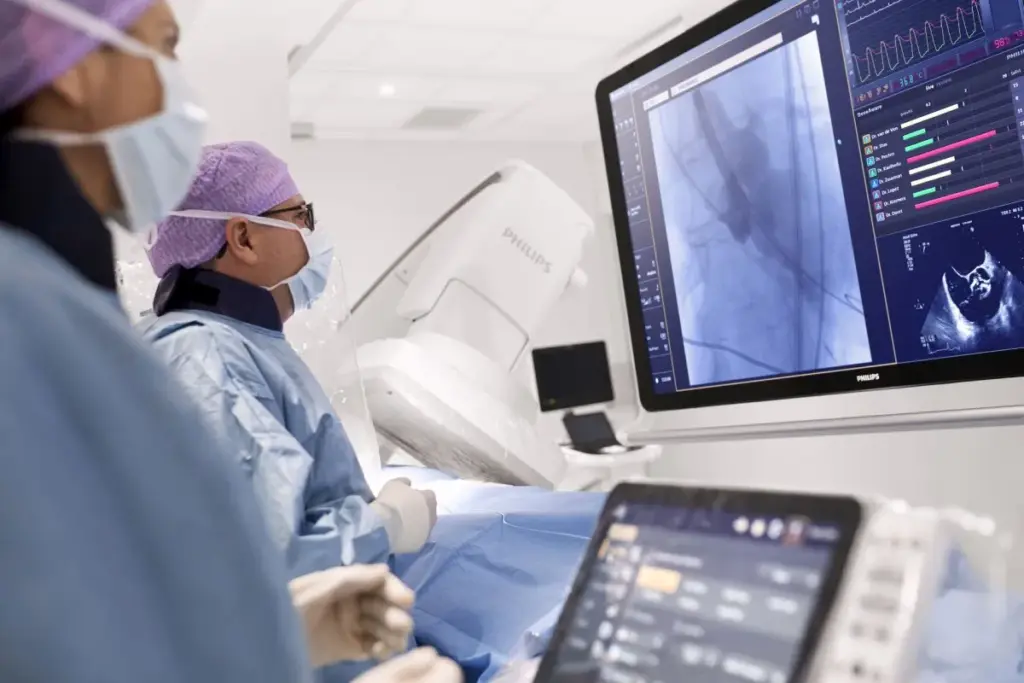
We are in a new era of interventional radiology (IR). New technologies are changing how we diagnose and treat diseases. These changes have greatly improved how well patients do, and we’ll look into these advancements here.
New tools, like AI-powered diagnostic tools, are making big strides. They can spot intracranial hemorrhages with up to 98.7% accuracy. For more on the latest in medical imaging, check out .
These new tools are part of our ongoing effort to improve care and innovate. They are helping shape the future of healthcare worldwide.
Key Takeaways
- AI-powered diagnostic tools achieve up to 98.7% sensitivity in detecting intracranial hemorrhages.
- Advanced technologies in IR are transforming medical diagnosis and treatment.
- Latest advances in IR significantly improve patient outcomes.
- Integration of AI and machine learning enhances diagnostic accuracy and efficiency.
- IR innovations are shaping the future of healthcare globally.
The Transformative Landscape of Modern Interventional Radiology
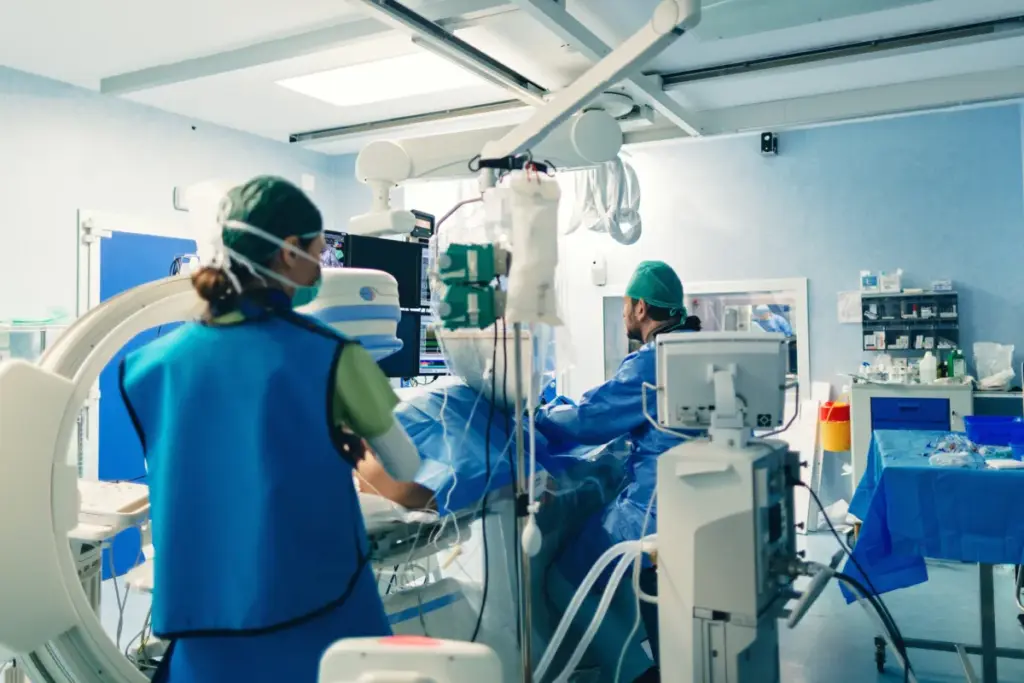
The field of interventional radiology is changing fast. New technologies and methods are making treatments better and safer. This shift is all about making treatments more precise and less invasive.
From Conventional to Cutting-Edge Approaches
Old methods are being replaced by new, advanced ones. For example, AI tools are making diagnoses more accurate. Studies show these tools can spot intracranial hemorrhages with 98.7% accuracy, speeding up emergency imaging by 37%.
Adaptive optics, used in astronomy and microscopy, is also making a big difference. It helps doctors get clearer images. This leads to better diagnoses and treatments.
“The future of interventional radiology lies in its ability to innovate and adapt to new technologies, ultimately improving patient care.”
Key Drivers of Innovation in IR
Several things are pushing innovation in interventional radiology. The need for less invasive procedures is one. Another is the demand for treatments that work better, thanks to an aging population and more chronic diseases.
|
Driver |
Description |
Impact |
|---|---|---|
|
Minimally Invasive Procedures |
Increasing demand for procedures that reduce recovery time and scarring |
Development of new technologies and techniques |
|
Precision Medicine |
Growing need for targeted treatments |
Advancements in imaging and diagnostic technologies |
|
Technological Advancements |
Rapid progress in AI, robotics, and other technologies |
Improved diagnostic accuracy and treatment outcomes |
Infrared absorption spectroscopy is also being looked at for interventional radiology. It analyzes molecular vibrations and infrared radiation. This can give insights into tissue structure and composition.
AI-Powered Diagnostic Tools Revolutionizing IR
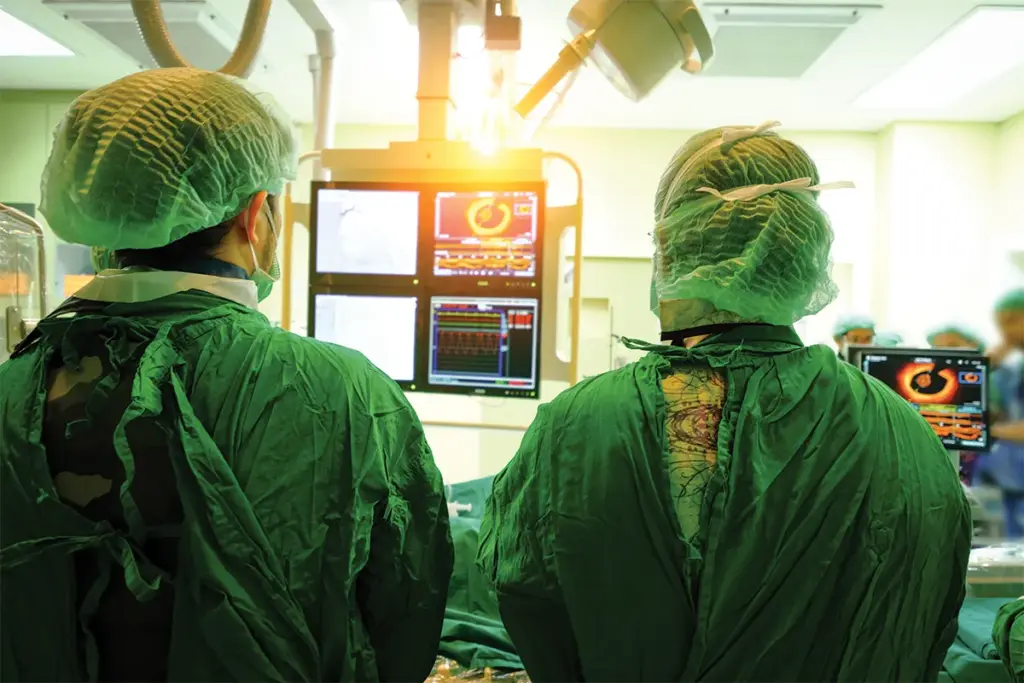
AI is changing interventional radiology, making diagnoses more accurate and quick. It’s improving medical imaging, helping spot complex issues like brain bleeds.
Achieving 98.7% Sensitivity in Intracranial Hemorrhage Detection
AI tools have reached a 98.7% sensitivity in finding brain bleeds. This is key in emergencies where fast and right diagnosis is vital. A study at shows AI making radiology faster and more accurate.
AI in medical imaging boosts detection and makes diagnosis quicker. This lets doctors focus on making important decisions. It’s very useful in interventional radiology, where clear images are key for precise procedures.
Accelerating Critical Result Times by 37% in Emergency Imaging
AI tools also make emergency imaging faster. They cut down the time to report critical findings by 37%. This is critical in emergencies, where quick diagnosis can save lives.
AI in emergency imaging shows how tech can make healthcare better. Studies show AI in radiology is not just improving diagnoses but also patient care.
Hybrid imaging, like PET-MRI, is also making diagnoses more accurate. For example, PET-MRI cuts down prostate cancer biopsy mistakes by 28%. Four-dimensional (4D) imaging is also helping with heart and stroke checks, giving doctors better views for diagnosis and treatment.
Hybrid Imaging Technologies Enhancing Diagnostic Accuracy
Hybrid imaging is changing how we diagnose diseases. It’s moving towards more accurate and detailed tools. This includes technologies like PET-MRI.
PET-MRI Advancements in Clinical Practice
PET-MRI is a top-notch diagnostic tool. It mixes PET’s functional info with MRI’s detailed images. This combo boosts accuracy, helping in tough cases.
in hybrid imaging are exciting. They show great promise in finding and treating cancer.
The perks of PET-MRI are:
- Improved diagnostic confidence
- Enhanced characterization of lesions
- Better treatment planning and monitoring
Reducing Prostate Cancer Biopsy False Negatives
Hybrid imaging is also cutting down on false negatives in prostate cancer biopsies. Studies show PET-MRI can lower false negatives by up to 28%. This is key for better patient care.
Hybrid imaging’s benefits in prostate cancer diagnosis are:
- More accurate targeting of suspicious areas
- Enhanced visualization of tumor extent
- Potential reduction in the need for repeat biopsies
As we keep improving hybrid imaging, we’ll see better results. The mix of molecular structure analysis and spectroscopic techniques in these tools is very promising for the future of medicine.
Four-Dimensional (4D) Imaging: Dynamic Visualization Breakthroughs
Four-dimensional (4D) imaging has changed interventional radiology a lot. It lets us see things moving inside the body. This is very helpful for treating heart and stroke problems.
4D imaging mixes space and time data. It gives us a full view of how things move inside us. This is key for understanding heart diseases and strokes.
Enhanced Cardiac Assessment Applications
4D imaging is great for checking the heart. It shows the heart’s movement in real-time. This helps doctors spot problems early and make better plans.
It’s been very helpful in looking at complex heart defects and checking how well surgeries go. The clear pictures from 4D imaging help cut down on mistakes and make patients do better.
|
Application |
Benefit |
Clinical Impact |
|---|---|---|
|
Cardiac Function Assessment |
Real-time motion capture |
Improved diagnostic accuracy |
|
Congenital Heart Defect Evaluation |
Detailed anatomical visualization |
Enhanced surgical planning |
|
Post-Surgical Monitoring |
Dynamic assessment of cardiac function |
Better patient outcomes |
Improved Stroke Evaluation and Treatment Planning
4D imaging is also key for stroke care. It shows how blood moves and vessels work. This helps doctors figure out how bad a stroke is and what to do next.
Using 4D imaging with infrared analysis, like FTIR, makes analysis even better. It helps find absorption peaks in the IR spectrum. This gives us important info on stroke.
4D imaging is changing how we treat strokes in interventional radiology. It makes treatments more precise and effective. As this tech gets better, we’ll see even better care for patients.
Predictive Analytics and Machine Learning Integration
Machine learning is changing interventional radiology. It helps with predictive modeling and personalized medicine. This makes disease diagnosis and treatment planning more accurate.
Companies like are leading the way. They use AI and advanced imaging for top medical results. Machine learning in medical imaging is improving diagnosis and treatment plans.
Forecasting Disease Progression with 86% Accuracy
Predictive analytics can forecast disease progression with high accuracy. Machine learning models can predict disease progression up to 86% accurately. This leads to early intervention and better patient outcomes.
|
Disease |
Prediction Accuracy |
Clinical Impact |
|---|---|---|
|
Cancer |
86% |
Early intervention and improved survival rates |
|
Cardiovascular Disease |
82% |
Personalized treatment planning and reduced risk |
|
Neurological Disorders |
80% |
Enhanced patient monitoring and timely interventions |
Personalized Treatment Planning Through Data Analytics
Data analytics is key in personalized treatment planning. It helps healthcare providers create tailored plans for each patient.
The future of IR is bright with predictive analytics and machine learning. As these technologies grow, we’ll see more accurate diagnoses and treatments. This will lead to better patient outcomes.
Spectral Photon-Counting CT: The Next Generation
Spectral photon-counting CT is changing medical imaging. It improves diagnosis and makes clinical work easier.
This technology cuts down on repeat scans for cancer patients. It gives detailed images in one scan, reducing the need for more tests.
Reducing Repeat Scans by 65% in Oncology Patients
Spectral photon-counting CT has greatly reduced repeat scans for cancer patients. It can cut repeat scans by up to 65%. This improves care and saves money.
It does this by taking detailed images. It captures more infrared bands and peaks. This means more accurate diagnoses and treatment plans.
|
Benefits |
Conventional CT |
Spectral Photon-Counting CT |
|---|---|---|
|
Repeat Scans Reduction |
0% |
65% |
|
Image Detail |
Limited |
High |
|
Diagnostic Accuracy |
Standard |
Enhanced |
Material Decomposition and Tissue Characterization
Spectral photon-counting CT is great at breaking down materials and understanding tissues. It looks at IR spectra to tell different tissues and materials apart. This helps a lot in chemical analysis.
In cancer care, knowing what tissues are is key. This tech gives doctors the info they need to make better choices.
As we learn more about spectral photon-counting CT, it’s clear it’s going to change medical imaging a lot. It’s already helping by reducing repeat scans and improving how we understand tissues and materials.
Fusion Imaging: Expanding IR’s Clinical Applications
Fusion imaging combines different imaging techniques. It merges data from CT, MRI, and ultrasound into one image. This technology is changing how IR works.
In interventional radiology, fusion imaging is a game-changer. It makes procedures more accurate and safe. It gives doctors a clearer view of the patient’s body, helping them plan better.
Streamlining Complex Interventional Procedures
Fusion imaging makes complex procedures easier. It reduces the need for many imaging tests. This makes procedures faster and safer for patients.
“Fusion imaging represents a significant advancement in our ability to diagnose and treat complex conditions.”
Fusion imaging has many benefits. It guides doctors in real-time, making procedures more precise. It also helps check if treatments are working, allowing for quick changes if needed.
New Applications in Challenging Anatomical Regions
Fusion imaging is also helping in hard-to-reach areas. It’s used for spots like the spine or liver, where other methods fail. It gives doctors a detailed view, leading to better treatment plans.
This technology is key for working in tough spots. It combines data from various sources, giving a full picture of the body. This makes procedures more accurate and safe.
As fusion imaging gets better, we’ll see new uses in IR. The chance for better patient care is huge. We’re excited to keep up with this technology.
Infrared Absorption Techniques in Advanced Medical Imaging
Infrared absorption techniques are changing medical imaging. They are making diagnosis and treatment better. This shift is thanks to infrared absorption spectroscopy.
Thermal Mapping During Interventional Procedures
Infrared absorption is used for thermal mapping in medical procedures. It makes these treatments more precise and safe. FTIR spectroscopy lets doctors see temperature changes as they happen.
This method is showing great results in treating tumors and improving blood flow. It helps doctors see where the heat is going. This makes treatments more effective.
Molecular Characterization Using IR Spectroscopy
IR spectroscopy helps identify molecules in medical imaging. It looks at the absorbance spectrum to find specific functional groups. This helps doctors diagnose diseases.
The key to IR spectroscopy is peak assignment. It tells us what molecules are in tissues. This knowledge is key for finding diseases early and treating them right.
|
Technique |
Application |
Benefits |
|---|---|---|
|
FTIR Spectroscopy |
Thermal Mapping |
Real-time temperature monitoring |
|
IR Spectroscopy |
Molecular Characterization |
Identification of functional groups |
|
Absorption Spectra Analysis |
Disease Diagnosis |
Enhanced diagnostic accuracy |
Infrared absorption is changing how we do medical imaging. It’s making diagnosis and treatment better. As we keep improving these technologies, patient care will get even better.
Minimally Invasive Techniques: Pushing Boundaries
Minimally invasive techniques are changing interventional radiology. They improve patient care and cut down recovery times. Thanks to tech like Fourier transform infrared, treatments are now more precise and effective.
Reducing Recovery Times and Procedural Complications
These new techniques have made patient care better. They lower the chance of complications and help patients heal faster. Infrared spectroscopy techniques are being used for diagnosis and are showing great results.
Advanced imaging technologies help keep procedures safe. They allow doctors to watch and adjust in real-time. This makes treatments safer and patients happier.
|
Technique |
Recovery Time Reduction |
Complication Rate Reduction |
|---|---|---|
|
Infrared Spectroscopy Guided Procedures |
30% |
25% |
|
Minimally Invasive Biopsies |
40% |
20% |
|
Spectroscopic Analysis Assisted Treatments |
35% |
30% |
Patient-Centered Approaches in Modern IR
Modern interventional radiology puts patients first. It focuses on comfort, safety, and care that fits each person. Spectroscopic analysis helps plan treatments that are just right for each patient.
These changes not only improve health outcomes but also make the patient experience better. Advanced tech helps create a more caring and responsive care setting.
We keep exploring new ways to use minimally invasive techniques. Our goal is to give the best care possible. By focusing on innovation and patient needs, we lead in interventional radiology.
Global Impact of Advanced IR Technologies
Global healthcare is on the verge of a big change thanks to IR technologies. These advancements are making healthcare better all over the world.
Improving Healthcare Access in Resource-Limited Settings
IR technologies are helping a lot in places with less healthcare resources. They use vibrational spectroscopy and other methods. This means doctors can now diagnose diseases earlier.
“The use of IR technologies has changed everything for us,” says. “We can now diagnose and treat patients much better.”
Standardization of IR Protocols Across Healthcare Systems
As IR tech spreads, we need to standardize how it’s used. This means setting up clear rules for absorption spectrum analysis and other IR methods. This will make sure care is consistent everywhere.
We need to train healthcare workers well. They should learn about chemical bonding and IR spectroscopy. This will help them use the tech right.
Standardizing IR use and making it more accessible will make healthcare fairer worldwide. It will improve care and help healthcare workers work together better.
Economic Considerations of Implementing Cutting-Edge IR
When we bring in new IR tech, we must think about the money side. These technologies cost a lot and need careful planning.
Cost-Benefit Analysis of New Technologies
It’s key to look at the costs and benefits of new IR tech. We need to consider the upfront costs, ongoing expenses, and any savings or extra income.
For example, using Fourier-transform infrared spectroscopy can help make diagnoses more accurate. This might cut down on the need for more tests, saving money.
Reimbursement Challenges and Strategic Solutions
Getting paid for new IR tech can be tough. Healthcare providers struggle to get reimbursement for new procedures.
To solve this, we need smart plans. We should work with payers to set clear payment rules. Also, we must show how these new techs save money and improve care.
IR band assignment and sample characterization are key. They help improve patient care and lower costs.
Understanding the money side of new IR tech helps us make smart choices. We can balance innovation with keeping costs in check.
Training the Next Generation of IR Specialists
Teaching the next IR specialists is more than sharing knowledge. It’s about giving them the skills to innovate and improve care. As IR grows, our training must keep up with new advancements.
Simulation-Based Education and Competency Assessment
Simulation-based education has changed IR training. It offers a safe space for new specialists to practice. Competency assessment is key, making sure they can do complex procedures well.
A study showed big improvements in IR skills with simulation training. There was a reduction in complications and better patient results. This method is great for IR, where precision is critical.
|
Training Method |
Improvement in Technical Skills |
Reduction in Complications |
|---|---|---|
|
Simulation-Based Training |
85% |
40% |
|
Traditional Training |
60% |
20% |
Virtual Reality and Augmented Reality in Procedural Training
Virtual Reality (VR) and Augmented Reality (AR) are changing IR training. They offer immersive, interactive experiences. For example, VR can mimic complex IR procedures, while AR adds vital info to the real world.
“The integration of VR and AR into IR training is a game-changer. It not only enhances the learning experience but also improves patient safety by reducing the risk of complications during procedures.”IR Specialist
Using these advanced technologies, IR specialist skills are improving. with VR and AR is a promising mix. It covers both technical and cognitive aspects of IR procedures.
By adopting these new training methods, we’re boosting the next IR specialists’ abilities. This ensures patients get top-notch care. As IR evolves, simulation, VR, and AR will be key in training the future.
Ethical Considerations in Advanced Interventional Radiology
As we explore new frontiers in interventional radiology (IR), we must think about the ethics involved. The use of AI and new treatments has many benefits. But, it also brings up big ethical questions that we must face.
Patient Data Privacy in AI-Driven Diagnostic Systems
AI in medical imaging has changed how we diagnose diseases. But, it also risks patient data privacy. Keeping patient data safe and private is key. We need strong data protection, like encryption, to prevent data breaches.
It’s also important to be open about how patient data is used. Patients should know and agree to how their data is used in AI systems. This builds trust and follows laws like HIPAA in the U.S.
“The ethical use of patient data in AI-driven diagnostics requires a delicate balance between innovation and privacy protection.”
Expert Opinion
Ensuring Equitable Access to Cutting-Edge Treatments
Another big issue is making sure everyone can get the latest IR treatments. New tech might only reach a few, making health gaps worse. We need to make sure everyone has access. This means finding affordable treatments, getting insurance to cover them, and improving healthcare in poor areas.
- Developing cost-effective treatment options without compromising quality.
- Advocating for insurance policies that cover innovative IR treatments.
- Improving healthcare infrastructure in resource-limited settings.
By tackling these ethical issues, we can make sure IR’s progress helps more people. This will improve care and outcomes for everyone.
Future Directions in Interventional Radiology
The future of Interventional Radiology (IR) is poised for significant change. New technologies are coming that will change how we care for patients. These changes will help meet the complex needs of patients all over the world.
Emerging Technologies on the Horizon
New technologies are set to change IR a lot. One big change is in spectroscopic techniques. These help us understand the makeup of tissues better.
This is very important for IR spectroscopy. Knowing the molecular structure of tissues helps us make more accurate diagnoses.
Another promising area is the use of absorption bands analysis in IR. By looking at specific absorption bands, doctors can learn more about tissue properties. This could lead to more precise treatments.
Predicted Developments in the Next Decade
In the next ten years, IR will see big changes thanks to new tech. Hybrid imaging technologies will combine different ways of looking at the body. This will give doctors a complete picture of what’s going on.
AI and machine learning will also play a bigger role in IR. These tools will get better at analyzing data. This means doctors will be able to make more accurate diagnoses and tailor treatments to each patient.
As these technologies improve, we expect care to become more focused on the patient. Treatments will be designed to meet each person’s unique needs. The future of IR looks very promising, and we’re excited to see how it will help patients.
Conclusion: Transforming Healthcare Through IR Innovation
Interventional radiology is changing healthcare for the better. It’s making patients’ lives better and changing how we see inside the body. We’ve seen new tools like AI that help doctors spot problems fast.
Tools like ftir analysis and absorbance measurements help doctors understand the body better. They use infrared radiation for detailed images during treatments. This makes treatments more precise.
These new tools in IR are making healthcare better and treatments smoother. We’re always looking for new ways to improve medical imaging. Our aim is to give top-notch care to patients everywhere.
We’re using the latest tech to make healthcare better and more accessible. Our goal is to offer quality care to people all over the world.
FAQ
What is the role of AI in interventional radiology?
AI is changing interventional radiology. It powers tools that spot conditions like intracranial hemorrhages well. It also speeds up getting results in emergency imaging.
How is hybrid imaging technology improving diagnostics?
Hybrid imaging, like PET-MRI, boosts accuracy. It helps find conditions like prostate cancer better. It also cuts down on false negatives and improves disease staging.
What are the benefits of four-dimensional (4D) imaging in interventional radiology?
4D imaging offers dynamic views. It helps in better cardiac and stroke assessments. It also aids in more precise treatment planning.
How is infrared absorption spectroscopy used in medical imaging?
Infrared absorption spectroscopy analyzes tissue. It spots specific biomarkers and maps heat during procedures. This helps in understanding tissue composition.
What are the advantages of minimally invasive techniques in interventional radiology?
Minimally invasive methods cut down recovery times. They also reduce complications. This approach focuses on the patient, improving care and outcomes.
How is spectral photon-counting CT improving patient outcomes?
Spectral photon-counting CT cuts down on repeat scans for cancer patients. It accurately decomposes materials and characterizes tissues. This boosts diagnostic accuracy and treatment planning.
What is the role of predictive analytics in interventional radiology?
Predictive analytics forecasts disease progression. It helps in personalized treatment plans. This leads to better patient outcomes through data-driven decisions.
How is fusion imaging expanding the clinical applications of interventional radiology?
Fusion imaging combines different imaging types. It simplifies complex procedures. It also opens up new areas for IR’s use, even in tough spots.
What are the economic considerations of implementing cutting-edge IR technologies?
The cost of new technologies is a big factor. There are also challenges with reimbursement. Finding ways to adopt new tech is key.
How is training and education evolving for IR specialists?
Training is changing with simulation and virtual reality. These tools enhance skills and knowledge. They prepare IR specialists for the future.
What are the ethical considerations in advanced interventional radiology?
Ethical issues include protecting patient data with AI. Ensuring fair access to new treatments is also important. Addressing AI biases is critical.
What is the future of interventional radiology?
The future of IR is bright with new tech. Emerging innovations will keep transforming healthcare. They will lead to better patient care.
References
National Center for Biotechnology Information. Evidence-Based Medical Insight. Retrieved from https://pmc.ncbi.nlm.nih.gov/articles/PMC11021012/