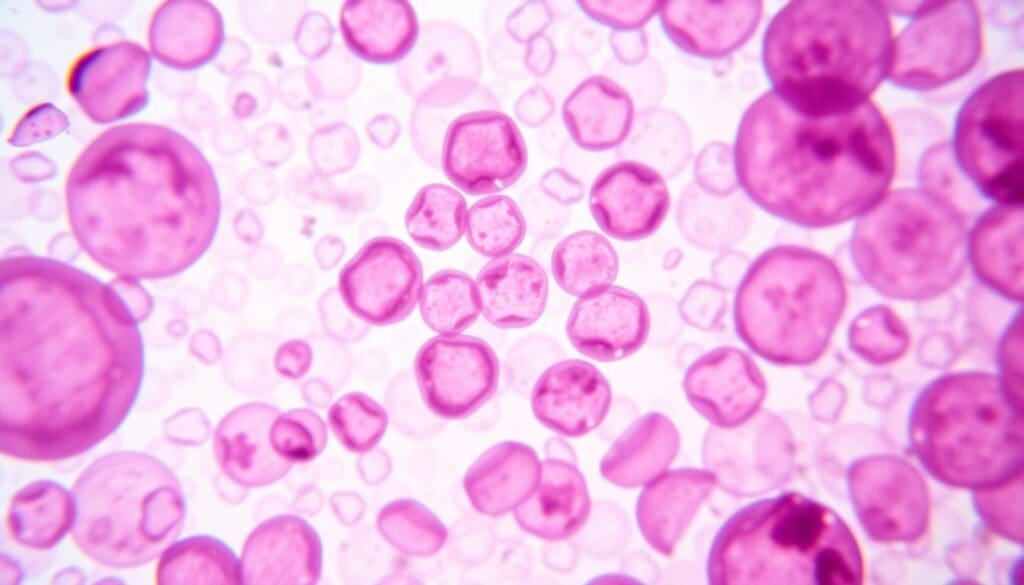
Diagnosing acute lymphoblastic leukemia depends on spotting key signs in an ALL peripheral smear. At Liv Hospital, we utilize the latest technology and expertise to accurately diagnose and treat blood diseases like ALL.
Acute lymphoblastic leukemia (ALL) is a blood and bone marrow cancer. It causes the overproduction of young white blood cells, called lymphoblasts. Our team of doctors and specialists works together to provide the best care for ALL patients, ensuring each individual receives a personalized and effective treatment plan.
Key Takeaways
- Accurate diagnosis of ALL relies on peripheral smear findings.
- LivHospital provides state-of-the-art evaluation for hematologic conditions.
- ALL is a cancer that affects the blood and bone marrow.
- Immature white blood cells, known as lymphoblasts, are a hallmark of ALL.
- Comprehensive care for ALL patients involves a team of hematologists and oncologists.
Understanding Acute Lymphoblastic Leukemia (ALL)
Acute Lymphoblastic Leukemia (ALL) is a serious blood cancer. It happens when a single cell in the blood grows out of control. This cell has many genetic changes that affect how blood cells grow and multiply.
Pathophysiology of Lymphoblastic Transformation
ALL starts when normal blood cells turn cancerous. This can happen in B-cells or T-cells. Genetic changes are key in this process. They mess with how cells grow, die, and fix DNA problems.
Some genes, like ARID5B, CDKN2A/2B, CEBPE, IKZF1, GATA3, and PIP4K2A, are linked to ALL risk. These genes play important roles in cell function.
Epidemiology and Risk Factors
ALL affects people of all ages, but in different ways. The exact cause is often a mystery. Yet, some genetic and environmental factors are known to raise the risk.
Genetic conditions like Down syndrome, Fanconi anemia, and ataxia-telangiectasia increase the risk. Exposure to radiation and certain chemicals also raises the risk.
| Risk Factor | Description | Relative Risk |
| Down Syndrome | A genetic condition characterized by an extra chromosome 21 | 20-30 times higher |
| Fanconi Anemia | Rare genetic disorder affecting DNA repair mechanisms | High risk, exact RR varies |
| Ionizing Radiation | Exposure to high-energy radiation, e.g., from nuclear accidents | Increased risk, dose-dependent |
Knowing these risk factors helps us spot who’s at higher risk. This lets us take steps to watch over them closely.
The Critical Role of ALL Peripheral Smear in Diagnostic Workflow
In diagnosing Acute Lymphoblastic Leukemia, the peripheral blood smear is key. It lets us see blood cells and spot abnormal ones typical of ALL. This first step is vital for understanding the patient’s health.
What Constitutes a Peripheral Blood Smear
A peripheral blood smear is made by spreading blood on a slide, staining it, and then looking at it under a microscope. It shows us the shape and details of blood cells. This is important for spotting diseases like ALL.
Creating a peripheral blood smear involves a few steps:
- Collecting a blood sample
- Spreading the blood on a slide
- Staining the smear to highlight cell details
- Looking at it under a microscope
Integration with Other Diagnostic Modalities
Combining peripheral blood smear results with other tests is key to accurate diagnosis. We use findings from the smear, flow cytometry, cytogenetics, and more to understand the disease fully. This helps us find the right treatment for ALL.
Some important tests we use with the smear include:
- Flow cytometry to find specific markers on cells
- Cytogenetic analysis to spot chromosomal issues
- Molecular diagnostics to find genetic changes
By using these tools together, we get a clearer picture of the patient’s health. This is essential for planning effective treatment.
Laboratory Techniques for Optimal ALL Peripheral Smear Analysis
Diagnosing Acute Lymphoblastic Leukemia (ALL) depends a lot on analyzing peripheral blood smears. This process needs careful laboratory techniques. It involves several steps, like Complete Blood Count (CBC), Peripheral Blood Smear (PBS), and Bone Marrow Aspiration/Biopsy (BMA/BMB).
Other important steps include flow cytometry, cytogenetic analysis, and molecular studies.
Sample Collection and Preparation Methods
Getting the right blood sample is key for ALL diagnoses. Blood is collected in EDTA tubes to stop it from clotting. Then, it’s smeared onto glass slides. The quality of the smear is very important for accurate results.
- Proper venipuncture technique is essential to avoid hemolysis and contamination.
- EDTA tubes should be filled to the recommended volume to ensure the correct anticoagulant-to-blood ratio.
- Smears should be made within a few hours of collection to preserve cell morphology.
It’s vital to train lab staff well in making high-quality blood smears. The smearing technique can greatly affect cell distribution and shape.
Staining Protocols for Blast Identification
Staining blood smears is a key step in finding blasts and abnormal cells in ALL. Wright-Giemsa staining is often used for this.
The staining process involves several steps:
- Fixation of the smear to preserve cell morphology.
- Application of the Wright-Giemsa stain, which differentially stains various cell components.
- Buffering to achieve the optimal pH for staining.
Optimal staining techniques are essential for telling different types of leukemia apart. They help spot specific ALL blast features, like Auer rods or cytoplasmic granules.
We suggest sticking to standardized staining protocols. Regularly checking the staining process helps keep the diagnosis accurate and consistent.
Finding #1: Lymphoblasts with High Nuclear-to-Cytoplasmic Ratio
Lymphoblasts with a high nuclear-to-cytoplasmic ratio are a key sign of Acute Lymphoblastic Leukemia (ALL) in blood smears. This feature is vital for diagnosing ALL and differentiating it from other leukemias.
Morphological Characteristics and Measurements
Lymphoblasts in ALL are small to medium-sized cells. They have a high nuclear-to-cytoplasmic ratio, meaning their nucleus is large compared to their cytoplasm. The chromatin is condensed, and the cytoplasm is sparse. These traits are essential for spotting lymphoblasts and telling ALL apart from other blood cancers.
The nuclear-to-cytoplasmic ratio is a key factor in identifying lymphoblasts. A higher ratio means the nucleus is bigger compared to the cytoplasm, a hallmark of ALL lymphoblasts. This ratio can vary, but a ratio over 0.7 usually points to lymphoblasts.
Differential Diagnosis Considerations
When looking at blood smears for lymphoblasts, it’s important to think about other possible diagnoses. Conditions like acute myeloid leukemia (AML) and lymphoma can also show abnormal cells. But lymphoblasts with a high nuclear-to-cytoplasmic ratio are most typical of ALL.
To make a sure diagnosis, we need to look at the cells’ shape and other tests like immunophenotyping, cytogenetics, and molecular studies. This detailed approach helps us accurately diagnose and classify ALL. It’s key to choosing the right treatment.
Finding #2: Nuclear Irregularities and Prominent Nucleoli
Nuclear irregularities and large nucleoli are key signs in ALL. They help doctors understand the disease better. These signs in blood smears tell us about the disease’s outlook and how it might react to treatment.
Nuclear Membrane Characteristics in ALL
Nuclear oddities in ALL blasts can look like folds or bumps. These odd shapes can make diagnosis tricky, as they might look like other diseases. We look at these details to figure out the best treatment.
Studies show that these odd shapes are linked to certain genetic changes. These changes can make the disease more aggressive. Knowing this helps doctors find better treatments.
Nucleoli Patterns and Prognostic Significance
In some cases, large nucleoli are a big deal. The size and shape of nucleoli can tell us about the disease’s future. We study these patterns to improve disease management.
A recent study found that “Large nucleoli in lymphoblasts mean a worse outlook for some ALL types.” (
This finding highlights the need for careful blood smear analysis in ALL diagnosis.
)
Finding #3: Cytoplasmic Features and Vacuolation in ALL Blasts

Cytoplasmic features and vacuolation in ALL blasts are key to understanding the disease. The cytoplasm of ALL blasts can vary in basophilia and may show vacuolation, mainly in certain subtypes.
Cytoplasmic Basophilia Assessment
The cytoplasm of ALL blasts can show different levels of basophilia, which is vital for diagnosis. Basophilia refers to the intensity of blue staining due to RNA. We check this to see the maturity and type of the blasts.
The degree of basophilia can differ in various ALL cases. Some blasts have deeply basophilic cytoplasm, while others appear more pale.
Significance of Vacuoles in L3 Subtype
Vacuolation is a key feature in certain ALL subtypes, like the L3 subtype. L3 ALL is characterized by blasts with prominent vacuolation, which helps in distinguishing it.
- Vacuoles are typically rounded and can vary in size.
- The presence of vacuoles can aid in the diagnosis of specific ALL subtypes.
- L3 subtype, also known as Burkitt-type ALL, often presents with pronounced vacuolation.
Examining cytoplasmic features and vacuolation in ALL blasts gives us important diagnostic information. Understanding these helps in accurately classifying and diagnosing ALL subtypes.
Finding #4: Presence of Specific Cytoplasmic Inclusions
Specific cytoplasmic inclusions are key in diagnosing Acute Lymphoblastic Leukemia (ALL). They help tell ALL apart from other leukemias like Acute Myeloid Leukemia (AML).
Distinguishing ALL from AML Inclusions
Certain cytoplasmic inclusions are linked to specific leukemias. For example, Auer rods are common in AML and are a key sign of this disease. But finding Auer rods in ALL is very rare. This makes spotting them important for telling ALL and AML apart.
We use detailed looks at peripheral blood smears to find these inclusions. This helps us tell ALL from AML.
Rare Inclusion Bodies in ALL Variants
While Auer rods are typical of AML, some ALL types might have rare inclusion bodies. These can include things like cytoplasmic granules or vacuoles. They’re not usually seen in ALL. Finding these rare inclusions needs careful study.
They give us clues about the variety in ALL. Knowing about these inclusions can also affect how we diagnose and treat ALL.
In summary, the presence of specific cytoplasmic inclusions in ALL is a key part of the diagnosis. By knowing what inclusions are in ALL and how they differ from others, we can get better at diagnosing. This can also help guide treatment choices.
Finding #5: Quantitative Abnormalities in ALL Peripheral Smear
In ALL, we look at how many blasts are in the blood. This helps us know how serious the disease is and what treatment to use.
We count the blasts and see how they are spread out. More blasts often mean a tougher fight against the disease.
Blast Percentage Thresholds and Significance
The number of blasts in the blood can change a lot in ALL patients. More blasts usually mean a worse outlook. Doctors use certain numbers to decide how serious the disease is and what to do next.
For example, more than 20% blasts in the blood means the disease is more aggressive. Watching these numbers helps doctors change treatment plans.
Distribution Patterns in Peripheral Blood
How blasts are spread out in the blood also tells us a lot. Sometimes they are spread out evenly, other times they bunch up or show other patterns.
Knowing these patterns is key to making the right diagnosis and predicting the future. Some patterns might point to certain types of ALL that need special treatments.
By looking at both the number and spread of blasts, doctors get a clearer picture of the disease. This helps them make better treatment plans and improve patient results.
Finding #6: Characteristic ALL Peripheral Smear Patterns in Different Subtypes
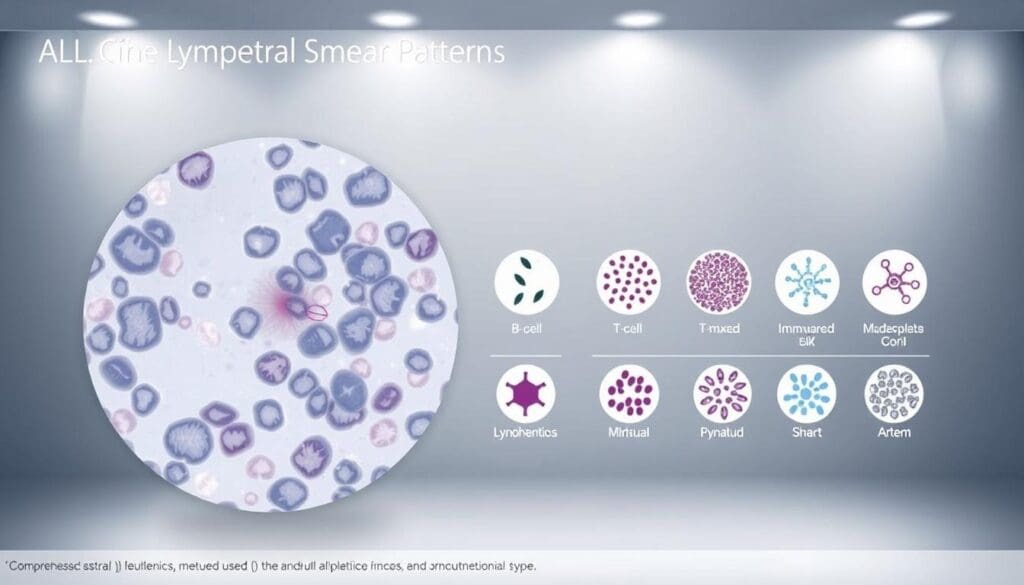
In diagnosing Acute Lymphoblastic Leukemia (ALL), it’s key to know the smear patterns of each subtype. B-cell and T-cell ALL have unique features on blood smears. These details are vital for correct diagnosis and treatment.
B-Cell vs. T-Cell ALL Morphological Differences
B-cell and T-cell ALL show different looks on blood smears. B-cell ALL has lymphoblasts with big nuclei and often has cytoplasmic vacuoles. On the other hand, T-cell ALL lymphoblasts vary in size and have odd-shaped nuclei. Knowing these differences helps identify the subtype.
While blood smears offer clues, they’re not enough for a final diagnosis. Immunophenotyping is needed. But smears can guide the next steps in diagnosis.
Philadelphia Chromosome-Positive ALL Features
Philadelphia chromosome-positive ALL has a BCR-ABL1 fusion gene. This subtype has its own prognosis. Blood smears may look like other B-cell ALL cases. Yet, the Philadelphia chromosome changes the outlook and treatment plans, possibly adding tyrosine kinase inhibitors.
Spotting the unique smear patterns in ALL subtypes, including Philadelphia chromosome-positive, is key. It helps in making the right diagnosis and treatment plans for each patient.
Finding #7: Associated Hematopoietic Cell Abnormalities
ALL peripheral smears often show more than just lymphoblasts. They reveal other important cell abnormalities. These findings help doctors understand the disease better.
Red Blood Cell Morphology in ALL
Anemia is common in ALL patients. The smear can show different red blood cell issues. Normocytic normochromic anemia is often seen, but microcytic hypochromic anemia can also appear due to iron deficiency or chronic illness.
The red blood cells may vary in size and shape. This suggests problems in how they are made. Sometimes, nucleated red blood cells are found, showing the bone marrow is stressed or invaded.
Platelet Abnormalities and Significance
Thrombocytopenia is common in ALL patients. The smear can show low platelet counts and size/morphology issues.
Giant platelets or hypogranular platelets might be seen. These signs point to problems in platelet production. They hint at how much the bone marrow is affected and the risk of bleeding.
In summary, looking at cell abnormalities in ALL smears is key. It helps doctors diagnose, predict outcomes, and plan treatments. By studying red blood cells and platelets, doctors get a clearer picture of the disease’s effects on the body.
Finding #8: Bone Marrow Failure Manifestations in Peripheral Blood
Lymphoblasts in the bone marrow cause big changes in the blood. This shows bone marrow failure. It leads to low counts of blood cells, which is key for diagnosing Acute Lymphoblastic Leukemia (ALL).
Evidence of Marrow Infiltration
Lymphoblasts in the bone marrow mess up how blood cells are made. This shows up in the blood as:
- Anemia: Fewer red blood cells or less hemoglobin means anemia. It’s a sign of marrow problems.
- Thrombocytopenia: Fewer platelets mean a higher risk. It’s a big deal in ALL patients.
- Leukopenia or Leukocytosis: Lymphoblasts in the blood can lower or raise white blood cell counts. This makes diagnosis tricky.
Compensatory Hematopoietic Responses
The body tries to fix bone marrow failure in its own way. It does this by making blood cells outside the bone marrow, like in the liver or spleen. This is called extramedullary hematopoiesis. But it’s not enough to fix the blood cell counts.
It’s important to understand these signs of bone marrow failure in the blood. Doctors look at the blood smear to see how the disease affects blood cell making. This helps them figure out how severe the disease is.
LivHospital’s Advanced Approach to ALL Diagnosis
At LivHospital, we’re dedicated to finding the best ways to diagnose Acute Lymphoblastic Leukemia (ALL). We use the latest technology and expert hematopathology services. This ensures our patients get the most accurate and quick diagnoses.
State-of-the-Art Hematopathology Services
Our hematopathology services help diagnose and manage ALL. We use advanced lab techniques and detailed analysis. This helps us spot the specific traits of lymphoblasts in patient samples.
Key features of our hematopathology services include:
- Advanced staining techniques for clear visualization of cellular structures
- Expert morphological analysis for accurate identification of lymphoblasts
- Integration with other diagnostic modalities for a complete patient evaluation
Integrated Diagnostic Algorithms
At LivHospital, we use a special way to diagnose ALL. We mix clinical data, lab results, and imaging techniques. This helps us understand each patient’s condition fully.
This approach lets our doctors create treatment plans that fit each patient’s needs.
The following table shows what our ALL diagnostic algorithm includes:
| Diagnostic Component | Description | Clinical Significance |
| Peripheral Smear Analysis | Detailed examination of blood smears for lymphoblast identification | Critical for initial diagnosis and monitoring of ALL |
| Flow Cytometry | Immunophenotyping of lymphoblasts to determine lineage and maturity | Essential for subclassification and treatment planning |
| Cytogenetic Analysis | Identification of chromosomal abnormalities associated with ALL | Important for prognostication and risk stratification |
By using these advanced tools, LivHospital can give accurate diagnoses for ALL patients. This helps us start treatment quickly and effectively.
Clinical Implications of Peripheral Smear Findings
The findings from a peripheral smear in Acute Lymphoblastic Leukemia (ALL) are very important. They help us decide the best treatment and predict how well a patient will do.
Treatment Strategy Determination
Peripheral blood smear analysis is key in planning treatment for ALL. For example, a high number of blasts might mean more intense chemotherapy is needed. We look at several things, like the type of blasts, any special genetic changes, and the patient’s overall health.
The table below shows how smear findings affect treatment:
| Peripheral Smear Finding | Treatment Implication |
| High blast percentage | Intensive chemotherapy |
| Presence of specific cytogenetic abnormalities | Targeted therapy |
| Morphological characteristics of blasts | Risk stratification |
Prognostic Indicators from Smear Analysis
Peripheral smear analysis also gives us clues about how well a patient might do. Some features and genetic changes seen in the smear can tell us about treatment success and survival chances. For instance, the Philadelphia chromosome is linked to a worse outlook, while some genetic changes might mean a better chance of recovery.
“The integration of peripheral smear findings with other diagnostic modalities enhances our ability to predict patient outcomes and tailor treatment strategies.”
By studying the smear findings closely, we can understand more about ALL. This helps us create treatment plans that can really help patients.
Conclusion
At LivHospital, we know how important it is to use peripheral blood smear findings with other tests to find acute lymphoblastic leukemia (ALL) accurately. The peripheral smear helps spot key features like lymphoblasts and specific inclusions in the cells.
We use the latest in hematopathology and diagnostic tools to diagnose ALL. By mixing peripheral smear results with clinical signs and other tests, we give patients the right diagnosis quickly. This helps us offer complete care for those with ALL.
Finding ALL needs a team effort, and we’re dedicated to top-notch healthcare for all patients. Our experts work with patients to create care plans that fit their needs. This is based on detailed diagnostic results.
FAQ
What is Acute Lymphoblastic Leukemia (ALL)?
ALL is a blood cancer. It affects the bone marrow. It’s caused by immature white blood cells, called lymphoblasts.
How is ALL diagnosed?
Doctors use blood smears to diagnose ALL. They look for lymphoblasts and other cell abnormalities.
What are the risk factors for developing ALL?
Some genetic syndromes increase the risk of ALL. These include Down syndrome and Fanconi anemia. Environmental factors like radiation also play a role.
What is the significance of lymphoblasts in ALL diagnosis?
Lymphoblasts are key in diagnosing ALL. They have a unique shape. Finding them is essential for a diagnosis.
How do peripheral blood smears help in ALL diagnosis?
Blood smears show lymphoblasts and other important features. They help doctors tell ALL apart from other leukemias.
What is the role of cytoplasmic features in ALL diagnosis?
Cytoplasmic features, like basophilia, help in diagnosing ALL. They are important, like in L3 subtypes.
How does LivHospital approach ALL diagnosis and treatment?
LivHospital uses a detailed approach for ALL. We have advanced diagnostic tools and services.
What are the clinical implications of peripheral smear findings in ALL?
Findings from blood smears guide treatment and predict outcomes. Certain features, like blast percentage, are key.
What is the significance of quantitative abnormalities in the ALL peripheral smear?
Quantitative findings, like blast percentage, are important. They help predict how well a patient will respond to treatment.
How do different subtypes of ALL exhibit distinct peripheral blood smear patterns?
B-cell and T-cell ALL show different patterns in blood smears. Philadelphia chromosome-positive ALL also has unique features that affect treatment.
Reference
MedlinePlus. (n.d.). Complete blood count (CBC). U.S. National Library of Medicine.https://medlineplus.gov/lab-tests/complete-blood-count-cbc/