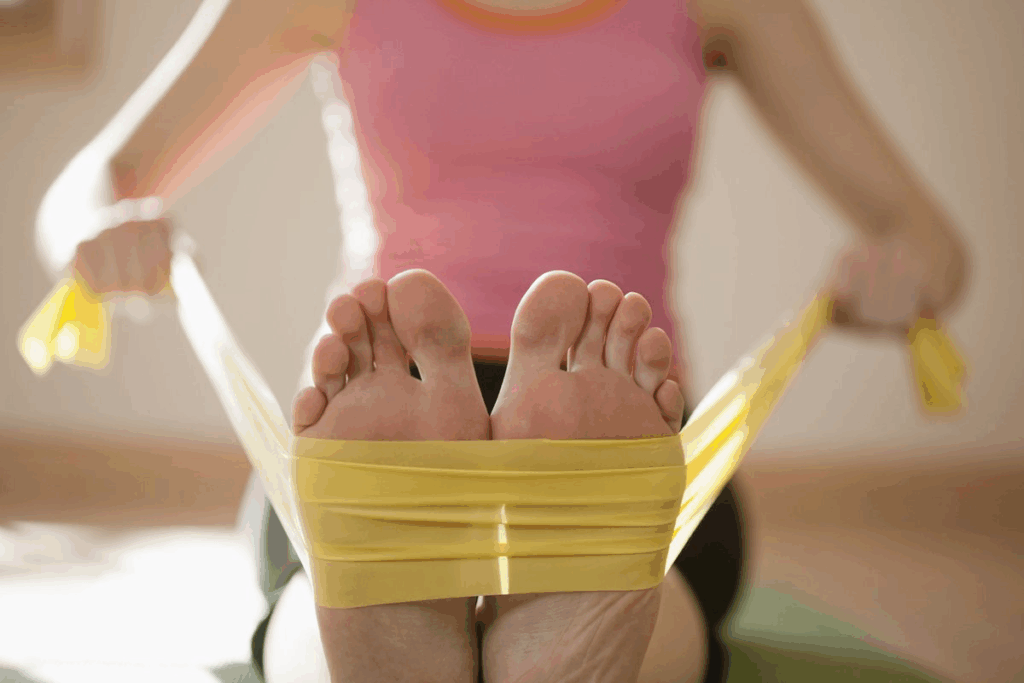
Strengthening the muscles around the ankle is key for recovery and injury prevention. Ankle eversion exercises with a resistance band are great for the peroneal muscles. These muscles help keep the ankle stable on the outside.
We suggest adding resisted ankle eversion to your rehab plan. It boosts ankle strength and stability. Rehab experts around the world recommend it.
At Liv Hospital, we help you learn these exercises for our rehab programs. Strengthening the peroneal muscles makes ankles more stable. This is good for those recovering from sprains or wanting to improve in sports.
Key Takeaways
- Ankle eversion exercises target the peroneal muscles, which are vital for lateral ankle stability.
- Using a resistance band makes eversion exercises more effective.
- Adding resisted ankle eversion to rehab plans boosts ankle strength and stability.
- Liv Hospital offers expert advice on doing these exercises as part of our full rehab programs.
- Strengthening the peroneal muscles helps keep ankles stable and prevents injuries.
Understanding Ankle Eversion and Its Importance

Ankle eversion is a key movement where the foot turns outward. It’s important for daily activities and sports. It helps keep the ankle stable and supports the lower limb.
What Is Ankle Eversion?
Ankle eversion means turning the foot’s sole outward. It’s a main foot movement, along with inversion and others. This action involves many muscles and joints working together.
Key Muscles Involved in Eversion
The peroneal muscles are key for ankle eversion. They include the peroneus longus and peroneus brevis. These muscles are on the outside of the lower leg. They help rotate the foot outward, keeping the ankle stable.
The Role of Eversion in Ankle Stability
Eversion is essential for ankle stability, mainly on uneven surfaces or quick turns. The peroneal muscles fight off too much inversion. This reduces ankle sprains and injuries. Doing eversion ankle exercises strengthens these muscles, improving ankle stability and athletic performance.
Benefits of Ankle Eversion Exercises

Ankle eversion exercises do more than just prevent injuries. They also boost athletic performance and balance. By working the muscles that control eversion, people can make their ankles stronger and more stable.
Injury Prevention and Rehabilitation
Ankle eversion exercises are key in preventing injuries, like those from ankle instability. They strengthen the peroneal muscles, which is great for athletes who need to make quick turns. This is because these muscles help keep the ankle stable.
Key benefits for injury prevention and rehabilitation include:
- Enhanced ankle stability
- Reduced risk of ankle sprains
- Improved recovery from ankle injuries
Improved Athletic Performance
These exercises can make athletes better by strengthening their ankles. This is very helpful for sports that need fast movements and quick changes in direction.
Sport | Benefit of Ankle Eversion Exercises |
Soccer | Improved stability during quick turns |
Basketball | Enhanced jumping and landing stability |
Tennis | Better balance during rapid movements |
Enhanced Balance and Stability
Eversion exercises make ankles stronger, which helps with balance and stability. This is good for athletes and anyone wanting to avoid falls.
Regular ankle eversion exercises can greatly improve balance and stability. It’s a key part of fitness and rehab programs.
Essential Equipment for Ankle Eversion Exercises
To get the most out of ankle eversion exercises, you need the right equipment. The main thing you need is a resistance band. It gives the needed resistance to strengthen the muscles involved in ankle eversion.
Choosing the Right Resistance Band
When picking a resistance band for ankle eversion, think about the material, size, and resistance level. Mini bands or resistance tubing are often recommended because they are versatile and effective. It’s best to choose bands made from durable, latex-free materials for those with latex allergies.
Resistance Levels for Different Fitness Stages
Resistance bands have different levels of resistance, like light, medium, or heavy. Beginners should start with light resistance to get used to the movement. As they get stronger, they can move to higher resistance levels. Advanced users can start with medium to heavy resistance bands to push their ankle muscles harder.
Additional Supportive Equipment
While a resistance band is key, other equipment can make the exercise better. Using a stable chair or bench for seated ankle eversion exercises can help with support and balance. For standing exercises, a wall or sturdy object can help with balance.
By picking the right resistance band and using extra support when needed, you can do ankle eversion exercises safely and effectively. This helps improve ankle stability and overall foot health.
Preparing for Ankle Eversion Exercises
Before starting ankle eversion exercises, it’s important to prepare well. This helps get the most out of the workout and keeps you safe from injury. There are a few key steps to follow for a safe and effective workout.
Proper Seating Position
First, find a comfortable sitting position. Your back should be straight and your legs relaxed. Make sure your feet are flat on the floor or on a footrest, if needed, for stability.
- Ensure your knees are at a 90-degree angle.
- Adjust your position to avoid straining your lower back.
Warm-Up Techniques
Warming up is key before any exercise, including ankle eversion. Simple ankle rotations and toe wiggles are great warm-ups. They boost blood flow and get your ankles ready for the exercise.
- Rotate your ankles in both clockwise and counterclockwise directions.
- Perform toe wiggles and ankle circles to loosen the muscles.
Setting Up Your Resistance Band
Getting your resistance band ready is important for ankle eversion exercises. Loop the resistance band around your foot, securing it comfortably. Make sure the other end is tied to a stable object.
- Adjust the band’s tension according to your fitness level.
- Make sure the band is not twisted or tangled.
By following these steps, you can ensure a safe and effective ankle eversion exercise routine. Proper preparation is essential for the best results and to avoid injury.
Basic Ankle Eversion Exercises With Resistance Bands
Resistance bands are great for doing basic ankle eversion exercises. These exercises help strengthen the muscles around the ankle. This makes your ankle more stable and helps prevent injuries.
Seated Ankle Eversion
To do seated ankle eversion, sit on the floor with your legs straight out. Loop the resistance band around your foot’s ball. Secure it to something stable. Then, rotate your foot outward against the band’s resistance. Hold for a few seconds before going back to the start.
Key points to focus on:
- Keep your knee straight throughout the exercise.
- Use a slow and controlled movement.
- Avoid compensatory movements with other parts of your body.
Standing Ankle Eversion
Standing ankle eversion is similar but harder because you’re balancing on one leg. Stand on one foot, lift the other off the ground. Loop the band around your standing foot’s ball and secure it. Rotate your foot outward against the band, then return to the start.
Tips for effective execution:
- Maintain balance by engaging your core.
- Keep the movement slow and controlled.
- Start with lower resistance and gradually increase as you build strength.
Proper Form and Technique
It’s important to keep the right form and technique when doing ankle eversion exercises with resistance bands. Wrong form can make the exercises less effective or even hurt you.
Exercise | Key Benefits | Common Mistakes |
Seated Ankle Eversion | Strengthens peroneal muscles, improves ankle stability | Allowing knee to bend, using too much resistance |
Standing Ankle Eversion | Enhances balance, strengthens ankle muscles | Losing balance, not controlling the movement |
“Proper technique is the foundation of effective exercise. By focusing on correct form, individuals can maximize the benefits of ankle eversion exercises while minimizing the risk of injury.”
— Expert in Physical Rehabilitation
By following these guidelines and adding resistance band exercises to your routine, you can greatly improve your ankle strength and stability.
Advanced Ankle Eversion Exercises
Once you’ve learned the basics, it’s time for more challenging ankle exercises. These advanced exercises boost ankle stability, strength, and function. They’re great for those recovering from ankle injuries or wanting to up their athletic game.
Multi-Directional Eversion Movements
Multi-directional eversion exercises strengthen the ankle in various ways. This is key for better ankle stability and function. To do these, adjust your resistance band to move in different directions, like diagonally or rotationally.
Example: Sit down, loop the band around your foot’s ball, and move your ankle at different angles. Try 45 degrees or 90 degrees from the start. This makes the ankle muscles stronger and more flexible.
Weight-Bearing Eversion Exercises
Weight-bearing eversion exercises are done while standing on the ankle. They’re like real-life movements, making the ankle stronger. A good example is standing on one leg and moving the other foot against the band.
Tip: To make it harder, do these on a soft surface like a foam pad. It’s great for balance and stability.
Combining Eversion With Other Ankle Movements
Mixing eversion with dorsiflexion and plantarflexion makes your ankle stronger in all directions. This is good for stability and injury prevention.
- Do eversion, then dorsiflexion or plantarflexion exercises.
- Use different resistance bands to challenge your ankle.
- Add these to your routine to keep your ankle healthy.
Adding these advanced exercises to your routine can greatly improve your ankle’s strength and stability. Always progress slowly and listen to your body to avoid injury.
Progressive Training Protocol for Ankle Eversion
A six-week progressive strength-training protocol can greatly boost eversion ankle strength. This is backed by scientific studies. We will share a structured plan for ankle eversion exercises over six weeks.
Week 1-2: Building Foundation
In the first two weeks, we build a strong base for ankle eversion strength. We start with low resistance and slowly increase it as the muscles get stronger. Proper form and technique are key to ensure the right muscles are working.
Week 3-4: Increasing Resistance
When the ankle muscles get stronger, we move to higher resistance levels. This phase is vital for boosting strength and endurance in eversion muscles. Increasing resistance should be done slowly to prevent overtraining.
Week 5-6: Functional Integration
In the last phase, we add functional movements that mimic daily activities and sports. This phase is key for using the gained strength in real-life situations. Functional integration prepares the ankle for various everyday and sports-related actions.
Scientific Evidence for Progressive Protocols
Research proves that progressive training boosts ankle eversion strength. Studies show a six-week program can significantly improve eversion strength. We suggest sticking to evidence-based plans for the best results from ankle eversion exercises.
Common Mistakes to Avoid During Ankle Eversion Exercises
To get the most out of ankle eversion exercises and avoid injury, it’s key to steer clear of common mistakes. Knowing these pitfalls helps us exercise safely and effectively.
Improper Band Placement
Getting the resistance band right is critical for ankle eversion exercises. Wrong band placement can mess up the exercise and stress other ankle or leg parts.
- Make sure the band is tied to a solid object.
- Adjust the band so it resists in the eversion direction.
- Ensure the band isn’t twisted or tangled, which could change its resistance.
Compensatory Movements
Compensatory movements happen when other body parts move to cover up ankle weakness. These can ruin your exercise form and might hurt you.
- Pay attention to your body’s position and movement during the exercise.
- Try to keep the ankle movement focused on eversion.
- Use a mirror or get a pro to check your form for any bad movements.
Overtraining Risks
Overtraining can make you tired, lower your performance, and up your injury risk. It’s important to balance exercise with enough rest and recovery.
- Slowly up the intensity and amount of your ankle eversion exercises.
- Listen to your body and take breaks between hard workouts.
- Try different exercises to avoid too much strain on the ankle.
Ignoring Pain Signals
Pain is a big warning sign that something’s wrong. Ignoring it can lead to more injury and longer recovery times. If you feel pain during ankle eversion exercises, stop right away and see a doctor.
By knowing these common mistakes and avoiding them, we can make the most of ankle eversion exercises while keeping risks low. This careful approach to exercise is key for keeping our ankles healthy and our overall well-being.
Incorporating Ankle Eversion Exercises Into Rehabilitation Programs
Ankle eversion exercises are key in rehab, helping with ankle stability and function. They are essential in rehab programs for ankle sprains and chronic ankle instability.
Post-Ankle Sprain Protocol
After an ankle sprain, a good rehab program is vital. We suggest starting ankle eversion exercises early. This helps prevent chronic ankle instability.
The rehab plan should include:
- Initial immobilization and pain management
- Progressive strengthening exercises, including ankle eversion
- Proprioception and balance training
- Functional activities tailored to the patient’s specific needs
Chronic Ankle Instability Treatment
For chronic ankle instability, ankle eversion exercises are vital. Strengthening the muscles responsible for eversion can improve ankle stability and reduce the frequency of sprains. We create a personalized exercise program for each patient.
A good treatment plan for chronic ankle instability may include:
- Strengthening exercises for the peroneal muscles
- Proprioceptive training to enhance neuromuscular control
- Bracing or taping to provide additional support during activities
- Education on proper footwear and activity modification
Return-to-Sport Progression
Returning to sports after an ankle injury needs a careful plan. Ankle eversion exercises are key in this process. A gradual and criterion-based progression ensures that athletes are adequately prepared for the demands of their sport.
The return-to-sport plan should be tailored to each athlete and may include:
Phase | Criteria | Interventions |
1. Rehabilitation | Pain-free ankle motion, initial strength recovery | Ankle eversion exercises, proprioception training |
2. Strengthening | Significant strength improvement, minimal pain | Progressive resistance exercises, including eversion |
3. Functional Training | Functional strength, agility, and endurance | Sport-specific drills, agility training |
By adding ankle eversion exercises to rehab programs, we see better recovery for patients with ankle sprains and chronic ankle instability. Our focus is on a detailed and tailored treatment plan. This ensures the best recovery and return to activity.
Measuring Progress and Tracking Results
Tracking how well we do in ankle eversion exercises shows if our rehab plan works. Regular checks let us tweak our training to get the best ankle stability.
Strength Assessment Methods
To see how our ankle eversion exercises are going, we use different ways to check strength. These include:
- Manual muscle testing to check the strength of the peroneal muscles
- Dynamometer measurements to measure ankle eversion strength
- Progressive resistance exercises to push the ankle evertors harder
Functional Testing for Ankle Stability
Testing how stable our ankles are is key. We use tests like:
Test | Description | Indicators of Progress |
Single-leg stance test | Standing on one leg with eyes open and closed | Improved balance time |
Star Excursion Balance Test | Reaching in different directions while standing on one leg | Increased reach distance |
Hop test | Performing single-leg hops | Reduced pain, improved distance |
When to Advance Your Program
Deciding when to move up in our ankle eversion exercise program depends on a few things. We look for signs that our rehab is working, like:
Signs of Successful Rehabilitation
These signs show our ankle eversion exercise program is working well:
- Significant improvement in strength as shown by dynamometer or manual muscle testing
- Enhanced functional ability shown by better performance in tests
- Less pain and discomfort in daily life and sports
As we get better, we can try harder exercises. This includes multi-directional eversion movements and exercises that make us stand on our ankle.
Conclusion
Ankle eversion exercises with resistance bands are key for strengthening ankle muscles. This helps improve stability and prevent injuries. We’ve looked at how these exercises work and how they fit into rehab programs.
These exercises offer many benefits. They help prevent injuries, boost athletic performance, and improve balance and stability. By picking the right resistance band and following a training plan, you can strengthen your ankles effectively.
In summary, ankle eversion exercises are vital for anyone wanting to boost ankle stability. They are important for both rehab and improving athletic performance. Adding these exercises to your routine can greatly benefit your ankle health.
FAQ
What is ankle eversion?
Ankle eversion is when you move your foot outward. It’s like rotating your ankle so your foot’s sole faces outward.
What muscles are responsible for ankle eversion?
The fibularis longus and brevis muscles are key for ankle eversion. They help keep the ankle stable and prevent sprains.
How do ankle eversion exercises help in injury prevention?
These exercises strengthen the ankle muscles. This makes the ankle more stable and less likely to get injured, like sprains.
Can ankle eversion exercises improve athletic performance?
Yes, they can. They make the ankle stronger, which helps with balance and movement. This is great for athletes who need to change direction fast.
How do I choose the right resistance band for ankle eversion exercises?
Pick a band that matches your fitness level. Choose one that’s challenging but doesn’t strain you too much.
What are some common mistakes to avoid during ankle eversion exercises?
Avoid using the band wrong, moving in ways you shouldn’t, and overdoing it. Keeping the right form is key to avoiding injury.
How can I measure progress in ankle eversion exercises?
Check your strength, how stable your ankle is, and your balance. Regular checks help you know when to make the exercises harder.
What is the role of ankle eversion exercises in rehabilitation programs?
They’re vital for fixing ankle sprains and chronic instability. They help regain strength and stability, making it safe to move around again.
How often should I perform ankle eversion exercises?
Do them 2-3 times a week, depending on your goals. Adjust based on how you’re doing and what you need.
Can ankle eversion exercises be done without a resistance band?
Yes, you can use bodyweight or other resistance methods. The goal is to challenge the muscles enough to strengthen them.
What is foot eversion?
Foot eversion is when you rotate your foot outward. It’s important for balance and stability, like when walking on uneven ground.
References
National Center for Biotechnology Information. Evidence-Based Medical Guidance. Retrieved from https://pmc.ncbi.nlm.nih.gov/articles/PMC3392158/