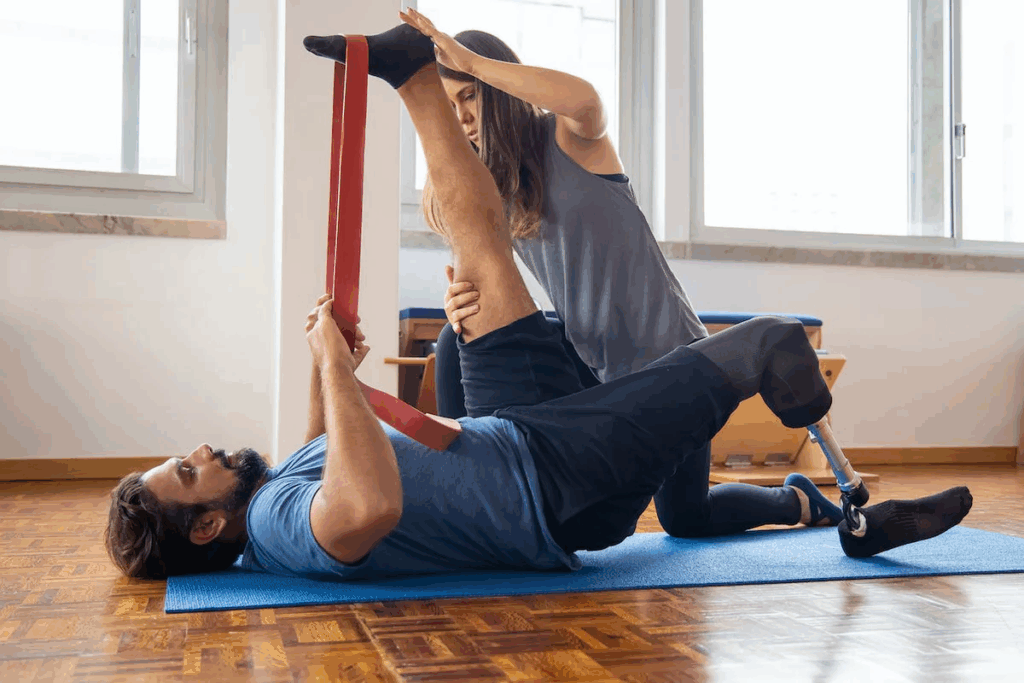
Step-by-step guide to below knee amputation rehabilitation from surgery to independent ambulation. Recovering from a lower limb amputation is more than just surgery. At Liv Hospital, we use international standards and new ways to help those with lower limb amputations.
Transtibial amputation, or below knee amputation (BKA), happens a lot each year. Studies show BKA patients use prosthetics more than those with above-knee amputations.
This guide will show you how to get better after an amputation. We’ll cover everything from before you start rehab to learning new mobility skills. Our goal is to help you use your prosthetic well and stay independent.
Key Takeaways
- Comprehensive rehabilitation approach for lower limb amputation
- Innovative rehabilitation protocols at Liv Hospital
- Higher prosthetic use rates for BKA patients
- Step-by-step guide to rehabilitation process
- Maximizing prosthetic use and independence
Understanding Below Knee Amputation

Below knee amputation (BKA) is a big surgery that needs a lot of understanding for good recovery. It’s known that BKA makes up more than half of all major lower limb amputations. This makes it very important for doctors and nurses to know about it well.
Definition and Prevalence Statistics
Below knee amputation, or BKA, means cutting off the lower leg below the knee. It’s a common surgery for the lower leg. BKA is a big part of all lower limb amputations done worldwide.
Understanding BKA in medical terms is key. It helps doctors and nurses take better care of patients. Knowing about BKA helps plan better for recovery.
Types of Lower Extremity Amputations
There are different kinds of lower limb amputations. They are based on where and how much of the leg is removed. The main types are:
- Toe amputations
- Below knee amputations (BKA)
- Above knee amputations (AKA)
- Hip disarticulation
Each type of amputation has its own challenges and needs for recovery. Knowing these differences helps doctors give better care to amputees.
Common Causes Leading to BKA
The main reasons for below knee amputation are:
- Diabetes and related problems
- Peripheral arterial disease
- Trauma
- Infection
- Cancer
It’s important to deal with these causes during recovery. They affect the patient’s health and how well they can get better.
Pre-Rehabilitation Assessment and Planning

Pre-rehabilitation assessment and planning are key for those with below knee amputations. A detailed pre-rehab evaluation helps find the best therapy plan for amputation physical therapy.
We start by learning about the patient’s health and their amputation details. This means a deep medical evaluation process to spot any rehab challenges.
Medical Evaluation Process
The medical evaluation is a big part of pre-rehab. It looks at the patient’s health history, current status, and amputation details. This helps us plan for any risks during rehab.
Important parts of the medical evaluation are:
- Review of medical history and current health status
- Assessment of the amputation site and residual limb
- Evaluation of cardiovascular and respiratory function
- Identification of any comorbidities or possible complications
Setting Realistic Recovery Goals
Setting realistic goals is key for patient motivation and success. We work with patients to set goals that fit their needs and situation.
Goals might include:
Goal | Description | Timeline |
Short-term mobility | Ability to transfer safely and move with assistance | 1-4 weeks |
Prosthetic fitting | Successful fitting and initial training with a prosthetic limb | 4-12 weeks |
Advanced mobility | Independent walking and navigating various environments | 3-6 months |
The Multidisciplinary Rehabilitation Team
A multidisciplinary rehabilitation team is vital for those with below knee amputations. This team has healthcare experts from different fields. They work together to meet the patient’s physical, emotional, and social needs.
As the web source “Amputee exercises are more than just routines” says, a team approach is key for rehab success. The team usually includes:
- Physiatrists and other medical specialists
- Physical and occupational therapists
- Prosthetists and orthotists
- Nurses and other support staff
The team works together to offer prosthetic limb care and support the patient’s recovery. Knowing the LAKA medical abbreviation and other terms helps the team communicate well.
Immediate Post-Surgical Care
The time right after below knee amputation surgery is very important. It sets the stage for a successful recovery. We will help you understand the key steps in post-surgical care. This will make sure you can manage your recovery well.
Wound Healing Management
Managing wound healing is key after surgery. You need to watch the wound for signs of infection. Keeping the area clean and following dressing advice from doctors is important. Good wound care helps avoid complications.
Pain Control Strategies
Managing pain is a big part of recovery. Doctors use different ways to control pain, like medicine and therapy. We help create a personalized pain plan for each patient. This plan helps keep you comfortable while you heal.
Positioning After Surgery
How you position your leg after surgery is very important. It helps prevent contractures and aids in healing. Doctors will tell you the best ways to position your leg. This includes elevating it to reduce swelling and using pillows for support. Right positioning is essential for a smooth recovery.
By focusing on these important care steps, we can greatly improve recovery outcomes. Our team is here to support you every step of the way. We aim to give you the best start for a successful rehabilitation.
Residual Limb Care and Management
Caring for the residual limb is key for those with a Below Knee Amputation (BKA). It helps with healing, prevents problems, and gets the limb ready for prosthetics.
Compression and Bandaging Techniques
Compression and bandaging help reduce swelling and shape the limb for prosthetics. We use special bandaging to make a conical shape, perfect for prosthetics. The bandage should fit snugly but not too tight.
Important points for compression and bandaging include:
- Using elastic bandages or shrinkers for even pressure
- Rewrapping the bandage several times a day for consistent compression
- Watching for signs of irritation or skin breakdown
Skin Care and Hygiene Protocols
Good skin hygiene is vital to prevent infections and keep the limb healthy. We suggest washing with mild soap and water, then drying well.
Key skin care points are:
- Checking the skin daily for irritation or damage
- Keeping the skin moisturized to avoid dryness and cracks
- Avoiding harsh soaps or lotions that can irritate the skin
Edema Control Methods
Edema, or swelling, is common after amputation. We use elevation, compression garments, and gentle exercises to manage it.
Effective edema control methods include:
- Elevating the residual limb above the heart
- Using compression stockings or shrinkers
- Doing gentle range of motion exercises
Desensitization Techniques
Desensitization helps reduce sensitivity and prepares the limb for prosthetics. We suggest gentle tapping, massage, and exposure to different textures.
Desensitization techniques include:
- Gentle tapping or massage on the residual limb
- Exposure to various textures, such as cloth or soft brushes
- Gradual introduction to different temperatures
Below Knee Amputation Rehabilitation Protocol
Recovering from a below knee amputation needs a good plan. The process is complex, needing a structured approach for the best results.
Acute Phase (1-4 Weeks)
The first few weeks focus on healing the wound, managing pain, and starting to move. We do gentle exercises to keep the joint moving and prevent stiffness. “Early mobilization is key to avoid problems and help recovery,” experts say.
Important steps include:
- Keeping the limb in the right position to avoid stiffness
- Managing pain effectively
- Starting to strengthen the muscles
Subacute Phase (1-3 Months)
This phase is about getting stronger and thinking about prosthetics. It’s vital for building the strength and stamina needed for prosthetic use.
Important parts are:
- Doing more intense strength training
- Working on balance and feeling where your body is
- Starting to look at prosthetics
Advanced Phase (3+ Months)
The final phase is about mastering prosthetic use and improving mobility. We focus on making prosthetic use better and solving any issues with the residual limb.
Advanced steps might include:
- Learning to walk with the prosthetist
- Doing more challenging balance and agility exercises
- Getting back into the community
Throughout, we stress the value of a team effort. This includes physical therapy, prosthetic care, and mental health support. Experts agree, “A detailed rehabilitation plan is essential for the best results in lower limb amputation recovery.”
Essential Physical Therapy Interventions
Physical therapy is key for patients with below-knee amputations. It helps restore function and improve mobility. This makes life better for those with lower limb amputations.
Range of Motion Exercises
Range of motion exercises keep the residual limb and joints flexible. They prevent contractures. We start with gentle, controlled movements and gradually move to active exercises.
Example Range of Motion Exercises:
- Knee flexion and extension
- Hip abduction and adduction
- Ankle dorsiflexion and plantarflexion (for the intact limb)
Progressive Strengthening Protocols
Progressive strengthening exercises build muscle strength. This is needed for prosthetic use and daily activities. We focus on strengthening the residual limb, core, and upper body.
Muscle Group | Exercise | Sets/Reps |
Quadriceps | Straight leg raises | 3 sets of 10 reps |
Hamstrings | Hamstring curls | 3 sets of 10 reps |
Core | Planks | 3 sets, holding for 30 seconds |
Core Stability Training
Core stability training is vital for balance, posture, and mobility. It helps patients stay stable during prosthetic training and daily activities.
Core Stability Exercises:
- Bridging
- Russian twists
- Leg raises on a stability ball
Balance and Proprioception Exercises
Balance and proprioception exercises improve prosthetic control and navigation. We use exercises like single-leg standing and balance boards.
By using these physical therapy interventions, patients with below-knee amputations can reach their best outcomes. This improves their quality of life.
Prosthetic Fitting and Training Process
Getting back on your feet after a below knee amputation starts with a good prosthetic fitting. It’s key to getting your independence and mobility back. This journey is complex, with many steps from the first check-up to picking the right prosthesis.
Temporary Prosthesis Considerations
A temporary prosthesis is used first. It helps as your leg heals and changes. It lets you get used to wearing a prosthetic and start learning how to walk again.
Using a temporary prosthesis also helps doctors see how you’re doing. They can make changes before you get your final prosthesis. This is important for making sure everything fits right.
Definitive Prosthesis Selection
Choosing your final prosthesis is based on what you need and want. Doctors look at your leg, health, and what you like to do. They pick the best parts for you, based on your amputation and how active you are.
A team of doctors, including prosthetists and physical therapists, helps pick the right prosthesis for you. They make sure it fits your life and helps you do everyday things better.
Components and Technology Options
Today’s prosthetics have many parts and options. They use new materials and designs for better function and look. We keep up with new prosthetic tech to give you the best options.
Things like smart knees and feet can really help you move better. We help you choose what’s best for you, based on what you want and need.
Prosthetic Wearing Schedule
Creating a schedule for wearing your prosthetic is important. It’s made just for you, to help you get used to it. We teach you how to put it on and take it off, and how to take care of your leg.
Sticking to your schedule is key. We watch how you’re doing and adjust it if needed. This helps you get used to your prosthetic smoothly.
Gait Training and Advanced Mobility Skills
Gait training is key for those with below knee amputations. It helps them walk better and feel more independent. We focus on making them confident in their daily activities.
Progressive Walking Program
A good walking program starts with simple steps. It gets harder as you get stronger. We make sure your prosthetic fits right to help you walk naturally.
- First, we teach you to walk steadily.
- Then, we add exercises to make your muscles stronger.
- Next, we practice walking on different surfaces and slopes.
Navigating Environmental Challenges
Learning to handle different environments is important. We teach you to walk on various terrains and stairs. This helps you move safely in complex places.
- We start with stairs, with and without handrails.
- Then, we practice on uneven ground to improve balance.
- Lastly, we work on overcoming obstacles like curbs.
Fall Prevention and Recovery
Preventing falls is a big part of our training. We teach you to stay balanced and use tools when needed. We also show you how to spot dangers.
Key strategies include:
- Exercises to boost your balance.
- Using canes or walkers when needed.
- Staying away from hazards.
With these steps, people with below knee amputations can move better. This improves their life and independence.
Managing Complications During Rehabilitation
Managing complications is key in the rehab process for those with below-knee amputations. These issues can pop up at any stage. It’s vital to tackle them head-on for the best results.
Phantom Limb Pain Management
Phantom limb pain is a common issue after losing a limb. It’s pain felt in a limb that’s gone. We tackle it with meds, physical therapy, and mirror therapy.
Medication, like anticonvulsants and antidepressants, helps manage the pain. Physical therapy, like desensitization and strengthening, is also important.
Addressing Skin and Socket Issues
Skin and socket problems can mess with prosthetic comfort and fit. Keeping the prosthetic well-fitted, checking skin regularly, and staying clean are key steps.
Issue | Description | Management Strategy |
Skin Irritation | Redness and irritation due to friction or pressure | Adjust prosthetic fit, apply topical creams |
Socket Problems | Discomfort or pain due to poor socket fit | Modify socket, use socket liners |
Joint Protection Strategies
Protecting joints is critical for those with below-knee amputations. It prevents injuries and keeps the limb strong. We teach proper transfer and mobility techniques and suggest strengthening exercises.
Overuse Injury Prevention
Overuse injuries happen when joints and muscles work too hard. We prevent them by gradually increasing activity, aligning prosthetics right, and monitoring closely.
By tackling these complications, we can greatly improve outcomes for those with below-knee amputations. This helps them reach a better function and quality of life.
Psychological Adaptation and Support
Psychological support is key for those dealing with below knee amputation rehab. Adapting to a new body can be tough, both in body and mind.
Dealing with amputation changes is complex. It’s not just about getting better physically. It’s also about adjusting mentally.
Coping with Body Image Changes
Adjusting to body image changes is a big challenge. People may feel grief, denial, and then acceptance. Supportive counseling helps a lot in this journey.
A supportive place is vital. It’s where people can share their feelings freely, without fear of judgment.
Depression and Anxiety Interventions
Depression and anxiety are common after amputation. Early intervention is critical. This might include therapy, medication, or both, depending on the person.
Intervention | Description | Benefits |
Cognitive Behavioral Therapy (CBT) | A type of therapy that helps individuals understand and change negative thought patterns. | Reduces symptoms of depression and anxiety |
Medication | Pharmacological interventions to manage symptoms of depression and anxiety. | Effective in reducing symptom severity |
Support Groups | Group sessions where individuals can share their experiences and support one another. | Provides a sense of community and understanding |
Support Groups and Resources
Support groups are very helpful for those rehabbing. They offer a chance to share, get support, and learn from others facing similar issues.
We suggest joining support groups as part of the rehab plan.
Family Education and Involvement
Family plays a huge role in rehab. Teaching them about the challenges helps a lot. Getting them involved in the process can improve recovery.
Bilateral Below Knee Amputation Rehabilitation Strategies
Patients with bilateral below knee amputations need a detailed rehabilitation plan. This plan helps them regain their mobility and independence. It’s a complex process that tackles the special challenges these patients face.
Challenges in Bilateral Amputations
Bilateral below knee amputations come with unique challenges. These include more energy needed to move, a higher fall risk, and the need for special prosthetics. Rehabilitation programs must be tailored to address these challenges effectively.
- Increased energy expenditure during mobility
- Higher risk of falls due to reduced stability
- Need for specialized prosthetic devices and training
- Potential for psychological impacts such as depression or anxiety
Modified Mobility Approaches
Modified mobility approaches are key for bilateral below knee amputees. This includes using advanced prosthetics and customized physical therapy. Prosthetic limbs are designed to provide maximum functionality and comfort.
- Initial mobility training with temporary prosthetics
- Progressive strengthening and balance exercises
- Gait training to improve walking patterns and stability
- Advanced mobility skills such as stair climbing and navigating uneven terrain
Energy Conservation Techniques
Energy conservation techniques are vital for bilateral amputees. Patients are taught to pace themselves and use assistive devices when necessary.
Specialized Equipment Needs
Specialized equipment is a big part of bilateral below knee amputation rehabilitation. This includes prosthetic limbs and assistive devices for daily living and mobility aids.
- Prosthetic limbs with advanced technology for improved functionality
- Wheelchairs or mobility scooters for energy conservation
- Adaptive tools for daily living activities
- Home modifications to improve safety and accessibility
By tackling these unique challenges and using modified mobility approaches, energy conservation techniques, and specialized equipment, rehabilitation programs can greatly improve outcomes for individuals with bilateral below knee amputations.
Conclusion
Rehabilitation after a below knee amputation is complex. It needs a detailed plan. We’ve covered the key steps and methods to help patients get better, from the start to learning new mobility skills.
A good rehab plan is vital for those with a below knee amputation, or l bka. Working with a team and using proven methods helps patients recover well. This improves their life quality greatly.
The prosthetic fitting is a big part of this journey. It helps people move and live on their own again. With new prosthetic tech and rehab methods, we can help patients face and beat the challenges of below knee amputation.
FAQ
What is a below knee amputation (BKA)?
A below knee amputation, or BKA, is a surgery that removes the lower leg below the knee. It’s often needed because of injury, infection, or disease.
What are the different types of lower extremity amputations?
There are several types of lower leg amputations. These include below knee amputation (BKA), above knee amputation (AKA), and partial foot amputation. Each type needs its own rehabilitation plan.
How long does it take to recover from a below knee amputation?
The recovery time for a BKA varies. It depends on your health, age, and any other health issues you might have. The first few weeks are the most intense, followed by several months of gentle recovery.
What is the role of physical therapy in below knee amputation rehabilitation?
Physical therapy is key in BKA recovery. It helps improve movement, strength, balance, and how you move around. Physical therapists create a custom exercise plan and teach prosthetic use to help you function better.
How is phantom limb pain managed?
Phantom limb pain is common after amputation. It’s treated with a mix of medicine, physical therapy, and other methods like mirror therapy or cognitive behavioral therapy.
What are the benefits of a multidisciplinary rehabilitation team?
A team of different healthcare professionals offers complete care for BKA patients. This team approach ensures all aspects of your health are addressed, from physical to emotional and social needs.
How can patients with bilateral below knee amputations adapt to their new mobility challenges?
Those with both legs amputated need special rehab strategies. This includes learning new ways to move, saving energy, and using adaptive tools. A rehab team helps build confidence and safety in moving around.
What is the importance of residual limb care?
Proper care of the remaining limb is vital. It helps with healing, prevents problems, and gets the limb ready for a prosthetic. This includes using compression, taking care of the skin, controlling swelling, and desensitizing the area.
How can patients prevent overuse injuries during rehabilitation?
To avoid injuries, slowly increase your exercise, wear the right prosthetics, and use injury prevention methods daily.
What are the benefits of support groups for patients with lower extremity amputations?
Support groups offer a place to share experiences, get emotional support, and meet others facing similar challenges. They are a valuable resource during the rehab journey.



 Departments
 Related Videos
 Our Doctors
 News
News