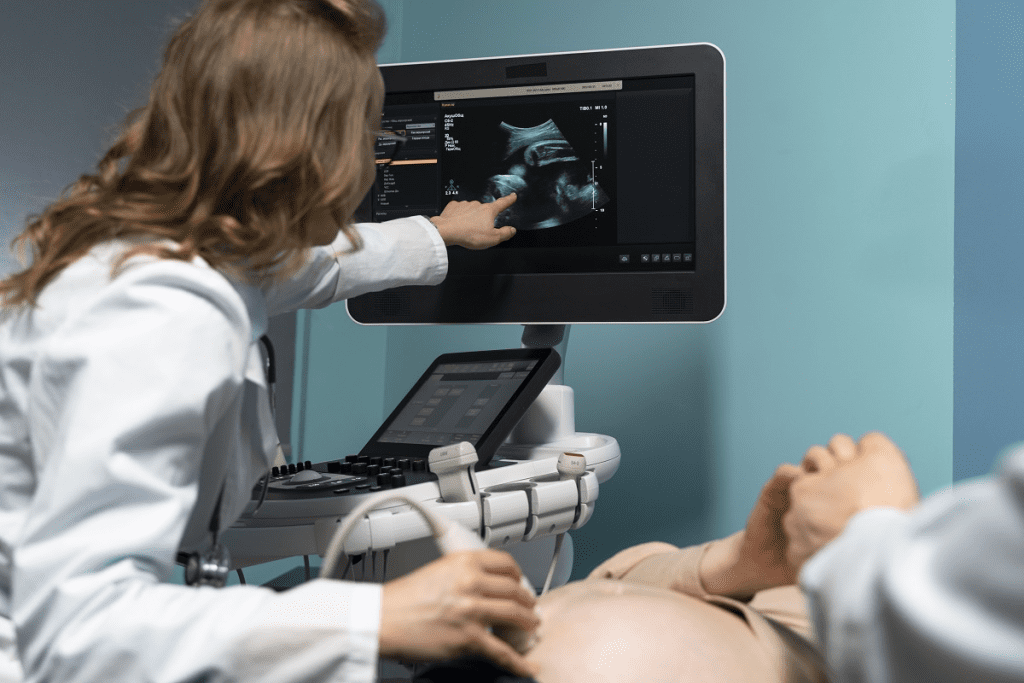
Fetal biometry is key for checking the health and growth of the fetus. FL is a major measurement. It helps doctors track the baby’s growth and spot any problems early.
Key Takeaways
- Fetalbiometry includes several key measurements taken during an ultrasound.
- FL (femur length) is a critical indicator of fetal growth and development.
- Understanding fetal biometry helps expectant parents know what to expect during pregnancy.
- Ultrasound measurements like FL, BPD, and HC are vital for monitoring fetal health.
- Regular ultrasounds can help detect problems early in pregnancy.
Understanding Fetal Ultrasound Measurements
Regular fetal ultrasound measurements help doctors keep track of how a baby is growing. They look for any signs of problems. These checks are key to making sure the baby is healthy and spotting issues early.
The Purpose of Fetal Measurements
Fetal measurements are taken to watch how a baby grows and find any problems. The main goal is to make sure the baby is growing right and catch any issues early.
These measurements include Biparietal Diameter (BPD), Head Circumference (HC), Abdominal Circumference (AC), and Femur Length (FL). Each one gives important info about the baby’s development.
When Measurements Are Taken During Pregnancy
Fetal ultrasound measurements are usually done in the second and third trimesters. The second trimester, around 18-22 weeks, is key for checking the baby’s anatomy and growth.
In the third trimester, these checks help watch the baby’s growth and spot any problems. Regular ultrasounds help doctors see if the baby is growing right and make the right choices for the pregnancy.
Knowing about these measurements and why they matter helps expectant parents understand their baby’s growth and any needed care.
What is FL (Femur Length) on an Ultrasound?
The femur length (FL) is a key part of fetal ultrasound. It shows how the fetus is growing and developing. It’s used to check the fetus’s age and look for any growth problems.
Definition and Significance of Femur Length
Femur length is the length of the fetus’s thigh bone. It’s measured during an ultrasound. This measurement is important because it shows how the fetus is growing. FL is a key indicator of fetal health, and big changes can mean there’s a problem.
How FL is Measured by Sonographers
Ultrasound technology is used to see the fetus’s femur. The sonographer then measures its length. This is done in a straight line to get accurate results. Proper measurement technique is vital for reliable data.
Normal FL Ranges Throughout Pregnancy

FL changes as pregnancy goes on. Doctors use growth charts to compare FL to what’s expected. These charts help see if the fetus is growing right or not.
| Gestational Age (weeks) | Average FL (mm) | Range (mm) |
| 20 | 33 | 28-38 |
| 24 | 43 | 38-48 |
| 28 | 53 | 48-58 |
What Abnormal FL Measurements Might Indicate
Abnormal FL measurements can mean growth issues or skeletal problems. If FL is way off from what’s expected, more tests might be needed. Doctors look at FL with other measurements to understand the fetus’s health.
Knowing about FL is important for parents-to-be. It helps them understand their baby’s growth and helps doctors take better care of them.
What is BPD (Biparietal Diameter) on an Ultrasound?
Biparietal Diameter, or BPD, is a key ultrasound measurement. It checks how a fetus is growing. It looks at the distance between the two sides of the fetal skull’s bones.
Definition and Significance of Biparietal Diameter
The Biparietal Diameter is the widest part of the fetal skull. It’s measured in millimeters. This measurement helps guess the fetus’s age and check if it’s growing right.
“BPD is a key part of fetal biometry, giving a good guess of gestational age with other measurements.” This shows how important BPD is in prenatal care.
How BPD is Measured
To measure BPD, an ultrasound is done. The sonographer finds the thalami and the cavum septum pellucidum. Then, they measure the distance between the outer and inner edges of the parietal bones.
Normal BPD Ranges Throughout Pregnancy
BPD ranges change as the fetus grows. For example, at 16 weeks, it’s usually between 35-40 mm. By 32 weeks, it’s about 75-85 mm. These numbers can change a bit based on the reference charts used, like Hadlock’s.
The BPD Hadlock meaning is about measurement method and values. These are commonly used in ultrasound for pregnancy.
Limitations of BPD Measurements
Even though BPD is useful, it has its limits. It might not be perfect for all fetal head shapes. So, BPD is often checked with other measurements to understand fetal growth better.
Understanding HC (Head Circumference) Measurements
Head Circumference (HC) is a key ultrasound measurement. It gives insights into how a fetus grows during pregnancy. It helps check if the fetus is growing right and if there are any problems.
Definition and Significance of Head Circumference
Head Circumference is the widest part of the fetal head. It shows how the fetus is growing, focusing on the brain. HC measurements are important for checking if the fetus is developing normally and spotting any issues.
How HC is Measured
During an ultrasound, HC is measured by finding the widest part of the fetal head. The sonographer or healthcare provider uses specific points to get the measurement. Getting accurate HC measurements is key to knowing the fetus’s age and growth.
Normal HC Ranges Throughout Pregnancy
Normal HC ranges change as pregnancy goes on. Doctors use charts like the Hadlock ones to compare HC values. Any big differences from these ranges might mean there’s a growth problem.
When HC is More Reliable Than BPD
In some cases, HC is more reliable than Biparietal Diameter (BPD). This is true when the fetal head is either long and narrow or short and wide. HC gives a better look at how the fetal head is growing, which is very useful in these cases.
What is AC (Abdominal Circumference) on an Ultrasound?

The Abdominal Circumference (AC) is a key part of fetal ultrasound checks. It shows how the fetus is growing and if it’s healthy. Doctors use it to watch the fetus’s development and spot any growth problems.
Definition and Significance of Abdominal Circumference
AC is the measurement around the fetus’s belly, taken at a specific spot. It shows the size of the fetus’s liver and how much fat it has. These are signs of how well the fetus is being nourished and its overall health.
Significance of AC: This measurement is important. It helps doctors see how the fetus is growing, guess its weight, and find any nutrition or development issues.
How AC is Measured
To measure AC, a sonographer takes a picture of the fetus’s belly. They find the right spot where the stomach and umbilical vein are seen. Then, they measure the belly’s circumference.
“Accurate measurement of fetal abdominal circumference is critical for assessing fetal growth and detecting abnormalities.”
– Expert in Fetal Medicine
Normal AC Ranges Throughout Pregnancy
AC values change as pregnancy goes on. Generally, the belly gets bigger as the pregnancy advances. Here’s a table showing typical AC ranges at different weeks:
| Gestational Age (Weeks) | Average AC (mm) | Range (mm) |
| 20 | 150 | 130-170 |
| 24 | 200 | 180-220 |
| 28 | 250 | 230-270 |
| 32 | 290 | 270-310 |
| 36 | 330 | 310-350 |
What AC Reveals About Fetal Nutrition
The AC measurement tells a lot about the fetus’s nutrition. A normal or higher AC means the fetus is getting enough nutrients. But, a lower AC might mean the fetus is not getting enough food or is growing too slowly.
Knowing about AC and what it means can help parents understand their baby’s health better. It helps them make informed choices.
Understanding OFD (Occipitofrontal Diameter) Measurements
The occipitofrontal diameter (OFD) is a key ultrasound measurement. It helps us understand the shape and growth of a fetus’s head. It’s used in fetal biometry to check how a fetus is growing.
Definition and Significance
OFD measures the distance from the back of the skull to the forehead of the fetus. This measurement is important. It shows us if the head is growing normally or not.
Significance of OFD: It helps us see if the head shape is normal. This is important for spotting any growth problems early.
How OFD is Measured
Measuring OFD needs precise ultrasound imaging. Sonographers make sure they get a clear image of the fetal head. This is to get an accurate measurement.
- The fetal head is imaged in a transverse plane.
- The measurement is taken from the outer edge of the occipital bone to the outer edge of the frontal bone.
- Care is taken to avoid including the scalp in the measurement.
Normal OFD Ranges Throughout Pregnancy
OFD values change throughout pregnancy. Here’s a general idea of how they change:
| Gestational Age (Weeks) | Normal OFD Range (mm) |
| 20 | 40-60 |
| 24 | 55-75 |
| 28 | 70-90 |
OFD in Relation to Head Shape
The OFD measurement is key for checking the shape of the fetal head. If OFD is off, it might mean the head is too long or too short.
“Accurate measurement of OFD is essential for the assessment of fetal head shape and the detection of possible abnormalities.”
Knowing about OFD and its role in fetal development is very important. It helps doctors keep an eye on how the fetus is growing. This information is key for making good decisions about the pregnancy.
The Science of Fetal Biometry in Pregnancy Monitoring
Fetal biometry is key in tracking how a fetus grows and spotting any issues early. It measures different parts of the fetus to check on its health and growth.
Principles of Biometry in Prenatal Assessment
Fetal biometry focuses on measuring the fetus’s size, like femur length (FL), biparietal diameter (BPD), head circumference (HC), and abdominal circumference (AC). These measurements are taken during ultrasounds. They help doctors see how the fetus is growing and developing.
The accuracy of these measurements depends on the skill of the sonographer and the quality of the ultrasound machine. New technology has made these measurements more precise. This helps doctors make better decisions about prenatal care.
Tracking Fetal Growth and Development
Fetal biometry is vital for keeping track of a fetus’s growth and development during pregnancy. By watching how these measurements change over time, doctors can spot any growth issues early. This allows them to take action if needed.
- Regular ultrasound exams help track fetal growth and development.
- Fetal biometry can spot growth problems or abnormalities.
- Early detection leads to better prenatal care and outcomes.
Identifying Potencial Growth Abnormalities
Fetal biometry helps find growth issues like intrauterine growth restriction (IUGR) or macrosomia. Finding these problems early lets doctors create the right care plans. This ensures the best possible results for the fetus.
The science of fetal biometry keeps getting better. New research and ultrasound tech help us understand fetal growth and development better.
The Hadlock Method for Fetal Measurements
The Hadlock method is known for its accuracy in estimating fetal weight and measurements. It’s a key tool in prenatal care. This method uses several fetal biometric parameters to assess fetal growth and development.
Understanding Hadlock Formulas and Tables
The Hadlock formula uses measurements like Biparietal Diameter (BPD), Femur Length (FL), Abdominal Circumference (AC), and Head Circumference (HC). These help estimate fetal weight and gestational age. The formula and tables help healthcare providers make informed decisions about pregnancy management.
| Measurement | Description | Significance |
| BPD | Biparietal Diameter | Measures the distance between the two parietal bones of the fetal skull. |
| FL | Femur Length | Measures the length of the fetal femur. |
| AC | Abdominal Circumference | Measures the circumference of the fetal abdomen. |
| HC | Head Circumference | Measures the circumference of the fetal head. |
BPD Hadlock Meaning and Application
BPD is a key measurement in the Hadlock method. It shows fetal head size and development. It helps estimate gestational age and monitor fetal growth.
FL Hadlock Meaning and Application
FL is another important parameter in the Hadlock formula. It gives insights into fetal limb development. It’s used with other measurements to estimate fetal weight and age.
AC and HC Hadlock Measurements
AC and HC measurements are essential in the Hadlock method. They provide data on fetal abdominal and head circumference. These measurements help assess fetal nutrition and overall growth.
Ratios and Relationships Between Measurements
Understanding the ratios between different fetal measurements is key. It helps us see how a fetus is growing and if there are any problems. These ratios give us a better view of fetal development than just looking at one measurement.
FL/BPD Ratio: Meaning and Significance
The FL/BPD ratio is found by dividing the femur length (FL) by the biparietal diameter (BPD). This ratio shows if a fetus is growing in proportion. If the ratio is off, it might mean the head is too long or too wide.
FL/HC Ratio: Meaning and Significance
The FL/HC ratio compares femur length to head circumference. It’s another way to check if a fetus is growing right. If the head is too big or too small compared to the legs, it could mean growth issues.
FL/AC Ratio: Meaning and Significance
The FL/AC ratio looks at femur length compared to abdominal circumference. It helps us see if the body and limbs are growing in balance. If not, it might point to problems with nutrition or growth.
How Ratios Help Detect Growth Abnormalities
Ratios between different fetal measurements are vital for spotting growth problems. By looking at these ratios, doctors can catch issues early. This allows for quick action to help the fetus grow right.
| Ratio | Significance | Potential Issues |
| FL/BPD | Assesses head shape and proportionality | Dolichocephaly, Brachycephaly |
| FL/HC | Compares limb growth to head circumference | Growth restriction, Macrosomia |
| FL/AC | Assesses proportionality between limb and body growth | Nutritional deficiencies, Growth restriction |
How to Read Your Ultrasound Measurement Report
Understanding your ultrasound report can give you insights into your baby’s health. It has important data that doctors use to check on your baby’s growth and spot any problems early.
Deciphering Measurement Values and Units
Ultrasound reports have measurements like femur length, biparietal diameter, head circumference, and abdominal circumference. These are in millimeters or centimeters. They are compared to growth charts to see how your baby is doing.
The femur length is measured from the top to the bottom of the femur, not counting the ends. Knowing these measurements helps you understand your baby’s growth.
Understanding Percentiles on Reports
Percentiles are key in ultrasound reports. They show how your baby’s measurements compare to others at the same age. For example, if your baby’s weight is at the 50th percentile, it means 50 babies weigh less and 50 weigh more.
Percentiles help doctors see if your baby is growing right. If your baby’s measurements are far from average, it might mean there’s a problem.
What the Gestational Age Estimates Mean
Gestational age estimates are also important in ultrasound reports. They are based on ultrasound measurements and show how far along your pregnancy is. They can be compared to the expected age based on your last period to check on your baby’s growth.
If the ultrasound and last period ages don’t match, it could mean a problem with your baby’s growth or the pregnancy’s timing.
When to Ask Questions About Your Report
If you’re worried about your ultrasound report, talk to your doctor. You might ask: What do the measurements mean for my baby? Are there any concerns? What should we do next?
| Measurement | Description | Significance |
| Femur Length (FL) | Length of the femur | Indicates long bone growth |
| Biparietal Diameter (BPD) | Distance between the two parietal bones | Assesses head size and growth |
| Head Circumference (HC) | Circumference of the head | Monitors brain and skull development |
| Abdominal Circumference (AC) | Circumference of the abdomen | Indicates fetal nutrition and growth |
Understanding your ultrasound report is key for expectant parents. Knowing what the measurements mean helps you talk better with your doctor and make good choices for your care.
Common Concerns with Fetal Measurements
During pregnancy, fetal measurements can sometimes show concerns that need closer watching. These measurements are key for checking how the fetus is growing and developing. Any changes from what’s expected can mean there’s an issue.
Small for Gestational Age (SGA): Causes and Implications
A fetus is Small for Gestational Age (SGA) if its size is below the 10th percentile for its age. SGA can happen for many reasons, like problems with the placenta, health issues in the mother, or genetics.
Causes of SGA: Placental insufficiency, maternal health conditions, genetic factors.
Large for Gestational Age (LGA): Causes and Implications
On the other hand, a fetus is Large for Gestational Age (LGA) if it’s bigger than the 90th percentile. LGA is often linked to the mother’s diabetes, too much weight gain during pregnancy, and genetics.
Causes of LGA: Maternal diabetes, excessive weight gain, genetic predispositions.
Asymmetrical vs. Symmetrical Growth Restriction
Growth restriction can be either asymmetrical or symmetrical. Asymmetrical growth means the fetus isn’t getting enough nutrients, often because of placental problems. Symmetrical growth, where everything is smaller, might point to genetic or birth defects.
When Additional Testing May Be Recommended
If fetal measurements show concerns, more tests might be needed. This could include more ultrasounds, Doppler studies to check blood flow, and other tests to keep an eye on the fetus’s health.
| Condition | Causes | Implications |
| SGA | Placental insufficiency, maternal health conditions, genetic factors | Potential for growth restriction, need for close monitoring |
| LGA | Maternal diabetes, excessive weight gain, genetic predispositions | Increased risk of delivery complications, possible need for cesarean section |
| Asymmetrical Growth Restriction | Placental insufficiency, inadequate fetal nutrition | Potential for fetal distress, need for timely intervention |
The 20-Week Anatomy Scan and Biometry Measurements
The 20-week anatomy scan is a key moment in pregnancy. It gives a detailed look at how the fetus is growing. This scan is important for checking the baby’s growth and spotting any issues early.
What to Expect During the Scan
A sonographer will carefully examine the fetus during the 20-week scan. They will measure things like femur length (FL), biparietal diameter (BPD), head circumference (HC), and abdominal circumference (AC). These measurements help check if the baby is growing right and spot any problems.
Parents should get ready for a detailed ultrasound that might take 30 to 45 minutes. Having a full bladder helps sonographers get better images.
Normal Measurements at 20 Weeks
At 20 weeks, the fetus’s measurements should be within certain ranges. For example, the FL is about 3.3 cm, BPD is 4.7 to 5.3 cm, HC is 17 to 20 cm, and AC is 14 to 17 cm. These numbers can vary a bit because every baby is different.
| Measurement | Average Value at 20 Weeks | Range |
| FL | 3.3 cm | 3.0 – 3.6 cm |
| BPD | 5.0 cm | 4.7 – 5.3 cm |
| HC | 18.5 cm | 17 – 20 cm |
| AC | 15.5 cm | 14 – 17 cm |
What Doctors Look For Beyond Measurements
Doctors also look at the fetus’s anatomy in detail. They check the heart, brain, spine, and other important organs. They also look at the placenta and the amniotic fluid.
“The 20-week scan is not just about measurements; it’s a complete check of the fetus’s anatomy and health.” – Maternal-Fetal Medicine Specialist
Questions to Ask Your Healthcare Provider
It’s important for expectant parents to ask their healthcare provider questions during the 20-week scan. Some questions to ask include:
- What do the biometric measurements show about my baby’s growth?
- Are there any signs of complications or abnormalities?
- How often will we need growth scans, and what do they involve?
Growth Scans and Serial Measurements
Growth scans and serial measurements are key in checking on a baby’s health during pregnancy. They help track how the baby is growing and spot any problems early. This ensures the baby is growing as it should.
When Additional Growth Scans Are Recommended
More growth scans are needed when there are worries about the baby’s growth or health. This is true for moms with diabetes, high blood pressure, or other health issues that might affect the baby.
A study in a Journal found that regular growth scans are vital. They help catch issues with the baby’s growth early on.
How Serial Measurements Help Monitor Fetal Health
By using growth scans, doctors can keep an eye on the baby’s health. They look at how the baby’s size and development change over time. This helps spot problems early and act quickly if needed.
For example, comparing the baby’s measurements from different scans can show how it’s growing:
| Gestational Age (weeks) | FL (mm) | BPD (mm) | AC (mm) | HC (mm) |
| 28 | 52 | 72 | 240 | 280 |
| 32 | 60 | 82 | 280 | 310 |
| 36 | 68 | 92 | 320 | 340 |
Interpreting Changes in Measurements Over Time
Doctors carefully look at how the baby’s measurements change. They look for patterns that show if the baby is growing normally or not. A steady increase is good, but a stop or decrease might mean a problem.
“Serial ultrasound measurements are essential for monitoring fetal growth and detecting abnormalities. By tracking changes in fetal biometry, healthcare providers can identify problems early and take action if needed.”
Maternal-Fetal Medicine Specialist
Technology Advancements in Fetal Biometry
New ultrasound technology has made taking accurate measurements easier. Modern machines give clear images, helping doctors spot issues more easily.
As technology gets better, we’ll see even more ways to check on a baby’s health. This will make growth scans and serial measurements even more important in prenatal care.
Conclusion
Fetal biometry is key in tracking a baby’s growth during pregnancy. It helps doctors check on the baby’s health and spot any issues early. This is done through ultrasound measurements.
Knowing about fetal biometry is important for parents-to-be. It gives them a peek into their baby’s growth. Measurements like femur length and head circumference give a full view of how the baby is doing.
Ultrasound checks help doctors keep an eye on the baby’s growth. They can spot any problems and make the right choices for the pregnancy. Thanks to fetal biometry, babies get the best care possible.
Pregnancy monitoring keeps getting better, and fetal biometry is a big part of it. Expectant parents can learn a lot about their baby’s growth. Working with their doctors, they can help ensure a healthy pregnancy.
FAQ
What is fetal biometry, and why is it important during pregnancy?
Fetal biometry is about measuring the fetus’s size and growth. It’s key for checking how the fetus is developing. It helps spot any growth problems early on.
What does FL mean on an ultrasound, and what does it measure?
FL stands for Femur Length. It measures the length of the fetus’s thigh bone. This is important for checking the fetus’s growth.
What is BPD on an ultrasound, and what does it measure?
BPD stands for Biparietal Diameter. It measures the distance between the two sides of the fetus’s skull. It helps estimate the fetus’s age and growth.
How is HC (Head Circumference) measured, and what does it indicate?
HC measures the fetus’s head circumference. It shows how the fetus is growing. It’s often checked with BPD to see how the head is developing.
What is AC (Abdominal Circumference) on an ultrasound, and what does it reveal?
AC measures the fetus’s abdomen size. It shows how well the fetus is getting nutrients. It also reflects the size of the fetus’s liver and organs.
What is the Hadlock method, and how is it used in fetal measurements?
The Hadlock method uses formulas to guess the fetus’s age and weight. It looks at BPD, HC, AC, and FL. It’s a trusted way to check fetal growth.
How do ratios between measurements help detect growth abnormalities?
Ratios like FL/BPD and FL/HC help spot growth issues. They compare different parts of the fetus. This can show if the fetus is growing too slow or too fast.
What is the significance of the 20-week anatomy scan, and what measurements are taken?
The 20-week anatomy scan is a detailed ultrasound. It checks the fetus’s anatomy and growth. It measures BPD, HC, AC, and FL to set a growth baseline.
When are additional growth scans recommended, and what do they monitor?
More growth scans are needed if there’s concern about the fetus’s growth. They watch how measurements change over time. This helps doctors find and fix any growth issues.
How do I read my ultrasound measurement report, and what do the values mean?
Ultrasound reports give values for BPD, HC, AC, and FL. Knowing these values and their percentiles helps understand your fetus’s growth.
What does it mean if my fetus is small for gestational age (SGA), and what are the implications?
SGA means the fetus is smaller than expected. It can be due to many reasons, like poor placenta function. It might mean more monitoring and possible treatments to help the fetus grow.
What is the difference between asymmetrical and symmetrical growth restriction?
Asymmetrical growth restriction means uneven growth in the fetus. Symmetrical growth restriction means even growth reduction. Both need careful watching and possible treatments.
References
- Wang, W., et al. (2021). Diagnostic significance of a color Doppler ultrasound combined with serum CXCL16 and E-cad levels in cervical cancer. Translational Cancer Research, 10(12), 5554-5564.
https://www.ncbi.nlm.nih.gov/pmc/articles/PMC8799128
- Moustafa, A. F., et al. (2020). Color Doppler Ultrasound Improves Machine Learning Diagnosis of Breast Cancer. Radiologic Clinics of North America, 58(4), 727-737.
https://www.ncbi.nlm.nih.gov/pmc/articles/PMC7555557
- Scientific Research Publishing Inc. (2016). Transvaginal Color Doppler in the Assessment of Cervical Cancer.
https://www.scirp.org/journal/paperinformation?paperid=69759