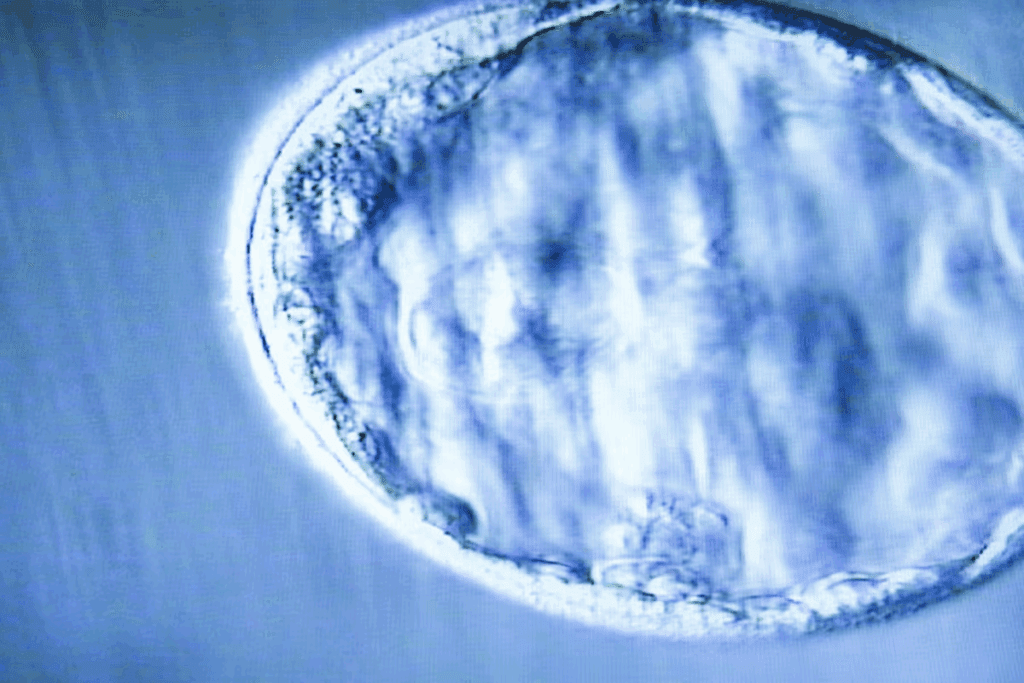
We’re diving into a key moment in early human development: the blastocyst. This tiny structure is only 0.1-0.2 millimeters wide. It happens about 5-6 days after fertilization.
The blastocyst is a ball of 100-200 cells. It starts to turn into different tissues. This marks a big change from a solid cluster of cells to a structured embryo with layers.
Knowing about the blastocyst’s shape and role helps us understand early embryo growth. This is very important in fertility medicine.
Key Takeaways
- The blastocyst stage occurs approximately 5-6 days after fertilization.
- It measures about 0.1-0.2 mm in diameter.
- The blastocyst consists of 100-200 cells.
- This stage is key for understanding early embryo growth.
- The blastocyst starts to form different tissues.
The Embryonic Journey to Blastocyst Formation
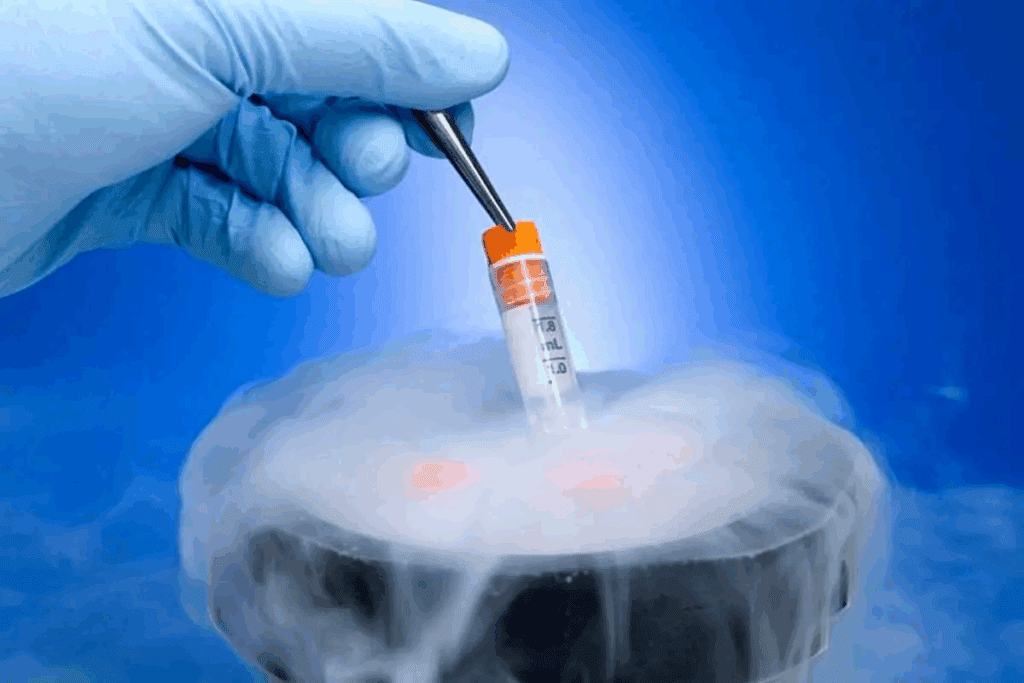
The path to becoming a blastocyst starts with fertilization and early cell divisions. This journey has many steps that are vital for the blastocyst’s development. The blastocyst is key for the growth of the embryo.
Fertilization and Early Cell Division
Fertilization is the first step in making a blastocyst. When a sperm meets an egg, it sets off a chain of cell divisions. These divisions are important for the next stages of growth.
The fertilized egg, now called a zygote, divides many times. It grows into a group of cells called a morula.
The early cell division process includes:
- Rapid cell divisions without significant growth
- Formation of a compact cluster of cells (morula)
- Initial differentiation of cells
Transition from Morula to Blastocyst
The morula then changes into a blastocyst. This change happens when a fluid-filled cavity, called the blastocoel, forms. The blastocoel is a key part of the blastocyst.
The main steps in this transition are:
- Formation of the blastocoel cavity
- Differentiation of cells into two groups: the inner cell mass and the trophoblast
- Reorganization of cells to form the blastocyst structure
Understanding how a blastocyst forms is key to knowing about embryonic development. From fertilization to blastocyst, the journey is complex. It involves many cell changes. By looking at these stages, we learn about the early growth of a healthy embryo.
Understanding Blastocyst Size and Cellular Structure
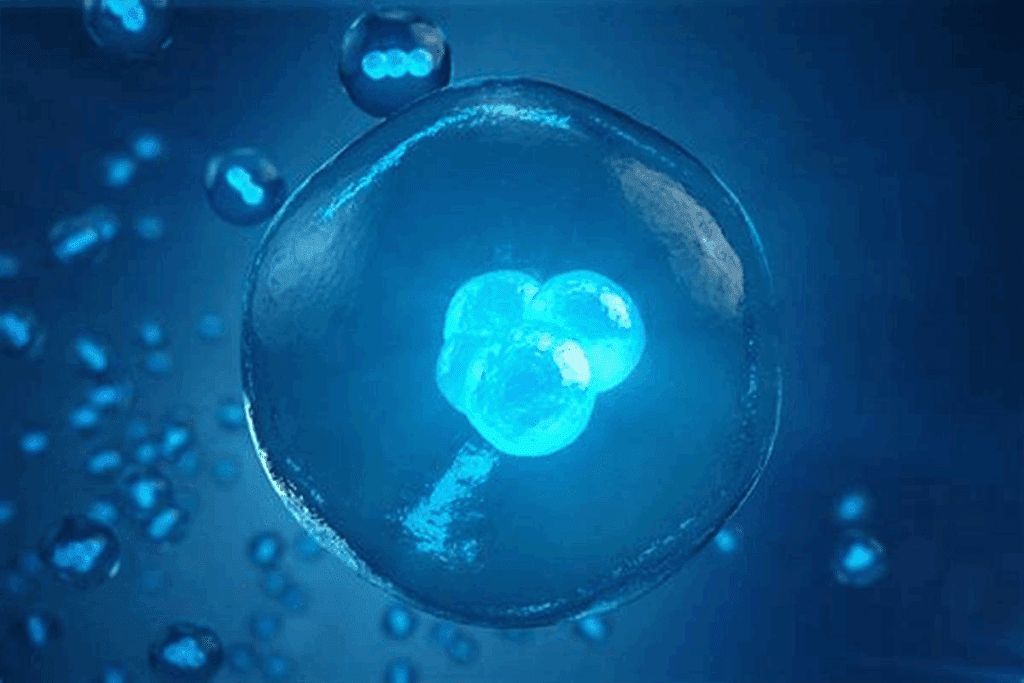
A blastocyst’s size and cellular structure give us clues about its development and health. This stage is key in early embryo growth, happening 5-6 days after fertilization.
The embryo grows into a structure with a fluid-filled center. It’s surrounded by two cell groups: the inner cell mass and the trophectoderm.
Measuring Blastocyst Diameter
The size of a blastocyst tells us about its growth stage. It usually measures between 0.1 and 0.2 mm. Accurate measurement is key to knowing the embryo’s growth chance.
Key factors in measuring blastocyst diameter include:
- The presence of a clear blastocoel cavity
- The overall size and shape of the embryo
- The thickness and integrity of the zona pellucida
Cell Count and Division Patterns
The number of cells in a blastocyst and how they divide are important. A normal blastocyst has 100-200 cells. The inner cell mass and trophectoderm play different roles in growth.
| Cell Type | Function | Typical Cell Count |
|---|---|---|
| Inner Cell Mass | Forms the embryoblast, which will develop into the fetus | 20-40 cells |
| Trophectoderm | Contributes to the formation of placental tissues | 60-100 cells |
The way cells divide is closely controlled. Any problems can affect the embryo’s growth chance. Knowing these patterns helps us understand the blastocyst’s viability.
The Three Fundamental Layers of a Blastocyst
The blastocyst has three main layers: trophoblast, inner cell mass, and blastocoel. Each layer has a unique role in the growth of the embryo. Knowing about these layers helps us understand how the blastocyst develops.
Structural Organization Overview
The blastocyst’s structure is made up of three key layers. The trophoblast is the outer layer. It will help form the placenta and other tissues. Inside the trophoblast, the inner cell mass holds cells that will become the embryo. The blastocoel is a fluid-filled space in the blastocyst. It’s important for the embryo’s growth and development.
“The way these layers are organized is key for the embryo’s growth and implantation,” say experts in embryology. The right arrangement of the trophoblast, inner cell mass, and blastocoel is essential for the embryo’s development.
Interdependence of Layers
The layers of the blastocyst work together. For example, the trophoblast and inner cell mass work closely during implantation. The trophoblast helps the blastocyst attach to the uterine wall. At the same time, the inner cell mass starts to form the embryo’s tissues.
The blastocoel supports the growth and development of the embryo. Its unique environment is vital for the embryo’s growth and maturation.
Visualization Through Modern Imaging Techniques
Modern imaging has changed how we see the blastocyst and its layers. Time-lapse microscopy lets us watch the blastocyst grow in real-time. This gives us important insights into its layers.
These advanced imaging methods have greatly improved our understanding of the blastocyst. They help us see how the layers work together. This knowledge is key for understanding why some embryos implant better than others.
Trophoblast: The Outer Cellular Layer
The trophoblast layer is around the blastocyst and is key for implantation and placenta growth. It’s vital for the embryo’s early development, helping it connect with the mother’s tissue.
Cellular Characteristics and Organization
The trophoblast has a special structure that lets it do its job well. It breaks into two types: the syncytiotrophoblast and the cytotrophoblast. The syncytiotrophoblast is a group of cells that digs into the uterine lining. The cytotrophoblast is a single-layered cell group that helps the syncytiotrophoblast grow.
These cells work together in a special way. They are arranged in a specific pattern. This pattern is important for implantation and making the placenta.
Function in Placenta Formation and Implantation
The trophoblast is very important for making the placenta and implanting the embryo. It helps the embryo attach to the uterine lining. This connection is key for the exchange of nutrients and waste between the mother and the embryo.
- The syncytiotrophoblast makes human chorionic gonadotropin (hCG). This hormone helps keep the pregnancy going.
- The cytotrophoblast grows and turns into syncytiotrophoblast. This keeps the placenta working well.
In short, the trophoblast is a key part of the blastocyst. It’s essential for implantation and making the placenta. Its special structure and organization help the embryo and mother’s tissue work together in the early stages of development.
Inner Cell Mass: The Embryonic Foundation
The inner cell mass is key in making the embryo. It holds pluripotent stem cells. These cells can turn into many different cell types.
This structure is vital for the growth of the embryo. It helps form the embryo itself and some parts of the placenta.
Pluripotent Stem Cell Properties
The inner cell mass has pluripotent stem cells. These cells can become any type of body cell. They can also self-renew and turn into the three main germ layers: ectoderm, endoderm, and mesoderm.
These stem cells’ ability to change into different cells is important. It helps the embryo grow and develop. This change is controlled by special proteins and signals.
Differentiation into Embryonic Tissues
The inner cell mass turns into the epiblast and hypoblast, forming a bilaminar disc. This is a key step in the embryo’s development. It sets the stage for the embryo’s growth and some supporting tissues.
The epiblast forms the three germ layers during gastrulation. The hypoblast helps make some extraembryonic tissues. Knowing how this happens helps us understand normal and abnormal development.
The Blastocoel: Composition and Function
The blastocoel is a fluid-filled space inside the blastocyst. It’s key for cell growth and differentiation. This space is a key feature of the blastocyst stage, important for early development.
Biochemical Composition of Cavity Fluid
The fluid in the blastocoel is more than just water. It’s filled with amino acids, growth factors, and other molecules. These are vital for cell growth and differentiation in the blastocyst.
Studies reveal the fluid contains proteins, sugars, and ions. These are essential for keeping the balance needed for cell growth and division.
Role in Cell Differentiation and Development
The blastocoel is vital for cell differentiation and development. It provides nutrients and signaling molecules. This helps in the formation of the embryoblast and trophoblast.
| Component | Function |
|---|---|
| Amino Acids | Building blocks for proteins, vital for cell growth and differentiation |
| Growth Factors | Regulate cell growth, differentiation, and survival |
| Ions and Sugars | Maintain osmotic balance and provide energy for cell processes |
In summary, the blastocoel is a critical part of the blastocyst. It affects development through its complex composition and roles in cell growth and differentiation.
Embryonic and Abembryonic Poles: Spatial Organization
The blastocyst’s development relies on its organization into embryonic and abembryonic poles. The inner cell mass and mural trophoblast at the abembryonic pole are key to this organization.
The inner cell mass is on one side, forming the embryonic pole. The other side is the abembryonic pole. This setup is vital for the blastocyst’s structure and growth.
Positional Significance of the Inner Cell Mass
The inner cell mass at the embryonic pole is essential for the embryo’s formation. Its location guides the development of embryonic tissues.
The inner cell mass’s position affects the embryo’s growth stages. It is the starting point for the embryo’s development.
The Mural Trophoblast at the Abembryonic Pole
The mural trophoblast at the abembryonic pole is critical for implantation. It is part of the trophoblast layer around the blastocoel.
The mural trophoblast’s role at the abembryonic pole is to interact with the uterine lining. This interaction helps the blastocyst implant.
The blastocyst’s organization, including the embryonic and abembryonic poles, is outlined below:
| Pole | Characteristics | Function |
|---|---|---|
| Embryonic Pole | Inner cell mass present | Embryo formation |
| Abembryonic Pole | Mural trophoblast present | Implantation facilitation |
Critical Processes in Blastocyst Development
Blastocyst formation is a complex process. It relies on precise cellular mechanisms like compaction and differentiation. These processes are key for the embryo’s development and survival.
Compaction: Cell Adhesion and Polarization
Compaction is a vital step in blastocyst development. It involves increased cell adhesion and polarization. During this time, the embryo’s cells become more tightly packed and organized.
This process is essential for the blastocyst’s structural integrity. It also prepares the embryo for future developmental stages.
“Compaction is a fundamental process that enables the embryo to transition from a loose collection of cells to a more cohesive structure,” highlights its importance in embryonic development. As cells compact, they also undergo polarization. This is vital for the proper functioning and organization of the cells within the blastocyst.
Differentiation of Trophectoderm and Inner Cell Mass
Differentiation is another critical process in blastocyst development. It leads to the formation of two distinct cell populations: the trophectoderm and the inner cell mass. The trophectoderm will eventually give rise to the placenta and other supporting tissues. The inner cell mass will form the embryo itself.
The differentiation of these cell populations is a complex process. It involves a series of molecular and cellular events. It is during this stage that the foundation for the future development of the embryo is laid. This makes it a critical period in the embryonic development process.
As stated by a leading embryologist, “The differentiation of the trophectoderm and inner cell mass is a pivot moment in embryonic development, setting the stage for the complex processes that follow.” This shows the importance of differentiation in the overall development of the blastocyst.
Blastocyst Size: Factors Affecting Growth and Viability
Looking at a blastocyst’s size helps us understand its growth and quality. The size of a blastocyst is key to knowing if it can implant well.
Normal Size Range and Variations
A normal blastocyst is usually 0.1-0.2 mm in diameter. But, size can change due to genetics, IVF conditions, and when it’s checked.
While size matters, it’s not everything. The inner cell mass and trophectoderm’s health also count a lot.
Growth Dynamics During Development
The growth of a blastocyst is complex. It involves fast cell division and change. The blastocyst grows by expanding and the zona pellucida gets thinner.
Growth rates differ among embryos. Things like nutrients and environment affect how fast it grows. Knowing this helps improve fertility treatments.
Size as an Indicator of Embryo Quality
Blastocyst size can show its quality and chance of implanting. Bigger ones with clear inner cell mass and trophectoderm are better.
But, size alone isn’t enough. We must look at other features too. This helps doctors choose the best embryo for IVF.
Blastocyst Implantation in the Uterine Wall
The implantation process starts when the blastocyst breaks free from its outer shell, the zona pellucida. This is a key step. It lets the blastocyst touch the uterine lining, making it possible to attach and grow in the uterine wall.
Hatching from the Zona Pellucida
Breaking free from the zona pellucida is a detailed process. It involves enzymes breaking down the zona pellucida. This is important because it lets the blastocyst move out of its shell and meet the uterine endometrium.
Mechanisms of Hatching: The hatching process is a series of steps. The blastocyst releases enzymes that soften the zona pellucida. This makes it possible for the blastocyst to come out.
Attachment and Invasion Processes
After breaking free, the blastocyst sticks to the uterine lining. This sticking is helped by special molecules. It’s a key step for implantation to be successful.
The invasion process lets the trophoblast cells go through the uterine lining. They connect the embryo with the mother’s blood. This is vital for the exchange of nutrients, gases, and waste between the mother and the growing embryo.
| Stage | Description | Key Events |
|---|---|---|
| Hatching | Escape from zona pellucida | Enzymatic degradation, emergence |
| Attachment | Adhesion to uterine epithelium | Molecular interactions, adhesion |
| Invasion | Penetration into uterine lining | Trophoblast differentiation, vascular connection |
Knowing about these steps helps us understand how a baby starts to grow inside the womb. It shows how complex and amazing the early stages of life are.
Blastocysts in Fertility Treatments and Research
Blastocysts are key in fertility treatments, like IVF. They help make these treatments more effective.
Role in In Vitro Fertilization (IVF)
Blastocysts are used in IVF because they have a better success rate than early-stage embryos. This makes IVF more likely to work.
Embryos are grown to the blastocyst stage, about 5-6 days after fertilization. This lets us pick the best embryos for transfer.
Benefits of Using Blastocysts in IVF:
- Higher implantation rates
- Better embryo selection
- Reduced risk of multiple pregnancies
Blastocyst Grading and Selection Criteria
Grading blastocysts is vital in IVF. It helps choose the best embryo for transfer. We look at expansion, inner cell mass, and trophectoderm quality.
We use a set grading system to pick the best embryo. This ensures the chosen embryo has the best chance of success.
| Grade | Expansion | Inner Cell Mass | Trophectoderm |
|---|---|---|---|
| 1 | Early blastocyst | Many cells, tightly packed | Many cells, cohesive epithelium |
| 2 | Partially expanded | Moderate number of cells | Moderate number of cells |
| 3 | Fully expanded | Few cells, loosely arranged | Few cells, loose epithelium |
By looking at these factors, we can pick the best blastocyst for transfer. This boosts the chances of a successful IVF outcome.
Conclusion
Understanding blastocyst development is key to grasping the complexity of embryonic growth. From fertilization to the formation of a blastocyst, there are many stages and important cell events. These events are essential for a successful pregnancy.
We’ve looked at the blastocyst’s structure, including its three main parts: the trophoblast, inner cell mass, and the blastocoel. Each part is vital for the embryo’s growth and implantation.
Blastocyst development is not just for natural conception but also for assisted reproductive technologies like IVF. The ability to grow and choose high-quality blastocysts for transfer has boosted IVF success. This gives hope to those facing fertility issues.
As we learn more about blastocyst and embryonic development, we can better help those seeking fertility treatments. We can also develop new treatments. Understanding early embryonic development helps us appreciate the complexity of human reproduction.
FAQ
What is a blastocyst, and when does it form?
A blastocyst is an early embryo stage. It forms about 5-6 days after fertilization. It’s small, with a diameter of 0.1-0.2 mm and has 100-200 cells.
What are the three fundamental layers of a blastocyst?
The blastocyst has three main layers. The trophoblast, the inner cell mass, and the blastocoel. Each layer is vital for the embryo’s growth and implantation.
How is blastocyst size measured, and why is it important?
We measure blastocyst size by its diameter. It’s usually between 0.1 to 0.2 mm. This size is key to knowing its developmental stage and health.
What is the role of the trophoblast in placenta formation?
The trophoblast is split into syncytiotrophoblast and cytotrophoblast. These parts are essential for implantation and making the placenta.
What is the significance of the inner cell mass in embryonic development?
The inner cell mass is critical for the embryo’s growth. It turns into the epiblast and hypoblast. It also gives us pluripotent stem cells.
How does the blastocoel contribute to cell differentiation and development?
The blastocoel’s fluid is vital for cell growth and differentiation. It helps cells in the blastocyst develop and grow.
What is the importance of compaction in blastocyst development?
Compaction is when cells stick together and line up. It’s important for the blastocyst’s structure. It helps form the trophectoderm and inner cell mass.
How does blastocyst size affect its viability?
Knowing the right size range is key. Size can show how good the embryo is and if it’s viable.
What is the process of blastocyst implantation?
Implantation starts with hatching from the zona pellucida. Then, it attaches and invades the uterine wall. This is essential for a successful pregnancy.
How are blastocysts graded and selected for IVF transfer?
We grade blastocysts based on size, cell count, and division patterns. This helps pick the best embryo for IVF transfer.
What is the significance of the blastocyst stage in both natural conception and assisted reproductive technologies?
The blastocyst stage is vital for development. Understanding it helps us see the importance of both natural conception and IVF.
References
National Center for Biotechnology Information. Blastocyst Development: Definition, Size, and Early Formation. Retrieved from https://www.ncbi.nlm.nih.gov/books/NBK26842/



 Departments
 Related Videos
 Our Doctors
 News
News