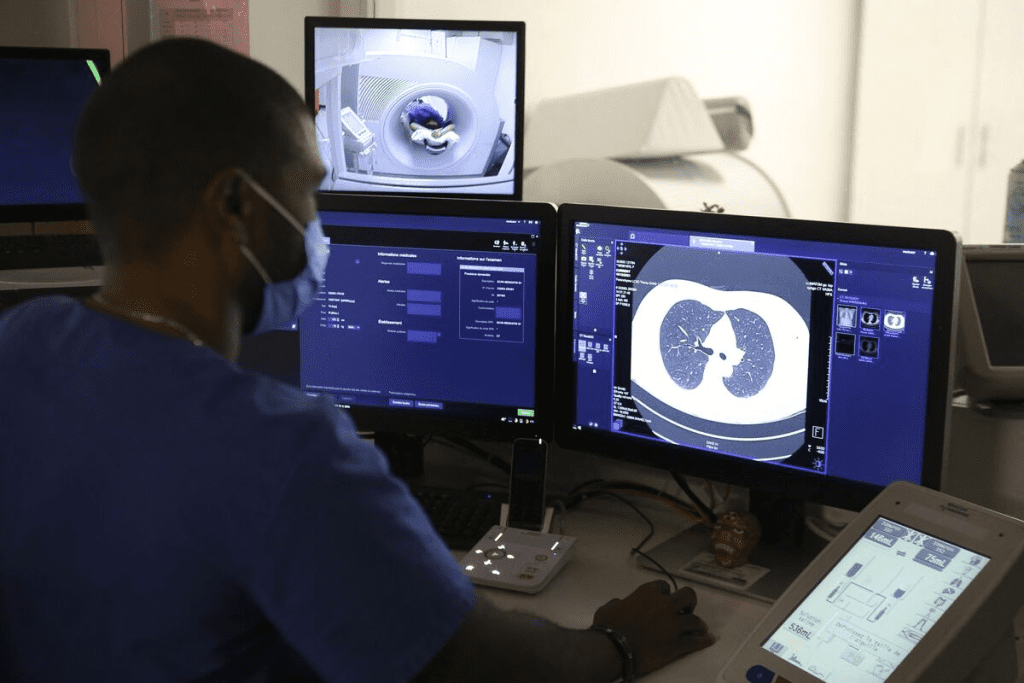
A bone cancer bone scan, also known as bone scintigraphy, is a test that uses a radioactive isotope. It finds areas of abnormal bone metabolism. This test is non-invasive and key for spotting cancer spread to bones.
The goal of a bone scan is to diagnose and track bone conditions, like cancer. It uses a tiny amount of radioactive material. This helps doctors see bone activity clearly, helping them understand the disease’s extent and plan treatment.
Key Takeaways
- A bone cancer bone scan is a diagnostic tool that uses a radioactive isotope.
- It helps detect the spread of cancer to the bones.
- The scan is non-invasive and provides detailed images of bone activity.
- It is used to diagnose and monitor bone-related conditions.
- Healthcare professionals use the scan results to plan treatment.
Understanding Bone Scintigraphy: Technology and Purpose
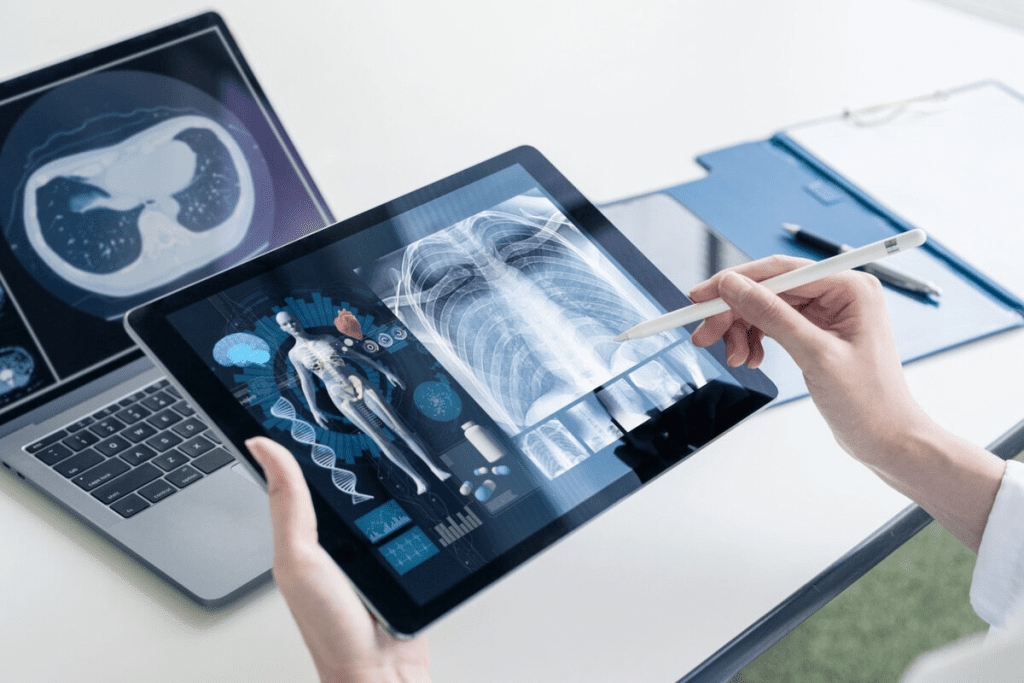
Bone scintigraphy, also known as radionuclide bone scanning, is key in nuclear medicine for checking bone health. It uses a tiny amount of radioactive tracer to see how bones work and find bone problems.
What Is Radionuclide Bone Scanning?
Radionuclide bone scanning is a way to use a radioactive tracer to find and track bone diseases. The tracer goes into a vein, usually in the arm or hand. It builds up in bones that are very active. A study in Nature shows it’s great for spotting bone metastases and other bone issues.
How Radioactive Isotopes Work in Diagnostic Imaging
Radioactive isotopes, or radionuclides, are used in bone scintigraphy to show where bones are most active. When they’re injected, they send out gamma rays. A gamma camera catches these rays, making images that help doctors see bone health.
Evolution of Bone Scintigraphy Machines
The tech behind bone scintigraphy machines has gotten much better over time. Now, they can make clearer images faster. This means doctors can spot bone diseases sooner and more accurately. So, bone scintigraphy is a vital tool in cancer and bone care, helping find bone metastases in many cancers.
Bone scintigraphy machines are key for finding bone metastases in cancers. They use a small amount of radioactive tracer. A technician puts it into a vein in your arm or hand. It then gathers in different parts of your body.
The Bone Cancer Bone Scan Procedure
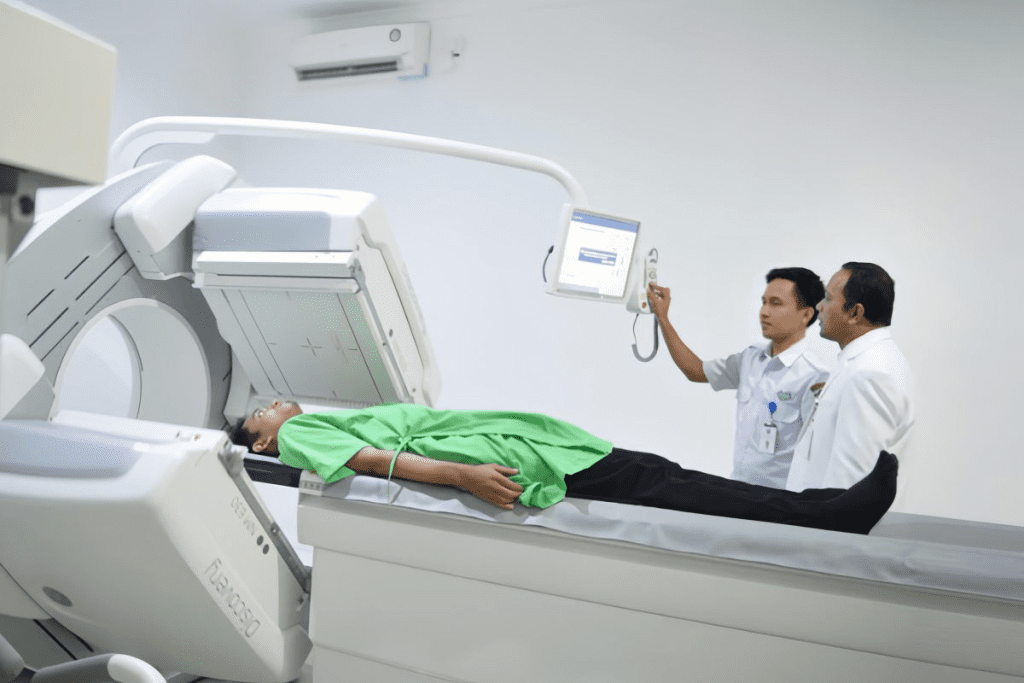
Getting a bone cancer bone scan is a simple process with several steps. This test is key for finding bone cancer or tumors. Knowing what to expect can help ease any worries.
Patient Preparation Requirements
Before the scan, patients must remove all jewelry and metal items. They might need to wear a hospital gown. This ensures the scan works correctly.
- Remove all jewelry and metal objects
- Wear a hospital gown if instructed
- Inform your doctor about any medications or allergies
The Injection and Waiting Period
A small amount of radioactive tracer is injected into the blood. This tracer highlights abnormal bone areas. After, patients wait a few hours for it to spread.
While waiting, patients can move around and often leave the hospital. But, they must follow their doctor’s advice, like drinking water to clear the tracer.
The Scanning Process
The scanning part takes 30 to 60 minutes. Patients lie on a table as a camera moves around, capturing bone images. The scan is painless and doesn’t need special prep.
After scanning, patients can go back to their usual activities. The images are then analyzed by a radiologist. The results are shared with the patient’s doctor for further discussion.
How Bone Scans Detect Abnormal Bone Metabolism
Bone scans use radioactive isotopes to find problems in bones. They show where bones are active. This helps find issues with bone metabolism.
Normal vs. Abnormal Uptake Patterns
Bone scans use a radioactive tracer. Normal uptake patterns are even across the skeleton. But, abnormal uptake patterns can mean cancer, arthritis, or fractures. It’s important to see how the tracer spreads.
- Even tracer spread is usually normal.
- Spotting areas with more tracer can mean disease.
- Wide tracer spread might show metabolic bone diseases.
Osteoblastic vs. Osteolytic Lesions
Bone lesions are either osteoblastic or osteolytic. Osteoblastic lesions show more bone growth, meaning more tracer uptake. On the other hand, osteolytic lesions destroy bone, showing less tracer uptake.
| Lesion Type | Tracer Uptake | Characteristics |
| Osteoblastic | Increased | Bone formation |
| Osteolytic | Decreased | Bone destruction |
Interpreting “Hot Spots” and “Cold Spots”
“Hot spots” on a bone scan mean more tracer uptake, showing active bone. These are often signs of bone growth or disease. “Cold spots” have less uptake, showing bone loss or death.
- Find and measure “hot spots” and “cold spots.”
- Link these findings with symptoms and other tests.
- Think about possible causes based on tracer uptake.
Knowing how to read bone scans is key for correct diagnosis and treatment. By understanding normal and abnormal patterns, and osteoblastic and osteolytic lesions, doctors can better care for patients.
Diagnostic Accuracy in Bone Cancer Detection
Bone scans are key in finding bone cancer today. They help doctors rule out other conditions that might look like cancer. This can be scary for patients and their families.
Sensitivity Rates Above 80%
Bone scans are very good at finding bone cancer. They can spot most cases, with a success rate over 80%. Studies show bone scans can be up to 96% accurate in finding bone cancer.
Specificity Challenges and Limitations
Even though bone scans are good, they’re not perfect. They can show false positives, meaning they might show things that aren’t cancer. This can lead to more tests and worry. This can cause a lot of anxiety and extra tests.
Factors Affecting Diagnostic Accuracy
Many things can change how accurate bone scans are. The type of cancer, how far it has spread, and other bone issues matter. Knowing these can help doctors understand bone scan results better.
- The type and stage of bone cancer can influence detection rates.
- Other bone conditions, such as arthritis or fractures, can complicate the interpretation of bone scans.
- The quality of the scanning equipment and the expertise of the interpreting physician also play significant roles.
Primary Bone Malignancies Revealed by Bone Scans
Bone scans are key in finding primary bone cancers. They show where and how big these cancers are. These tests spot unusual bone activity, which might mean cancer.
Osteosarcoma Imaging Characteristics
Osteosarcoma, the most common bone cancer, shows up bright on bone scans. This is because it’s very active in making bone. This makes bone scans great for finding osteosarcoma and seeing how big it is.
Key Features:
- Intense tracer uptake in the tumor
- Potential for skip lesions within the bone
- Possible extension into surrounding soft tissues
Ewing’s Sarcoma Detection
Ewing’s sarcoma, another aggressive bone cancer, can be found with bone scans. Its look on scans is not as clear as osteosarcoma’s, but it does show up a lot.
“Bone scans are valuable in the initial staging and follow-up of Ewing’s sarcoma, helping to identify both the primary tumor and any possible metastases.”
Chondrosarcoma and Other Primary Bone Cancers
Chondrosarcoma, a cancer of cartilage cells, can show up differently on bone scans. Some chondrosarcomas are very active, while others are not. Other cancers, like chordoma and malignant fibrous histiocytoma, can also be found with bone scans. But their looks are not as clear.
| Cancer Type | Typical Bone Scan Appearance |
| Osteosarcoma | Intense tracer uptake |
| Ewing’s Sarcoma | Significant tracer uptake |
| Chondrosarcoma | Variable uptake |
Case Examples and Typical Findings
Studies show bone scans are key in finding and understanding primary bone cancers. For example, a patient with osteosarcoma in the femur might show a lot of activity on the scan. This could mean the cancer has spread. Knowing this helps doctors plan treatment and predict how well the patient will do.
Diagnostic accuracy gets better when bone scan results are matched with other scans like MRI and CT. This gives a full picture of the cancer’s spread.
Metastatic Cancer Detection Using Bone Scintigraphy
Bone scintigraphy is key in finding cancer spread to bones. It’s very useful in spotting cancer in bones, which happens in many cancers.
Breast Cancer Metastases Patterns
Breast cancer often spreads to bones. Bone scintigraphy can spot this spread. It shows up as hot spots on scans. Studies show bone scans help track breast cancer and see how treatments work bone metastases detection.
Prostate Cancer Bone Involvement
Prostate cancer also spreads to bones, causing bone growth. This shows up as hot spots on scans. Finding these spots is key for planning treatment.
Lung and Other Common Metastatic Sources
Lung cancer and others like kidney and thyroid cancer can also spread to bones. Bone scintigraphy helps find these spots. This info is important for planning treatment.
Role in Cancer Staging and Treatment Monitoring
Info from bone scintigraphy helps figure out how far cancer has spread. This affects treatment plans. It also helps see if treatments are working and if changes are needed.
Arthritis and Inflammatory Conditions on Bone Scans
Bone scans are a key tool for finding bone problems like arthritis and inflammatory diseases. They are not just for cancer. They help spot other bone issues too.
Characteristic Patterns of Arthritis
Arthritis shows up on bone scans in certain ways. Osteoarthritis causes more activity in the affected joints as the body tries to fix the bone. Rheumatoid arthritis often shows up in a symmetrical pattern in the hands and feet.
The signs of arthritis on bone scans include:
- Increased radionuclide uptake in the joints
- Symmetrical distribution in cases of rheumatoid arthritis
- Uptake in characteristic locations such as the hips, knees, and spine for osteoarthritis
Differentiating Arthritis from Malignancy
It can be hard to tell if a bone scan shows arthritis or cancer. Both can cause areas of high activity. This makes it tricky to tell them apart just by looking at the scan.
Key differences include where and how the activity spreads. Arthritis usually affects joints in a predictable way. Cancer can show up anywhere and not just in joints.
Supplemental Tests Needed for Definitive Diagnosis
Bone scans are helpful but not enough to confirm arthritis or rule out cancer. More tests are needed. These might include:
- X-rays to check joint damage and bone shape
- MRI or CT scans for detailed images
- Blood tests for inflammation markers
- Looking at symptoms and medical history
In summary, bone scans can hint at arthritis or inflammation, but they’re just part of the puzzle. A full diagnosis needs a mix of scan results, clinical checks, and other tests.
Other Conditions Revealed During Bone Scanning
Bone scans are not just for finding cancer. They also help diagnose many other bone problems. This makes them a valuable tool in healthcare.
Bone Infections and Osteomyelitis
Bone scans are great for spotting bone infections like osteomyelitis. They work because infected bones use more energy. This shows up on the scan.
The scan can tell if it’s an acute or chronic infection. This helps doctors plan the right treatment.
Fractures and Traumatic Injuries
Bone scans can find fractures and injuries that X-rays miss. Stress fractures, for example, show up because bones are repairing themselves.
They’re also good for checking how well bones heal after trauma. This is very helpful for older patients or those with weak bones.
Metabolic Bone Diseases
Scans can also spot metabolic bone diseases like Paget’s disease and osteoporosis. These diseases change how bones use energy, which shows up on scans.
Paget’s disease looks like a bright spot on the scan. Osteoporosis shows up as a more spread-out pattern.
Avascular Necrosis and Bone Infarcts
Bone scans can find avascular necrosis (AVN) and bone infarcts. AVN looks like a “cold spot” because it lacks blood. But sometimes, it looks “hot” when it’s healing.
Bone infarcts, or dead bone, also show up on scans. Finding these early helps prevent more damage and helps doctors take better care of patients.
Conclusion: The Evolving Role of Bone Scans in Modern Diagnostics
Bone scan scintigraphy is now a key tool in medicine. It helps understand bone health and finds many conditions, like bone cancer and arthritis. Knowing what does a bone scan reveal helps doctors use it better, leading to better care for patients.
The evolving role of bone scans in medicine is thanks to new tech and imaging methods. As more radiology centers open, they help improve health by catching diseases early.
Bone scans are vital for diagnosing and treating bone issues. They can spot problems and are very useful in today’s medicine. As tech keeps getting better, bone scans will play an even bigger part in helping patients.
FAQ
What is a bone scan, and what does it reveal?
A bone scan, or bone scintigraphy, uses a small amount of radioactive material. It helps see the bones. It shows how bones work and can find problems like cancer, arthritis, and infections.
Can a bone scan detect arthritis?
Yes, a bone scan can show arthritis and other inflammatory conditions. It looks for patterns of increased or decreased activity. But, it can be hard to tell if it’s arthritis or cancer, so more tests might be needed.
What cancers can a bone scan detect?
Bone scans can find cancers that start in the bones and cancers that spread to the bones. This includes cancers from the breast, prostate, and lung.
How does radionuclide bone scanning work?
Radionuclide bone scanning uses a radioactive tracer, usually technetium-99m. It’s injected into the blood. The tracer goes to active bone areas, showing where bones are working too much or too little.
What is the role of radioactive isotopes in diagnostic imaging?
Radioactive isotopes, like technetium-99m, are key in imaging tests. They help see specific body functions or structures. In bone scans, they spot abnormal bone activity.
Can a bone scan detect bone cancer?
Yes, bone scans can find bone cancer. They’re good at spotting osteoblastic lesions, where bones grow too much.
How accurate are bone scans in detecting bone cancer?
Bone scans are very good at finding bone cancer, with a sensitivity rate over 80%. But, it can be tricky to be sure, depending on the cancer type, location, and the patient’s health.
What is the difference between osteoblastic and osteolytic lesions?
Osteoblastic lesions are where bones grow too much. Osteolytic lesions are where bones break down. Bone scans are better at finding osteoblastic lesions, which show up as hot spots.
Can a bone scan detect other bone conditions beside cancer?
Yes, bone scans can find many bone issues, like infections, fractures, and metabolic diseases. They help understand bone metabolism and diagnose various bone problems.
What should I expect during a bone cancer bone scan procedure?
During a bone scan, you’ll get an injection of a radioactive tracer. Then, you’ll wait. The scan takes about 30-60 minutes. You’ll lie on a table while images of your bones are taken. It’s usually painless.
References
- Van den Wyngaert, T., et al. (2016). The EANM practice guidelines for bone scintigraphy. European Journal of Nuclear Medicine and Molecular Imaging. https://www.ncbi.nlm.nih.gov/pmc/articles/PMC4932135/
- Kim, J. Y., et al. (2016). Bone scintigraphy in the diagnosis of rheumatoid arthritis. Scientific Reports. https://www.ncbi.nlm.nih.gov/pmc/articles/PMC4810331/
- Santos, J.C., et al. (2023). Bone metastases detection in patients with breast cancer: PET/CT vs bone scintigraphy. Cancer Medicine. https://pmc.ncbi.nlm.nih.gov/articles/PMC10400135/