The brainstem is a key part of our brain, made up of three main areas: the midbrain, pons, and medulla oblongata. It’s small, making up only about 2.6 percent of the brain’s weight. Yet, it’s vital for keeping us alive by controlling important functions.brain stem nerve9 Brain Tumor Vision Problems: Key Symptoms & Warning Signs
We’ll dive into why the brainstem is so important. We’ll look at its three main parts and how they help us breathe, keep our heart rate steady, and control our blood pressure. Knowing about the brainstem’s structure and role helps us understand its role in our health.
The brainstem sits below the thalamus, above the spinal cord, and in front of the cerebellum. Its unique design and function make it a key part of our nervous system.
Key Takeaways
- The brainstem consists of three main parts: midbrain, pons, and medulla oblongata.
- It plays a critical role in keeping us alive by controlling essential functions.
- The brainstem manages important tasks like breathing, heart rate, and blood pressure.
- Understanding the brainstem’s anatomy and functions is key to appreciating its role in our health.
- The brainstem is a vital part of our nervous system.
The Brainstem: Overview and Significance
The brainstem is key to keeping our bodies running. It connects the cerebrum to the spinal cord. This lets signals flow between them.
Definition and Anatomical Position
The brainstem looks like a stalk and goes from the diencephalon to the spinal cord. It also links to the cerebellum at the back. It’s between the diencephalon and the spinal cord, linking the brain to the spinal cord.
The front part of the brainstem has important structures. These include the pyramids and the basilar artery. Knowing about the brainstem’s anatomy helps us understand its role and importance.
Evolutionary Importance
The brainstem has always been vital in the central nervous system. It helped early vertebrates survive. It also paved the way for more complex brain functions.
Looking back, the brainstem is one of the oldest brain parts. It’s been around for millions of years. Its constant presence shows how essential it is for life.
Role in Vital Functions
The brainstem controls vital functions like breathing, consciousness, blood pressure, heart rate, and sleep. These are key for keeping our bodies balanced and responding to needs.
Damage to the brainstem can cause big problems. It can lead to breathing issues, heart problems, and changes in awareness. Knowing how the brainstem works is important for treating related health issues.
General Anatomy of the Brainstem

The brainstem is a key part of our central nervous system. It connects the cerebrum to the spinal cord. This connection is vital for nerve signals to travel between the brain and the body. Knowing its anatomy helps us understand its role and importance.
External Features and Boundaries
The brainstem has three main parts: the midbrain, pons, and medulla oblongata. The midbrain is at the top, linking the pons and diencephalon. The pons is in the middle, helping with sleep and wakefulness. The medulla oblongata is at the bottom, connecting to the spinal cord and controlling breathing and heart rate.
The brainstem has many nuclei and tracts on its surface. It houses cranial nerve nuclei, which control facial expressions and eye movements. Its boundaries are where it meets the cerebrum and spinal cord.
Internal Structure and Organization
Inside, the brainstem is divided into the tectum, tegmentum, and basis. The tegmentum has nuclei and tracts, including the reticular formation. This formation is key for consciousness and sleep-wake cycles.
- The brainstem has important nuclei, including those for cranial nerves.
- The reticular formation is a network of neurons in the brainstem.
- The brainstem’s inside is a mix of gray and white matter.
Vascular Supply
The brainstem gets its blood from the vertebrobasilar system. This includes the vertebral and basilar arteries. The vertebral arteries merge to form the basilar artery, which runs along the pons. This blood supply is essential for the brainstem’s functions.
- The vertebral arteries start from the subclavian arteries and go up the neck.
- They merge at the medullary-pontine junction to form the basilar artery.
- The basilar artery has branches that supply the pons and midbrain.
The Brain Stem Nerve Pathways and Connections
The brainstem is key to many bodily functions. It houses most cranial nerve nuclei. It also connects the cerebrum and spinal cord through neural pathways.
Ascending Sensory Pathways
Ascending sensory pathways send body information to the brain. They help us feel and react to our surroundings.
- The spinothalamic tract carries pain, temperature, and touch signals.
- The dorsal column-medial lemniscus pathway transmits fine touch, vibration, and body position signals.
Descending Motor Pathways
Descending motor pathways send brain signals to the spinal cord. They control both voluntary and involuntary movements.
Pathway | Function |
Corticospinal tract | Voluntary motor control |
Reticulospinal tract | Regulation of posture and movement |
Vestibulospinal tract | Balance and equilibrium |
Reticular Formation and Consciousness
The reticular formation is a network in the brainstem. It’s vital for controlling consciousness and alertness.
The reticular activating system (RAS) manages our sleep-wake cycle and alertness.
The Midbrain: Superior Region of the Brainstem
The midbrain, or mesencephalon, is at the top of the brainstem. It connects the forebrain and hindbrain. It controls eye movements, processes visual and auditory info, and regulates motor control.
Anatomical Structure and Boundaries
The midbrain is the top part of the brainstem. It goes from the base of the thalamus to the top of the fourth ventricle. It’s divided into the tectum, tegmentum, and crus cerebri.
Key Features:
- The tectum includes the superior and inferior colliculi, which are involved in visual and auditory processing.
- The tegmentum contains various nuclei and tracts, including those related to motor control and arousal.
- The crus cerebri are significant for motor control, containing corticospinal and corticobulbar tracts.
Key Components of the Midbrain
The midbrain has several important structures. These include:
- Periaqueductal Gray (PAG): Surrounds the cerebral aqueduct and is involved in pain modulation and defensive behaviors.
- Red Nucleus: Plays a role in motor coordination.
- Substantia Nigra: Comprises the pars compacta and pars reticulata, which are key for dopamine production and motor control.
- Superior and Inferior Colliculi: Involved in visual and auditory processing, respectively.
Functions of the Midbrain
The midbrain is vital for many functions. These include:
- Eye Movement Control: The midbrain controls voluntary eye movements through the oculomotor nucleus.
- Auditory and Visual Processing: The superior and inferior colliculi process visual and auditory information.
- Motor Control: The midbrain is involved in motor control through the substantia nigra and red nucleus.
- Arousal and Alertness: The reticular formation within the midbrain contributes to arousal and alertness.
In summary, the midbrain is a key part of the brainstem. It controls many neurological functions. Knowing its structure, components, and functions helps us understand the brainstem’s complexity.
The Pons: Middle Region of the Brainstem
The pons is the middle part of the brainstem. It helps the cerebrum and cerebellum talk to each other. It’s the biggest part of the brainstem, sitting above the medulla oblongata and below the midbrain.
Anatomical Structure and Boundaries
The pons looks like a bulb and is a big part of the brainstem. It’s surrounded by the midbrain above and the medulla oblongata below. Inside, you’ll find gray and white matter. The gray matter has distinct nuclei, and the white matter has tracts for communication.
Key Components of the Pons
The pons has important parts that help it work. These include:
- Pontine nuclei: These nuclei help send signals from the brain to the cerebellum.
- Cranial nerve nuclei: The pons is linked to several cranial nerves. These are the trigeminal nerve (cranial nerve V), the abducens nerve (cranial nerve VI), the facial nerve (cranial nerve VII), and the vestibulocochlear nerve (cranial nerve VIII).
- Ascending and descending tracts: The pons has tracts for sending and receiving sensory and motor signals.
A neuroscientist said, “The pons is key for many functions like sleep, swallowing, and processing sensory information.”
“The pons is not just a simple bridge between different parts of the brain; it is a complex structure that is integral to many of our daily functions.”
Functions of the Pons
The pons does many important things, including:
Function | Description |
Sensory processing | The pons helps process sensory info like touch and pain. |
Motor control | The pons has tracts for motor control. They help send signals from the brain to the spinal cord and other motor centers. |
Sleep and arousal | The pons helps control sleep and wakefulness. Certain nuclei affect our level of consciousness. |
In summary, the pons is a vital part of the brainstem. It helps with many neurological functions. Its structure, components, and functions make it essential for our nervous system.
The Medulla Oblongata: Inferior Region of the Brainstem
The medulla oblongata is at the bottom of the brainstem. It connects the brain to the spinal cord. It helps with important functions that keep us alive.
Anatomical Structure and Boundaries
The medulla oblongata goes from the pons to the spinal cord. Its front side has the anterior median fissure. Inside, you’ll find the pyramids, which carry signals to the spinal cord.
Key anatomical features include the olivary nucleus and the vagus nerve roots. The back side is part of the fourth ventricle.
Key Components of the Medulla
The medulla oblongata has important parts for our body’s functions. These include:
- The pyramids, which help control our movements.
- The olivary nucleus, which helps with coordination.
- The nuclei of cranial nerves IX, X, XI, and XII, which control swallowing, breathing, and tongue movement.
Structure | Function |
Pyramids | Motor control through corticospinal tracts |
Olivary nucleus | Motor coordination |
Cranial nerve nuclei (IX, X, XI, XII) | Control of swallowing, respiration, and tongue movement |
Functions of the Medulla Oblongata
The medulla oblongata is key for many autonomic functions. These include:
- Respiratory control: It helps regulate breathing.
- Cardiovascular regulation: It controls heart rate and blood pressure.
- Reflexes: It coordinates reflexes like coughing and sneezing.
Damage to the medulla oblongata can cause serious problems. It can lead to breathing failure. This shows how vital it is for our survival.
Vital Functions Regulated by the Brainstem
Our brainstem is key to managing important bodily functions we often overlook. It includes the midbrain, pons, and medulla oblongata. These parts play a big role in keeping us alive by controlling essential functions.
Cardiovascular Regulation
The brainstem controls our heart rate and blood pressure. It has cardiovascular centers in the medulla oblongata and pons. These centers adjust our heart rate and blood pressure based on our body’s needs.
For example, when we exercise, the brainstem makes our heart rate and blood pressure go up. This helps our muscles get more oxygen. When we rest, it lowers these rates to help us relax and reduce stress.
Respiratory Control
The brainstem also controls our breathing. It has respiratory centers in the medulla oblongata and pons. These centers make sure we breathe at the right rate and depth to get enough oxygen.
It changes how fast we breathe based on blood oxygen and carbon dioxide levels. For instance, during hard exercise, it makes us breathe faster to get more oxygen.
Sleep-Wake Cycles
The brainstem helps regulate our sleep-wake cycles, or circadian rhythms. The suprachiasmatic nucleus, though not part of the brainstem, works with it to control our sleep-wake cycle.
It’s complex, involving many neurotransmitters and nuclei. These help us switch between being awake and asleep.
Consciousness and Arousal
The brainstem is also vital for keeping us conscious and alert. The reticular activating system (RAS) in the brainstem controls our alertness.
The RAS filters out most of the sensory information we get. It decides what we should pay attention to. Damage to the RAS can lead to problems with consciousness or even coma.
Function | Description | Key Brainstem Component |
Cardiovascular Regulation | Control of heart rate and blood pressure | Cardiovascular centers in medulla and pons |
Respiratory Control | Regulation of breathing rate and depth | Respiratory centers in medulla and pons |
Sleep-Wake Cycles | Regulation of circadian rhythms | Interaction between suprachiasmatic nucleus and brainstem nuclei |
Consciousness and Arousal | Maintenance of alertness and consciousness | Reticular Activating System (RAS) |
Clinical Significance and Disorders of the Brainstem
The brainstem is a key part of our nervous system. It can get sick and affect how we live. Knowing about its problems helps doctors find and treat them.
Stroke and Vascular Disorders
Strokes and blood vessel problems are big worries for the brainstem. Its blood supply makes it prone to strokes. Ischemic strokes block blood flow, while hemorrhagic strokes are caused by blood vessel ruptures. Both can cause serious brain damage.
When the brainstem gets a stroke, symptoms vary. They might include trouble speaking, swallowing, and moving. Facial weakness and breathing issues can also happen. Quick medical help is key to reduce damage.
Traumatic Injuries
Head trauma can hurt the brainstem. This often happens in car accidents, falls, or fights. The brainstem’s location makes it easy to damage.
Dealing with brainstem injuries needs a team effort. Doctors, surgeons, and rehab experts work together. They aim to keep the patient safe and help them recover.
Neurodegenerative Diseases
Diseases like Parkinson’s can harm the brainstem. They cause the brain to slowly get worse. These diseases are linked to abnormal proteins and dying brain cells.
Signs of brainstem problems in these diseases include shaking, stiffness, slow movement, and trouble with body functions. Finding new treatments is a focus of ongoing research.
Diagnostic Approaches and Imaging
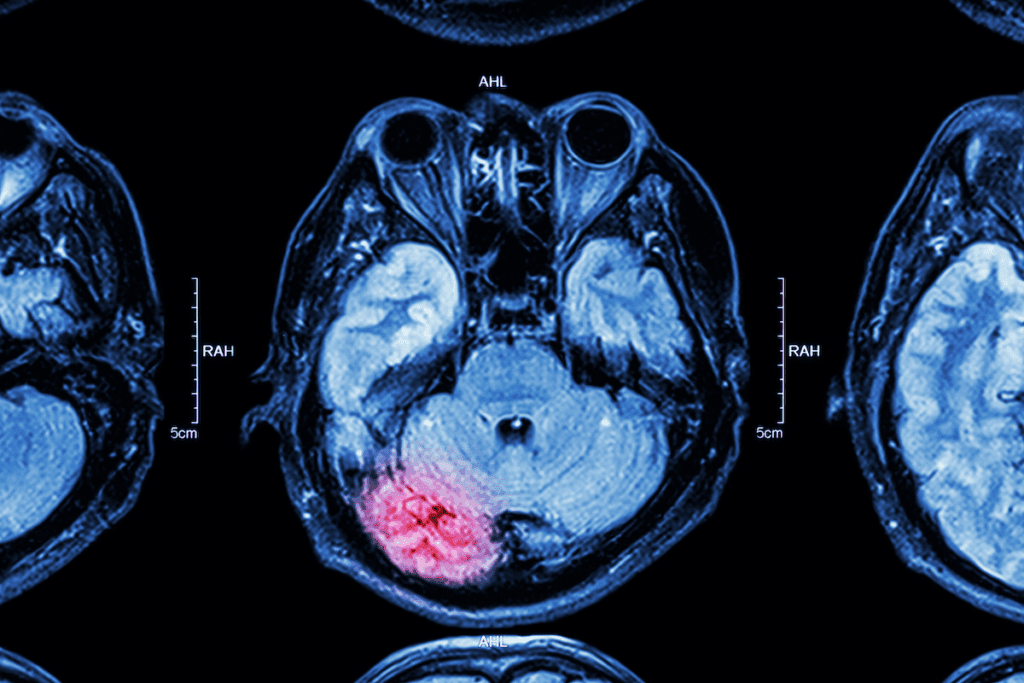
Figuring out brainstem issues needs both doctor checks and special scans. Magnetic Resonance Imaging (MRI) is great for seeing the brainstem and finding problems like tumors or strokes.
Other tests might include Computed Tomography (CT) scans, electrophysiological tests, and lumbar puncture. A full check-up helps doctors find the cause and treat it right.
Conclusion
The brainstem is a key part of our brain. It connects the cerebrum to the spinal cord, helping signals move. It has three main parts: the midbrain, pons, and medulla oblongata.
These parts work together to control important functions. Knowing about the brainstem helps us see its role in keeping us alive.
The brainstem’s three parts are key to our health. They help control our heart and breathing, among other things. Understanding these parts is important for diagnosing and treating health issues.
Damage to the brainstem can be serious. Knowing its anatomy and functions helps doctors treat patients better. This knowledge is key for caring for those with brainstem injuries or disorders.
FAQ
What are the three main parts of the brainstem?
The brainstem has three main parts: the midbrain, pons, and medulla oblongata.
What is the brainstem’s role in controlling vital functions?
The brainstem controls vital functions like breathing, heart rate, and blood pressure.
What is the brainstem’s anatomical position?
The brainstem connects the cerebrum to the spinal cord. It’s a key structure for signal transmission.
What are the components of the brainstem?
The brainstem includes the midbrain, pons, and medulla oblongata. Each part has its own structure and function.
What is the significance of the brainstem in maintaining life?
Knowing about the brainstem’s anatomy and functions shows its vital role. It keeps us alive by managing vital functions and connecting the cerebrum and spinal cord.
What are the key functions of the midbrain?
The midbrain controls eye movements and processes visual and auditory information. It also regulates motor control.
What are the primary functions of the pons?
The pons manages facial movements, hearing, balance, and breathing. It’s essential for many bodily functions.
What is the role of the medulla oblongata in controlling involuntary vital systems?
The medulla oblongata controls involuntary systems like breathing and circulation. It’s key for maintaining balance in the body.
How does the brainstem regulate cardiovascular function?
The brainstem controls heart rate and blood pressure. This helps keep the body’s functions in balance.
What is the clinical significance of brainstem disorders?
Brainstem disorders, like stroke or injuries, are serious. They highlight the need to understand the brainstem’s anatomy and functions.
What are the diagnostic approaches for brainstem disorders?
To diagnose brainstem disorders, doctors use imaging like MRI and CT scans. These help see the brainstem and find problems.
References
National Center for Biotechnology Information. Evidence-Based Medical Guidance. Retrieved from https://www.ncbi.nlm.nih.gov/books/NBK537289/