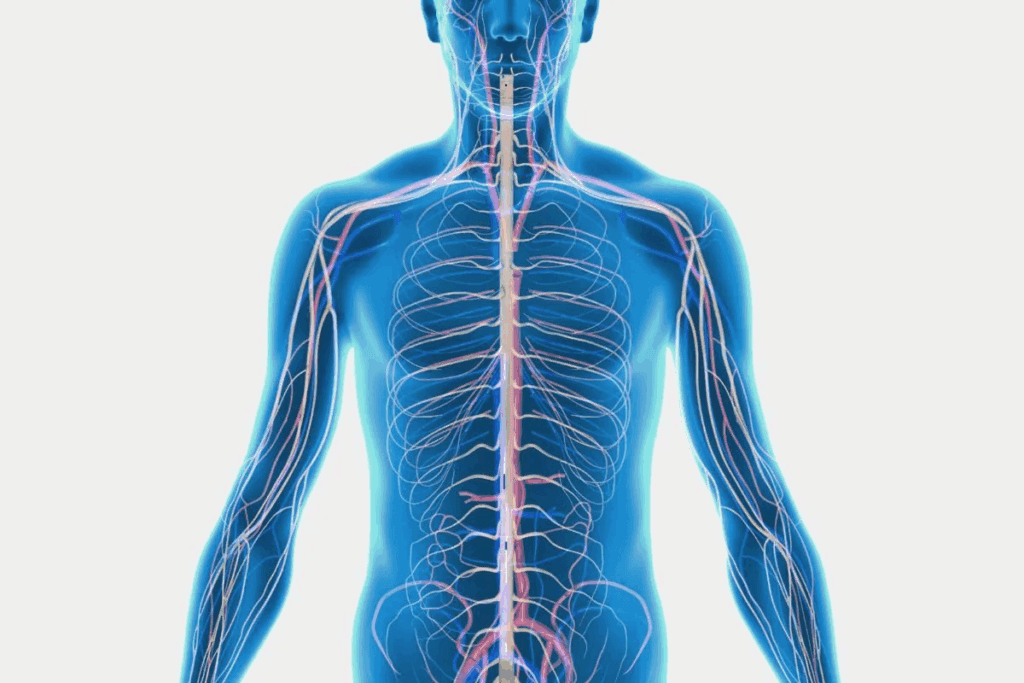
The 12 cranial nerves are key to many bodily functions. They handle sensory, motor, and autonomic processes. At Liv Hospital, we understand the detailed anatomy of these nerves and their origins in the brainstem. An amazing visual guide to the brainstem cranial nerves. See exactly where nerves III-XII originate in this critical area.
Ten of the twelve pairs of cranial nerves start from the brainstem. The first two come from the cerebrum. The brainstem, made up of the midbrain, pons, and medulla oblongata, is where nerves III through XII begin.
Knowing about the cranial nerves is vital for diagnosing and treating neurological issues. We will dive into the complex relationships between these nerves and their roles. This will give us a detailed map to help diagnose and treat related conditions.
Key Takeaways
- The 12 cranial nerves control vital bodily functions.
- Ten pairs of cranial nerves originate from the brainstem.
- Understanding cranial nerve anatomy is key for diagnosing neurological disorders.
- A detailed map of cranial nerves helps in diagnosis and treatment.
- Liv Hospital offers expert care for patients with neurological conditions.
Anatomy of the Brainstem and Cranial Nerves
The brainstem connects the cerebrum to the spinal cord. It controls automatic functions like breathing and heart rate. It has three main parts: the midbrain, pons, and medulla oblongata.
Structure of the Brainstem: Midbrain, Pons, and Medulla
The midbrain is at the top. It handles auditory and visual info. It controls eye movements and is where the oculomotor and trochlear nerves start.
The pons is below the midbrain. It relays signals and controls sleep and swallowing. It’s linked to the trigeminal, abducens, facial, and vestibulocochlear nerves.
The medulla oblongata is at the bottom. It connects to the spinal cord. It controls breathing and circulation. It’s connected to the glossopharyngeal, vagus, accessory, and hypoglossal nerves.
General Organization of Cranial Nerve Nuclei
Cranial nerve nuclei are organized in the brainstem. Sensory nuclei are in the back and sides. They receive sensory info. Motor nuclei are in the front. They control muscles and glands.
This organization helps with functions like swallowing and speaking. It’s key to understanding the brainstem and its nerves.
Healthcare professionals use this knowledge to diagnose neurological disorders. By studying the brainstem and its nerves, they can find the causes of many conditions.
- The brainstem is divided into the midbrain, pons, and medulla oblongata.
- Cranial nerves III to XII originate from the brainstem.
- Sensory and motor nuclei are organized functionally within the brainstem.
Understanding Brainstem Cranial Nerves and Their Classification
Knowing how to classify brainstem cranial nerves is key for diagnosing neurological issues. These nerves are grouped by their functions, how they develop, and where they are located.
Functional Categories: Sensory, Motor, and Mixed Nerves
The brainstem’s cranial nerves fall into three main types: sensory, motor, and mixed nerves. Sensory nerves send information like smells, sights, and sounds. Motor nerves control muscles and glands. Mixed nerves do both, handling a variety of tasks.
- Sensory Nerves: Olfactory (CN I), Optic (CN II), and Vestibulocochlear (CN VIII) nerves are mainly sensory.
- Motor Nerves: Oculomotor (CN III), Trochlear (CN IV), Abducens (CN VI), and Hypoglossal (CN XII) nerves are mainly motor.
- Mixed Nerves: Trigeminal (CN V), Facial (CN VII), Glossopharyngeal (CN IX), and Vagus (CN X) nerves contain both sensory and motor fibers.
Embryological Development and Organization
The growth of cranial nerves is tied to the brainstem’s development in the womb. The brainstem splits into three parts: the midbrain, pons, and medulla oblongata. Each cranial nerve starts from a specific part of the brainstem, showing how they’re organized.
The brainstem’s nerve nuclei follow a pattern. Sensory nuclei are on the sides, and motor nuclei are in the middle. This layout helps us grasp the complex roles of these nerves.
Topographical Distribution on the Brainstem
The cranial nerves spread out over the brainstem in a specific way. The midbrain is home to CN III and CN IV. The pons has CN V, CN VI, CN VII, and CN VIII. The medulla oblongata is where CN IX, CN X, CN XI, and CN XII are found. Knowing this helps us spot problems and understand damage’s effects.
By sorting cranial nerves by function, development, and location, we get a clearer picture of their roles. This knowledge helps us diagnose and treat neurological issues better.
Cerebrum-Originating Cranial Nerves
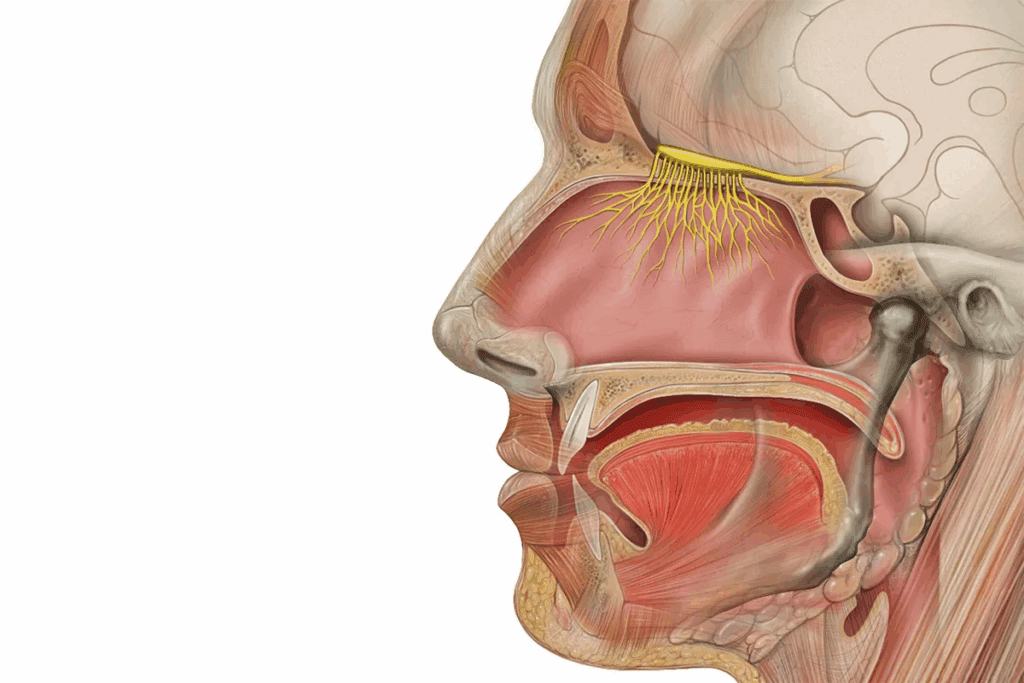
The first two cranial nerves, the olfactory and optic nerves, start in the cerebrum. They are key for our senses like smell and sight. Knowing how they work helps us understand our world better.
Olfactory Nerve (CN I): Structure and Olfactory Function
The olfactory nerve carries smell information from our nose to the brain. It begins in the nasal cavity and ends in the olfactory bulb. There, it sends signals to the brain for processing.
This system can grow back, keeping our sense of smell strong. It’s special because it can repair itself over time.
Optic Nerve (CN II): Visual Pathway and Processing
The optic nerve sends visual info from our eyes to the brain. It sends signals from the retina to the optic chiasm. Then, it goes to the lateral geniculate nucleus for more processing.
Damage to the optic nerve can greatly affect our vision. It’s a key part of how we see the world.
Both nerves are essential for how we experience our surroundings. The olfactory nerve lets us smell, and the optic nerve lets us see. They work together to help us understand our environment.
Midbrain Cranial Nerves: Origins and Functions
In the midbrain, two key cranial nerves control eye movements and coordination. The oculomotor and trochlear nerves are vital. They manage eye muscles for precise eye movements.
Oculomotor Nerve (CN III): Eye Movement and Pupillary Control
The oculomotor nerve, or CN III, controls most eye muscles. It works with the superior, medial, inferior rectus, and inferior oblique muscles. It also controls the levator palpebrae superioris muscle for eyelid lifting.
This nerve is essential for eye movements. It helps us focus on objects at different distances.
Trochlear Nerve (CN IV): Superior Oblique Muscle Control
The trochlear nerve, or CN IV, is the thinnest and longest cranial nerve. It controls the superior oblique muscle. This muscle helps rotate the eye downward and laterally, mainly when the eye is adducted.
This nerve is key for eye movement control. It helps in coordinated vision.
Pons Cranial Nerves: Complex Sensorimotor Functions
It’s important to know about the cranial nerves that start in the pons. This part of the brainstem is key for many bodily functions. It’s where several important nerves begin.
Trigeminal Nerve (CN V): Facial Sensation and Mastication
The trigeminal nerve handles facial feelings and chewing. It splits into three parts: ophthalmic, maxillary, and mandibular. These parts help us feel the face and chew food.
Functions: Facial sensation, mastication, and proprioception.
Abducens Nerve (CN VI): Lateral Eye Movement
The abducens nerve controls the eye’s outward movement. It’s vital for smooth eye movements.
Function: Lateral eye movement.
Facial Nerve (CN VII): Facial Expression and Taste
The facial nerve does many things. It controls our facial expressions and helps us taste food from the tongue’s front parts. It also helps some neck muscles move.
Functions: Facial expression, taste, and motor innervation to some neck muscles.
Vestibulocochlear Nerve (CN VIII): Balance and Hearing
The vestibulocochlear nerve deals with sound and balance. It has two parts: the cochlear for hearing and the vestibular for balance.
The pons is key for many important body functions. Knowing about these nerves helps us understand and treat brain disorders.
Cranial Nerve | Function | Clinical Significance |
Trigeminal Nerve (CN V) | Facial sensation, mastication | Trigeminal neuralgia, facial pain |
Abducens Nerve (CN VI) | Lateral eye movement | Diplopia, strabismus |
Facial Nerve (CN VII) | Facial expression, taste | Facial paralysis, taste disturbances |
Vestibulocochlear Nerve (CN VIII) | Hearing, balance | Hearing loss, vertigo |
Medulla Oblongata Cranial Nerves: Vital Functions
The medulla oblongata is a key part of the brainstem. It gives rise to four important cranial nerves. These nerves control swallowing, breathing, heart rate, and other vital functions.
Glossopharyngeal Nerve (CN IX): Throat and Tongue Functions
The glossopharyngeal nerve, or CN IX, is vital for swallowing and taste. It connects to the stylopharyngeus muscle and sends sensory signals to the pharynx and tongue. This nerve helps us swallow and taste food from the back of the tongue.
Vagus Nerve (CN X): Extensive Visceral Innervation
The vagus nerve, or CN X, is very complex and widespread. It connects to many organs like the heart, lungs, and stomach. It helps control heart rate, digestion, and breathing. This nerve is key for keeping our body balanced and working well.
Accessory Nerve (CN XI): Neck Muscle Control
The accessory nerve, or CN XI, controls the sternocleidomastoid and trapezius muscles. These muscles are important for moving the neck and shoulders. This nerve helps us rotate our head and lift our shoulders, allowing for many movements.
Hypoglossal Nerve (CN XII): Tongue Movement
The hypoglossal nerve, or CN XII, controls the tongue’s movements. It connects to the tongue’s muscles, enabling us to stick out, pull back, and move food during chewing.
To better understand the functions and characteristics of these cranial nerves, let’s examine a summary table:
Cranial Nerve | Function | Innervation |
Glossopharyngeal (CN IX) | Swallowing, taste | Stylopharyngeus muscle, pharynx, tongue |
Vagus (CN X) | Regulation of visceral organs | Heart, lungs, abdominal organs |
Accessory (CN XI) | Neck and shoulder movement | Sternocleidomastoid, trapezius muscles |
Hypoglossal (CN XII) | Tongue movement | Extrinsic and intrinsic tongue muscles |
Understanding the medulla oblongata cranial nerves is key to seeing how the brainstem works with our body. These nerves are vital for our health and help us do everyday things.
Comprehensive Mapping of Cranial Nerves on the Brainstem
Mapping cranial nerves on the brainstem is a complex task. It requires a deep understanding of neuroanatomy. The brainstem, made up of the midbrain, pons, and medulla oblongata, is where 12 cranial nerves start and end. These nerves control vital functions.
Surface Anatomy and Exit Points
The surface anatomy of the brainstem is key to knowing where cranial nerves exit. The cranial nerves exit the brainstem at specific locations. Knowing these exit points is vital for diagnosing neurological issues.
The oculomotor nerve (CN III) exits between the superior and inferior colliculi on the midbrain. The trigeminal nerve (CN V) exits from the lateral aspect of the pons.
Internal Nuclei Locations
The internal nuclei of the cranial nerves are inside the brainstem. The precise location of these nuclei is vital for understanding cranial nerve functions and diagnosing lesions.
Cranial Nerve | Nucleus Location |
Oculomotor (CN III) | Midbrain |
Trigeminal (CN V) | Pons |
Facial (CN VII) | Pons |
Hypoglossal (CN XII) | Medulla Oblongata |
Vascular Relationships
The cranial nerves have complex relationships with blood vessels around the brainstem. Understanding these relationships is key for neurosurgical procedures and diagnosing vascular-related pathologies.
The posterior inferior cerebellar artery (PICA) is closely related to the glossopharyngeal, vagus, and accessory nerves as they exit the medulla oblongata.
Mnemonics and Learning Strategies for the 12 Cranial Nerves
Learning the 12 cranial nerves can be easier with the right strategies and mnemonics. These nerves are key for many bodily functions. Healthcare professionals need to know them well.
Traditional Mnemonics for Names and Functions
Mnemonics have helped students remember cranial nerves for years. A famous one is: “On Old Olympus’ Towering Top, A Finn And German Viewed Some Hops.” It lists the first letter of each nerve: Olfactory, Optic, Oculomotor, Trochlear, Trigeminal, Abducens, Facial, Vestibulocochlear, Glossopharyngeal, Vagus, Spinal Accessory, and Hypoglossal.
Using such mnemonics makes memorization easier. We can also create new ones that are more memorable or fit our learning needs better.
Cranial Nerve | Function | Mnemonic Device |
Olfactory (I) | Sensory – Smell | On |
Optic (II) | Sensory – Vision | Old |
Oculomotor (III) | Motor – Eye Movement | Olympus’ |
Trochlear (IV) | Motor – Eye Movement | Towering |
Trigeminal (V) | Mixed – Facial Sensation, Mastication | Top |
Abducens (VI) | Motor – Eye Movement | A |
Facial (VII) | Mixed – Facial Expression, Taste | Finn |
Vestibulocochlear (VIII) | Sensory – Hearing, Balance | And |
Glossopharyngeal (IX) | Mixed – Swallowing, Salivation | German |
Vagus (X) | Mixed – Various Visceral Functions | Viewed |
Spinal Accessory (XI) | Motor – Neck and Shoulder Movement | Some |
Hypoglossal (XII) | Motor – Tongue Movement | Hops |
Visual Learning Approaches
Visual learning is a great way to understand cranial nerves. Diagrams and illustrations help show each nerve’s origin, course, and function. By linking these visuals with mnemonics, learning becomes more solid.
Clinical Correlation Techniques
Linking cranial nerves to clinical scenarios makes learning stick. Knowing how these nerves work in health and disease helps in diagnosing and treating conditions. This is key for healthcare professionals.
For example, the trigeminal nerve’s role in facial sensation and chewing helps in understanding trigeminal neuralgia. The vagus nerve’s function in visceral functions aids in diagnosing related disorders.
By using mnemonics, visual learning, and clinical connections, learners get a deep grasp of the 12 cranial nerves. This knowledge is vital for effective clinical practice.
Clinical Assessment and Pathologies of Brainstem Cranial Nerves
Understanding brainstem cranial nerve pathologies is key for good patient care. The brainstem, made up of the midbrain, pons, and medulla oblongata, is where many cranial nerves start or pass through. Checking these nerves is important for diagnosing and treating neurological issues.
Systematic Examination Techniques
Checking cranial nerves systematically is a must in neurological exams. We test each nerve’s sensory, motor, and autonomic functions. For example, we check the trigeminal nerve (CN V) by looking at facial feeling and chewing ability.
We use different methods to check these nerves. This includes eye tests for CN II, eye movement tests for CN III, IV, and VI, and tests for facial feeling and movement for CN V and VII.
- Visual acuity and field testing for CN II
- Eye movement examination for CN III, IV, and VI
- Facial sensation and motor function testing for CN V and VII
- Hearing and balance assessment for CN VIII
- Gag reflex and swallowing evaluation for CN IX and X
- Tongue movement examination for CN XII
Common Brainstem Lesions and Their Effects
Brainstem lesions can come from many causes like ischemia, hemorrhage, tumors, and demyelinating diseases. These can harm one or more cranial nerves, causing symptoms. For instance, a midbrain lesion can affect the oculomotor nerve, leading to droopy eyelids, dilated pupils, and eye movement problems.
Some common brainstem syndromes include Weber’s syndrome, Millard-Gubler syndrome, and locked-in syndrome. These happen when specific brainstem areas are damaged, leading to serious symptoms.
Diagnostic Imaging and Electrophysiological Testing
Imaging tests like MRI and CT scans are vital for seeing brainstem structures and finding lesions. MRI is great for its detailed look at soft tissues, helping us see cranial nerve anatomy and problems.
Electrophysiological tests, like electromyography (EMG) and nerve conduction studies (NCS), check if cranial nerves are working right. EMG looks at muscle activity, helping us see if nerves are damaged.
Using these tests together helps us fully check brainstem cranial nerve function and find the cause of problems. This guides us in choosing the right treatment.
Conclusion
We’ve looked into the complex world of the 12 cranial nerves from the brainstem. These nerves are key in controlling our body’s functions. Knowing about them helps us diagnose and treat neurological issues.
A detailed look at the cranial nerves shows their importance in medical practice. Studying the brainstem and its nerves is essential for doctors. It helps them understand and treat neurological problems better.
In summary, knowing about the 12 cranial nerves is critical for healthcare workers. By understanding their roles and functions, we can better diagnose and manage neurological diseases. This improves patient care overall.
FAQ
What are the 12 cranial nerves and their functions?
The 12 cranial nerves control many body functions. They help us see, move, and breathe. They also help us feel sensations and control our body’s automatic actions.
What is the brainstem and its role in cranial nerve origins?
The brainstem is at the base of the brain. It’s where cranial nerves III through XII start. It controls important body functions like breathing and heart rate.
How are cranial nerves classified?
Cranial nerves are divided into three types. Sensory nerves send information to the brain. Motor nerves control body movements. Mixed nerves do both.
What are the cerebrum-originating cranial nerves?
The cerebrum is the top part of the brain. Two nerves start here. The olfactory nerve helps us smell. The optic nerve lets us see.
What is the significance of understanding cranial nerve anatomy?
Knowing about cranial nerves is key for diagnosing and treating brain disorders. It helps doctors find and fix nerve problems.
What are some common mnemonics for remembering the 12 cranial nerves?
Mnemonics help remember the 12 cranial nerves. There are many ways to learn them, like pictures or rhymes. They make learning easier.
How are cranial nerves assessed clinically?
Doctors check cranial nerves with special tests. They use images and tests to see if nerves are working right. This helps them treat problems.
What are some common pathologies associated with brainstem cranial nerves?
Brainstem problems can cause nerve damage. This includes strokes and tumors. Symptoms can be weakness or trouble feeling things.
What is the importance of understanding the cranial nerves in clinical practice?
Knowing about cranial nerves is vital for doctors. It helps them diagnose and treat brain problems. It ensures patients get the best care.
Where can I find a detailed map of the cranial nerves on the brainstem?
You can find detailed maps in medical books and online. These resources show where nerves start and end. They also show how nerves connect to the brain.
References
National Center for Biotechnology Information. Evidence-Based Medical Guidance. Retrieved from https://www.ncbi.nlm.nih.gov/books/NBK544297/