Millions of Americans with nearsightedness, or myopia, dream of not wearing glasses or contacts. LASIK eye surgery is a top choice for clear vision. At Liv Hospital, we use the latest tech and care to help you see without glasses.
LASIK surgery is safe and works well, backed by decades of research. We focus on you, giving care that fits your needs. Knowing the risks and benefits helps you decide if LASIK is for you.
Key Takeaways
- LASIK surgery is a highly effective treatment for myopia, giving a safe and reliable fix.
- Our patient-centered approach at Liv Hospital combines advanced technology with thorough care.
- Understanding the risks and benefits is key to making a smart choice.
- LASIK has a strong record, with serious problems being rare.
- Most people see big improvements in their vision after LASIK surgery.
Understanding Myopia and How LASIK Works
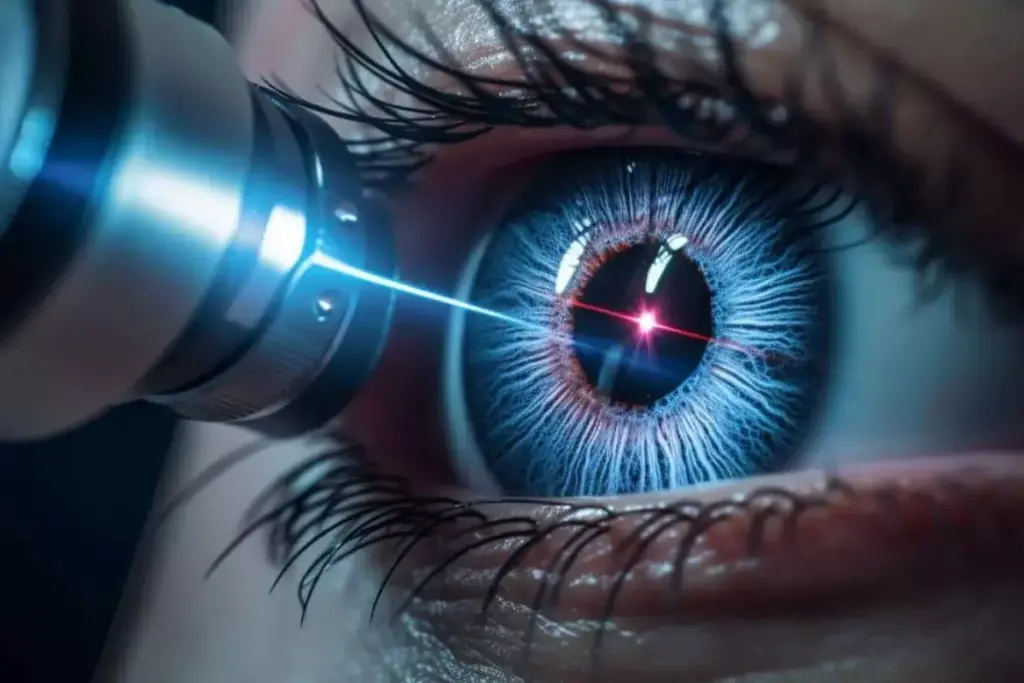
Nearsightedness, or myopia, makes it hard to see things far away. It happens when the eyeball is too long or the cornea is too curved. This stops light from focusing right on the retina.
About 41.6% of Americans have myopia. This number has gone up a lot in the last few decades. Many things can cause myopia, like genes, not playing outside enough, and staring at screens too long.
What Causes Nearsightedness and Its Prevalence
Myopia often runs in families. Not spending enough time outside and too much screen time also matter. It usually starts in kids and teens and gets worse as they grow.
- Genetics: Family history is a big risk factor.
- Environmental factors: Less outdoor activity and more near-work.
- Age: Myopia usually starts in childhood and gets worse in teens.
How LASIK Reshapes the Cornea to Correct Vision
LASIK is a surgery that fixes myopia by changing the cornea. An excimer laser carefully removes tiny bits of tissue. This changes the cornea’s shape so light focuses right on the retina.
The LASIK process makes a thin flap in the cornea. It lifts the flap to expose the tissue underneath. The laser then reshapes this tissue. The flap is then put back, healing without stitches.
LASIK changes the cornea’s shape to improve vision. It works for mild to severe myopia. This makes it a good choice for those tired of glasses or contacts.
Can LASIK Fix Myopia? Success Rates and Effectiveness

Many studies have looked into LASIK’s success in treating myopia. They show good results for different levels of nearsightedness. We’ll look at how well LASIK works for mild, moderate, and high myopia. We’ll also talk about how long the results last.
Results for Mild to Moderate Myopia (-0.5D to -9.0D)
Research shows that 83-95% of eyes get close to the target correction with LASIK for mild to moderate myopia. This range is the most common for LASIK. The results are usually very good.
Success Rates: LASIK works well for mild to moderate myopia. Many patients see 20/20 or better after surgery.
Outcomes for High Myopia (-10.0D to -13.5D)
New laser tech has made LASIK possible for high myopia. Data shows 72%, 84%, and 94% of eyes get within 0.50D, 0.75D, and 1.0D of the goal, respectively. For more on LASIK for high prescriptions, check Vision Institute.
High myopia results are good, but a bit less predictable than mild to moderate. New laser tech has made LASIK safer and more accurate for higher prescriptions.
Long-Term Stability and Follow-Up Studies
Long-term studies show LASIK results stay stable for most patients. The corrections from LASIK usually last, with many patients happy years later.
| Myopia Range | Success Rate within 0.50D | Success Rate within 1.0D |
| Mild to Moderate (-0.5D to -9.0D) | 80% | 90% |
| High (-10.0D to -13.5D) | 72% | 94% |
These findings highlight LASIK’s success in treating myopia at various levels. But, results can vary. Always talk to an eye specialist to see if LASIK is right for you.
What to Expect: LASIK Procedure, Recovery, and Candidacy
LASIK surgery is a quick and painless way to fix nearsightedness. It’s a popular choice for many. We make sure the process is as smooth and quick as possible.
The LASIK Surgery Process
The LASIK process has a few main steps. First, we make a thin flap in the cornea. This flap is then lifted to expose the tissue underneath.
Next, an excimer laser reshapes the cornea. This corrects the myopia. After that, the flap is put back in place, and the cornea heals on its own.
Key Steps in the LASIK Procedure:
- Creation of a thin flap in the cornea
- Reshaping the cornea with an excimer laser
- Replacement of the flap
The whole process takes less than 30 minutes per eye. The laser part is very quick, lasting just a few seconds.
Recovery Timeline and Post-Operative Care
Most people can go back to normal in 24-48 hours. We give detailed instructions for after the surgery. This includes using eye drops to prevent infection and help healing.
Recovery Timeline:
| Timeframe | Expected Recovery |
| Within 24 hours | Vision starts to improve, some discomfort |
| Within 48 hours | Return to normal activities |
| 1-3 months | Vision continues to stabilize and improve |
Ideal Candidates for Laser Eye Surgery
Not everyone can have LASIK. We check if you’re a good candidate. This includes having a stable prescription, being over 18, and no eye diseases.
Ideal Candidate Criteria:
- Stable prescription for at least one year
- Over 18 years old
- No underlying eye diseases
- Realistic expectations about the outcome
We choose candidates carefully and follow a precise process. This helps people with myopia see better and use glasses or contacts less.
Conclusion
LASIK surgery is a safe and effective way to treat myopia, or nearsightedness. It reshapes the cornea to focus light correctly. This means you can see clearly without glasses or contact lenses.
Most patients get long-term stable vision after LASIK. The success rate is high for mild to moderate myopia. This makes LASIK a reliable choice for many.
If you’re thinking about LASIK, it’s key to know what it involves. Understand its benefits and risks. Choosing a skilled surgeon and following care instructions can help avoid problems.
Laser eye surgery has changed how we treat myopia. It offers quick recovery and lasting results. LASIK is a great option for many, improving their vision and life quality.
FAQ
Can LASIK surgery fix myopia?
How does LASIK correct myopia?
Is LASIK safe for correcting high myopia?
What are the success rates for LASIK in treating myopia?
Can laser eye surgery cure myopia permanently?
How long does it take to recover from LASIK surgery?
Am I a suitable candidate for LASIK surgery?
Can LASIK correct nearsightedness with astigmatism?
What are the possible risks and complications of LASIK surgery?
How do I choose a qualified eye surgeon for LASIK surgery?
References
National Center for Biotechnology Information. Evidence-Based Medical Insight. Retrieved from https://pubmed.ncbi.nlm.nih.gov/20869137/