
Ectopic pregnancy is a serious condition where a fertilized egg grows outside the uterus, often in the fallopian tube. It happens in about 1 in 80 pregnancies and is a major cause of death in the first trimester. Finding it early is key to avoiding serious problems. Clarifying why can you feel your fallopian tubes from the outside is not possible and ectopic symptoms.
We will look into when ectopic pregnancy can be found early and if you can feel your fallopian tubes from the outside. Knowing the early signs is important for quick action. Thanks to new tests like transvaginal ultrasound and hCG hormone tests, doctors can spot it as early as 5-6 weeks.
Key Takeaways
- Ectopic pregnancy is a serious condition that requires prompt medical attention.
- Early detection is critical to prevent severe complications.
- Modern diagnostic advances enable early detection around 5-6 weeks after conception.
- Awareness of early signs and symptoms is key for timely action.
- Understanding ectopic pregnancy definition and its risks is vital for expectant mothers.
What Is Ectopic Pregnancy: Definition and Medical Significance
Ectopic pregnancy is a serious issue, happening in about 1-2% of pregnancies. It’s a major cause of death in the first trimester. It happens when a fertilized egg implants outside the uterus, often in the fallopian tube. This can cause serious problems if not caught early.
What Ectopic Pregnancy Means Medically
An ectopic pregnancy is when a fertilized egg implants outside the uterus, usually in the fallopian tube. This place can’t support the growing embryo, which can lead to rupture and dangerous bleeding. It’s very important to get medical help right away to avoid serious issues.
Prevalence and Statistics
About 1 in 80 pregnancies are ectopic. Medical data shows ectopic pregnancies happen in 1-2% of all pregnancies. This shows why it’s so important to know about it and catch it early.
| Category | Statistic |
|---|---|
| Prevalence | 1 in 80 pregnancies |
| Percentage of Pregnancies Affected | 1-2% |
| Significance | Leading cause of first-trimester pregnancy-related deaths |
It’s key for pregnant women to understand ectopic pregnancy. Knowing about it and its risks is vital. This knowledge helps women get the medical help they need quickly.
Why Early Detection Is Critical for Maternal Health
Early detection of ectopic pregnancy is key to saving lives. It helps prevent deaths in the first trimester. Ectopic pregnancy happens when the embryo grows outside the uterus, often in the fallopian tube. It’s a major reason for early pregnancy deaths.
Ectopic Pregnancy as Leading Cause of First-Trimester Death
Ectopic pregnancy is a top cause of death in the first trimester. It affects about 1 in 80 pregnancies. Quick diagnosis is vital to avoid serious problems.
Potential Complications Without Timely Intervention
Ignoring ectopic pregnancy can lead to serious issues. These include internal bleeding and even death. The risk of a rupture and heavy bleeding is high if not caught early. Here are some possible complications:
| Complication | Description | Consequence |
|---|---|---|
| Rupture of the Fallopian Tube | The ectopic pregnancy ruptures the fallopian tube. | Severe internal bleeding. |
| Internal Bleeding | Bleeding into the abdominal cavity. | Hemorrhagic shock, potentially life-threatening. |
| Infection | Infection of the reproductive organs. | Pelvic inflammatory disease, potentially leading to infertility. |
Can You Feel Your Fallopian Tubes From The Outside During an Ectopic Pregnancy?
Many women wonder if they can feel their fallopian tubes during an ectopic pregnancy. We need to know about the fallopian tubes’ anatomy and location. This helps us understand how they might feel during an ectopic pregnancy.
Anatomy of Fallopian Tubes and Their Location
The fallopian tubes are narrow tubes that connect the ovaries to the uterus. They are about 10-13 cm long and are in the pelvis, one on each side of the uterus. Normally, you can’t feel them because they are small and deep.
Location and Structure: The fallopian tubes have four parts: the intramural, isthmus, ampulla, and infundibulum. The intramural part is inside the uterus, the isthmus is narrower, the ampulla is wider, and the infundibulum has fimbriae to catch the ovum.
Physical Sensations Associated with Tubal Pregnancy
During an ectopic pregnancy, the fallopian tube can stretch or get damaged. This might cause sharp or crampy pain on one side of the pelvis. But, you can’t feel the fallopian tubes from the outside because of where they are.
Common Symptoms: You might feel abdominal pain, vaginal bleeding, or shoulder tip pain. These symptoms mean you need to see a doctor right away.
| Symptom | Description |
|---|---|
| Abdominal Pain | Sharp or crampy pain on one side of the pelvis |
| Vaginal Bleeding | Irregular or heavy bleeding |
| Shoulder Tip Pain | Pain referred to the shoulder due to internal bleeding |
As a medical professional once said,
“Ectopic pregnancy is a serious condition that requires prompt diagnosis and treatment to prevent complications.”
It’s important to know the symptoms and get medical help early.
When Do Women Typically Feel Symptoms of Ectopic Pregnancy?
It’s important to know when symptoms of ectopic pregnancy show up. This condition happens when the embryo grows outside the uterus, often in a fallopian tube. Spotting symptoms early can help manage the condition better.
Timeline of Symptom Development
Symptoms of ectopic pregnancy start between 4 to 12 weeks of pregnancy. Women might feel symptoms that seem like a normal pregnancy. Knowing these symptoms is key to getting help fast.
Common Symptoms That Mimic Normal Pregnancy
Some symptoms of ectopic pregnancy seem like normal pregnancy signs. These include missed periods, nausea, and tender breasts. But, there are signs that mean it’s an ectopic pregnancy. Severe abdominal pain, vaginal bleeding, and dizziness are big warning signs.
Warning Signs That Require Immediate Medical Attention
Some symptoms might seem like a normal pregnancy. But, there are signs that mean you need to see a doctor right away. These include:
- Severe abdominal pain, often on one side
- Vaginal bleeding or spotting
- Dizziness or fainting
- Shoulder pain
- Weakness or rapid heartbeat
If you notice any of these symptoms, get medical help right away. Early treatment can greatly improve the outcome of ectopic pregnancy.
How Early Can Ectopic Pregnancy Be Detected: The Complete Timeline
Today, we can spot ectopic pregnancies sooner than ever. This is thanks to new tools and knowing when and how to find them.
Detection Possibilities Before Missed Period
Thanks to hCG hormone testing and transvaginal ultrasound technology, we can find ectopic pregnancies before a missed period. hCG tests can show pregnancy signs as early as 11 days post-conception. Yet, they don’t tell us where the pregnancy is.
Studies show we can spot ectopic pregnancies by 4-5 weeks with hCG tests and ultrasound. Finding it early is key for quick action.
First Trimester Detection Windows
In the first trimester, there are times when finding the pregnancy is easier. Between 4 to 6 weeks, ultrasound can pinpoint the pregnancy’s spot. By 5-6 weeks, doctors can usually see the gestational sac and sometimes the embryo.
As the pregnancy moves into the first trimester, finding it gets even better. But, it’s important to remember that some ectopic pregnancies are hard to find. They might not show symptoms until later.
If you’re at risk or feeling symptoms, talk to your doctor. They can give you the best advice and care.
Hormone Testing: The First Step in Early Detection
Hormone testing is the first step to find an ectopic pregnancy. It checks the levels of human chorionic gonadotropin (hCG) in blood or urine. We’ll see how hCG testing works and why it’s key for early detection.
Blood hCG Testing (11 Days After Conception)
Blood hCG testing can spot pregnancy as early as 11 days after conception. It’s very sensitive because hCG levels rise quickly after implantation. Early detection through blood hCG testing is vital for spotting issues like ectopic pregnancy.
These tests track how a pregnancy is going. In normal pregnancies, hCG levels double every 48 hours early on. But, in ectopic pregnancies, this increase might be slower or stop.
Urine Pregnancy Tests and Their Limitations
Urine pregnancy tests (UPTs) are easy to use and non-invasive. But, they’re not as sensitive as blood tests. They might not catch pregnancy as early, and their results can be affected by many things.
UPTs are good for a first check, but they’re not as accurate as blood tests, mainly in early pregnancy.
Abnormal hCG Patterns in Ectopic Pregnancy
Abnormal hCG patterns can mean an ectopic pregnancy. These might include slower hCG increases or levels not rising as they should. Watching hCG levels helps doctors spot problems and act fast.
| hCG Pattern | Normal Pregnancy | Ectopic Pregnancy |
|---|---|---|
| Rate of Increase | Typically doubles every 48 hours | May increase slower or plateau |
| Peak Levels | Reaches peak levels around 10 weeks | May not reach expected peak levels |
Knowing about hCG patterns is key for spotting and managing ectopic pregnancy early. By using hCG tests and other tools like ultrasound, doctors can give the right care on time.
Ultrasound Detection of Pregnancy Inside the Fallopian Tube
Early detection of ectopic pregnancy is greatly improved with ultrasound imaging. This technology is key in diagnosing ectopic pregnancies. It offers a safe and effective way to see the reproductive organs.
Transvaginal Ultrasound as the Gold Standard
Transvaginal ultrasound is the top tool for finding ectopic pregnancies. It involves putting an ultrasound probe in the vagina. This gives a clear view of the reproductive organs. Transvaginal ultrasound helps spot pregnancy early and where it is, which is vital for diagnosing ectopic pregnancies.
What Doctors Can See at 5-6 Weeks
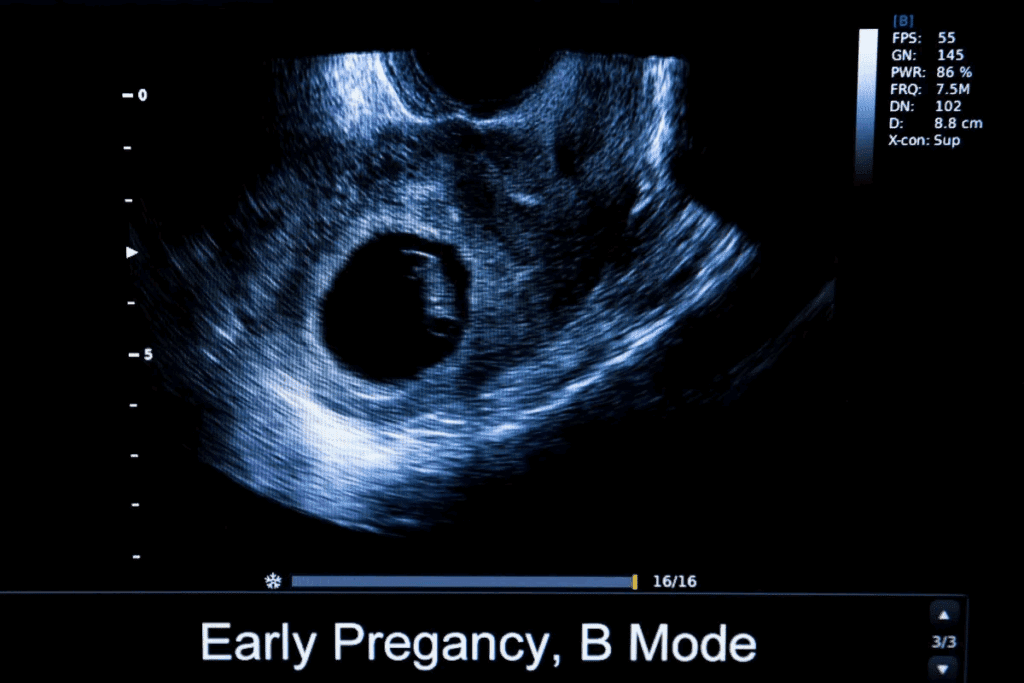
At 5-6 weeks, doctors can see the gestational sac and where it is with transvaginal ultrasound. In normal pregnancies, the sac is in the uterus. But in ectopic pregnancies, it’s outside, often in the fallopian tube. Early visualization is key for quick action.
Empty Uterus Signs and Other Ultrasound Indicators
One important sign of an ectopic pregnancy on ultrasound is an empty uterus. No gestational sac is seen inside the uterus. Other signs include a pseudogestational sac, free fluid in the pelvis, or an adnexal mass. These signs, along with symptoms and hCG levels, help confirm an ectopic pregnancy.
Being able to spot pregnancy in the fallopian tube with ultrasound is a vital skill for doctors. By knowing what ultrasound can do, we can find and treat ectopic pregnancies sooner. This helps improve patient care.
Ectopic Pregnancy Detection at Specific Milestones
Knowing when an ectopic pregnancy can be found is key for quick medical help. Finding an ectopic pregnancy is a detailed process that uses many tools and methods. It’s important to know when it can be spotted at different times.
Ectopic Pregnancy at 5 Weeks: What Can Be Detected
At 5 weeks, spotting an ectopic pregnancy is hard but very important. Transvaginal ultrasound is often used to look at the reproductive organs. It might be too early to see the ectopic pregnancy, but signs like an empty uterus or fluid in the pelvis can hint at a problem. Blood tests checking hCG levels are also key, as odd patterns can point to an ectopic pregnancy.
Ectopic Pregnancy at 9 Weeks: Advanced Symptoms and Findings
By 9 weeks, symptoms of an ectopic pregnancy get stronger. Women might feel severe abdominal pain, vaginal bleeding, or dizziness. Ultrasound can better spot an ectopic pregnancy at this time, showing where the embryo is. Blood tests show higher hCG levels, making them more telling of an ectopic pregnancy if they’re not rising as they should.
Ectopic Pregnancy at 12 Weeks: Late Detection Scenarios
Spotting an ectopic pregnancy at 12 weeks is rare because of better ultrasound tech and symptom awareness. Yet, sometimes an ectopic pregnancy is missed until then, often because of unusual symptoms or missing early prenatal care. Finding it at 12 weeks can lead to serious issues, like rupture of the fallopian tube, which is a big emergency.
In summary, knowing when an ectopic pregnancy can be found is critical for doctors and moms-to-be. Finding it early greatly improves chances of a good outcome. Knowing the signs and symptoms at different times can lead to quick medical help.
Risk Factors That May Prompt Earlier Screening
Certain factors can increase the risk of ectopic pregnancy, making early screening important. We will look at these risk factors. They help healthcare providers spot women who need early detection and care.
Previous Ectopic Pregnancy History
Having had an ectopic pregnancy before raises the risk of another one. Research shows women with a history of ectopic pregnancy are at higher risk. So, women with this history should get close monitoring during early pregnancy.
Fallopian Tube Damage or Surgery
Damage to the fallopian tubes, from surgery or infection, ups the ectopic pregnancy risk. Tubal surgery can cause scarring leading to ectopic pregnancy. Women with fallopian tube damage or surgery history should get screened earlier.
Other Medical and Lifestyle Risk Factors
Other medical and lifestyle factors also raise ectopic pregnancy risk. These include:
- Pelvic inflammatory disease (PID)
- Previous pelvic or abdominal surgery
- In vitro fertilization (IVF)
- Smoking
- Advanced maternal age
- History of infertility
Knowing these risk factors is key for early detection and prevention of ectopic pregnancy complications. Healthcare providers should watch for these signs and suggest early screening.
Challenges in Detecting Ectopic Pregnancy with No Symptoms
Some ectopic pregnancies are hard to spot because they don’t show symptoms. This is when the embryo grows outside the uterus. Usually, women feel pain in their belly and bleed vaginally. But, some women don’t show these signs, making it tough to find the problem early.
Why Some Cases Remain Asymptomatic
Why some ectopic pregnancies don’t show symptoms is complex. It depends on where the embryo is and how a woman’s body reacts. For example, if the ectopic pregnancy is in a less blood-rich area, it might not cause pain right away. Doctors need to know these details to watch pregnancies closely.
Monitoring Pregnancy of Unknown Location
When doctors think there might be an ectopic pregnancy but can’t find it, they watch it closely. They check hCG levels and use ultrasounds to see where the pregnancy is. This way, they can spot ectopic pregnancies early, even without symptoms.
When to Seek Medical Care Even Without Symptoms
Even without symptoms, some women should see a doctor. Those who have had an ectopic pregnancy before or have had tubal surgery should be careful. Regular visits to the doctor and knowing the risks can help catch problems early.
It’s key to be aware and proactive about ectopic pregnancies, even when there are no symptoms. By understanding the challenges and acting early, women can get the care they need, leading to better health outcomes.
Treatment Options Based on Detection Timing
Early detection of ectopic pregnancy offers several treatment options. These range from medical management to surgical interventions. The choice of treatment depends on several factors. These include the size and location of the ectopic pregnancy, the patient’s overall health, and whether the ectopic pregnancy has ruptured.
Medical Management for Early Detection
For patients diagnosed early, medical management is often the preferred treatment. This involves the administration of methotrexate. Methotrexate stops the growth of rapidly dividing cells, like those in an ectopic pregnancy. Medical management is most effective when the ectopic pregnancy is detected early and is small in size. We closely monitor the patient’s condition and hCG levels to determine the effectiveness of the treatment.
Surgical Interventions and Tube Preservation
When medical management is not suitable or has failed, surgical intervention becomes necessary. The primary goal of surgery is to remove the ectopic pregnancy while preserving the fallopian tube whenever possible. Laparoscopic surgery is a minimally invasive technique that allows for quicker recovery times and less scarring. In some cases, a laparotomy may be required, if the ectopic pregnancy has ruptured or is large.
Emergency Surgery for Ruptured Ectopic Pregnancy
In cases where the ectopic pregnancy has ruptured, emergency surgery is critical. Rupture is a life-threatening complication that requires immediate medical attention. The surgical approach in such cases focuses on stabilizing the patient and addressing the bleeding.
| Treatment Option | Description | Indications |
|---|---|---|
| Medical Management | Use of methotrexate to stop ectopic pregnancy growth | Early detection, small ectopic pregnancy size |
| Laparoscopic Surgery | Minimally invasive surgery to remove ectopic pregnancy | Failed medical management, unruptured ectopic pregnancy |
| Emergency Surgery | Surgery to address ruptured ectopic pregnancy and internal bleeding | Ruptured ectopic pregnancy |
Pregnant After Ectopic Pregnancy Tube Removed: Future Fertility
Women who have had an ectopic pregnancy and lost a fallopian tube worry about their future fertility. The good news is that many can get pregnant naturally, even with just one tube.
Conception Possibilities After Tubal Surgery
After an ectopic pregnancy and the loss of a tube, knowing your chances of getting pregnant is key. Having one healthy tube is often enough for natural conception. But, the health of the tube and other reproductive factors matter too.
Research shows that women with one tube can get pregnant, but it might be a bit harder. Other things like the health of the tube, ovulation, and overall health also affect fertility.
Monitoring Subsequent Pregnancies
Women who have had an ectopic pregnancy and surgery need to watch their future pregnancies closely. Early ultrasound scans help make sure the pregnancy is in the right place.
Early monitoring helps doctors catch any problems quickly. This is very important for women who have had an ectopic pregnancy before, as they are at higher risk for another one.
Success Rates and Special Considerations
Success rates for getting pregnant after surgery depend on many things. These include why the surgery was needed, the woman’s age, and her overall health. Younger women with no other fertility problems usually have better chances.
Some women might need fertility treatments like IVF, if they have other fertility issues. Talking to a fertility specialist can give you a better idea of your chances.
One study says, “The human body’s ability to get pregnant again is amazing.” This shows that even after big challenges, like an ectopic pregnancy, women can get pregnant again.
Conclusion: The Importance of Awareness and Prompt Medical Care
Knowing about ectopic pregnancy risks and symptoms is key for women’s health. We stress the need for awareness and quick medical care to avoid serious issues.
Ectopic pregnancy needs fast medical help to manage it well. By knowing the risks and symptoms, women can get help quickly, leading to better results.
Quick medical care for ectopic pregnancy is vital to avoid deadly problems. We urge women to watch their bodies and get medical help if they notice unusual signs early in pregnancy.
The role of awareness and quick medical care is huge. By staying informed and acting fast, women can lower their risk of ectopic pregnancy complications.
FAQ
What is an ectopic pregnancy?
An ectopic pregnancy happens when a fertilized egg implants outside the uterus. This is usually in the fallopian tube.
How early can ectopic pregnancy be detected?
You can find out about ectopic pregnancy as early as 11 days after conception. This is through blood hCG tests. New medical tech lets us spot it even before a missed period.
Can you feel your fallopian tubes from the outside during an ectopic pregnancy?
No, you can’t feel your fallopian tubes from the outside. They are too deep in the pelvis, even during an ectopic pregnancy.
What are the symptoms of ectopic pregnancy?
Symptoms start between 4-12 weeks of pregnancy. They include missed periods, nausea, and stomach pain.
What are the warning signs that require immediate medical attention?
Severe stomach pain, heavy bleeding, and dizziness need quick medical help.
How is ectopic pregnancy detected?
Doctors use hormone tests and ultrasound to find ectopic pregnancy. The ultrasound, called transvaginal, is the best method.
What is the role of hCG testing in detecting ectopic pregnancy?
hCG tests can spot pregnancy early, at 11 days. Abnormal levels might mean an ectopic pregnancy.
Can ectopic pregnancy be detected at 5 weeks?
Yes, ultrasound can find ectopic pregnancy at 5 weeks. It shows the gestational sac and checks the uterus.
What are the risk factors for ectopic pregnancy?
Risks include past ectopic pregnancies, fallopian tube damage, and other health issues.
Can you become pregnant after an ectopic pregnancy if a fallopian tube has been removed?
Yes, you can get pregnant again, even with a removed tube. But it might change your chances.
What are the treatment options for ectopic pregnancy?
Treatments vary based on when it’s found and the patient’s health. They include medicine, surgery, and emergency surgery for ruptures.
Why is early detection of ectopic pregnancy critical?
Finding it early is key to avoid serious problems like bleeding and death. It helps improve outcomes for women.
References
National Center for Biotechnology Information. Evidence-Based Medical Guidance. Retrieved fromhttps://www.ncbi.nlm.nih.gov/books/NBK539860/



 Departments
 Related Videos
 Our Doctors
 News
News