
Have you ever thought about the details of our digestive system? Like the size and role of the large intestine? It’s about 1 to 1.5 meters long in adults. This part of our body is key for absorbing water and electrolytes and holding onto feces.colon parts of large intestineWhat are the symptoms of a damaged colon?
Knowing about the length of the large intestine and its parts is very important. It helps keep our digestive system working right and prevents health problems.
Key Takeaways
- The large intestine measures approximately 1 to 1.5 meters in length.
- It plays a vital role in absorbing water and electrolytes.
- Understanding its anatomy is vital for maintaining digestive health.
- The large intestine stores fecal matter until it is eliminated.
- Its proper functioning is essential for overall wellbeing.
The Large Intestine in Human Anatomy
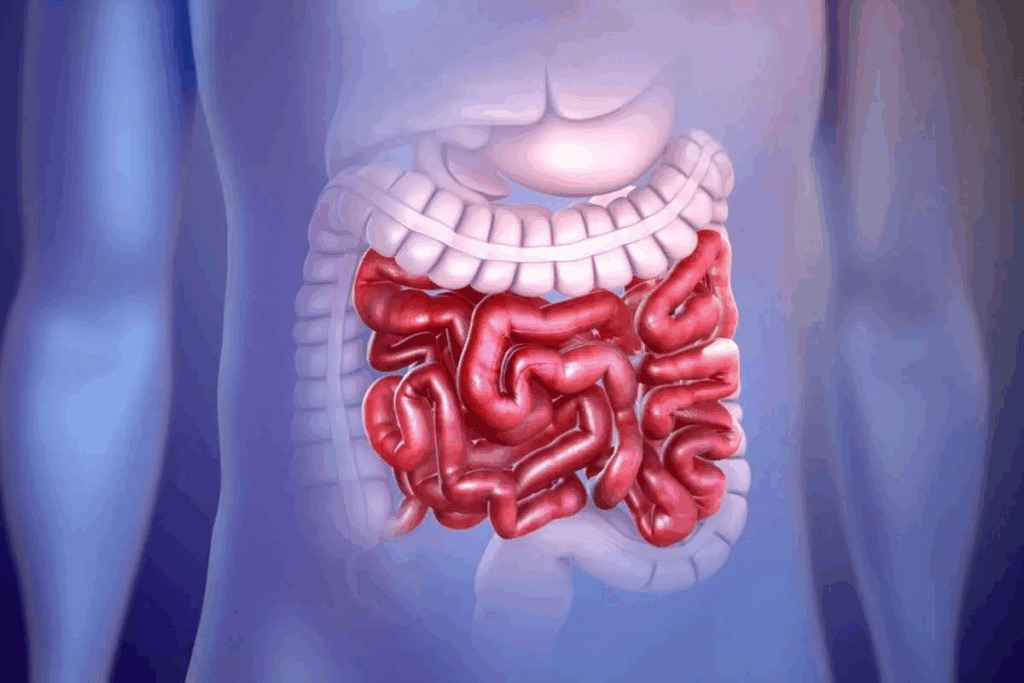
The large intestine is key to our digestive system. Knowing its anatomy helps us understand its role. It’s wider and shorter than the small intestine, with a smooth inner wall.
Position Within the Endocrine System
The large intestine isn’t part of the endocrine system. Yet, it works with hormones that affect its work. Hormonal changes can influence bowel habits and how the intestine moves.
Even though it’s mainly part of the digestive system, it’s linked to our metabolic health.
Primary Functions
The large intestine’s main jobs are absorbing water and electrolytes, storing feces, and breaking down undigested carbs. It absorbs water and electrolytes, making the stool solid. This is key for keeping our body hydrated and balanced.
It also hosts a variety of microbes called the gut microbiota. These microbes help break down carbs, making short-chain fatty acids. These acids give energy to the colon’s cells and keep the gut healthy.
Developmental Origins
The large intestine starts forming early in a fetus’s development. It comes from the midgut and hindgut. The midgut forms most of the small intestine and the large intestine’s start.
The hindgut develops the large intestine’s end parts, like the descending colon and rectum. Knowing how it develops helps us understand its complex role.
Dimensions and Physical Characteristics
We look at the large intestine’s physical traits to grasp its role in digestion. This part of the digestive system is key. It has unique features that help it do its job well.
Total Length
The large intestine is about 1 to 1.5 meters long in adults. This length is important for its main tasks. It absorbs water and holds feces.
Sex-Based Variations
Studies show sex-based differences in the large intestine’s size. While not huge, these differences can impact its health in men and women.
Weight
The large intestine weighs around 1 to 1.5 kilograms. This weight shows the size of the intestinal tissue, its contents, and blood vessels.
Color and Appearance
The large intestine is usually a deep red or reddish-brown. This color comes from its blood supply. Its look can change based on health and any diseases.
Physical Attribute | Average Measurement | Significance |
Total Length | 1-1.5 meters | Crucial for water absorption and fecal storage |
Weight | 1-1.5 kg | Reflects the mass of intestinal tissue and associated structures |
Color | Deep red or reddish-brown | Indicates rich blood supply |
Large vs. Small Intestine: Key Differences
The small intestine is longer, but the large intestine is wider. This is why it’s called “large.” These two parts of our digestive system are different in size, function, and characteristics.
Length Comparison
The small intestine is about 6-7 meters long. The large intestine is much shorter, at around 1.5 meters. Yet, the large intestine is key to digestion.
Why Is It Called “Large”? Understanding Diameter Differences
The large intestine is called “large” because of its width. It’s about 7.5 cm wide, while the small intestine is 2.5-3 cm wide. This size difference is important for its role.
Functional Distinctions
The small intestine absorbs nutrients from our food. The large intestine absorbs water and electrolytes, making feces. It also hosts a lot of our body’s microbiome.
Characteristics | Large Intestine | Small Intestine |
Length | Approximately 1.5 meters | Approximately 6-7 meters |
Diameter | About 7.5 cm | About 2.5-3 cm |
Primary Function | Water absorption, feces formation | Nutrient absorption |
It’s important to know how each intestine works. The large intestine, though shorter and wider, has unique roles in digestion.
The Colon Parts of Large Intestine: Anatomical Breakdown
The colon parts of the large intestine are key to our digestive system. Knowing their anatomy is vital for doctors and patients. The large intestine, or intestino grueso, is split into segments with different roles.
Major Divisions
The large intestine is mainly split into the cecum, ascending colon, transverse colon, descending colon, sigmoid colon, rectum, and anus. Each part has its own role in digestion.
- The cecum is the first part, getting waste from the small intestine.
- The ascending colon moves waste up. The transverse colon carries it across the belly.
- The descending colon and sigmoid colon process waste before it reaches the rectum.
Haustra, Taeniae Coli, and Epiploic Appendages
The large intestine’s outer layer has special features. Haustra are pouches that make the colon look unique. Taeniae coli are narrow bands of muscle that help move waste. Epiploic appendages are fat-filled structures, but their purpose is unclear.
Blood Supply and Innervation
The large intestine gets blood from the superior and inferior mesenteric arteries. The superior mesenteric artery feeds the right side, including the cecum and ascending colon. The inferior mesenteric artery supplies the left side, like the sigmoid colon and rectum.
The innervation of the large intestine is complex. It involves both sympathetic and parasympathetic systems. The parasympathetic system helps with motility and secretion. The sympathetic system slows these down. Knowing this is key for managing digestive issues.
The Cecum: Gateway to the Large Intestine
We begin our journey through the large intestine with the cecum. It’s the first part of this journey. The cecum is a pouch-like structure that marks the start of the large intestine.
Size and Location
The cecum is about 8 cm or 3 inches big. It sits in the lower right part of the abdomen. This is where the small intestine meets the large intestine.
The Ileocecal Valve
The ileocecal valve is key. It controls what moves from the small intestine into the cecum. It stops things from flowing back, keeping digestion on track.
The Vermiform Appendix
Next to the cecum is the vermiform appendix. It’s a small, finger-like pouch. Its role is not fully understood, but it might help with gut development and the immune system.
The Four Segments of the Colon
The colon is a key part of the large intestine, split into four segments. Each segment has its own role in digestion.
Ascending Colon (20 cm/8 inches)
The ascending colon starts at the cecum and goes up the right side of the abdomen. It’s about 20 cm (8 inches) long. Its main job is to absorb water and salts from undigested material.
Transverse Colon (46 cm/18 inches)
The transverse colon is the second part, stretching from the right to the left colic flexure across the upper abdomen. It’s the longest, at 46 cm (18 inches). It also absorbs water and salts.
Descending Colon
The descending colon is the third part, starting at the left colic flexure and going down the left side. It’s shorter than the transverse colon. It absorbs more water and salts, making stool solid.
Sigmoid Colon (35-40 cm/14-16 inches)
The sigmoid colon is the last segment, linking the descending colon to the rectum. It’s 35-40 cm (14-16 inches) long and has a S-shape. It holds feces until they’re expelled.
Knowing about the colon’s segments is key for diagnosing and treating gut issues. Each segment’s length and function can differ, but they all work together in the large intestine.
Colon Segment | Length (approx.) | Location | Primary Function |
Ascending Colon | 20 cm (8 inches) | Right side of abdomen | Absorbs water and electrolytes |
Transverse Colon | 46 cm (18 inches) | Upper part of abdomen | Continues absorption of water and electrolytes |
Descending Colon | Variable | Left side of abdomen | Further absorbs water and electrolytes |
Sigmoid Colon | 35-40 cm (14-16 inches) | Connecting to rectum | Stores fecal matter |
Terminal Sections: Rectum and Anal Canal
The large intestine ends with the rectum and anal canal. These parts are key in storing and getting rid of waste.
Rectal Anatomy
The rectum is about 12 to 15 cm long. It holds feces temporarily before they leave the body. It has three bends, or flexures, to help in this function.
The rectal wall has several layers. The top layer, the mucosa, is covered with simple columnar epithelium. This helps absorb water and salts.
The Anal Canal
The anal canal is the last part of the large intestine, about 5 cm long. It’s surrounded by two sphincters. These sphincters help keep things inside.
The lining of the anal canal changes as you move down. The top is like the rectum, but the bottom is tougher, with stratified squamous epithelium.
Sphincter Mechanisms
The sphincters control when waste goes out. The internal anal sphincter works without us thinking, keeping things in. The external anal sphincter is under our control, letting us decide when to go.
These sphincters work together to keep things in and let them out when needed. The anorectal junction marks where the anal canal starts.
Microscopic Structure and Histology
We dive into the large intestine’s microscopic world to see its detailed layers and cell types. These features help it do its job.
Layers of the Large Intestinal Wall
The large intestine’s wall has layers: mucosa, submucosa, muscularis externa, and serosa. The mucosa is closest to the inside. It’s covered in simple columnar epithelium with many goblet cells.
The submucosa is under the mucosa, full of blood and lymph vessels. The muscularis externa has two muscle layers. The serosa is the outer layer, a serous membrane.
Simple Columnar Epithelium
The large intestine’s lining is a simple columnar epithelium. It’s made of column-shaped cells. This type of epithelium absorbs water and electrolytes and secretes mucus.
Goblet Cells and Mucus Production
Goblet cells in the large intestine’s lining make mucus. Mucus lubricates the contents and protects the lining from harm.
Absence of Villi
The large intestine doesn’t have villi, unlike the small intestine. Villi increase absorption area. Without them, the large intestine focuses on water absorption and making feces.
Histological Feature | Description | Function |
Simple Columnar Epithelium | Lining of the mucosa | Absorption and secretion |
Goblet Cells | Specialized cells in the epithelium | Mucus production |
Absence of Villi | Lack of finger-like projections | Reduced surface area for absorption |
Visualizing the Large Intestine
Healthcare experts use advanced imaging to understand the large intestine. These tools help diagnose and prevent many gut problems.
Imaging Techniques: Colonoscopy and CT Colonography
Colonoscopy uses a camera tube to see inside the colon. It finds polyps, cancer, and other issues. CT colonography, or virtual colonoscopy, uses CT scans for detailed images. It’s less invasive and good for those who can’t have a full colonoscopy.
Doctors pick the best method based on the patient’s needs and history.
Normal Variations in Size and Position
The large intestine’s size and position differ from person to person. Age, body size, and health can affect these differences. For example, the colon’s length can be between 1 to 1.5 meters.
Knowing these variations helps doctors make accurate diagnoses.
Characteristics | Normal Variations |
Length | 1 to 1.5 meters |
Position | Frames the small intestine |
Diameter | Approximately 7-10 cm |
Age-Related Changes
With age, the large intestine changes. These changes can include more diverticula and changes in muscle layers. These changes are important for diagnosing health issues.
We use these imaging methods to give our patients the best care. This ensures accurate diagnoses and effective treatments.
Conclusion
We’ve looked into the large intestine, a key part of our digestive system. It’s also known as the colon. It’s vital for our health, and knowing about it is important for everyone.
The large intestine helps us by absorbing water and electrolytes. It also stores and gets rid of waste. We’ve talked about its different parts, like the cecum and the sigmoid colon. We also looked at the rectum and anal canal.
In short, the large intestine is a complex but essential part of our body. By learning about it, we can see how important a healthy gut is for our well-being.
FAQ
How long is the adult colon?
An adult colon is about 1-1.5 meters long.
What is the average length of a colon?
On average, a colon is 1-1.5 meters long. People can vary slightly.
How long is the large bowel?
The large bowel, or large intestine, is 1-1.5 meters long.
How long is the large intestine?
The large intestine is usually 1-1.5 meters long.
What is the length of the human colon?
The human colon is about 1-1.5 meters long.
Why is the large intestine called large?
It’s called “large” because of its wider diameter, not its length.
How much does the large intestine weigh?
The large intestine weighs about 1-1.5 kg.
What color is the large intestine?
The large intestine is darker and more muted than other digestive parts.
What are the cells of the large intestine?
It’s lined with simple columnar epithelium. This includes goblet cells that make mucus.
What is the real-life appearance of the intestines?
In real life, the intestines look like tubes. The large intestine is wider and has haustra.
What are the different parts of the colon?
The colon has parts like the ascending, transverse, descending, and sigmoid colon.
How long is the large colon?
The large colon’s length varies. It’s part of the 1-1.5 meters of the large intestine.
What is the length of the intestino grueso?
“Intestino grueso” means the large intestine in Spanish. It’s about 1-1.5 meters long.
What is the long intestine length?
“Long intestine” can mean the small intestine (6-7 meters) or the total intestine length.
References:
National Center for Biotechnology Information. Large Intestine Length and Function in Adults. Retrieved from https://pubmed.ncbi.nlm.nih.gov/12497219/