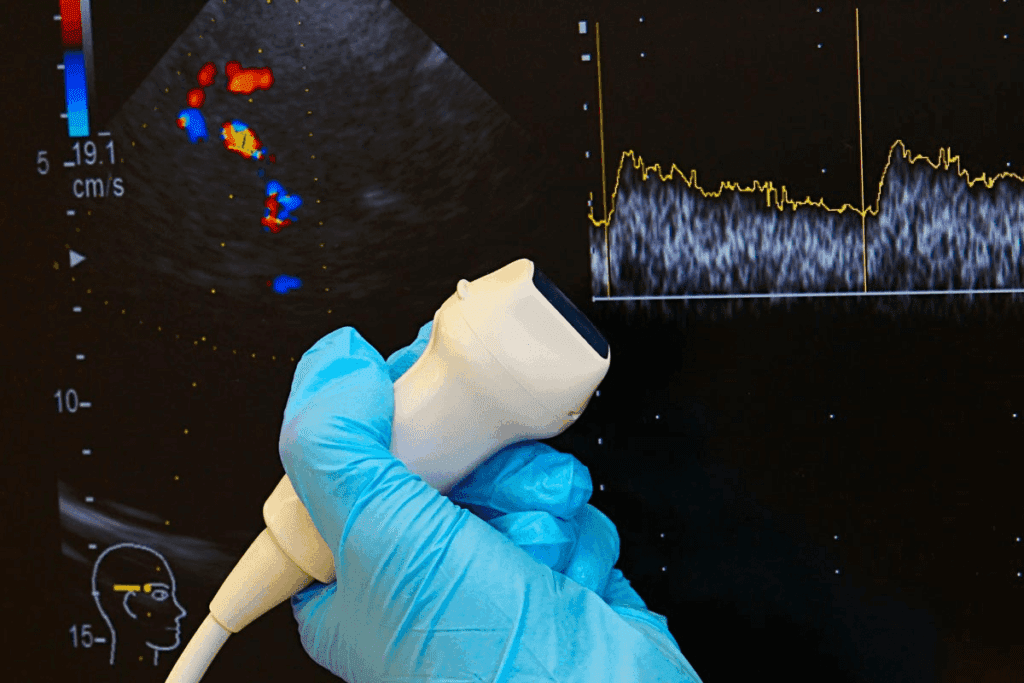
At Liv Hospital, we use color doppler ultrasonography to change how we diagnose blood vessels. It shows blood flow in real-time without needing to cut you open. This method is now common on all ultrasound machines. It helps doctors spot problems fast and make better treatment plans.This is the ultimate guide to color doppler ultrasonography. Learn what this amazing, vital test is and what critical information it reveals.
We use this advanced tool with the latest skills and care for our patients. Doppler ultrasound checks blood flow with sound waves. It’s key for checking blood vessels and the heart.
Key Takeaways
- Color doppler ultrasonography provides real-time visualization of blood flow.
- This non-invasive technique is critical for spotting blood flow issues.
- It helps doctors make precise treatment plans.
- We apply this technology with the latest skills.
- Our main focus is on caring for our patients.
The Fundamentals of Color Doppler Ultrasonography
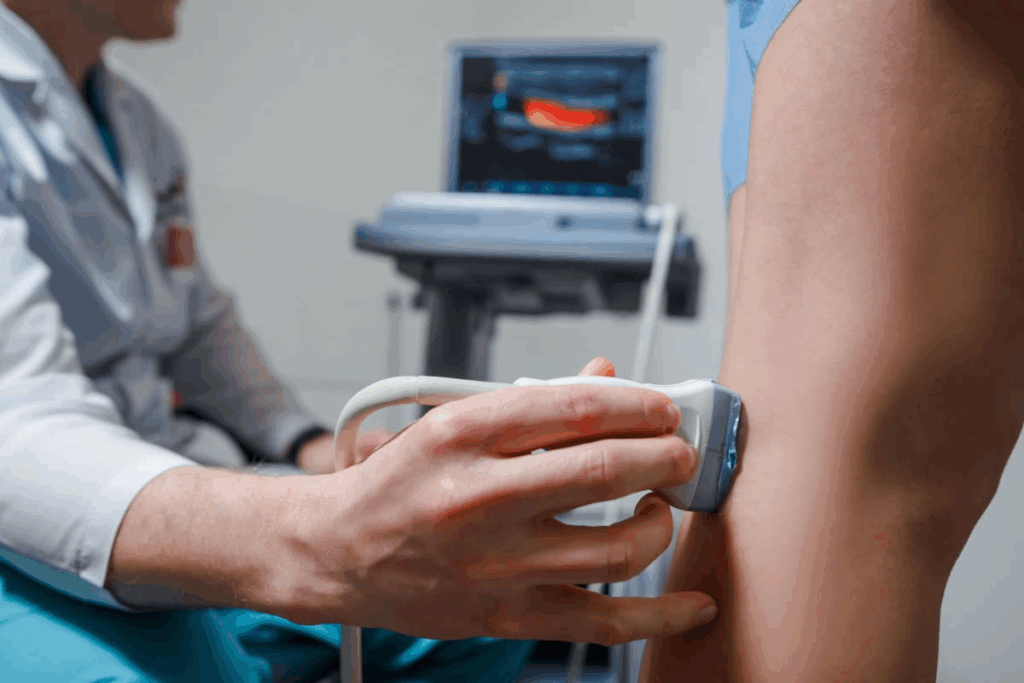
The Doppler effect is key to Color Doppler ultrasonography. It happens when sound waves hit moving objects, like blood cells. This changes the sound wave’s frequency. We use this to see and study blood flow in different areas.
The Physics Behind Doppler Effect in Ultrasound
The Doppler effect changes sound wave frequency when hitting moving objects. In ultrasound, this means sound waves hitting blood cells change their frequency. The change tells us how fast and in which direction the blood is moving.
Knowing the Doppler effect’s physics is key to understanding Color Doppler images. It helps us spot normal and abnormal blood flow. This is vital for diagnosing vascular problems.
How Color Mapping Represents Blood Flow
Color Doppler uses colors to show blood flow’s speed and direction. Flow towards the transducer is red, and away is blue. The color’s brightness shows how fast the blood is moving.
This color mapping lets us see blood flow patterns in real-time. It gives us important info about vascular health. We can spot problems like stenosis or blockages by analyzing these images.
Differences Between Color Doppler and Power Doppler
Color Doppler and Power Doppler both show blood flow, but differently. Color Doppler uses a color scale for velocity and direction. Power Doppler is better at finding slow or weak flow, but doesn’t show direction.
Power Doppler is great for finding blood flow in small areas or weak flow. But it doesn’t show flow direction like Color Doppler does. The choice between them depends on what we’re looking for and where.
Essential Equipment and Setup Requirements

The quality of color Doppler ultrasonography depends on the equipment and setup. Proper equipment and setup are key for reliable results. We will look at what you need for effective color Doppler ultrasonography.
Ultrasound Machine Specifications for Color Doppler
The ultrasound machine is vital for color Doppler ultrasonography. High-quality machines with advanced Doppler features are needed. Important specs include:
- High-resolution display
- Advanced signal processing capabilities
- Multiple Doppler modes (color, power, and spectral)
Transducer Selection and Preparation
Choosing the right transducer is critical. Transducers with the right frequency ranges are needed for each vascular area. Also, preparing the transducer with enough gel is essential for clear images.
Optimizing Room and Patient Positioning
Getting the room and patient setup right is important. Comfortable patient positioning reduces movement issues. The room should be well-lit and set up for easy access to the area being scanned.
Patient Preparation for Vascular Studies
Getting ready for vascular studies is key to getting good results. We help our patients get ready by following a few steps. This makes sure they are ready for their test.
Pre-examination Instructions and Considerations
We give our patients clear instructions before the test. These include:
- Fasting Requirements: Sometimes, patients need to fast before the test. This helps avoid any issues with their digestive system.
- Avoiding Certain Substances: We tell patients to stay away from nicotine and caffeine. These can change blood flow and affect the test results.
- Comfortable Clothing: We suggest wearing loose, comfy clothes. This makes it easier to access the area being checked.
By following these steps, patients help make sure their test goes well. This ensures the results are accurate.
Positioning Techniques for Different Vascular Territories
Getting the right position is important for good images. We use different methods for different areas.
For the legs, patients might lie on their back or side. This depends on the vessels we’re checking. For the arms, they usually lie with their arm out and slightly turned.
Addressing Patient Comfort and Anxiety
We know vascular studies can make patients nervous. Our team works hard to make them feel at ease. We explain the test, answer questions, and make sure they’re comfortable.
By preparing well, positioning right, and focusing on comfort, we get top-notch images. These images help doctors make accurate diagnoses and plans for treatment.
Basic Color Doppler Ultrasonography Scanning Protocol
Color Doppler ultrasonography needs a systematic scanning protocol for accurate vascular assessment. This protocol ensures all necessary information is captured efficiently.
Establishing Baseline Gray-Scale Images
The first step is to get high-quality baseline gray-scale images. These images give essential anatomical information and help spot areas for further color Doppler evaluation. We adjust the ultrasound machine settings and focus on image quality. Proper patient positioning is also key to ensure the area of interest is accessible.
Transitioning to Color Doppler Mode
After getting good baseline images, we switch to color Doppler mode to check blood flow. We activate the color Doppler function and adjust the color box to cover the region of interest. We then fine-tune the color Doppler settings to accurately detect blood flow without noise or aliasing.
Documentation and Image Acquisition Standards
Proper documentation and image acquisition are essential in our scanning protocol. We label all images correctly and take and record relevant measurements. Our protocol includes images in both gray-scale and color Doppler modes, and Doppler spectral waveforms when needed. This approach helps in accurate diagnosis and communication with other healthcare professionals.
Optimizing Color Doppler Parameters for Accurate Assessment
Color Doppler ultrasonography needs the right settings to work well. To get clear images, several key settings must be adjusted.
Adjusting Color Gain and PRF Settings
The color gain and pulse repetition frequency (PRF) are key. Color gain affects how sensitive the Doppler signal is. PRF sets the max speed without aliasing.
Changing the color gain is about finding the right balance. Too high and you get noise, too low and you miss flow. The PRF should match the blood flow speed in the area you’re looking at.
Parameter | Adjustment | Effect |
Color Gain | Increase | Improved detection of low-velocity flow |
Color Gain | Decrease | Reduced noise and artifacts |
PRF | Increase | Higher maximum measurable velocity |
PRF | Decrease | Better detection of low-velocity flow |
Wall Filter and Baseline Optimization
The wall filter is important for removing noise from vessel walls. Adjusting it helps keep the Doppler signal clear.
The baseline setting is the threshold for flow display. Changing it can reduce aliasing and improve flow direction.
“Optimizing the wall filter and baseline settings is essential for obtaining clear and accurate color Doppler images, particular in complex vascular territories.”
Color Box Positioning and Steering
Positioning and steering the color box are critical. It should cover the area of interest and be the right size for detail and speed.
Steering the color box improves Doppler angle accuracy. This is key in complex vessels or when vessels are not flat against the skin.
By tweaking these settings, doctors can make color Doppler ultrasonography more useful. This leads to better vascular assessments and patient care.
Lower Extremity Arterial and Venous Doppler Techniques
Doppler ultrasound is key for checking blood flow in the lower legs. It helps us see both artery and vein systems. This info is vital for spotting and treating vascular diseases.
Assessment of Femoral and Popliteal Vessels
The femoral and popliteal vessels are important in the lower leg arteries. We start by having the patient lie down with their leg slightly turned out. A special transducer is used to see the common femoral artery and its split into the superficial and deep femoral arteries.
Getting the Doppler angle right is key for accurate blood flow measurements. We adjust the angle to be under 60 degrees to get good Doppler waveforms.
Tibial Artery Evaluation Techniques
Checking the tibial arteries is key for finding peripheral artery disease. We mix gray-scale and Color Doppler images to see the anterior and posterior tibial arteries. The patient lies down with their knee slightly bent to relax the calf muscles.
We focus on the flow characteristics in these arteries, looking for signs of blockage. Spectral Doppler helps measure blood flow speeds, showing how bad any blockage is.
Deep Vein Thrombosis Detection Protocol
Finding deep vein thrombosis (DVT) is a big part of Doppler ultrasound in the lower legs. We first check the common femoral vein and then move to the popliteal and tibial veins. We check if the veins can be compressed; if not, it might mean thrombosis.
Color Doppler shows us blood flow in the veins. No flow or a filling defect means DVT. Spectral Doppler also checks for the lack of flow changes with breathing, a sign of vein blockage.
Upper Extremity and Carotid Color Doppler Examination
We use color Doppler ultrasonography to check blood flow in the upper limbs and carotid arteries. This helps us diagnose different vascular conditions. It’s key for spotting diseases in the upper limbs and carotid arteries, which feed the brain.
Brachial and Radial Artery Assessment
We focus on the brachial and radial arteries in the upper limbs. Color Doppler ultrasonography lets us see blood flow and find any problems like stenosis or blockages. Here’s how we do it:
- Position the patient comfortably with the arm extended.
- Use a high-frequency transducer to capture detailed images.
- Adjust the color Doppler settings to optimize the visualization of blood flow.
By checking the brachial and radial arteries, we can spot conditions like peripheral artery disease. This can cause arm pain or weakness.
Carotid Artery Stenosis Evaluation
Carotid artery stenosis is a big risk for stroke. Color Doppler ultrasonography helps us see how severe it is by looking at blood flow in the carotid arteries. Here’s what we do:
- Position the patient supine with the head slightly turned.
- Use a linear transducer to get high-resolution images.
- Optimize color Doppler and spectral Doppler settings to measure stenosis.
This test helps us find people at risk of stroke and helps decide how to treat them.
Subclavian and Jugular Vein Imaging
Color Doppler ultrasonography is also great for looking at the subclavian and jugular veins. It’s very important for finding venous thrombosis or stenosis, which can be very serious.
To get good images of these veins:
- Use a mix of gray-scale and color Doppler imaging.
- Adjust the transducer to get views from different angles.
- Look for signs of thrombosis, like filling defects or no flow.
By checking both arteries and veins in the upper limbs and neck, we can make accurate diagnoses. This helps us make the right treatment plans.
Abdominal and Pelvic Color Doppler Applications
Color Doppler ultrasonography has changed how we look at blood flow in the abdomen and pelvis. It gives us important details about different vascular conditions. We use it to check blood flow and find any problems in these areas.
Renal Artery Stenosis Assessment
Renal artery stenosis can cause high blood pressure and kidney problems. Color Doppler ultrasonography is a safe way to check for this condition. We look for signs like turbulence and high blood flow in the renal arteries.
To diagnose renal artery stenosis, we check for a peak systolic velocity (PSV) over 180 cm/s. We also look at the ratio of renal-to-aortic velocity, which should be over 3.5.
Diagnostic Criteria | Value |
Peak Systolic Velocity (PSV) | > 180 cm/s |
Renal-to-Aortic Velocity Ratio | > 3.5 |
Portal Hypertension Evaluation
Portal hypertension is a liver problem that raises pressure in the portal vein. Color Doppler ultrasonography helps us check this by looking at the flow in the portal vein. We also look for signs of new blood paths.
We search for signs like backward flow in the liver, bigger splenic vein, and new blood paths. Measuring the speed of blood in the portal vein and congestion index helps too.
Pelvic Congestion Syndrome Imaging
Pelvic congestion syndrome is a condition that causes chronic pain and varicose veins in the pelvis. Color Doppler ultrasonography can spot this by showing reflux in the ovarian veins and varices in the pelvis.
We check the ovarian veins for swelling and reflux, and look for varices in the pelvis. This info is key for planning treatment.
Advanced Applications of Color Doppler Ultrasonography
Advanced Color Doppler Ultrasonography techniques are changing how we diagnose diseases. They help us improve patient care and make diagnosis faster.
Cardiac Valve Function Assessment
Color Doppler Ultrasonography is key for checking cardiac valve function. It lets doctors see how blood moves through the heart valves. This helps spot problems like valve stenosis or regurgitation.
By tweaking the Color Doppler settings, we can see the flow around the heart valves. This gives us important info on heart health.
Fetal Blood Flow Evaluation
Color Doppler Ultrasonography is essential for fetal blood flow evaluation in high-risk pregnancies. It looks at blood flow in the umbilical artery, middle cerebral artery, and ductus venosus. This helps check if the fetus is doing well.
Any odd blood flow patterns might mean the fetus is in trouble. This allows for quick action to help the fetus.
Tumor Vascularity Assessment
Checking tumor vascularity is another big use of Color Doppler Ultrasonography. It shows how blood flows through tumors. This tells doctors about the tumor’s growth and how it might react to treatment.
This info is super helpful in cancer care. It helps doctors decide on treatments and track how the disease is doing.
These advanced uses show how Color Doppler Ultrasonography is vital in today’s medicine. It helps us diagnose better and care for patients more effectively in many areas of medicine.
Conclusion: Mastering Color Doppler Ultrasonography in Clinical Practice
Learning to use color Doppler ultrasonography is key for making accurate diagnoses and treatment plans. We’ve looked at the basics of this technology, like the Doppler effect and the differences between color and power Doppler. Knowing how to set up equipment and prepare patients can make color Doppler ultrasonography more useful.
Doppler ultrasonography helps check blood flow in different body parts, like the legs. It’s used for sonograms and Doppler tests. By getting good at color Doppler, doctors can spot problems like deep vein thrombosis and peripheral artery disease. This helps them create better treatment plans.
As medical imaging gets better, knowing how to use color Doppler ultrasonography is more important than ever. By combining technical skills with clinical knowledge, we can help patients get better care and outcomes.
FAQ
What is color Doppler ultrasonography used for?
Color Doppler ultrasonography is a non-invasive way to see blood flow. It helps diagnose vascular conditions. It also checks for blockages in arteries and veins.
How does color Doppler ultrasonography work?
It uses the Doppler effect to detect blood flow changes. It shows blood flow direction and speed in real-time. This helps visualize vascular dynamics.
What is the difference between color Doppler and power Doppler?
Color Doppler shows blood flow direction and speed with colors. Power Doppler is more sensitive to low-flow states. It shows blood flow amplitude but not direction.
What preparation is required for a color Doppler ultrasonography examination?
Patients might need to fast or avoid certain meds. They may also need to position themselves for better images. We give specific instructions for the best results.
How is color Doppler ultrasonography used to assess lower extremity arteries and veins?
It evaluates femoral and popliteal vessels. It checks tibial artery flow and detects deep vein thrombosis. This helps diagnose peripheral artery disease and deep vein thrombosis.
Can color Doppler ultrasonography be used to assess upper extremity vessels?
Yes, it can assess brachial and radial arteries. It evaluates carotid artery stenosis and images subclavian and jugular veins. This helps diagnose conditions like thoracic outlet syndrome and carotid artery disease.
What are the applications of color Doppler ultrasonography in the abdomen and pelvis?
It assesses renal artery stenosis and evaluates portal hypertension. It also images pelvic congestion syndrome. This provides valuable info for diagnosing and managing abdominal and pelvic conditions.
How is color Doppler ultrasonography used in advanced medical applications?
It assesses cardiac valve function and evaluates fetal blood flow. It also checks tumor vascularity. This provides important info for complex medical conditions.
What is the role of pulse repetition frequency (PRF) in color Doppler ultrasonography?
PRF determines the maximum velocity without aliasing. Adjusting PRF settings is key for optimal image quality.
How is the color gain adjusted in color Doppler ultrasonography?
The color gain is adjusted to enhance blood flow visualization. We ensure the gain is set correctly to avoid artifacts and ensure accurate diagnosis.
What is the significance of wall filter in color Doppler ultrasonography?
The wall filter removes low-frequency signals. This reduces noise and improves image quality. Optimizing the wall filter is essential for accurate diagnosis.
What is the arterial doppler exam?
An arterial Doppler exam is a non-invasive test. It uses ultrasound to evaluate blood flow through arteries. It helps diagnose conditions like peripheral artery disease.
What is venous and arterial doppler?
Venous and arterial Doppler is a diagnostic test. It uses ultrasound to evaluate blood flow through veins and arteries. It provides valuable info for diagnosing vascular conditions.
What is doppler ultrasound of legs?
Doppler ultrasound of legs is a non-invasive test. It uses ultrasound to evaluate blood flow through leg arteries and veins. It helps diagnose conditions like deep vein thrombosis and peripheral artery disease.
What is ultrasound for poor circulation in legs?
Ultrasound for poor circulation in legs is a diagnostic test. It uses ultrasound to evaluate blood flow through leg arteries and veins. It helps diagnose conditions like peripheral artery disease.
References
National Center for Biotechnology Information. Color Doppler Ultrasonography: Step-by-Step Guide for Blood Vessel Diagnosis. Retrieved from https://pmc.ncbi.nlm.nih.gov/articles/PMC6750311/