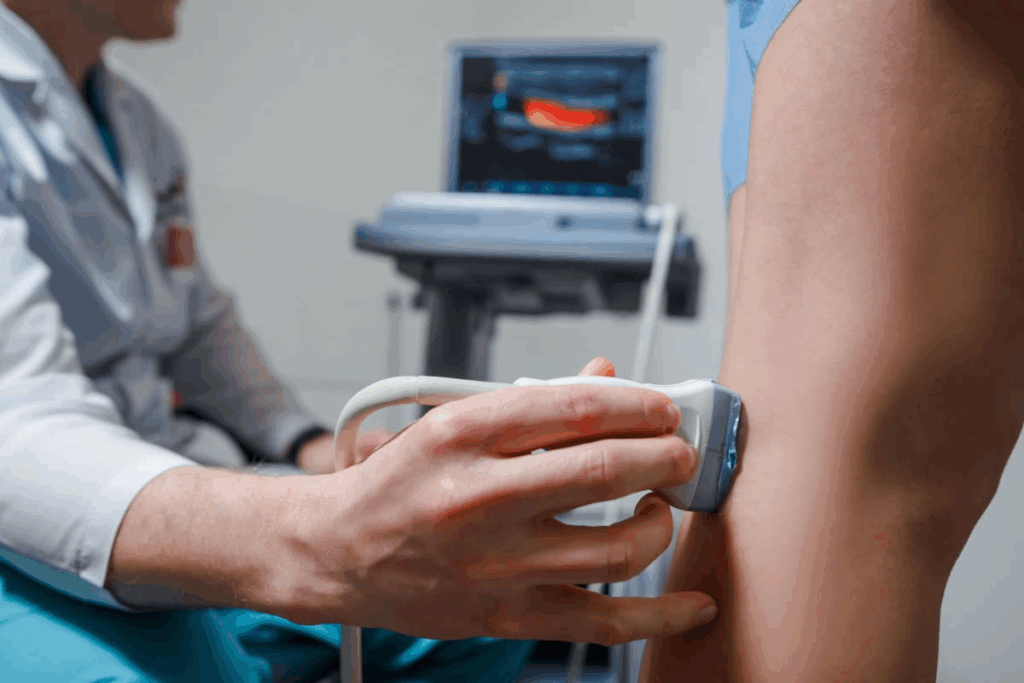
We are dedicated to top-notch healthcare for international patients. We use Colour Doppler Sonography, a non-invasive method that has changed how we diagnose heart and blood vessel issues.This is the ultimate guide to colour doppler sonography. Learn what this amazing, vital test is and what critical information it reveals.
This technology turns sound waves into colour pictures of blood flow in real time. It helps doctors spot serious problems like blood clots and blockages without using X-rays or needles.
At places like Liv Hospital, Colour Doppler Sonography is key to modern medicine. Here, we’ll show you how to use it step by step. We’ll talk about its uses and how it helps in medical tests.
Key Takeaways
- Colour Doppler Sonography is a non-invasive diagnostic modality that assesses blood flow through the heart, arteries, and veins.
- This technology provides real-time, colour-coded visualizations of blood flow, enabling the detection of life-threatening conditions.
- Colour Doppler Sonography is used to evaluate various organ systems and diagnose vascular diseases.
- The technique is performed without radiation or injections, making it a safe diagnostic tool.
- Understanding Colour Doppler Sonography is important for both healthcare professionals and patients.
The Science and Principles of Colour Doppler Sonography

Colour Doppler Sonography uses the Doppler effect, a key concept in physics. It shows how the frequency of a wave changes when its source moves. This is vital in medical imaging to see blood flow in vessels.
The Doppler Effect in Ultrasound Imaging
The Doppler effect helps Colour Doppler Sonography detect blood cell velocity. When ultrasound waves hit moving blood cells, the reflected waves’ frequency changes. This change is linked to the blood cell’s speed.
Colour Doppler Sonography then shows this blood flow visually. “The Doppler effect in medical imaging has been a game-changer in diagnosing vascular diseases,” say medical experts. It lets doctors check blood flow without surgery, improving patient care.
How Blood Flow Creates Frequency Shifts
Blood flow causes frequency shifts because of the movement of blood cells relative to the ultrasound probe. When blood cells move towards the probe, the frequency goes up. When they move away, it goes down.
The frequency shift is figured out using the Doppler equation. It considers the blood cell’s velocity, the ultrasound wave’s frequency, and the angle between the ultrasound beam and blood flow. This is key for accurate vascular health checks.
Color-Coding Velocity and Direction
In Colour Doppler Sonography, frequency shifts are color-coded. Flow towards the probe is red, and flow away is blue. The color’s intensity shows the blood flow’s speed, with brighter colors meaning faster flow.
This color system makes it easy to see vascular health. High-velocity areas might show stenosis or other problems. Doctors can use these images to make better patient care decisions.
Knowing Colour Doppler Sonography’s science is key for its use in clinics. Understanding the Doppler effect and its role in vascular imaging helps doctors improve diagnosis and patient care.
Essential Equipment and Technical Requirements
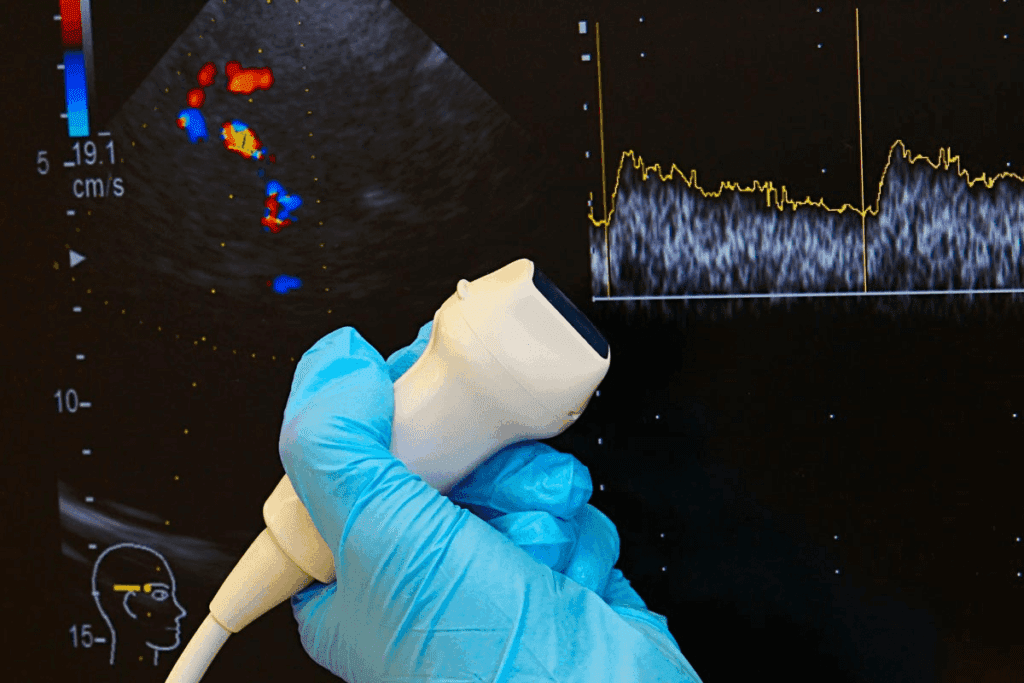
Colour Doppler Sonography needs top-notch equipment and precise settings for accurate vascular checks. It’s key to know the ultrasound machine parts, pick the right transducer, and use the right software.
Ultrasound Machine Components
A modern ultrasound machine is vital for Colour Doppler Sonography. It has:
- High-resolution display: Crucial for seeing blood flow and vascular structures clearly.
- Advanced signal processing: Helps accurately detect and show blood flow velocities.
- Multiple frequency capabilities: Allows for the best imaging for different patients and areas.
- Colour Doppler module: Shows blood flow direction and speed in real-time.
Transducer Selection for Vascular Studies
The right transducer is key for Colour Doppler exams. Consider:
- Frequency range: Higher frequencies are better for surface vessels, while lower ones are for deeper ones.
- Transducer type: Linear array transducers are best for vascular studies because of their near-field detail.
- Footprint size: Smaller footprints are good for smaller areas or hard-to-image patients.
Software and Processing Requirements
Advanced software is vital for top Colour Doppler images and accurate info. Key features are:
- Colour Doppler processing algorithms: Make blood flow detection more sensitive and accurate.
- Spectral Doppler analysis: Lets us measure blood flow velocities and waveforms.
- Image optimization tools: Help adjust gain, scale, and more for better images.
Knowing and using the right equipment and settings ensures top Colour Doppler Sonography exams. These exams give valuable info for vascular checks.
Patient Preparation for Colour Doppler Examination
Getting patients ready is key for top-notch Colour Doppler Sonography images. We help healthcare pros with the must-do steps for accurate results.
Pre-Examination Instructions and Considerations
Before starting, we give patients clear steps to get ready. We explain the procedure, its purpose, and what they’ll experience. They should skip caffeine and nicotine for 2 hours beforehand, as they can mess with blood flow.
We also ask about their medical history, like allergies to ultrasound gel or latex. Knowing their current meds is important, as some can change blood flow.
Optimal Patient Positioning Techniques
Right positioning is key for great Colour Doppler Sonography images. We place patients in a comfy spot for easy access to the area. For legs, they lie down, and for arms, they sit or lie down with their arm out.
The transducer’s angle is important, between 30 to 60 degrees, for clear blood flow images. We make sure the patient’s limb is relaxed to get the best image.
Room Setup and Environmental Factors
The room’s setup affects the quality of Colour Doppler images. We keep it warm, as cold can make blood vessels narrow. A quiet, calm space helps patients relax.
We also adjust the lights to avoid glare on the screen. By managing these factors, we improve the Colour Doppler exam’s quality.
Configuring Your Colour Doppler System
A well-configured Colour Doppler system is key for a successful vascular ultrasound. It makes sure the images you get are accurate and reliable.
Initial Machine Setup and Calibration
The first step is setting up and calibrating your Colour Doppler system. This means making sure the ultrasound machine is ready for the specific transducer and exam type. Calibration is vital for top-notch image quality and precise Doppler signals.
Adjusting Color Scale and Gain Settings
Adjusting the color scale and gain settings is critical for clear Colour Doppler images. The color scale should show blood flow velocities well. The gain should be just right to see the signal without too much noise. Finding the right balance is key for a successful exam.
Optimizing Pulse Repetition Frequency
Optimizing the pulse repetition frequency (PRF) is essential for capturing blood flow velocities accurately. A PRF that’s too low can cause aliasing, while too high might miss low-velocity flows. Adjusting the PRF based on the exam and patient conditions is vital for accurate diagnostic info, like in lower limb vein exams.
Step-by-Step Technique for Basic Colour Doppler Scanning
To do Colour Doppler scanning well, start with a good B-mode image. B-mode shows us the body’s layout. This helps us find what we need to scan before we turn on color flow.
Starting with B-Mode Orientation
We first set the ultrasound to B-mode. This is key because it gives us a clear view of the body. Good B-mode images are vital for Colour Doppler scanning. They let us see blood vessels and the area around them.
“A successful Colour Doppler scan starts with a great B-mode image,” say ultrasound experts. They stress the need to make sure the B-mode is perfect before moving to color flow.
Activating and Adjusting Color Flow
With a clear B-mode image, we turn on color flow. We might need to tweak the settings to see blood flow well. We adjust the color gain to avoid too much or too little color.
While adjusting, we watch the color scale and pulse repetition frequency (PRF). The color scale must show different flow speeds clearly. Changing the PRF is key to show blood flow right and avoid mistakes.
Angle Correction and Optimization
Correcting the angle is very important in Colour Doppler scanning. The angle affects how accurate our measurements are. We aim for a 60-degree angle to reduce errors.
To get the angle right, we align the Doppler cursor with blood flow. This is essential for precise measurements and spotting problems like stenosis or blockages.
By carefully following these steps, we can get top-notch images. These images help us diagnose better and care for our patients more effectively.
Performing Lower Extremity Arterial Doppler Studies
Doppler sonography is key for vascular specialists to check lower extremity arteries. These studies help diagnose and manage peripheral arterial disease. This condition affects millions globally.
Common Femoral Artery Assessment
Checking the common femoral artery is essential. We start by finding the artery with B-mode ultrasound. Then, we use Doppler to measure blood flow. A healthy artery should show a triphasic waveform.
Key parameters to assess include:
- Peak systolic velocity
- Diastolic flow
- Waveform characteristics
Popliteal and Tibial Artery Evaluation
Next, we examine the popliteal and tibial arteries. The popliteal artery is checked in the popliteal fossa. The tibial arteries are assessed down to the ankle.
Artery | Normal Waveform | Abnormal Findings |
Popliteal | Triphasic | Monophasic, damped waveform |
Tibial | Triphasic or biphasic | Monophasic, absent flow |
Identifying Stenosis and Occlusions
Our main goal is to spot stenosis and occlusions. We look for high velocity, turbulence, and waveform changes. Occlusions show as no flow or very low flow.
Criteria for diagnosing stenosis include:
- Peak systolic velocity ratio
- Presence of aliasing on color Doppler
- Post-stenotic turbulence
By examining these details, we can accurately diagnose and manage lower extremity arterial disease. This helps guide treatment and management.
Conducting Venous Doppler Ultrasound of the Legs
When we do a venous Doppler ultrasound on the legs, we need to follow a specific method. This ensures we get the right diagnosis and check everything thoroughly.
Deep Vein Thrombosis Protocol
Deep vein thrombosis (DVT) is a serious issue that needs quick diagnosis and treatment. Our DVT assessment includes a detailed look at the veins in the legs.
Key Steps in DVT Protocol:
- First, we check the common femoral vein.
- Then, we look at the superficial femoral vein.
- Next, we examine the popliteal vein.
- Lastly, we assess the calf veins.
This method helps us find DVT and see how big it is.
Compression Techniques for Vein Evaluation
Compression ultrasound is key in venous Doppler ultrasound. We use the ultrasound probe to apply gentle pressure. This helps us see if the veins can be compressed.
Normal veins can be fully compressed. But veins with DVT can’t be compressed fully or only a little. This helps us tell normal veins from those with DVT.
Assessing Venous Reflux and Insufficiency
Venous reflux happens when blood flows back through veins because of bad valves. To check for this, we use different methods, like:
- Augmentation maneuvers
- Valsalva maneuver
- Looking at vein size and flow
By checking for venous reflux, we can spot venous insufficiency. This helps us decide the best treatment.
In summary, doing a venous Doppler ultrasound on the legs needs a detailed approach. We assess DVT, use compression techniques, and check for venous reflux. Following these steps helps us make accurate diagnoses and care for our patients well.
Combined Arterial and Venous Doppler Examination
Healthcare providers use a combined Doppler ultrasound to understand vascular problems better. This method helps in a detailed vascular assessment. It’s key for diagnosing and treating complex vascular conditions.
Efficient Workflow for Complete Vascular Assessment
An efficient workflow is key for a combined Doppler exam. We first set up the ultrasound machine for both arterial and venous studies. We adjust settings to see blood flow clearly in both systems.
Key steps in optimizing the workflow include:
- Initial machine setup and calibration for vascular studies
- Adjusting settings for optimal arterial and venous flow visualization
- Utilizing Doppler ultrasound techniques to assess blood flow and velocity
Comparing Arterial and Venous Findings
It’s important to compare arterial and venous findings. This helps us see how they might be related. For example, arterial stenosis might be linked to venous reflux, guiding treatment.
The comparison involves analyzing:
- Arterial flow patterns and velocities
- Venous flow characteristics and valve function
- Potential interactions between arterial and venous disease
Identifying Arteriovenous Malformations
A combined Doppler exam is great for finding arteriovenous malformations (AVMs). AVMs are abnormal connections between arteries and veins. Doppler ultrasound shows these malformations by spotting abnormal flow and high-velocity jets.
Characteristics of AVMs on Doppler ultrasound include:
- High-velocity arterial flow feeding the malformation
- Turbulent flow within the AVM
- Arterialization of venous flow
By spotting these signs, we can diagnose AVMs. This helps us plan further steps, like angiography or other treatments.
Upper Extremity Colour Doppler Techniques
Colour Doppler sonography is key for checking the arm’s blood vessels. It helps us see how blood flows and spot problems. We use it to find issues and see if treatments work.
Brachial and Radial Artery Assessment
We start by finding the brachial and radial arteries with B-mode ultrasound. Then, Colour Doppler shows us the blood flow. The brachial artery is in the upper arm, and the radial artery is at the wrist.
Artery | Location | Colour Doppler Findings |
Brachial Artery | Upper Arm | Normal anterograde flow |
Radial Artery | Wrist | Normal anterograde flow |
Evaluating Venous Structures in the Arm
We check the cephalic and basilic veins for blockages or weakness. Colour Doppler helps us find flow issues. We also use special techniques to see if veins can be compressed.
Dialysis Access Evaluation
Colour Doppler is vital for dialysis access in the arm. We look at flow rates, blockages, and other issues. This helps us make sure the access is working right.
Learning Colour Doppler techniques helps us give better care to our patients. We can make accurate diagnoses and help them get better.
Clinical Applications of Colour Doppler Sonography
Colour Doppler sonography is very useful in many areas of medicine. It helps with heart and blood vessel checks, and even in pregnancy. This tool gives doctors a new way to see blood flow and body structures.
Cardiovascular Diagnostics
This method is key for heart and blood vessel checks. Doctors use it to spot problems like blockages. It’s vital for treating heart diseases and planning treatments.
Doctors can see blood flow live. This helps them understand how serious a problem is. It’s great for checking on heart and blood vessel health.
Organ Transplant Perfusion Assessment
Colour Doppler sonography checks how well transplanted organs work. It looks at the blood flow to see if the organ is healthy. This is important for the organ to work right after it’s transplanted.
It’s very important in the first days after a transplant. Finding problems early can help the organ and the patient do better.
Obstetric and Gynecological Applications
In pregnancy, Colour Doppler sonography is used to check on the baby’s blood flow. It also looks at the placenta and checks for any signs of trouble. This is important for keeping the mom and baby safe.
In women’s health, it helps check blood flow in the ovaries and uterus. It’s used to find problems like twisted ovaries or ectopic pregnancies. It also helps with checking on fibroids and other issues.
Interpreting Colour Doppler Images and Waveforms
Colour Doppler sonography is key for accurate diagnosis. It’s important to understand both the visual and quantitative data. This helps us make the right diagnosis.
Normal vs. Abnormal Flow Patterns
Normal flow patterns show a consistent, symmetrical waveform. This reflects the expected blood flow in a vessel. Abnormal patterns, like turbulent flow, may point to stenosis or other issues.
When looking at flow patterns, we must consider the patient’s history and symptoms. For example, in peripheral artery disease, we look for reduced flow in the affected limb.
Quantitative Measurements and Indices
Colour Doppler imaging lets us calculate important measurements. These include peak systolic velocity (PSV), end-diastolic velocity (EDV), and Doppler indices like the resistive index (RI) or pulsatility index (PI).
- Peak Systolic Velocity (PSV) helps us assess stenosis severity.
- End-Diastolic Velocity (EDV is key for evaluating downstream resistance.
- Resistive Index (RI) is useful for checking organ perfusion and vascular resistance.
Correlating Findings with Clinical Presentation
The last step is to match the imaging findings with the patient’s symptoms. This means combining the imaging results with the patient’s history and other findings for a complete diagnosis.
For instance, in a patient with leg pain during exercise, Colour Doppler can show reduced flow in the femoral artery. This supports a diagnosis of peripheral artery disease. By linking imaging with symptoms, we can give a precise diagnosis and plan treatment.
Conclusion: Advancing Your Colour Doppler Sonography Skills
This guide on Colour Doppler Sonography highlights its critical role in medical imaging. It’s vital to keep improving your skills in this field. Continuous learning and practice are key to staying current with new techniques and technologies.
To be great at Colour Doppler Sonography, focus on getting better at doppler sonography training. Also, work on your vascular imaging skills. This way, you can accurately diagnose and manage vascular conditions, leading to better patient care.
We urge you to keep improving your colour doppler skills. Do this through ongoing education and real-world experience. This will help you lead in vascular imaging and offer top-notch care to your patients.
FAQ
What is Colour Doppler Sonography used for?
Colour Doppler Sonography helps see and check blood flow in vessels. It’s used to find problems like stenosis, occlusions, and deep vein thrombosis.
How does Colour Doppler Sonography work?
It uses the Doppler effect to spot changes in ultrasound waves as they hit moving blood cells. It colors the flow based on speed and direction.
What is the difference between arterial and venous Doppler studies?
Arterial studies look at artery blood flow to find stenosis or blockages. Venous studies check vein blood flow to spot deep vein thrombosis or venous issues.
What is a Doppler ultrasound of the legs used for?
It checks blood flow in leg arteries and veins. It helps find conditions like peripheral artery disease or deep vein thrombosis.
How do I prepare for a Colour Doppler examination?
You might need to avoid some medicines and wear comfy clothes. Your healthcare provider will give you specific instructions.
What are the benefits of a combined arterial and venous Doppler examination?
It gives a full view of blood flow in both arteries and veins. This helps doctors spot problems in both systems at once.
Can Colour Doppler Sonography be used for upper extremity vascular assessment?
Yes, it can check blood flow in the arms, including the brachial and radial arteries, and veins.
How is Colour Doppler Sonography used in clinical practice?
It’s used for heart health checks, checking organ transplant blood flow, and in pregnancy and gynecology.
What is the role of Colour Doppler Sonography in diagnosing deep vein thrombosis?
It’s key in finding deep vein thrombosis by showing blood flow and spotting clots in deep veins.
How do I interpret Colour Doppler images and waveforms?
You need to know the difference between normal and abnormal flow. It’s about understanding measurements and matching them with symptoms.
What is the significance of pulse repetition frequency in Colour Doppler Sonography?
It’s important for detecting and measuring blood flow speeds. The right frequency is needed for each study.
Can Colour Doppler Sonography be used to evaluate dialysis access?
Yes, it checks how well dialysis access works. It looks at the health of arteriovenous fistulas and grafts.
What are the advantages of using Colour Doppler Sonography over other vascular imaging modalities?
It’s non-invasive, shows real-time images, and checks blood flow. These make it a great tool for vascular checks.
References
National Center for Biotechnology Information. Color Doppler Sonography: A Step-by-Step Diagnostic Guide. Retrieved from https://www.ncbi.nlm.nih.gov/pmc/articles/PMC8607315/



 Departments
 Related Videos
 Our Doctors
 News
News