The human body can see, hear, smell, taste, and feel thanks to twelve cranial nerves. These nerves connect the brain to the head and neck.cranial nerves labeledWhat Does a Tumor in the Head Feel Like? Symptoms, Headaches, and Survivor Stories
These nerves control many functions. They help us move our eyes and face. They also help us feel the world around us.
Even one damaged nerve can change how we sense things or move. This shows how important they are.
We will look at what each of the 12 cranial nerves does. We’ll see how they affect our daily lives. This guide will help you understand their role in keeping us healthy.
Key Takeaways
- The 12 cranial nerves emerge directly from the brain and brainstem.
- These nerves provide essential sensory and motor functions.
- Damage to a cranial nerve can significantly affect sensory perception or motor responses.
- Understanding the 12 cranial nerves is key to appreciating their role in daily life.
- A labeled diagram can help visualize the complex anatomy of cranial nerves.
The Fundamental Role of Cranial Nerves in the Nervous System
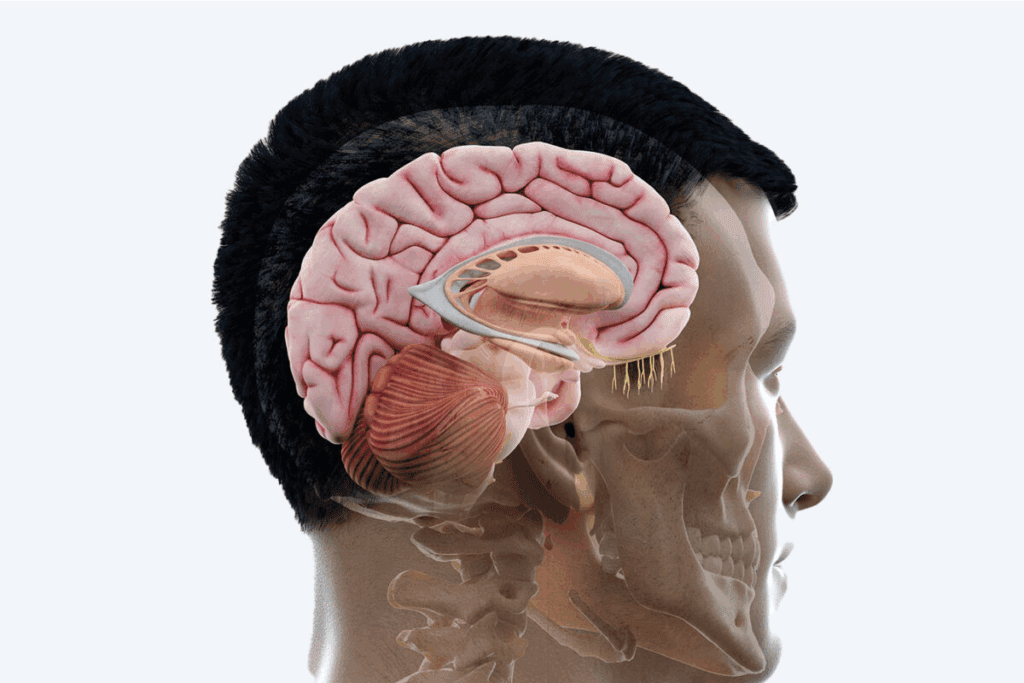
Cranial nerves are key to our nervous system, helping us with daily tasks. They connect directly to the brain, allowing for complex interactions. Unlike spinal nerves, they have unique roles that are vital for our body’s functions.
Direct Brain Connections vs. Spinal Nerves
Cranial nerves differ from spinal nerves because they connect directly to the brain. This connection is important for sending and receiving vital signals. The 12 pairs of cranial nerves come from the brain, including the brainstem. They control eye movements, facial expressions, and send sensory information.
Key differences between cranial and spinal nerves include:
- Direct connection to the brain
- Unique functions and roles
- Control over various bodily processes
Overview of Sensory and Motor Functions
Cranial nerves handle both sensory and motor tasks. Sensory nerves send information about smells, sights, and sounds. Motor nerves control movements like eye movements, facial expressions, and swallowing. Some nerves do both, carrying sensory and motor fibers.
The diverse functions of cranial nerves can be summarized as follows:
- Sensory functions: transmitting sensory information
- Motor functions: controlling movements
- Mixed functions: combining sensory and motor roles
To illustrate the complex anatomy of cranial nerves, consider the following diagram:
Understanding cranial nerves shows their importance in our nervous system. Their direct brain connections and varied functions make them essential for our body’s processes.
Anatomical Origin and Pathways of the 12 Cranial Nerves

The cranial nerves start from different parts of the brain and brainstem. Each has its own role. Knowing where they come from and how they travel is key to understanding their functions.
Emergence Points from the Brain and Brainstem
The 12 cranial nerves begin in various brain nuclei. The brainstem, with its midbrain, pons, and medulla oblongata, is very important. It’s where 10 of the 12 cranial nerves start.
The oculomotor nerve (CN III) and trochlear nerve (CN IV) come from the midbrain. The trigeminal nerve (CN V) starts in the pons.
Where a nerve starts tells us what it does. For example, the facial nerve (CN VII) comes from the pons. It controls our facial muscles and helps us taste food from the tongue’s front part.
Skull Foramina and Nerve Exit Routes
After leaving the brain and brainstem, the cranial nerves go out through skull openings. The optic nerve (CN II) goes through the optic canal. The trigeminal nerve (CN V) exits through the foramen ovale and foramen rotundum for its different parts.
Knowing how nerves leave the skull is important for doctors. For example, the vagus nerve (CN X) goes out through the jugular foramen. It has many important jobs, like controlling the heart and other organs.
Cranial Nerve | Emergence Point | Exit Foramen |
CN I (Olfactory) | Telencephalon | Cribriform plate |
CN II (Optic) | Diencephalon | Optic canal |
CN III (Oculomotor) | Midbrain | Superior orbital fissure |
CN V (Trigeminal) | Pons | Foramen ovale, foramen rotundum |
CN VII (Facial) | Pons | Stylomastoid foramen |
CN X (Vagus) | Medulla oblongata | Jugular foramen |
This table shows where some key cranial nerves start and where they exit. It highlights their complex paths.
Cranial Nerves Labeled: Complete Visual Guide with Diagrams
Seeing the cranial nerves is key to understanding their roles and paths. We’ll dive into their detailed anatomy with diagrams and labeled pictures.
Superior View: Brain Surface Anatomy
Looking at the cranial nerves from above, we see where they start on the brain. This view helps us understand their positions and how they connect.
This view shows where the nerves come out of the brainstem and where they go first. Knowing this is important for doctors and surgeons.
Lateral View: Skull Base and Nerve Pathways
Looking at the skull from the side, we see how the nerves leave the skull. This view is great for seeing how nerves relate to bones.
By looking at a labeled diagram, we can follow the nerves through holes in the skull. This helps us find where problems might be.
Key Anatomical Landmarks for Clinical Identification
There are important landmarks for finding and checking cranial nerve health. These include bony points, holes, and soft tissues.
Knowing these landmarks helps doctors diagnose and treat nerve problems. Using detailed diagrams and pictures, doctors can better understand and care for their patients.
Classification of Cranial Nerves by Function
The cranial nerves have different roles in our body. They help us understand how our nervous system works. By grouping them by function, we see their importance.
Sensory Nerves
Sensory nerves send information from our body to the brain. They are key for us to feel and see the world. The main sensory nerves are:
- Olfactory Nerve (CN I): It handles smell.
- Optic Nerve (CN II): It sends visual info from the eye to the brain.
- Vestibulocochlear Nerve (CN VIII): It deals with hearing and balance.
These nerves are vital for our senses. For example, the optic nerve is key for our vision. It carries visual signals from the eye to the brain.
Motor Nerves
Motor nerves control our muscles. They let us move on purpose. The main motor nerves are:
- Oculomotor Nerve (CN III): It controls most eye movements.
- Trochlear Nerve (CN IV): It works the superior oblique muscle of the eye.
- Abducens Nerve (CN VI): It helps move the eye sideways.
- Accessory Nerve (CN XI): It controls neck and shoulder muscles.
- Hypoglossal Nerve (CN XII): It works the tongue muscles.
These nerves are essential for our voluntary movements. For example, the oculomotor nerve lets us move our eyes.
Mixed Sensory and Motor Nerves
Some nerves do both sensory and motor jobs. These are the mixed nerves. They include:
- Trigeminal Nerve (CN V): It has sensory parts and a motor part for chewing.
- Facial Nerve (CN VII): It controls facial expressions and taste.
- Glossopharyngeal Nerve (CN IX): It helps with swallowing and taste.
- Vagus Nerve (CN X): It affects many bodily functions with its sensory and motor parts.
These mixed nerves show how complex and versatile our cranial nerves are. For example, the trigeminal nerve is important for feeling and chewing.
Cranial Nerves I-VI: Detailed Functions and Clinical Significance
Learning about the first six cranial nerves is key for diagnosing and treating many neurological issues. These nerves handle important tasks like smell, vision, and eye movement. They help us interact with the world around us.
Olfactory Nerve (CN I): Smell Perception and Disorders
The olfactory nerve carries smell information from the nose to the brain. Smell perception is complex, involving odor molecules binding to receptors in the nose. Problems with this nerve, like anosmia (loss of smell), can greatly affect a person’s life.
Optic Nerve (CN II): Visual Pathways and Processing
The optic nerve is vital for visual processing. It sends visual info from the retina to the brain. This process turns light into electrical signals that our brain interprets, allowing us to see and understand what’s around us. Damage to this nerve can cause vision problems, including blindness.
Oculomotor Nerve (CN III): Eye Movement and Pupillary Response
The oculomotor nerve controls eye movements like rotation and pupil constriction. It works with most of the extraocular muscles for smooth eye movements. Issues with this nerve can cause double vision and a drooping eyelid.
Trochlear Nerve (CN IV): Superior Oblique Muscle Innervation
The trochlear nerve is the thinnest cranial nerve. It controls the superior oblique muscle, which helps rotate the eyeball. This nerve is essential for eye movement, mainly looking down. Damage can weaken the superior oblique muscle, making eye movement hard.
Cranial Nerves VII-XII: Detailed Functions and Clinical Significance
The last six cranial nerves, VII-XII, are key to many bodily functions. They help with facial expressions, hearing, and controlling the body’s autonomic nervous system. These nerves are vital for our daily life and health.
Facial Nerve (CN VII): Expression, Taste, and Secretory Functions
The facial nerve controls our facial expressions and transmits taste from the tongue’s front part. It also helps with saliva and tear production. Damage can cause facial paralysis, taste loss, and less saliva.
Bell’s palsy is a condition where this nerve is affected, leading to facial weakness. Knowing how CN VII works is important for treating this and similar conditions.
Vestibulocochlear Nerve (CN VIII): Hearing, Balance, and Vertigo
The vestibulocochlear nerve handles hearing and balance. It has two parts: the cochlear nerve for hearing and the vestibular nerve for balance. Damage can cause hearing loss, tinnitus, or vertigo.
Testing this nerve is key in diagnosing Meniere’s disease. This condition affects balance and hearing.
Glossopharyngeal Nerve (CN IX): Pharyngeal Functions and Reflexes
The glossopharyngeal nerve is involved in swallowing, salivation, and taste from the tongue’s back part. It also controls the parotid gland. Damage can cause swallowing problems and less saliva.
This nerve is important for conditions affecting swallowing and gag reflexes. Damage can lead to dysphagia and less saliva.
Vagus Nerve (CN X): Parasympathetic Control and Visceral Functions
The vagus nerve is extensive, controlling many organs like the heart, lungs, and stomach. It regulates heart rate, breathing, and digestion. Damage can cause heart problems, stomach issues, and vocal cord paralysis.
Understanding CN X is key for managing conditions like gastroparesis and treating epilepsy with vagus nerve stimulation.
Cranial Nerve | Primary Functions | Clinical Significance |
VII (Facial) | Facial expression, taste, secretory functions | Bell’s palsy, facial paralysis |
VIII (Vestibulocochlear) | Hearing, balance | Hearing loss, vertigo, Meniere’s disease |
IX (Glossopharyngeal) | Swallowing, salivation, taste | Dysphagia, decreased salivation |
X (Vagus) | Parasympathetic control, visceral functions | Tachycardia, gastrointestinal disturbances, vocal cord paralysis |
Mnemonics and Memory Aids for the 12 Cranial Nerves
The human brain has 12 cranial nerves. Learning their names and functions can be easier with mnemonics. Mnemonics link new info to familiar things like words or images. We’ll look at common medical mnemonics and techniques to help learn the cranial nerves.
Traditional Medical Student Mnemonics
Medical students often use mnemonics to remember the 12 cranial nerves. A well-known one is: “On Old Olympus’ Towering Top, A Finn And German Viewed Some Hops.” Each word in this sentence matches the first letter of each nerve: Olfactory (I), Optic (II), and so on.
Other mnemonics include: “Only One Otter Tried To Touch And Feel Very Green Vegetables And Ham” or “Oh, Oh, Oh, To Touch And Feel Very Good Velvet, Ah Heaven.” These help students remember the nerves in order.
Function-Based Memory Techniques
Knowing what each nerve does can help remember them. For example, nerves like CN I, II, and VIII handle smell, vision, and hearing/balance. This makes them easier to recall.
- Sensory Nerves: CN I (Olfactory), CN II (Optic), CN VIII (Vestibulocochlear)
- Motor Nerves: CN III, IV, VI, XI, XII, which control eye movements, neck muscles, and tongue movements.
- Mixed Nerves: CN V, VII, IX, X, which have both sensory and motor functions, such as facial sensation, taste, and visceral innervation.
Visual aids like diagrams can also improve memory. A diagram showing the cranial nerves and their pathways can help remember their names and functions.
Linking nerves to their clinical significance can also aid in memory. For example, damage to CN II can cause visual loss, while damage to CN VII can lead to facial paralysis.
In conclusion, mnemonics and memory aids are key for remembering the 12 cranial nerves. By using traditional mnemonics and understanding nerve functions, learning becomes easier for medical students and professionals.
Clinical Assessment and Examination Techniques
Checking the 12 pairs of cranial nerves needs a careful plan to spot problems. A detailed check-up is key to finding and treating nerve issues. We’ll cover how to check cranial nerve function, from basic checks to advanced tests.
Systematic Cranial Nerve Examination Protocol
Checking each of the 12 pairs of cranial nerves in a set way is important. We look at the olfactory nerve (CN I) for smell, the optic nerve (CN II) for sight, and the oculomotor (CN III), trochlear (CN IV), and abducens (CN VI) nerves for eye movement. We also check the trigeminal nerve (CN V) for face feeling and movement, the facial nerve (CN VII) for face looks and taste, and the vestibulocochlear nerve (CN VIII) for hearing and balance.
We also look at the glossopharyngeal (CN IX) and vagus (CN X) nerves for swallowing and voice, the spinal accessory nerve (CN XI) for neck muscle strength, and the hypoglossal nerve (CN XII) for tongue actions. This full check helps find out which nerve is not working right.
Advanced Diagnostic Methods and Imaging
Along with the basic check, new ways to test nerves are very helpful. Imaging techniques like MRI and CT scans show the brain and nerves, spotting any problems. We also use electrophysiological tests like EMG and nerve conduction studies to see how nerves work.
Special tests like visual evoked potentials (VEP) check the optic nerve and brainstem auditory evoked potentials (BAEP) check the vestibulocochlear nerve. These tests help us get a clear picture of nerve problems. They work together with the basic check to help find and treat nerve issues.
Common Cranial Nerve Disorders and Treatment Approaches
Cranial nerve disorders can come from many sources, like trauma, infections, and neurological issues. Knowing about the 12 cranial nerves and what they do is key to figuring out and treating these problems.
These disorders can cause a variety of symptoms. For example, issues with the optic nerve (CN II) can lead to vision problems. On the other hand, problems with the vagus nerve (CN X) can affect how our body controls itself and how we swallow.
How to treat cranial nerve disorders depends on the cause. Treatments might include medicine, surgery, or therapy. For cranial nerve palsy, the goal is to manage symptoms and help the nerve heal.
It’s vital to offer full care to those with cranial nerve disorders. By understanding the 12 cranial nerves, doctors can give better care. This helps improve how well patients do.
FAQ
What are the 12 cranial nerves and their functions?
The 12 cranial nerves control many bodily functions. They help us sense the world, move, and keep our body working right. These nerves include Olfactory (CN I), Optic (CN II), and Oculomotor (CN III). Others are Trochlear (CN IV), Trigeminal (CN V), and Abducens (CN VI). There’s also Facial (CN VII), Vestibulocochlear (CN VIII), Glossopharyngeal (CN IX), and Vagus (CN X). Spinal Accessory (CN XI) and Hypoglossal (CN XII) are the last two.
How do cranial nerves differ from spinal nerves?
Cranial nerves come straight from the brain and brainstem. Spinal nerves start from the spinal cord. Cranial nerves handle head and neck functions. Spinal nerves manage the rest of the body.
What is the function of the cranial nerves in the nervous system?
Cranial nerves are key in sending and processing information. They help us sense smells and see. They also control eye movements and facial expressions.
How are cranial nerves classified?
Cranial nerves are grouped into three types. Sensory nerves (CN I, II, and VIII) handle senses. Motor nerves (CN III, IV, VI, XI, and XII) control movements. Mixed nerves (CN V, VII, IX, and X) do both.
What is the anatomical origin of the 12 cranial nerves?
The 12 cranial nerves start from the brain and brainstem. They leave the skull through different openings. Knowing where they start and go is key for diagnosing and treating nerve problems.
How can I remember the 12 cranial nerves?
There are many ways to remember the 12 cranial nerves. You can use old medical student tricks or make up your own based on their functions.
What are the clinical implications of damage to the cranial nerves?
Damage to cranial nerves can cause many problems. These include losing your sense of smell, vision issues, and eye movement problems. Facial weakness, hearing loss, and trouble swallowing are also possible. Knowing how these nerves work is vital for treating these issues.
How are cranial nerve disorders diagnosed?
Doctors use a special check-up to find cranial nerve problems. They also use advanced tests and imaging to help diagnose.
What are the treatment approaches for common cranial nerve disorders?
Treating cranial nerve disorders depends on the problem and its cause. Understanding how these nerves work is key to finding the right treatment.
What is the role of the cranial nerves in controlling eye movement?
The oculomotor (CN III), trochlear (CN IV), and abducens (CN VI) nerves control our eyes. Damage to these nerves can lead to double vision and crossed eyes.
How do the cranial nerves contribute to overall nervous system function?
Cranial nerves are essential for many bodily functions. They help us sense the world and move. They work with spinal nerves and other parts of the nervous system to keep everything running smoothly.
References
National Center for Biotechnology Information. Evidence-Based Medical Guidance. Retrieved from https://www.ncbi.nlm.nih.gov/books/NBK11154/