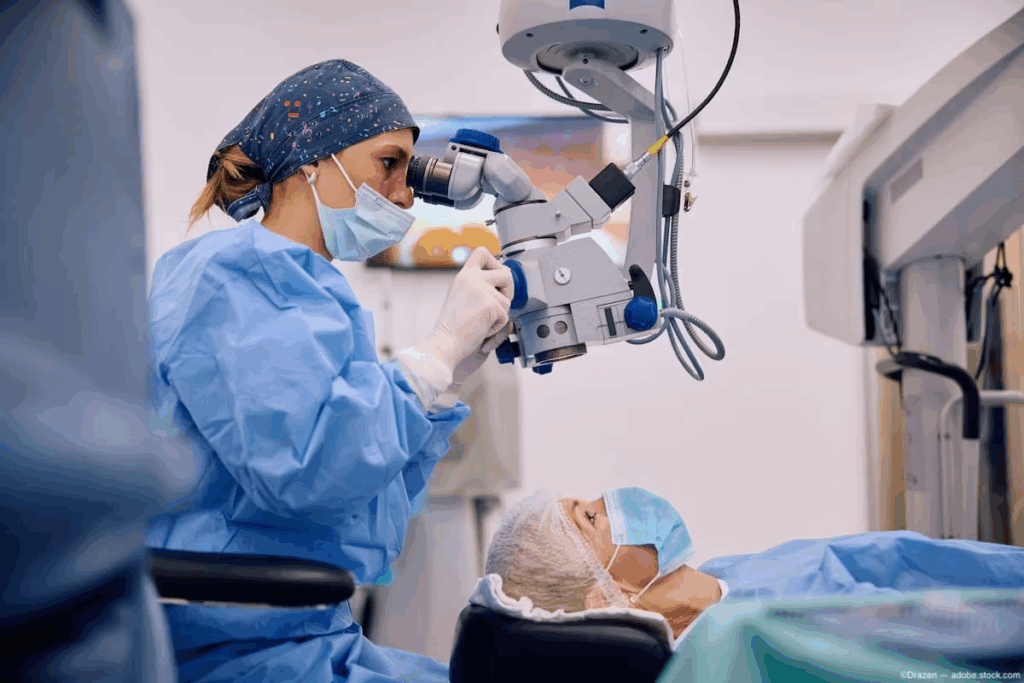
An epiretinal membrane (ERM) is a condition where a layer of cells forms on the retina’s surface. This layer, which doesn’t have blood vessels, can change how we see. It affects millions of people around the world. What is an epiretinal membrane? This essential guide explains what ERM is, how serious it is, and the best treatment options.
We will look into how ERM impacts the retina and our vision. This will help us understand this common eye condition better. It’s very common among older people.
Key Takeaways
- ERM is a layer of cells on the retina’s surface.
- It can cause vision changes and affect quality of life.
- ERM is common among aging populations.
- Advanced imaging technology aids in diagnosis and monitoring.
- Personalized care plans prioritize eye health and quality of life.
Understanding Epiretinal Membrane
It’s important to know about epiretinal membrane to treat vision problems well. An epiretinal membrane (ERM) is a thin layer of tissue on the retina’s inner side. It forms over the macula, which helps us see clearly and details.
ERM can cause vision problems like blurry vision and seeing things out of shape. Knowing about ERM helps both patients and doctors understand and treat it.
Definition and Structure
An epiretinal membrane is a thin layer of tissue on the retina, mainly over the macula. It’s made of cells like retinal pigment epithelial cells and fibroblasts. These cells gather and grow on the retina’s surface.
This membrane can look clear or cloudy and can pull on the retina. This pulling can make vision blurry and shapes look distorted.
How ERMs Form on the Retinal Surface
ERM forms when cells and molecules on the retina change. It starts with injury or inflammation, which brings cells to the surface.
These cells pile up and can pull on the retina. This can make the retina thicker, swell, and even detach in bad cases.
“The pathogenesis of epiretinal membrane involves a complex interplay of cellular proliferation, inflammation, and fibrosis, leading to the formation of a contractile membrane on the retinal surface.”
Source: Ophthalmology Journal
Researchers are trying to understand how ERM forms. Knowing this is key to finding good treatments.
Cell Type | Role in ERM Formation |
Retinal Pigment Epithelial Cells | Contribute to membrane formation and contraction |
Fibroblasts | Produce collagen and other matrix proteins |
Inflammatory Cells | Release cytokines and growth factors that promote membrane growth |
Prevalence and Demographics of Epiretinal Membrane
[Add image here]
It’s important to know who gets Epiretinal Membrane (ERM) to help those at risk. ERM is common worldwide, with certain groups more affected. We need to look at who is most at risk.
Global Prevalence Statistics
About 9.1% of people globally have ERM. It’s more common in some groups, with big differences in ethnic and age groups. Let’s dive into these differences to grasp ERM’s spread.
Ethnic Variations in ERM Occurrence
Research shows ERM hits different ethnic groups differently. Some groups have more cases than others. Knowing this helps us target who to screen for ERM.
Age-Related Prevalence Patterns
ERM gets more common with age. It’s rare in those 40 to 49 but common in those 70 to 79. This shows why older adults need regular eye checks.
Understanding ERM’s spread helps us find and treat it early. This is key to better vision for those affected.
Types of Epiretinal Membrane
ERM comes in different forms, like cellophane macular reflex and preretinal macular fibrosis. Knowing these types helps doctors diagnose and plan treatment better.
Cellophane Macular Reflex (CMR)
Cellophane Macular Reflex (CMR) is an early stage of ERM. It’s a thin, clear membrane on the retina. This condition might not show symptoms at first but can get worse if not watched.
Preretinal Macular Fibrosis (PMF)
Preretinal Macular Fibrosis (PMF) is a more serious stage of ERM. It has visible fibrosis on the retina. This can cause big problems with vision, like distortion and loss of central vision. It’s important to tell PMF apart from other eye problems to treat it right.
Differences in Severity and Presentation
CMR and PMF show different levels of ERM. CMR might have mild symptoms, but PMF can cause serious vision problems. The main differences are in the membrane’s thickness, how much fibrosis there is, and how it affects vision.
- CMR has a thin membrane and little fibrosis.
- PMF has a thicker, more fibrotic membrane that can cause a lot of retinal distortion.
- Going from CMR to PMF can happen over time, so regular checks are important.
Doctors need to know these differences to choose the right treatment. Some people might not show symptoms, but others might need surgery to help their vision.
Getting a full eye check is key to finding out if you have ERM and what kind it is. Tools like optical coherence tomography (OCT) help doctors see how bad ERM is and decide on treatment.
Common Causes and Risk Factors
Epiretinal Membrane (ERM) can be caused by many factors, like age and certain health conditions. Knowing these causes helps in preventing, detecting, and managing ERM.
Age-Related Changes
Getting older is a big risk factor for ERM. As we age, our eye’s vitreous gel changes, which can lead to detachment. This detachment can distort the retina, causing ERM to form.
Systemic Conditions
Some health conditions raise the risk of ERM. Diabetes and hypercholesterolemia are examples. Diabetes can harm the retina’s blood vessels, leading to ERM. High cholesterol can also cause vascular changes that increase ERM risk.
Managing these conditions is key to lowering ERM risk.
Ocular Procedures and Conditions
Ocular surgeries and some retinal conditions can also raise ERM risk. For example, cataract surgery can cause inflammation and eye changes that may lead to ERM. Conditions like retinal vascular occlusion can also damage the retina, increasing ERM risk.
Ocular Condition | Association with ERM |
Cataract Surgery | Increased risk due to post-surgical inflammation |
Retinal Vascular Occlusion | Damage to retinal vessels increases ERM risk |
Diabetic Retinopathy | Changes in retinal vessels contribute to ERM |
Genetic Predisposition
Genetics may also play a part in ERM. People with a family history of ERM or other eye conditions may be at higher risk. While the exact genetic links are being studied, knowing about genetic predisposition helps in early detection and monitoring.
Understanding ERM’s causes and risk factors helps in prevention, diagnosis, and treatment. Regular eye exams are vital, even more so for those with risk factors.
Signs and Symptoms of Epiretinal Membrane
It’s important for patients to know the signs of Epiretinal Membrane (ERM) to get help quickly. ERM can cause many visual problems that can really affect your life.
Early Warning Signs
The first signs of ERM are often small changes in vision. Blurred vision and distorted vision, or metamorphopsia, are common. This means straight lines might look wavy, which is a big clue.
Progressive Visual Changes
As ERM gets worse, vision problems get more serious. You might see things less clearly. How bad it gets can vary a lot from person to person.
People with ERM might also have trouble seeing differences in shades and colors. This makes things like reading or seeing faces harder.
Impact on Daily Activities
ERM can make everyday tasks hard because of vision problems. Even simple things like reading or driving can be tough. It can also make it hard to do things that need good vision, like cooking or crafting.
Knowing how ERM affects your life is key to managing it. Spotting the signs early means you can get help and keep doing the things you love.
Diagnosis and Evaluation Methods
Diagnosing epiretinal membrane (ERM) involves a detailed medical history and a thorough eye exam. Sometimes, optical coherence tomography (OCT) is used to help. Getting the diagnosis right is key to understanding how severe ERM is and what treatment is needed.
Clinical Eye Examination
The first step in diagnosing ERM is a detailed eye exam. An ophthalmologist uses a funduscope to check the retina for signs of ERM. They also do a visual acuity test to see how ERM affects vision.
Key components of a clinical examination include:
- Visual acuity testing to assess the sharpness of vision
- Dilated fundus examination to visualize the retina
- Assessment of retinal thickness and membrane presence
Imaging Technologies
Advanced imaging technologies are key in diagnosing and assessing ERM. Optical Coherence Tomography (OCT) is a non-invasive method that gives detailed images of the retina. OCT helps see the ERM, measure retinal thickness, and spot any other changes.
OCT has greatly improved diagnosing and managing ERM. It allows for early detection and precise tracking of the disease’s progress.
Differential Diagnosis
It’s important to rule out other conditions that might look like ERM. These include macular edema, vitreomacular traction syndrome, and age-related macular degeneration. A detailed exam and advanced imaging help make the right diagnosis.
Differential diagnosis considerations include:
- Macular edema
- Vitreomacular traction syndrome
- Age-related macular degeneration
- Other retinal pathologies
By using both clinical exams and advanced diagnostic tools, doctors can accurately diagnose ERM. This allows them to create a treatment plan that meets the patient’s needs.
Treatment Options for Epiretinal Membrane
Dealing with epiretinal membrane needs a plan that fits each person’s situation. The plan can range from simple care to surgery, based on how much it affects vision and daily life.
Conservative Management Approaches
For those with mild symptoms or little impact on daily life, simple care might be the first step. This includes regular eye checks and imaging to watch the membrane’s growth. Patients learn how to manage symptoms and keep a good quality of life through lifestyle changes.
Surgical Interventions
When symptoms worsen or vision is greatly affected, surgery might be needed. The main surgery is vitrectomy, which removes the vitreous gel and membrane to ease pressure on the macula. This surgery is done by a skilled specialist in vitreoretinal surgery.
Vitrectomy often improves or keeps vision stable in those with epiretinal membrane. But, like any surgery, it comes with risks like cataract, retinal detachment, and infection.
Surgical Outcome | Success Rate | Potential Complications |
Vision Improvement | 70-80% | Cataract Formation |
Vision Stabilization | 15-20% | Retinal Detachment |
Vision Deterioration | 5-10% | Infection |
Post-Treatment Care and Recovery
After vitrectomy for epiretinal membrane, proper care is key for recovery. Patients should avoid heavy lifting, bending, or hard work for weeks. Regular check-ups with the eye doctor are needed to watch healing and solve any problems fast.
Most people see their vision get better slowly over months after surgery. But, recovery times can differ, and some might see vision changes during healing.
Knowing about treatment options and what to expect during recovery helps patients with epiretinal membrane. They can make better choices about their care, working with their doctor for the best results.
How Serious Is Epiretinal Membrane?
Epiretinal membrane can be mild or severe, affecting vision differently. Knowing the severity helps patients understand their condition better. It also guides them in making treatment choices.
Severity Spectrum and Classification
ERM severity is based on vision impact and retina changes. We divide ERM into stages from mild to advanced. This depends on retinal distortion and vision loss.
Classification helps choose the right treatment and predict results. For example, early ERM might not need surgery right away. But advanced cases might need surgery to improve vision.
Key factors in classifying ERM severity include:
- Visual acuity
- Retinal distortion
- Presence of symptoms such as metamorphopsia
- Impact on daily activities
Potential Impact on Vision Quality
ERM can cause blurred vision, distorted vision, and trouble with fine details. The effect on vision varies. Some people have mild symptoms, while others face severe vision problems.
In some cases, ERM can cause permanent vision distortion, even after surgery. Early diagnosis and treatment are key to reduce vision impact.
Comparing ERM to Other Retinal Conditions
It’s important to compare ERM with other retinal diseases like AMD or diabetic retinopathy. Each condition has its own symptoms and treatments.
Condition | Primary Symptoms | Typical Treatment Approaches |
Epiretinal Membrane | Blurred vision, distorted vision | Surgical removal, observation |
Age-related Macular Degeneration | Central vision loss, distortion | Anti-VEGF injections, lifestyle changes |
Diabetic Retinopathy | Vision loss, floaters, blurred vision | Laser photocoagulation, anti-VEGF injections |
Knowing these differences helps in diagnosing and managing ERM. It also helps educate patients about their condition and treatment options.
When to Seek Medical Attention
Getting medical help quickly is key for dealing with Epiretinal Membrane. Knowing when to see a doctor can greatly improve your treatment. This is true if you’re showing symptoms or are at risk.
Warning Signs That Require Immediate Care
Some symptoms need immediate attention. If you see any of these, call your ophthalmologist right away:
- Sudden changes in vision, such as blurred vision or double vision
- Increased floaters or flashes of light
- Distortion in your central vision, making straight lines appear wavy
- Pain or discomfort in the eye
Routine Monitoring for At-Risk Individuals
People at risk of Epiretinal Membrane should get regular check-ups. This includes those with eye problems, diabetes, or a family history of retinal issues. Early detection is possible with regular eye exams.
During these visits, your ophthalmologist will do a detailed eye exam. This might include:
- Visual acuity tests to check your vision sharpness
- Optical Coherence Tomography (OCT) to see the retina clearly
- Fundus photography to check your retina’s condition
Questions to Ask Your Ophthalmologist
Being ready with questions helps you understand your condition better. It also helps you make informed decisions about your care. Ask your ophthalmologist:
- What are the possible complications of Epiretinal Membrane, and how can they be managed?
- What treatment options are available, and which one is best for me?
- How often should I come back for follow-up checks?
- Are there any lifestyle changes or precautions I should take for my vision?
By being informed and proactive, you can work well with your ophthalmologist. Together, you can manage Epiretinal Membrane effectively.
Conclusion
Understanding Epiretinal Membrane is key to managing and treating it well. We’ve looked into what it is, how common it is, its types, causes, symptoms, how it’s diagnosed, and treatment options.
Knowing about ERM early and getting the right treatment can make a big difference. It’s important to get regular eye checks, and there are many ways to treat it, from watching it to surgery.
Being aware of ERM helps people protect their vision and get help when needed. We stress the need to talk to an eye doctor to find the best treatment for each person.
FAQ
What is epiretinal membrane (ERM) in ophthalmology?
Epiretinal membrane is a condition where a layer of fibrous tissue forms on the retina. It can cause vision problems.
How does ERM affect the retina and vision?
ERM can cause vision problems by forming a membrane on the retinal surface. This membrane can contract and cause retinal wrinkling or detachment.
What are the common causes and risk factors of ERM?
ERM is often linked to age-related changes. It can also be caused by diabetes, ocular procedures, and genetic predisposition.
What are the signs and symptoms of ERM?
Symptoms include distorted vision, blurred vision, and difficulty with daily activities. These visual disturbances can be challenging.
How is ERM diagnosed?
Diagnosis involves a clinical eye examination and imaging technologies like Optical Coherence Tomography (OCT).
What are the treatment options for ERM?
Treatment options range from conservative management to surgical interventions like vitrectomy. The choice depends on the severity of the condition.
How serious is ERM, and what is its impact on vision quality?
The severity of ERM can vary. It has the ability to significantly impact vision quality if not treated or if treatment is delayed.
When should I seek medical attention for ERM?
Seek medical attention if you experience sudden vision changes. It’s also important for those at risk who need routine monitoring.
What questions should I ask my ophthalmologist about ERM?
Ask about the severity of your ERM, treatment options, outcomes, and follow-up care or monitoring.
Can ERM be prevented?
While some risk factors, like age, cannot be prevented, managing systemic conditions and regular eye check-ups can help in early detection.
What is the difference between Cellophane Macular Reflex (CMR) and Preretinal Macular Fibrosis (PMF)?
CMR and PMF are types of ERM. CMR is milder, while PMF is more advanced.
References
National Center for Biotechnology Information. Evidence-Based Medical Guidance. Retrieved from https://www.ncbi.nlm.nih.gov/books/NBK560703/