The glossopharyngeal nerve, or cranial nerve 9, is key for swallowing and taste. It carries both motor and sensory signals. This makes checking its health very important for spotting nerve problems. Master glossopharyngeal nerve testing. This guide provides the key clinical steps for assessing cranial nerve IX and the gag reflex.
We’ll show you how to test cranial nerve 9. This is a key part of checking the nerves in the head. Knowing how to check this nerve helps doctors find issues early and avoid big problems.
Testing cranial nerve 9 right involves checking the gag reflex and more. It gives important clues about the nerve’s work and the brain’s health.
Key Takeaways
- Understanding the role of the glossopharyngeal nerve in swallowing and taste sensation.
- Importance of testing cranial nerve 9 in neurological examinations.
- Methods for assessing the function of cranial nerve 9.
- Early detection of abnormalities through thorough testing.
- Preventing complications such as aspiration and dysphagia.
Understanding the Glossopharyngeal Nerve (CN IX)
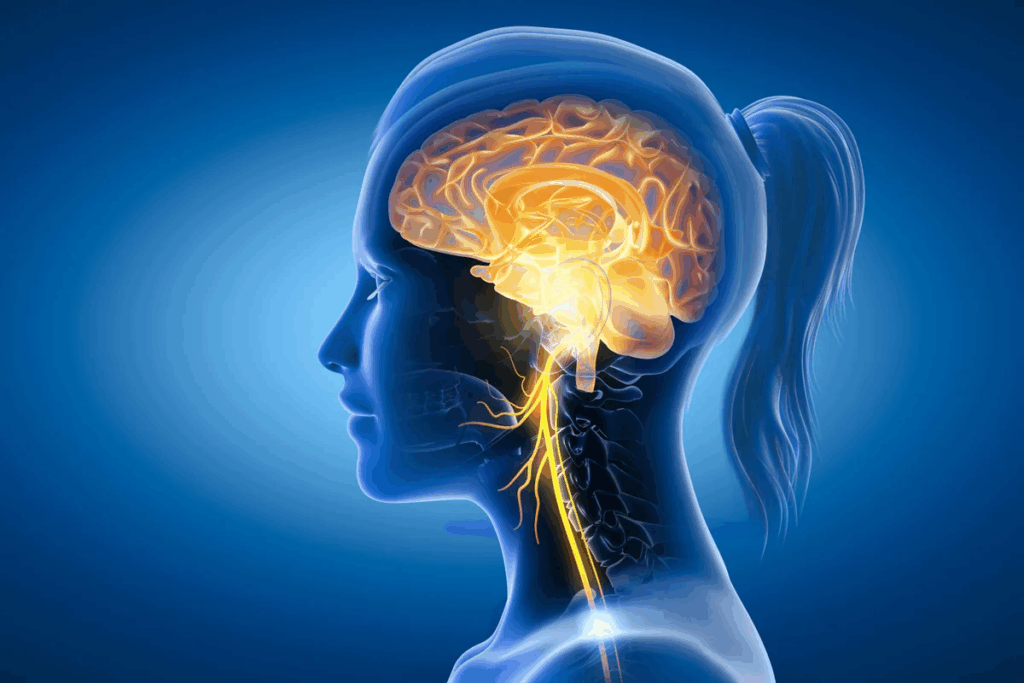
The glossopharyngeal nerve, or cranial nerve IX, is complex and vital. It helps with swallowing, taste, and salivation. Knowing about this nerve is key for diagnosing and treating neurological issues.
Anatomical Origins and Pathway
The glossopharyngeal nerve starts in the medulla oblongata, the top part of the medulla. It comes out of the brainstem between the olive and the inferior cerebellar peduncle. It then goes through the jugular foramen with the vagus and accessory nerves.
After leaving the skull, it goes down between the internal jugular vein and the internal carotid artery. It curves around the stylopharyngeus muscle and reaches the pharynx. There, it joins the pharyngeal plexus.
Functions and Innervation Targets
The glossopharyngeal nerve has several roles:
- It controls the stylopharyngeus muscle to lift the pharynx during swallowing.
- It sends sensory signals to the posterior third of the tongue, the pharynx, and the tonsils. This provides taste and general sensory info.
- It also controls the parotid gland to manage salivary secretion.
These roles show how important the nerve is for swallowing, taste, and salivation.
Clinical Significance in Neurological Examination
Damage to the glossopharyngeal nerve can cause swallowing problems, taste loss, and less saliva. Testing this nerve is vital in a neurological exam.
In a neurological exam, checking the glossopharyngeal nerve involves the gag reflex, taste tests, and watching swallowing. These tests help spot nerve problems.
Understanding the glossopharyngeal nerve’s anatomy, functions, and importance helps doctors diagnose and treat nerve-related issues.
Preparation for Glossopharyngeal Nerve Testing
Getting ready for a cranial nerve test is very important. When we test the glossopharyngeal nerve (CN IX), we need to make sure everything goes smoothly. This means the patient must be comfortable and safe.
Required Equipment and Materials
To check CN IX properly, we need certain tools. Here’s what we use:
- Tongue depressor
- Cotton swabs
- Gloves
- Penlight or flashlight
- Taste testing substances (sweet, sour, salty, bitter)
Having these tools ready makes the test go faster and smoother.
Patient Positioning and Comfort
How the patient sits is key for a good test. We tell them to sit up straight with their head a bit back. This helps us see the inside of their mouth and throat better.
It’s also important to make sure the patient feels at ease. This helps them relax and cooperate during the test.
Safety Considerations
When we do any medical test, safety comes first. Testing CN IX can make some people gag. So, we use gentle methods and watch closely to avoid any pain or discomfort.
Also, we often test CN IX with the vagus nerve (CN X) together. This helps us understand more about the patient’s nerves.
Comprehensive Glossopharyngeal Nerve Testing Methodology
Testing the glossopharyngeal nerve needs a detailed method because of its many roles. This nerve, or cranial nerve IX, helps with swallowing and taste from the back third of the tongue. It also controls the parotid gland’s secretions.
Because of its many roles, a thorough testing method is key to check if the nerve works right.
Overview of Testing Approach
The testing for the glossopharyngeal nerve mixes clinical checks for its motor, sensory, and parasympathetic tasks. The main test is the gag reflex, which checks the nerve’s sensation.
- Gag reflex testing to check the nerve’s sensation part.
- Checking taste from the back third of the tongue.
- Looking at the muscle’s motor function, like the stylopharyngeus.
- Examining how the nerve affects the parotid gland’s secretions.
Challenges in Isolated CN IX Assessment
Testing the glossopharyngeal nerve alone is hard because it works closely with other nerves, like the vagus nerve (CN X). The gag reflex, for example, needs both CN IX and CN X, making it tough to test CN IX by itself.
Combined Testing with Vagus Nerve (CN X)
Because CN IX and CN X share some functions, like in the gag reflex and swallowing, testing them together is common. This method helps understand the patient’s neurological health better.
Key parts of combined testing are:
- Checking the gag reflex and swallowing together.
- Looking at how CN IX and CN X work together in complex tasks like swallowing.
- Watching for any signs of nerve problems in either or both nerves.
Testing Motor Function of CN IX
Testing CN IX’s motor function looks at its role in the stylopharyngeus muscle. This muscle is key for swallowing and moving the pharynx.
Stylopharyngeus Muscle Assessment
The stylopharyngeus muscle gets its nerve supply from CN IX. It’s hard to check its function because it’s deep and the pharynx’s anatomy is complex. Watching the muscle work during swallowing can tell us a lot about CN IX’s motor function.
- Watch the patient swallow water or a small piece of food.
- Look at how the pharynx and larynx move.
- Any unevenness or weakness in these movements might show a CN IX issue.
Pharyngeal Elevation Observation
Pharyngeal elevation is vital for swallowing, mainly thanks to the stylopharyngeus muscle. Here’s what to do during the assessment:
- Have the patient swallow.
- See if the larynx and pharynx move up.
- If their movement is off, it could mean CN IX isn’t working right.
Documentation of Motor Findings
It’s key to document motor findings well for diagnosing and treating CN IX issues. The notes should cover:
- A detailed look at how the patient swallows.
- Any oddities in how the pharynx and larynx move.
- Any ways the patient adapts to swallow better.
Good notes help make a solid treatment plan and track the patient’s improvement.
Evaluating Sensory Function Through Gag Reflex
Checking the gag reflex is key to understanding the glossopharyngeal nerve’s sensory function. The gag reflex, or pharyngeal reflex, is a critical part of neurological exams. It shows how well the glossopharyngeal nerve (CN IX) and vagus nerve (CN X) are working.
Proper Technique for Eliciting the Gag Reflex
To get the gag reflex, we use a tongue depressor to lightly touch the pharynx’s back wall. It’s important to come from the side to avoid the tongue or hard palate. This can cause pain or a false-positive result.
The patient should open their mouth wide and say “ahh” to relax their throat muscles. This makes it easier to see the pharyngeal area.
Key steps in the technique include:
- Using a tongue depressor to touch the posterior pharyngeal wall
- Avoiding contact with the tongue or hard palate
- Instructing the patient to say “ahh” to relax the throat
Interpretation of Normal vs. Abnormal Responses
A normal gag reflex shows a quick contraction of the pharyngeal muscles. This means the glossopharyngeal nerve’s sensory function and the vagus nerve’s motor function are working well. An abnormal response, like a weak or missing gag reflex, could mean a problem with CN IX or CN X.
Interpretation considerations:
- Brisk contraction indicates normal function
- Diminished or absent reflex may indicate nerve dysfunction
Common Pitfalls and Variations
Many things can affect the gag reflex, like patient anxiety, body differences, and past experiences. Knowing these can help avoid mistakes. For example, some people might have a more sensitive gag reflex, while others might be less responsive.
Common pitfalls to avoid:
- Patient anxiety or apprehension
- Anatomical variations
- Previous traumatic experiences
Assessing Taste Function of the Posterior Tongue
Checking how well the posterior tongue tastes is key to seeing if the glossopharyngeal nerve works right. The glossopharyngeal nerve, or cranial nerve IX, carries taste signals from the back third of the tongue.
Taste Testing Methodology
Taste tests use different tastes on the tongue to see how people react. We test for sweet, sour, salty, and bitter tastes. The back tongue is special because it’s controlled by the glossopharyngeal nerve.
The steps are:
- Make solutions for each basic taste
- Put these solutions on the back tongue
- Ask the person to say what taste they feel without looking
Patient Instructions and Response Recording
It’s important to give clear directions for taste tests. We tell the patient to:
- Keep their tongue out during the test
- Not swallow the taste solution
- Identify the taste as sweet, sour, salty, or bitter
We write down what the patient says, looking for any trouble with taste or differences between sides.
Distinguishing CN IX from Other Taste Pathways
The cranial nerve IX handles taste from the back tongue, while the facial nerve (CN VII) deals with the front two-thirds. We test the back tongue to see how the glossopharyngeal nerve is doing.
Getting taste right is key for diagnosing nerve problems. By testing taste carefully, we learn a lot about the glossopharyngeal nerve. This helps us understand the whole nervous system better.
Evaluating Parotid Gland Function
Checking how well the parotid gland works means looking at its nerve connections and how much saliva it makes. The glossopharyngeal nerve, or cranial nerve IX, is key. It sends nerve fibers to the parotid gland, affecting how much saliva it produces.
Parasympathetic Function Assessment
The parotid gland gets its nerve supply from the glossopharyngeal nerve. To check this, we look at the nerve’s path and how it affects the gland. The parasympathetic fibers start in the glossopharyngeal nerve. They then connect in the otic ganglion and reach the parotid gland.
Important things to check in parasympathetic function include:
- Is the glossopharyngeal nerve working right?
- Is the otic ganglion doing its job?
- Does the parotid gland react to stimuli?
Salivary Production Testing
Testing how much saliva the parotid gland makes is a direct way to see if it’s working. We can measure how much saliva comes out in different ways, like:
- Citric acid stimulation test
- Salivary collection using absorbent materials
- Quantitative measurement of salivary output
Interpretation of Findings
Understanding the results of parotid gland function tests needs a deep look at both nerve function and saliva production. If the results are off, it could mean:
- The glossopharyngeal nerve isn’t working right
- There’s a problem with the parotid gland itself
- Something else is affecting how much saliva is made
By carefully looking at these points, we can learn a lot about the parotid gland’s health.
Clinical Interpretation of Test Results
Understanding glossopharyngeal nerve test results is complex. It involves knowing normal and abnormal findings. We must grasp the role of CN IX in the body’s functions.
Normal Findings and Variations
Normal results show a symmetrical gag reflex and taste on the tongue’s back. But, variations can happen due to different body shapes or past experiences.
Some people might gag more, while others less. These differences are okay as long as they’re even and normal.
Pathological Findings and Their Significance
Abnormal results suggest damage to the glossopharyngeal nerve. This can include:
- Absent or weak gag reflex on one or both sides
- Changes in taste on the tongue’s back
- Swallowing problems (dysphagia)
These signs can point to issues like glossopharyngeal neuralgia, brainstem problems, or tumors at the skull base.
“Accurate diagnosis of glossopharyngeal nerve dysfunction is key for proper treatment.”
— Neurological Examination Guide
Differential Diagnosis of Abnormalities
When we find abnormalities, we need to look at many possible causes. Differential diagnosis helps us tell apart conditions with similar symptoms.
A patient with a weak gag reflex might have nerve damage, brainstem issues, or a systemic disorder.
It’s vital to do a detailed check-up and use more tests for a correct diagnosis.
Common Disorders Affecting the Glossopharyngeal Nerve
Disorders of the glossopharyngeal nerve can have big effects on the body. This nerve, or cranial nerve IX, helps with swallowing, taste, and salivation. When it’s damaged, it can cause many symptoms and problems.
Glossopharyngeal Neuralgia
Glossopharyngeal neuralgia is a rare condition. It causes sharp pain in the tongue, throat, and ear. This pain often starts when you swallow, talk, or yawn. The exact reason for this pain is not always clear, but it might be due to a blood vessel pressing on the nerve.
Treatment options include medicines like anticonvulsants or pain relievers. Sometimes, surgery is needed to fix the nerve compression.
Brainstem Lesions
Brainstem lesions can harm the glossopharyngeal nerve because it starts there. These lesions can come from tumors, blood vessel problems, or inflammation.
A study found that
“Brainstem lesions, like those in the medulla oblongata, can cause problems with swallowing and taste.”
Condition | Symptoms | Potential Causes |
Glossopharyngeal Neuralgia | Intense pain in tongue, throat, ear | Nerve compression, unknown causes |
Brainstem Lesions | Difficulty swallowing, altered taste | Tumors, vascular issues, inflammation |
Skull Base Tumors and Trauma
Skull base tumors and injuries can also harm the glossopharyngeal nerve. Tumors can press on or invade the nerve, causing problems. Traumatic injuries to the skull base can also damage the nerve.
Systemic Conditions Affecting CN IX
Conditions like diabetes and autoimmune diseases can harm the glossopharyngeal nerve. These conditions can damage the nerve through metabolic issues and inflammation.
For instance, diabetes can cause nerve damage, including to the glossopharyngeal nerve. It’s important to manage diabetes to prevent more nerve damage.
Conclusion: Mastering Glossopharyngeal Nerve Assessment
Learning to assess the glossopharyngeal nerve is key for a full neurological check-up. It’s important to accurately check cranial nerve 9 to diagnose and treat neurological issues. Healthcare experts can give better care by knowing how to test the glossopharyngeal nerve.
Testing cranial nerve 9 well means checking its motor, sensory, and parasympathetic functions. We’ve talked about the main parts of checking the glossopharyngeal nerve, from getting ready to understanding the results. This info is essential for those who do neurological exams and care.
As we keep improving in neurological care, knowing how to check the glossopharyngeal nerve is more important than ever. Using these methods in regular checks can help patients get better care and outcomes.
FAQ
What is the glossopharyngeal nerve, and what are its functions?
The glossopharyngeal nerve, also known as cranial nerve 9 (CN IX), starts from the medulla oblongata. It controls swallowing and taste from the tongue’s back part. It also works with the stylopharyngeus muscle and parotid gland.
How is the glossopharyngeal nerve tested during a neurological examination?
To test the glossopharyngeal nerve, doctors check its motor and sensory parts. They look at the gag reflex and taste on the tongue’s back. They also watch how the pharynx moves during swallowing.
What is the significance of the gag reflex in glossopharyngeal nerve assessment?
The gag reflex is key in checking the glossopharyngeal nerve. It tests the nerve’s sensory function. A normal response means the nerve is working right.
How is taste function assessed for the glossopharyngeal nerve?
Doctors test taste by asking patients to identify tastes on the tongue’s back. They use sweet, sour, salty, and bitter tastes to check the nerve’s function.
What are some common disorders that affect the glossopharyngeal nerve?
Disorders like glossopharyngeal neuralgia and brainstem lesions can affect the nerve. Skull base tumors and conditions like diabetes also cause problems. Symptoms include pain, swallowing issues, and taste changes.
How is the parotid gland’s function assessed in relation to the glossopharyngeal nerve?
Doctors check the parotid gland’s work by looking at saliva production. The glossopharyngeal nerve helps control the gland. Issues with saliva can show nerve problems.
What are the challenges in isolating the glossopharyngeal nerve’s function during testing?
Testing the glossopharyngeal nerve is tricky because it works with other nerves, like the vagus nerve. It’s important to carefully check and understand the results to diagnose nerve issues correctly.
How is the motor function of the glossopharyngeal nerve assessed?
Doctors check the nerve’s motor function by looking at the stylopharyngeus muscle and swallowing. This helps them see if the nerve is working well.
What is the clinical significance of assessing the glossopharyngeal nerve?
Checking the glossopharyngeal nerve is vital for diagnosing and treating conditions that affect swallowing and taste. Accurate tests help doctors give the right care.
References
National Center for Biotechnology Information. Evidence-Based Medical Guidance. Retrieved from https://www.ncbi.nlm.nih.gov/books/NBK537153/