
Answering can x rays detect arthritis (yes) and detailing what visible changes in the joint indicate the condition.
If you’re feeling joint pain and wondering if an X-ray can show arthritis, the answer is not simple. It’s not just a yes or no.
At Liv Hospital, we know diagnosing arthritis needs a focus on the patient. X-rays help by showing signs of osteoarthritis. These signs include a narrowing of the joint space, which means cartilage is lost.
Even though X-rays are helpful, they might not catch the disease in its early stages. Our team uses both clinical checks and imaging to make sure we get the diagnosis right.
Key Takeaways
- X-rays are a key tool for finding osteoarthritis.
- A narrow joint space on an X-ray means cartilage loss.
- Early arthritis might not show up on X-rays.
- Putting the patient first is key for a correct diagnosis.
- We use both clinical checks and imaging for a full diagnosis.
Understanding Arthritis and Diagnostic Imaging
Arthritis is a group of conditions that affect the joints. Diagnostic imaging is key to understanding the extent of the damage. With over 100 different types, arthritis is complex and can manifest in various ways. Accurate diagnosis is essential for effective treatment.
Common Types of Arthritis
The most common forms of arthritis include osteoarthritis, rheumatoid arthritis, and psoriatic arthritis. Osteoarthritis is characterized by the breakdown of cartilage in joints, leading to pain and stiffness. Rheumatoid arthritis, on the other hand, is an autoimmune condition that causes inflammation and can lead to severe joint damage if not treated promptly. Psoriatic arthritis is associated with the skin condition psoriasis and can cause significant discomfort and disability.
- Osteoarthritis: Wear and tear on joints
- Rheumatoid arthritis: Autoimmune inflammation
- Psoriatic arthritis: Associated with psoriasis
The Role of Medical Imaging in Diagnosis
Medical imaging, including X-rays, plays a vital role in diagnosing arthritis. X-rays can help determine the extent of joint damage and the presence of certain types of arthritis. The question of whether X-rays can show arthritis is key, as it impacts diagnosis and treatment planning.
When considering if does arthritis show in an X-ray or does arthritis show on X-ray, it’s essential to understand that X-rays can reveal signs such as joint space narrowing, bone spurs, and erosions. These signs are indicative of various forms of arthritis. The visibility of these signs can depend on the type of arthritis and its stage.
Understanding the capabilities and limitations of X-rays in diagnosing arthritis is vital for healthcare providers. By combining clinical assessment with imaging findings, healthcare professionals can develop effective treatment plans tailored to each patient’s needs.
How X-Rays Work in Medical Diagnostics
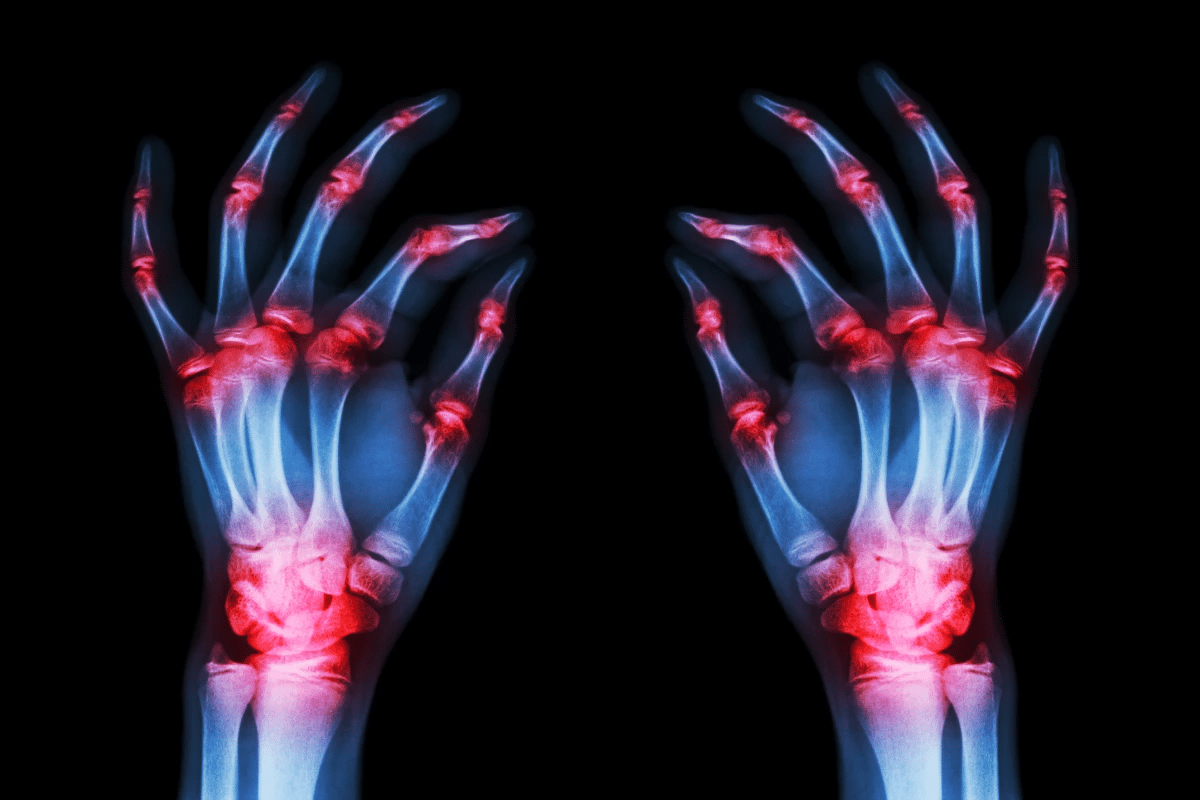
X-ray technology is key for seeing joint and bone issues linked to arthritis. We use X-rays to get quick and clear images. These images help in diagnosing, planning treatment, and monitoring arthritis patients.
Basic Principles of X-Ray Technology
X-rays are a type of electromagnetic radiation used in medical imaging. They help us see inside the body. When X-rays go through the body, they are absorbed differently by various tissues.
This difference in absorption creates contrast on the X-ray image. It lets us see bones, joints, and other internal structures.
Getting an X-ray image is simple and fast. The patient stands between the X-ray machine and a detector. The machine sends out X-rays, which go through the body and are caught by the detector to make an image.
What X-Rays Can and Cannot Visualize
X-rays are great for seeing bone structures and spotting issues like fractures and bone diseases. For arthritis, X-rays can show joint space narrowing, bone spurs, and other bony changes. But, X-rays can’t see soft tissues like cartilage, tendons, and ligaments well.
For example, X-rays can show joint space narrowing, which means cartilage loss. But, they can’t see the cartilage itself. This is important for diagnosing early arthritis, where cartilage damage might not show up on an X-ray.
|
Condition |
Visibility on X-Ray |
|---|---|
|
Bone Fractures |
Highly Visible |
|
Joint Space Narrowing |
Visible |
|
Bone Spurs |
Visible |
|
Cartilage Damage |
Not Directly Visible |
|
Soft Tissue Inflammation |
Not Visible |
Medical experts say X-rays are very useful for arthritis diagnosis. They help track disease progress and treatment response. This shows how important it is to know what X-rays can and can’t do in managing arthritis.
Understanding X-rays and their limits helps doctors make better decisions. They know when to use X-rays and when other imaging methods are needed.
Can X-Rays Detect Arthritis? The Capabilities and Limitations
To know if X-rays can spot arthritis, we need to look at what they can and can’t do. X-rays are key in checking bones and joints.
What Arthritis Signs Are Visible on X-Rays
X-rays show signs of arthritis like:
- Joint space narrowing, a sign of osteoarthritis
- Bone spurs or osteophytes, bony growths around joints
- Subchondral sclerosis, hardening of bone under cartilage
- Cysts in the bone, linked to arthritis
These signs help doctors see how much damage there is and plan treatment.
Types of Arthritis Best Detected by X-Rays
X-rays are best for osteoarthritis. They show joint space loss and bone spurs.
Rheumatoid arthritis can also be seen on X-rays, but they might miss early signs. For a better look, MRI might be needed.
Key Points to Consider:
- X-rays are good for spotting joint changes in arthritis.
- How well X-rays work depends on the arthritis type.
- Early diagnosis might need more imaging tests.
Knowing what X-rays can and can’t do helps both patients and doctors make better choices for diagnosis and treatment.
Key Indicators of Arthritis on X-Ray Images
Diagnosing arthritis often starts with looking at X-ray images. We search for specific signs that help us understand the condition’s extent.
Joint Space Narrowing
Joint space narrowing is a key sign of arthritis on X-rays. It happens when cartilage wears down, reducing the space between bones. This is common in joints like knees and hips, where we see osteoarthritis most.
Bone Spurs (Osteophytes)
Bone spurs or osteophytes are another indicator. These are extra bony growths around joints with arthritis. They’re the body’s way to try and stabilize the joint, but they can also cause pain and stiffness.
Bone Cysts and Sclerosis
Bone cysts and sclerosis are also important signs. Bone cysts are fluid-filled sacs in the bone near joints with arthritis. Sclerosis is when bone gets harder, showing up as denser areas on X-rays. Both show the degenerative changes of arthritis.
By looking at these signs on X-rays, we can diagnose arthritis and see how severe it is. Knowing these signs helps us create a treatment plan that fits the patient’s needs.
Mild Osteoarthritis Knee X-Ray: What to Look For
When we look at mild osteoarthritis of the knee through X-ray, we see important signs. These signs show when osteoarthritis starts. This is key for managing and treating the condition.
Early Signs of Knee Osteoarthritis
Early osteoarthritis of the knee shows up on X-rays in specific ways. We see joint space narrowing and early osteophyte formation. Osteophytes are bony growths around the joint due to degeneration.
“The presence of joint space narrowing is a critical indicator of osteoarthritis,” say medical experts. “It shows the loss of cartilage between bones, a key sign of the disease.”
Kellgren-Lawrence Grading System
The Kellgren-Lawrence Grading System helps classify osteoarthritis severity on X-rays. It ranges from 0 (normal) to 4 (severe). Mild osteoarthritis usually falls in the lower end, showing small but clear changes.
- Grade 0: Normal
- Grade 1: Doubtful narrowing of joint space and possible osteophytic lipping
- Grade 2: Definite osteophytes and possible narrowing of joint space
Comparing Normal vs. Arthritic Knee X-Rays
Looking at X-rays of normal knees and those with osteoarthritis shows big differences. Normal knees have well-maintained joint spaces and no osteophytes. But osteoarthritis X-rays show joint space narrowing and osteophytes.
As a study pointed out, “Comparing normal and arthritic knee X-rays is key. It helps us understand how osteoarthritis progresses and plan treatments.”
Arthritis in Different Joints: X-Ray Appearances
Arthritis shows up differently on X-rays in various joints. It’s key to know these differences for a correct diagnosis. Each joint affected by arthritis has its own X-ray signs, showing how severe it is.
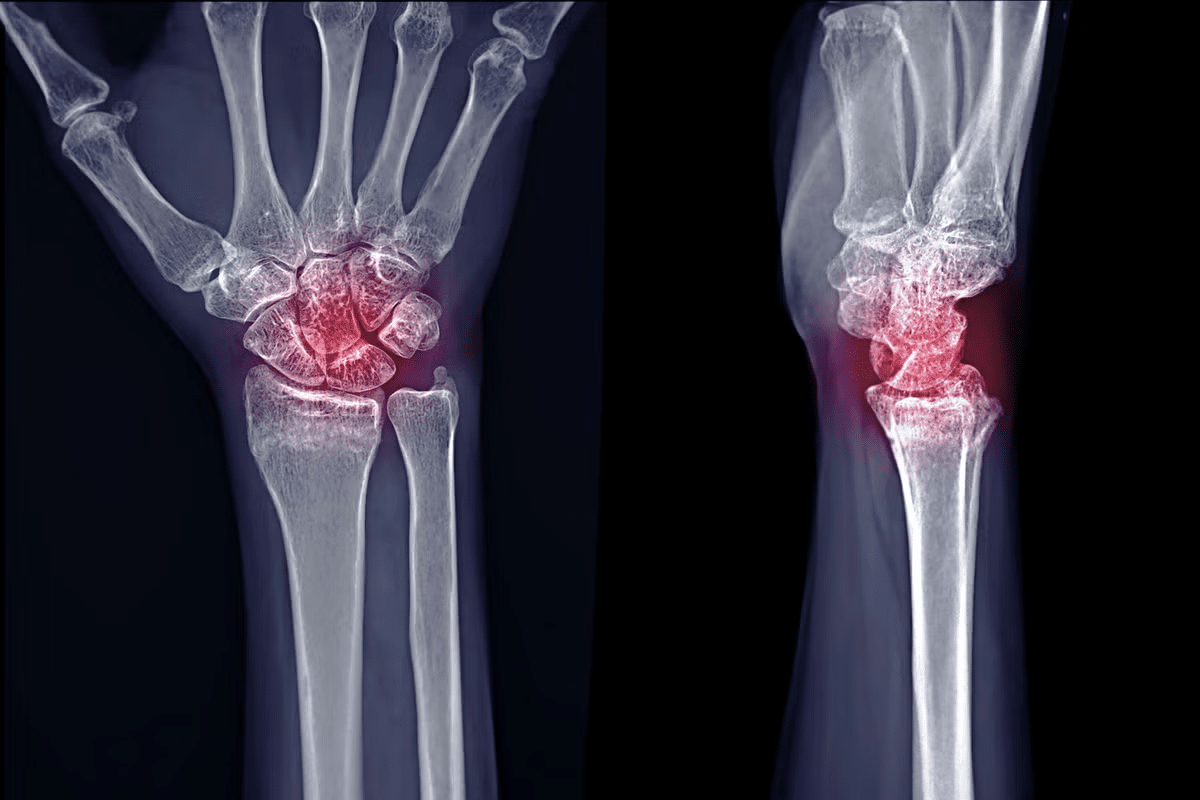
Hand and Wrist Arthritis on X-Ray
X-rays are great for spotting damage and changes in the hand and wrist with arthritis. You might see:
- Joint space narrowing, mainly in the thumb’s carpometacarpal joint
- Erosions and cysts in the wrist bones
- Osteophyte formation around the joints’ edges
- Subchondral sclerosis, which means bone hardening
Hip and Spine Arthritis Imaging
Arthritis in the hip and spine can really affect how you move and feel. X-rays might show:
- Joint space narrowing in the hip, often not even
- Osteophyte formation around the acetabulum and femoral head
- Subchondral cysts and sclerosis in the hip
- Disc space narrowing and vertebral endplate sclerosis in the spine
- Osteophytes or bone spurs along the vertebral bodies’ edges
These signs help doctors diagnose osteoarthritis and degenerative disc disease.
Foot and Ankle Arthritis Findings
Arthritis in the foot and ankle can be very painful and limit movement. X-rays might reveal:
- Joint space narrowing, mainly in the subtalar and midtarsal joints
- Erosions and cysts, often seen in rheumatoid arthritis
- Osteophyte formation around the joints, causing pain and stiffness
- Deformities like hallux valgus or hammertoes
Knowing these X-ray signs is vital for diagnosing and treating foot and ankle arthritis well.
Limitations of X-Rays in Early Arthritis Detection
X-rays have their limits when it comes to spotting early arthritis. They can show bone health and some joint changes. But they don’t give a full view of arthritis, mainly in its early stages.
The Cartilage Visibility Problem
X-rays struggle to see cartilage, a key part of joints. Cartilage loss is a big sign of osteoarthritis. X-rays can only guess at cartilage health by looking at joint space narrowing.
Table: Comparison of Imaging Techniques for Cartilage Visualization
|
Imaging Technique |
Cartilage Visualization Capability |
Common Use in Arthritis Diagnosis |
|---|---|---|
|
X-ray |
Indirect (via joint space narrowing) |
Common for initial assessment |
|
MRI |
Direct |
Increasingly used for detailed assessment |
|
CT Scan |
Limited |
Used in specific cases for bone detail |
Disconnect Between Symptoms and X-Ray Findings
There’s often a gap between what patients feel and what X-rays show. Patients might feel a lot of pain and stiffness, but their X-rays look fine. On the other hand, some people with clear X-ray signs might not feel anything wrong.
When X-Rays May Miss Arthritis
X-rays might not catch arthritis early or when it affects soft tissues. For example, early rheumatoid arthritis might not show up on X-rays until damage is severe. In these cases, MRI or ultrasound might be needed to spot the disease early.
We know X-rays have their limits in finding early arthritis. But by using X-rays, clinical checks, and advanced scans when needed, doctors can make better diagnoses. This helps in creating effective treatment plans.
Advanced Imaging Options for Arthritis Diagnosis
Diagnosing arthritis has gotten better with new imaging tools. X-rays are good to start, but newer methods give more details. They help see how joints and tissues are doing.
We use MRI, CT scans, and ultrasound to understand arthritis better. These tools spot problems early. This means we can treat them sooner.
Detecting Early Degenerative Changes with MRI
MRI is great for catching arthritis early. It shows soft tissues like cartilage and tendons clearly. MRI finds inflammation and cartilage loss, helping diagnose arthritis early.
MRI Advantages:
- Detailed view of soft tissues
- Finds inflammation early
- Checks cartilage health
CT Scans and Ultrasound Applications
CT scans and ultrasound help too. CT scans show bone details, like spurs and cysts. Ultrasound looks at soft tissue inflammation and finds synovitis, a sign of inflammatory arthritis.
|
Imaging Modality |
Primary Use in Arthritis Diagnosis |
|---|---|
|
MRI |
Early detection of degenerative changes, soft tissue assessment |
|
CT Scans |
Bone structure evaluation, detection of bone spurs and erosions |
|
Ultrasound |
Soft tissue inflammation assessment, synovitis detection |
When to Consider Advanced Imaging
Think about advanced imaging if X-rays don’t show enough. Or if symptoms don’t match X-ray results. MRI is key for soft tissue and early changes.
Choosing advanced imaging is a big decision. We think about the benefits and costs. We also consider how it affects the patient’s health.
Conclusion: The Value of X-Rays in Arthritis Management
We’ve looked at how X-rays help in diagnosing and managing arthritis. They are very useful, but they have their limits. X-rays are key in ruling out other conditions and tracking how the disease progresses.
X-rays show the extent of joint damage and how severe the disease is. Even though MRI gives more details, X-rays are vital for patient care. They help doctors see the big picture.
Doctors can spot signs of arthritis on X-rays and choose the best treatments. This way, they can see if the treatments are working. As medical imaging gets better, X-rays will keep being important for diagnosing and managing arthritis.
X-rays will keep being a top choice for diagnosing arthritis. They offer a good mix of accuracy and ease of use. This makes X-rays very valuable in managing arthritis.
FAQ
Does an X-ray show arthritis?
Yes, X-rays can show signs of arthritis. This includes joint space narrowing, bone spurs, and bone cysts. These are signs of conditions like osteoarthritis.
Can an X-ray detect osteoarthritis?
Yes, X-rays are used to detect osteoarthritis. They show joint space narrowing and other degenerative changes.
How does arthritis show up on an X-ray?
Arthritis shows up on X-rays as joint space narrowing, bone spurs, and bone cysts. These are signs of joint degeneration and inflammation.
What are the early signs of knee osteoarthritis on an X-ray?
Early signs of knee osteoarthritis include subtle joint space narrowing and minor bone spurs. These are often assessed using the Kellgren-Lawrence Grading System.
Can X-rays detect arthritis in different joints?
Yes, X-rays can detect arthritis in various joints. This includes hands, wrists, hips, spine, feet, and ankles. Each joint shows unique characteristics of the condition.
What are the limitations of using X-rays for arthritis diagnosis?
X-rays have limitations. They can’t visualize cartilage directly. There can be a disconnect between symptoms and X-ray findings. They also miss early arthritis.
Are there better imaging options than X-rays for diagnosing arthritis?
Yes, advanced imaging options like MRI, CT scans, and ultrasound are better. They provide more detailed information, including early detection and assessing soft tissue involvement.
When should I consider advanced imaging for arthritis diagnosis?
Consider advanced imaging when X-rays are inconclusive. Or when there’s a significant disconnect between symptoms and X-ray findings. Or to assess the extent of soft tissue involvement.
Can mild osteoarthritis be detected on a knee X-ray?
Yes, mild osteoarthritis can be detected on knee X-rays. It shows early signs like subtle joint space narrowing and minor osteophytes.
How do X-rays compare to other imaging modalities for arthritis?
X-rays are a first-line imaging tool for arthritis. They provide valuable information on bone changes. Advanced imaging modalities offer additional insights into soft tissue and early degenerative changes.
References
https://www.ncbi.nlm.nih.gov/books/NBK585751