
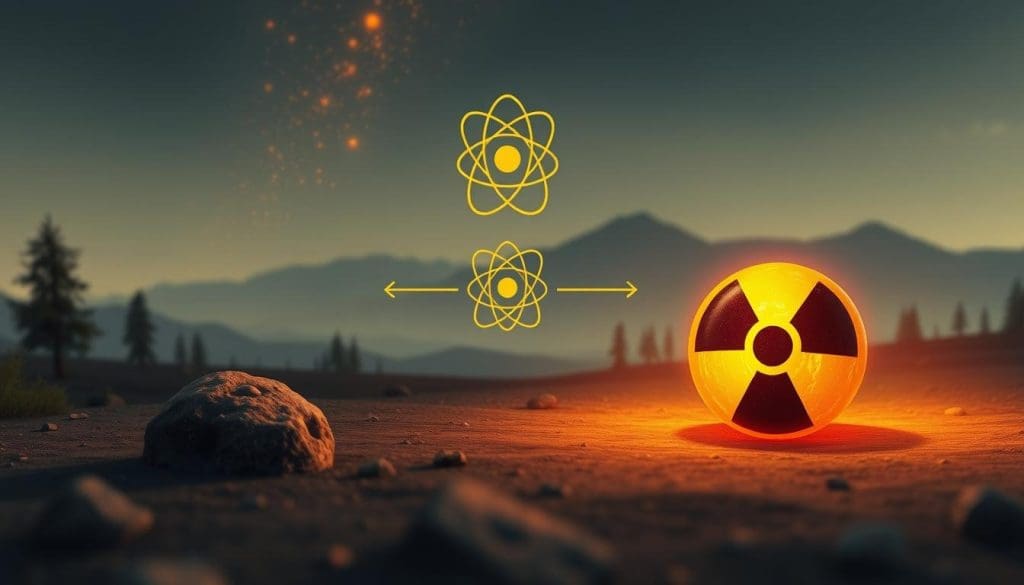
At Liv Hospital, we understand the importance of half life radiation. It helps improve medical treatments, keeps our environment safe, and aids in scientific dating. The concept of half life radiation is key in nuclear science, helping us understand how radioactive materials decay over time.
The half-life of a radioactive isotope never changes, no matter what happens around it. This makes it very useful in fields like chemistry, geology, and medicine.
We will look into the main facts about half-life radiation. This includes what it is, how to calculate it, and how it’s used in different areas. Knowing these facts helps us see how important half-life is in our world.
Key Takeaways
- Understanding half-life radiation is key to better medical treatments and environmental safety.
- The half-life of a radioactive isotope always stays the same, no matter what’s around it.
- Half-life radiation is used in many scientific areas.
- Half-life helps us understand how radioactive materials break down.
- Liv Hospital is dedicated to top-notch healthcare and supports patients from around the world.
The Science of Half-Life Radiation Explained

Half-life is key in nuclear physics. It shows how fast unstable atoms lose their radioactivity. We dive into the science behind it to grasp its full meaning.
What Defines Half-Life in Scientific Terms
Half-life, or t ½, is the time it takes for half of an unstable atom’s atoms to decay. This is vital in nuclear physics. It tells us how stable radioactive materials are. The half-life of a substance doesn’t change, no matter the conditions.
Ernest Rutherford said, “The rate of transformation of an atom is a characteristic property of the atom itself and is not influenced by external conditions.” This shows that half-life is a natural part of radioactive substances.
“The rate of transformation of an atom is a characteristic property of the atom itself and is not influenced by external conditions.” – Ernest Rutherford
The Symbol for Half-Life (t ½) and Its Significance
The symbol t ½ stands for half-life. It shows that after one half-life, a radioactive substance’s activity halves. The formula t ½ = 0.693/λ (where λ is the decay constant) shows this rate. Knowing t ½ is key for many fields, from energy to medicine.
| Substance | Half-Life (t ½) | Decay Constant (λ) |
| Carbon-14 | 5730 years | 0.000121 yearâ» ¹ |
| Uranium-238 | 4.51 billion years | 1.54 × 10â» ¹â° yearâ» ¹ |
Different substances have very different half-lives. They range from seconds to billions of years. This difference is important for understanding their uses and dangers.
Fundamental Principles of Radioactive Decay
Radioactive decay is a key process in nuclear physics. It changes unstable atomic nuclei into more stable ones. This change happens at a rate that depends only on the amount of radioactive substance. It doesn’t change with temperature or pressure.
Radioactive decay is marked by the release of radiation. There are different types of radiation. Knowing about these types helps us understand how decay works.
The Process of Nuclear Transformation
Nuclear transformation happens when an unstable nucleus becomes more stable. This can involve the release of particles like alpha or beta particles. Or, it can release energy as gamma radiation.
The kind of radiation released depends on the nucleus’s instability. For example, alpha decay happens in heavy elements. Beta decay occurs when there’s an imbalance in protons and neutrons.
Different Types of Radiation Emissions
There are three main types of radiation from radioactive decay: alpha, beta, and gamma. Each type interacts with matter in its own way.
| Type of Radiation | Composition | Penetration Power |
| Alpha | Helium nuclei | Low |
| Beta | Electrons or positrons | Moderate |
| Gamma | High-energy photons | High |
The half-life of a radioactive substance is linked to its decay constant. The decay constant shows how fast the substance decays. Knowing this relationship is key in nuclear science and technology.
Understanding radioactive decay helps us see why chemical half-lives vary so much. They can last from milliseconds to billions of years. This knowledge is important in many fields.
The Half-Life Formula and Its Mathematical Foundation
Understanding the half-life formula is key to learning about radioactive decay. It shows how fast radioactive atoms break down. This idea is very important in nuclear physics and chemistry.
The formula for half-life comes from a special rule for first-order reactions. It is t1/2 = 0.693/λ, where λ is the decay constant. The decay constant tells us how fast a radioactive substance decays.
Breaking Down t ½ = 0.693/λ
The formula t1/2 = 0.693/λ shows that half-life and decay constant are opposites. If a substance decays fast, its half-life is short. If it decays slowly, its half-life is long.
- The decay constant (λ) is a key feature of each radioactive element.
- The half-life (t1/2) helps identify specific radioactive isotopes.
Half-Life and Decay Constant Relationship
The link between half-life and decay constant is very important. Knowing one lets us figure out the other. This connection is vital in many areas, like nuclear medicine, dating, and energy.
In nuclear medicine, knowing a radiopharmaceutical’s half-life is very important. It tells us how long it stays active in the body. This affects its usefulness and safety.
In conclusion, the half-life formula and its math are essential for understanding radioactive decay. By understanding the half-life and decay constant relationship, we can see how radioactive substances are used in many fields.
Understanding Half Lives Chemistry: From Theory to Practice
Studying half-lives in chemistry shows us how radioactive decay works and its uses. It’s key for both learning and doing chemistry.
Chemical Reactions and Decay Rates
Chemical reactions with radioactive isotopes can change how fast they decay. Even though radioactive decay rates usually stay the same, some reactions can make isotopes more stable. We look at how these changes affect different isotopes’ half-lives.
For example, the decay rate of an isotope can be changed by its chemical surroundings. This is very important in nuclear chemistry. Knowing how chemical reactions and radioactive decay work together is vital.
Laboratory Methods for Half-Life Determination
To find a radioactive isotope’s half-life in a lab, we use several exact methods. We use different techniques to measure how fast isotopes decay accurately.
- Scintillation Counting: This method uses a scintillation counter to measure radiation from a sample.
- Gamma-Ray Spectrometry: By looking at a sample’s gamma-ray spectrum, we can find out which isotopes are there and how active they are.
- Mass Spectrometry: This technique helps us measure a sample’s isotopic makeup. It lets us figure out half-lives for some isotopes.
These lab methods are very important. They help us understand the half-lives of different isotopes. This knowledge is very useful in nuclear medicine, environmental monitoring, and nuclear energy.
The Remarkable Range of Half-Life Durations
Isotopes have half-lives that vary greatly, from very short to very long. This range is key in radioactive decay. It affects many areas of science and use.
Extremely Short Half-Lives: Milliseconds to Minutes
Some isotopes decay quickly, in milliseconds to minutes. Here are a few examples:
- Radon-220: It decays in about 55 seconds. It’s used in medical and nuclear physics research.
- Polonium-214: This isotope decays in about 164 microseconds. It’s used in nuclear applications.
Moderate Half-Lives: Days to Years
Many isotopes have half-lives between days and years. Here are a few:
- Phosphorus-32: It’s used in medical research and treatment. Its half-life is about 14.29 days.
- Cesium-137: It has a half-life of about 30.2 years. It’s used in various industrial and medical fields.
Extremely Long Half-Lives: Thousands to Billions of Years
Some isotopes last for thousands to billions of years. Here are a few:
- Uranium-238: It lasts about 4.5 billion years. It’s used in nuclear reactors and for dating rocks.
- Carbon-14: Its half-life is about 5,730 years. It’s key for dating in archaeology.
The wide range of half-lives shows how complex radioactive decay is. Knowing these differences is vital for nuclear science, medicine, and geology.
Half-Life in Nuclear Science and Energy Applications
Nuclear energy uses the half-life concept for reactor design and fuel management. Knowing the half-life of isotopes in nuclear reactors is key. It helps ensure safe and efficient nuclear energy generation.
Nuclear Reactor Design Considerations
Designing a nuclear reactor involves the half-life of fuel isotopes. Isotopes with shorter half-lives decay faster, releasing energy quickly. Those with longer half-lives provide steady energy release. The goal is to balance these for optimal performance and safety.
When designing a reactor, we look at several factors. These include the fuel type, cooling system, and construction materials. The half-life of the fuel isotopes impacts these, affecting power output and radiation safety.
Fuel Rod Management and Safety Protocols
Managing fuel rods safely is vital for a nuclear reactor’s operation. Fuel rods contain the material that undergoes fission, releasing energy. The half-life of these isotopes determines their radioactivity and heat output.
We follow strict safety protocols for fuel rod handling and storage. These are to reduce radiation exposure and prevent environmental harm.
| Isotope | Half-Life | Application in Nuclear Energy |
| Uranium-235 | 703.8 million years | Primary fuel for most nuclear reactors |
| Plutonium-239 | 24,100 years | Used in some reactor types and nuclear weapons |
| Iodine-131 | 8 days | Radioactive waste product; requires careful handling |
Understanding and managing isotopes’ half-life in nuclear energy is essential. It ensures safe and efficient reactor operation. This minimizes risks to human health and the environment.
Geology Half-Life Applications: Dating the Earth’s History
Half-life in geology has changed how we see the Earth’s past. It lets us know the age of rocks, fossils, and samples. This helps us understand the Earth’s history and how it evolved.
Radiometric Dating Techniques
Radiometric dating is a way to figure out the age of rocks and minerals. It compares the amount of a radioactive isotope to its decay products. Isotopes like uranium-238, uranium-235, and thorium-232 are used for this.
There are several radiometric dating methods:
- Uranium-Lead Dating: For rocks that are millions to billions of years old.
- Potassium-Argon Dating: For rocks that are thousands to millions of years old.
- Rubidium-Strontium Dating: For rocks that are millions to billions of years old.
Carbon-14 Dating for Organic Materials
Carbon-14 dating is used for organic materials. It’s based on carbon-14’s half-life, about 5,730 years. Carbon-14 dating helps archaeologists and geologists date recent events.
This method measures carbon-14 in a sample. It compares this to carbon-12 to find the sample’s age. But, it only works for samples up to 50,000 years old.
Uranium-Lead Dating for Ancient Rocks
Uranium-lead dating is great for ancient rocks. It looks at the lead-207 to uranium-235 and lead-206 to uranium-238 ratios. This method is perfect for rocks that are millions to billions of years old.
The uranium-lead dating method uses two decay chains. It compares the isotopes to find the rock’s age with great accuracy.
Medical Applications of Half-Life Radiation
Half-life radiation is key in medicine, from imaging to treating cancer. It has changed how we diagnose and treat diseases. This has made healthcare better and more precise.
Diagnostic Imaging with Radioisotopes
Modern medicine relies on imaging to see inside the body. Radioisotopes, with their unique half-lives, help in scans like PET and SPECT. These scans are vital for accurate diagnoses.
Technetium-99m is a common radioisotope used in these scans. It has a half-life of about 6 hours. This short half-life keeps radiation exposure low for patients.
- Benefits of Radioisotopes in Diagnostic Imaging:
- They are very sensitive and specific for disease diagnosis.
- They offer insights into the body’s functions.
- These scans are non-invasive.
Radiation Therapy for Cancer Treatment
Radiation therapy is a common cancer treatment. It uses high-energy radiation to kill or slow cancer cells. The choice of radioisotope depends on the cancer type and half-life.
Iodine-131 is used for thyroid cancer. It targets thyroid tissue, reducing harm to healthy tissues.
- Types of Radiation Therapy:
- External beam radiation therapy
- Internal radiation therapy (brachytherapy)
- Systemic radiation therapy
Pharmaceutical Drug Half-Lives and Metabolism
Knowing a drug’s half-life is vital for its safety and effectiveness. The half-life affects how often a drug is given and its side effects.
Drugs with short half-lives need more frequent doses. Those with longer half-lives can be given less often. This helps in creating effective treatment plans and reducing side effects.
Healthcare professionals use half-life to improve drug therapy. Understanding drug metabolism helps us give better care and advice to patients.
Environmental Implications of Radioactive Half-Lives
Understanding the environmental effects of radioactive half-lives is key when dealing with nuclear energy. Knowing how long radioactive isotopes last helps us store nuclear waste and monitor the environment.
Nuclear Waste Storage Challenges
Nuclear power plants create radioactive waste, like spent fuel rods. Storing this waste safely is a big challenge. To avoid pollution, deep underground storage sites are being built.
Environmental Monitoring Systems
Good environmental monitoring systems are vital. They help us find and manage radioactive pollution. This way, we can act fast if there’s a problem.
| Isotope | Half-Life | Environmental Impact |
| Carbon-14 | 5,730 years | Used in dating organic materials; relatively low impact due to its relatively short half-life. |
| Uranium-238 | 4.5 billion years | Long half-life poses significant long-term storage challenges. |
| Cesium-137 | 30.2 years | Significant contributor to radioactivity in nuclear fallout; requires careful monitoring. |
Half-Life in Mathematics: Beyond Chemistry and Physics
Half-life is often linked to radioactive decay. But its math goes far beyond chemistry and physics. We’ll see how half-life is used in different areas of study.
Exponential Decay Models in Various Fields
Exponential decay models are key to understanding half-life. They’re used in many fields, not just nuclear science. These models show how something decreases over time, following a specific curve.
In finance, these models help figure out how much something is worth over time. For example, a piece of equipment might lose value by a certain percentage each year.
The Math Half-Life Formula in Economic Applications
The half-life formula, t ½ = 0.693/λ, is also used in economics. Here, λ is the decay constant. For instance, in marketing, it helps measure how long an ad campaign stays effective.
This idea is also applied to how fast people lose interest in a product. By studying this, businesses can tweak their marketing plans.
Key economic applications of half-life concepts include:
- Predicting the shelf life of products
- Modeling the decline of natural resources
- Understanding the depreciation of assets
By seeing how half-life applies in many areas, we can make better choices in different fields.
Common Misconceptions About Half-Life Radiation Decay
Misconceptions about half-life radiation decay are common. They come from how popular media often gets it wrong. We see radiation shown as a mysterious, dangerous force without understanding its risks.
Let’s look at some of these myths and the real facts. The media loves to make radiation stories scary. They focus on the worst parts, not the whole picture.
Debunking Popular Media Portrayals
Popular media spreads false ideas about radiation. For example, they say all radiation is dangerous right away. Butdifferent isotopes have different half-lives and radiation levels.
Radiation isn’t always bad; it can be useful t,oo. Medical tools like X-rays and PET scans use radiation to help patients. They use safe amounts to help diagnose and treat diseases.
Clarifying Public Understanding of Radiation Risks
It’s important to know the real risks of radiation. We must tell the difference between low and high exposure levels. Low levels might not be a big deal, but high levels can be harmful.
Managing radiation risks means knowing the isotope, its half-life, and what kind of radiation it is. With this info, we can take the right steps to stay safe.
By teaching people about half-life radiation decay, we can have better talks about radiation. This helps us understand its impact on our health and the environment.
Conclusion: The Continuing Importance of Half-Life in Science and Society
Half-life is key in many scientific fields and everyday life. It helps us move science forward and meet society’s needs. This includes nuclear energy, medicine, environmental monitoring, and dating rocks.
The half-life equation is vital for understanding how radioactive isotopes work. It’s used in carbon dating and in medicine to treat diseases. Half-life shows us how to use these materials safely and effectively.
In science, half-life is essential in nuclear physics, chemistry, and medicine. In society, it guides rules for handling nuclear waste and safety in radiation therapy. By studying half-life, we can tackle the challenges of radioactive materials. This leads to new solutions that help society.
FAQ
What is half-life in chemistry?
Half-life in chemistry is the time it takes for half of a radioactive isotope’s atoms to decay.
What is the symbol for half-life?
The symbol for half-life is t ½.
What is the formula for calculating half-life?
To find half-life, use the formula t ½ = 0.693/λ. Here, λ is the decay constant.
How does half-life relate to radioactive decay?
Half-life shows how fast radioactive decay happens. Shorter half-lives mean faster decay.
What are the different types of radiation emissions during radioactive decay?
During radioactive decay, there are three main types of radiation: alpha, beta, and gamma.
How is half-life used in nuclear science and energy applications?
In nuclear science and energy, half-life helps check the safety and efficiency of reactors and fuel rods.
What is the significance of half-life in geology?
In geology, half-life helps figure out the age of rocks and minerals through dating methods like carbon-14 and uranium-lead.
How is half-life used in medical applications?
In medicine, half-life aids in imaging, cancer treatment, and studying drug metabolism.
What are the environmental implications of radioactive half-lives?
Radioactive half-lives pose challenges for nuclear waste storage and highlight the need for environmental monitoring.
How is half-life used in mathematics beyond chemistry and physics?
Beyond chemistry and physics, half-life is used in math to model decay in economics and other fields.
What are some common misconceptions about half-life radiation decay?
Misconceptions about half-life include overestimating radiation risks in mthe edia. Real risks are less severe.
Why is understanding half-life important?
Knowing half-life is key because it affects many areas like nuclear science, chemistry, geology, medicine, and the environment.
References
- Najam, H. (2023). Nuclear Medicine Instrumentation. In StatPearls. StatPearls Publishing. https://www.ncbi.nlm.nih.gov/books/NBK597384/



 Departments
 Related Videos
 Our Doctors
 News
News