
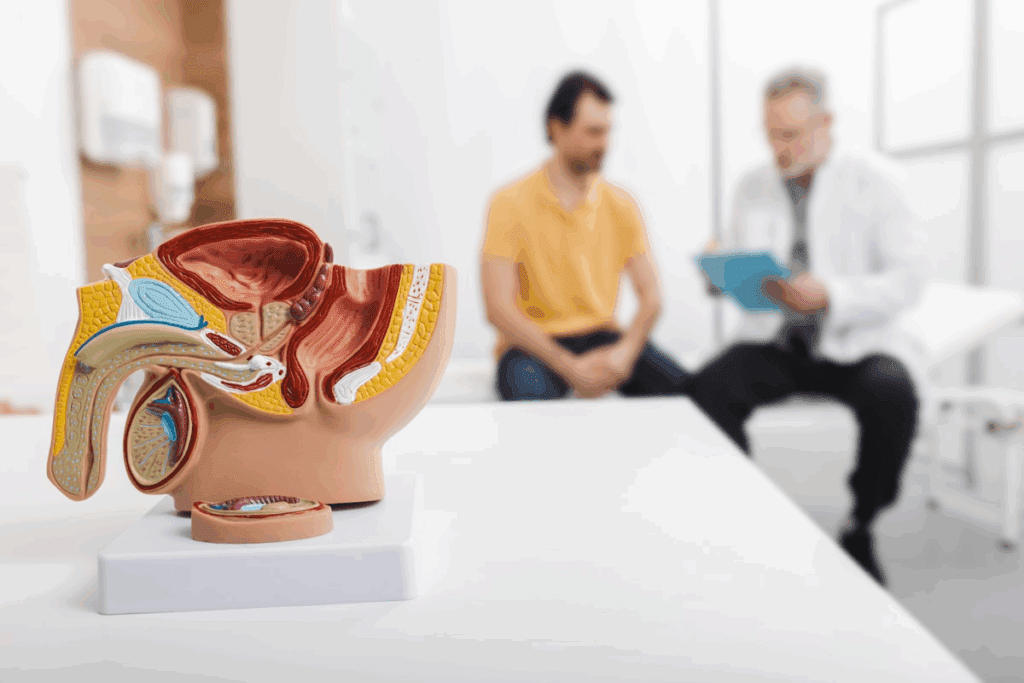
Understanding Enlarged Prostate
An enlarged prostate, or benign prostatic hyperplasia (BPH), is common in older men. It happens when the prostate gland gets bigger, leading to urinary issues. To diagnose BPH, doctors look at medical history, do physical exams, and run tests.Wondering how do you check for an enlarged prostate? We explain the exams and tests, and clarify if cystoscopy can detect prostate cancer.
Cystoscopy is a key test that lets doctors see inside the bladder and urethra. Knowing about enlarged prostate symptoms helps men get the right care. This can greatly improve their life quality.
Understanding Prostate Enlargement: Causes and Symptoms

Understanding Prostate Enlargement
Prostate enlargement, or benign prostatic hyperplasia (BPH), is common in older men. It makes the prostate gland grow, leading to urinary problems.
Causes and Symptoms
The exact cause of an enlarged prostate isn’t known. But, it’s thought to be linked to hormonal changes with age. Symptoms include weak urine flow, needing to urinate often, and trouble starting or stopping urination.
Importance of Medical Attention
If you have symptoms of an enlarged prostate, see a doctor. They can diagnose and suggest treatments.
Managing Prostate Enlargement
It’s important to understand and manage prostate enlargement to keep quality of life good. Recognizing causes and symptoms helps get medical help early. This improves overall health.
The Importance of Early Detection for Prostate Health
Early detection is key to keeping the prostate healthy. Regular screenings can spot problems early. This is very important for men, and even more so if they have a family history of prostate issues.
By getting regular checks, men can catch problems early. This means better treatment options and less risk of serious damage later on.
In short, regular screenings are vital for prostate health. Men can take charge of their health by getting checked regularly. This helps prevent serious problems related to prostate issues.
How Do You Check for an Enlarged Prostate: Initial Diagnostic Steps

Checking for an enlarged prostate starts with a detailed medical history and physical exam. A digital rectal examination (DRE) is a key tool. It helps check the prostate’s size and feel.
A healthcare professional will use a gloved, lubricated finger in the rectum for the DRE. This helps find any prostate issues.
A prostate-specific antigen (PSA) test might also be done. It checks PSA levels in the blood. High levels could mean prostate problems, like an enlarged prostate.
Seeing a doctor early is vital for treatment. Symptoms like hard time urinating, needing to pee a lot, or pain while urinating need attention. A healthcare professional can help diagnose and treat these issues.
Knowing how to detect prostate problems early is important. It helps men take care of their prostate health.
Laboratory Tests for Prostate Evaluation
Laboratory tests are key in checking prostate health. They help find out if the prostate is enlarged or if there are other issues.
Prostate-Specific Antigen (PSA) Testing
The Prostate-Specific Antigen (PSA) test is a main test for prostate health. It checks the PSA protein in your blood. High levels might mean cancer, prostatitis, or BPH.
PSA levels are categorized as follows:
| PSA Level (ng/mL) | Interpretation |
| 0-4 | Generally considered normal |
| 4-10 | Borderline; may indicate BPH or cancer |
| >10 | High; may indicate cancer |
Urinalysis and Other Blood Tests
Urinalysis and blood tests are also used to check prostate health. Urinalysis can spot urinary tract infections or other issues.
Other blood tests may include:
- Complete Blood Count (CBC) to rule out infection
- Blood urea nitrogen (BUN) and creatinine tests to assess kidney function
Interpreting Your Test Results
Healthcare professionals are needed to understand test results. They look at your PSA level, urinalysis, and other factors. This helps decide what to do next.
Knowing your test results is important for your prostate health. Your doctor will talk about what your results mean. They will suggest more tests or treatment if needed.
Functional Tests to Assess Prostate Enlargement
Diagnosing and managing prostate enlargement needs a detailed approach. This includes a thorough medical history, physical exam, and diagnostic tests. Understanding the condition helps healthcare providers create effective treatment plans. These plans aim to improve symptoms and enhance quality of life.
FAQ
Q: What is an enlarged prostate?
An enlarged prostate, also known as benign prostatic hyperplasia (BPH), is when the prostate gland gets bigger. This can cause urinary symptoms.
Q: What are the symptoms of an enlarged prostate?
Symptoms include trouble starting to urinate, weak or interrupted flow, and needing to urinate often. You might also wake up a lot at night to go to the bathroom.
Q: How is an enlarged prostate diagnosed?
To diagnose, doctors look at your medical history and do a physical exam. They might also do tests like PSA testing, DRE, and urinalysis.
Q: What is the role of cystoscopy in diagnosing prostate issues?
Cystoscopy is a procedure where a flexible tube with a camera is inserted into the urethra. It lets doctors see inside the bladder and prostate. It helps find issues like an enlarged prostate or bladder stones.
Q: Can an enlarged prostate be treated?
Yes, there are treatments available. These include making lifestyle changes, taking medications, or surgery. The choice depends on how bad your symptoms are and your overall health.
Q: How can I reduce my risk of developing prostate issues?
Keeping a healthy lifestyle can help. This includes eating well, exercising regularly, and not smoking. These habits can lower your risk of prostate problems
References
National Center for Biotechnology Information. (2025). How Do You Check for an Enlarged ProstateAnd. Retrieved from https://www.ncbi.nlm.nih.gov/pmc/articles/PMC3066667/