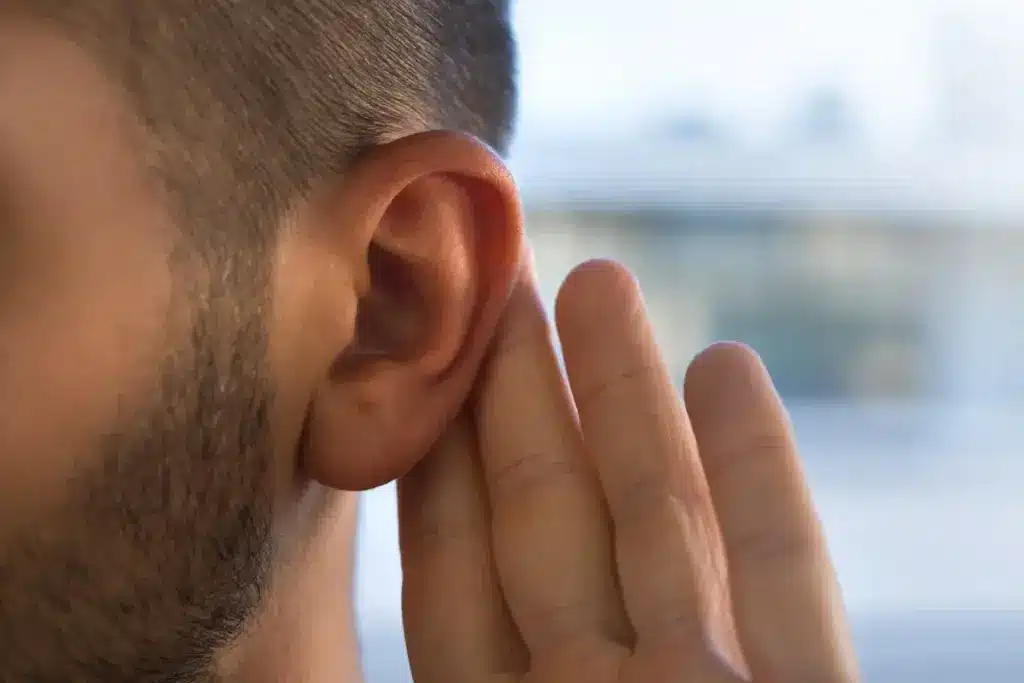
The human hearing mechanism is a complex process. It turns sound waves into electrical signals. Our brain then interprets these signals as sound we can recognize.
The ear has three main parts: the outer ear, middle ear, and inner ear. Each part has a key role in this process.
We will look at how sound waves move through these parts. They are then understood by the brain. This lets us hear and react to our surroundings.
Key Takeaways
- The ear is divided into three main sections: outer ear, middle ear, and inner ear.
- Sound waves are caught by the outer ear and directed into the ear canal.
- The middle ear amplifies these vibrations using three tiny bones.
- The inner ear converts the amplified vibrations into electrical signals.
- The auditory nerve carries these signals to the brain for interpretation.
Understanding the Eardrum Diagram and Outer Ear Function

The outer ear, made up of the visible pinna and the ear canal, is key to hearing. The pinna catches sound waves and sends them into the ear canal. As we look at the anatomy of the ear, it’s important to see how these waves are processed.
How Sound Waves Enter and Travel Through the Ear Canal
Sound waves come into the ear through the outer ear and move down the ear canal. The canal has tiny hairs and cerumen (earwax) to protect it. Earwax traps dust, bacteria, and other small particles. When sound waves hit the end of the ear canal, they make the eardrum vibrate.
The Eardrum’s Vibration Response to Different Sounds
The eardrum’s vibration is key to hearing different sounds. When sound waves make the eardrum vibrate, these vibrations go through the middle ear bones (ossicles) to the inner ear. This lets us hear various sounds, from low rumbles to high-pitched tones.
Learning about the eardrum diagram and outer ear function helps us understand hearing better. It shows how sound waves are caught and processed. This knowledge highlights the importance of ear health and how we connect with sound.
The Middle and Inner Ear: Converting Vibrations to Electrical Signals

When sound waves reach the eardrum, the middle ear amplifies these vibrations. This step is key to our hearing ability. The middle ear has three tiny bones called ossicles. They play a big role in sending sound vibrations to the inner ear.
The Three Ossicles: Malleus, Incus, and Stapes
The ossicles, made up of the malleus, incus, and stapes, work together to boost the vibrations from the eardrum. The malleus is connected to the eardrum. When it vibrates, it moves the malleus.
This movement is then passed to the incus and then to the stapes. The stapes is linked to the oval window of the inner ear. It sends these vibrations to the inner ear, where they become electrical signals.
The amplification process is critical because it makes sure the sound is strong enough for the brain to interpret. Without this boost, the sound would be too weak to hear.
Fluid Movement in the Cochlea and Basilar Membrane
In the inner ear, the cochlea turns these vibrations into electrical signals. The cochlea is filled with fluid. When the stapes sends vibrations to the oval window, it makes the fluid move.
This movement creates waves along the basilar membrane, a flexible part of the cochlea.
The basilar membrane has hair cells on it. These hair cells are moved by the fluid waves. As the basilar membrane vibrates, it bends the hair cells, sending neural signals.
How Stereocilia and Hair Cells Generate Neural Signals
The hair cells in the cochlea have stereocilia on their surface. When the basilar membrane vibrates, it bends the stereocilia. This bending sends a chemical signal to the auditory nerve, creating neural signals.
These neural signals go to the brain, where they are understood as sound. This complex process lets us hear a wide range of sounds, from soft whispers to loud noises.
| Structure | Function |
| Malleus, Incus, Stapes | Amplify vibrations from the eardrum |
| Cochlea | Converts vibrations into electrical signals |
| Basilar Membrane | Contains hair cells that generate neural signals |
| Hair Cells | Generate neural signals in response to vibration |
Conclusion: The Brain’s Role in Sound Interpretation
The journey of sound from its source to our brain is complex. It lets us understand and react to our surroundings. Sound travels through the ear, turns into electrical signals, and then the brain interprets it. The central auditory pathway is key in this process, helping us hear and make sense of the world.
The hearing brain processes these electrical signals. They go from the auditory nerve to the brain stem and then to the temporal lobe. There, they become recognizable sounds. This shows how sound travels and is processed, highlighting the brain’s role in hearing.
The path of sound is amazing, involving many parts of the ear and brain. Knowing how we hear sound helps us value the human auditory system. It also shows why protecting our hearing is so important.
FAQ
How do sound waves enter the ear?
Sound waves enter the ear through the auricle and travel down the external auditory canal to the eardrum.
What is the role of the eardrum in hearing?
The eardrum vibrates in response to sound waves, transmitting these vibrations to the middle ear bones.
How do the ossicles contribute to our ability to hear?
The ossicles amplify and transfer vibrations from the eardrum to the inner ear.
What happens to the vibrations in the inner ear?
Vibrations in the cochlea create fluid movement that stimulates hair cells.
How do stereocilia and hair cells generate neural signals?
Hair cells bend in response to fluid movement, converting mechanical vibrations into electrical signals for the auditory nerve.
What is the path of sound through the ear to the brain?
Sound travels from the cochlea via the auditory nerve to the brainstem and then to the auditory cortex.
How does the brain interpret sound?
The brain processes electrical signals from the auditory nerve to perceive pitch, volume, and location of sound.
What is the importance of the auditory pathway?
The auditory pathway ensures sound signals are accurately transmitted and interpreted, enabling hearing and balance functions.
References
National Institutes of Health. Evidence-Based Medical Insight. Retrieved from https://www.nidcd.nih.gov/health/how-do-we-hear[6