


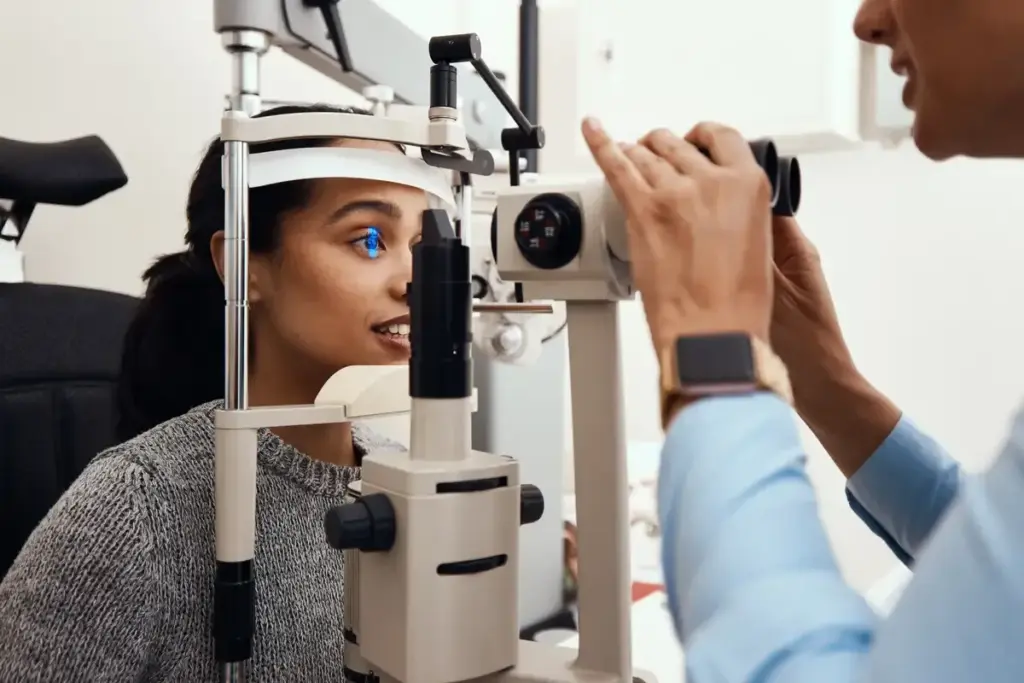
Those mysterious numbers and abbreviations on your vision report no longer need to feel like a puzzle. We believe clear information is key for making informed health decisions. At Liv Hospital, we empower patients by making medical findings easy to understand.
Our team offers preventive and curative healthcare services at the highest global standards. We aim to provide wisdom and care, helping you navigate your health journey with confidence. Knowing your vision metrics is the first step to clear vision for life.
This guide simplifies the technical measurements from your visit. You’ll learn to spot common metrics and understand prescription notations easily. Having your eye exam results explained empowers you to manage your health better.
Key Takeaways
- Identify standard symbols found on vision prescriptions.
- Recognize what specific clinical metrics reveal about wellness.
- Gain confidence in discussing findings with your doctor.
- Learn which readings require immediate professional focus.
- Support your long-term health through proactive education.
- Access world-class standards for vision care interpretation.
Understanding the Basics of Your Prescription

Your eye exam prescription is key to knowing how to fix your vision. It’s filled with abbreviations and numbers that tell you what you need. Each part of your prescription is important for your vision correction.
Decoding Abbreviations: OD, OS, and OU
First, learn the eye abbreviations. OD means Oculus Dexter, or “right eye.” OS is Oculus Sinister, or “left eye.” OU (Oculus Uterque) means both eyes.
Knowing these abbreviations is key. Your prescription will list each eye’s needs separately. This is because each eye might need different corrections.
Breaking Down the Numbers: SPH, CYL, and Axis
Your prescription has numbers for different vision corrections. The main parts are SPH (Sphere), CYL (Cylinder), and Axis.
- SPH shows the lens power for nearsightedness or farsightedness, in diopters (D).
- CYL is for astigmatism correction, also in diopters.
- Axis tells where the astigmatism correction goes, in degrees.
| Abbreviation | Meaning | What it Corrects |
| SPH | Sphere | Near- or farsightedness |
| CYL | Cylinder | Astigmatism |
| Axis | Axis | Orientation of astigmatism correction |
For instance, a SPH of -2.00 for your right eye (OD) means you’re nearsighted by 2 diopters. If the CYL is -1.00 with an Axis of 90 degrees, it means you have astigmatism. The Axis tells where the corrective lens should go.
How to Interpret Eye Exam Results for Common Conditions
[Add image here]
Eye exam results give you important info about your vision and eye health. Learning to understand them is key to caring for your eyes. When you get your results, you’ll know more about your eye health and what corrections you might need.
Identifying Refractive Errors
Refractive errors happen when your eye doesn’t bend light right, causing blurry vision. Common ones are myopia (nearsightedness), hyperopia (farsightedness), and astigmatism. Your exam results will show if you have any and how severe they are.
Myopia shows as a minus (-) in your prescription, meaning you see near things better. Hyperopia has a plus (+) sign, showing you see far things better. Astigmatism is shown by a cylindrical (CYL) value and an axis number, which tells where the astigmatism is.
| Condition | Prescription Indicator | Description |
| Myopia (Nearsightedness) | – (minus sign) | Difficulty seeing distant objects clearly |
| Hyperopia (Farsightedness) | + (plus sign) | Difficulty seeing close objects clearly |
| Astigmatism | CYL value and Axis | Blurred vision at all distances due to irregular corneal shape |
Reading Visual Acuity Scores
Visual acuity numbers show how well you can see at different distances. The 20/20 score is normal vision. For example, a 20/40 score means you see things at 20 feet that a normal person sees at 40 feet.
Knowing your visual acuity score helps you understand your vision problems. A score of 20/200 or worse in both eyes is legal blindness. Regular eye exams help track any changes in your vision.
Recognizing Notes on Eye Health and Pressure
Intraocular pressure (IOP) is key for spotting eye conditions like glaucoma. Your doctor uses a tonometer to measure IOP in millimeters of mercury (mmHg). Normal IOP is between 10-21 mmHg, but it can vary.
Your eye health notes might talk about your retina, cornea, and other parts of your eye. Any issues or concerns are usually noted, along with advice for more tests or treatment if needed.
Conclusion
Your eye exam results give you important insights into your vision health. Learning how to read these results helps you understand your vision better. This way, you can take steps to keep your vision sharp.
We showed you how to interpret your vision exam results. You now know what OD, OS, and OU mean. You also understand SPH, CYL, and Axis numbers. This knowledge helps you make smart choices about your eye care.
We suggest asking questions during your appointments. Keep records of your eye check results. Also, watch for any vision changes between visits. This way, you’ll be more involved in your eye care journey. You’ll get the best support for your vision health.
At our institution, we aim to provide top-notch healthcare with full support. By understanding your eye exam results, you can work with your healthcare provider. Together, you can keep your vision at its best.
FAQ
What is the most important part of understanding eye exam results?
The key is knowing your prescription details, eye health indicators, and any conditions that may need monitoring or treatment.
How do I read eye test report abbreviations if I have a complex prescription?
Understand common abbreviations like SPH (sphere), CYL (cylinder), and AX (axis), which describe your lens power and astigmatism correction.
What do my eyesight test results explained by the “20/20” score actually signify?
A 20/20 score means you can see at 20 feet what a person with normal vision can see at 20 feet. Lower scores indicate reduced visual acuity.
Why are eye screening results regarding pressure important during a routine checkup?
Eye pressure readings help detect glaucoma early, which can damage vision without obvious symptoms.
How to interpret eye exam results that mention astigmatism?
Astigmatism is indicated by cylinder (CYL) and axis (AX) values; higher numbers mean more curvature irregularity in the cornea.
Can I use old eye exam test results to order new glasses?
Old results may not reflect current vision, so it’s best to have an updated eye exam before ordering new glasses.
References
National Center for Biotechnology Information. Evidence-Based Medical Insight. Retrieved from https://pubmed.ncbi.nlm.nih.gov/26875007/


 Departments
 Related Videos
 Our Doctors
 News
News


