
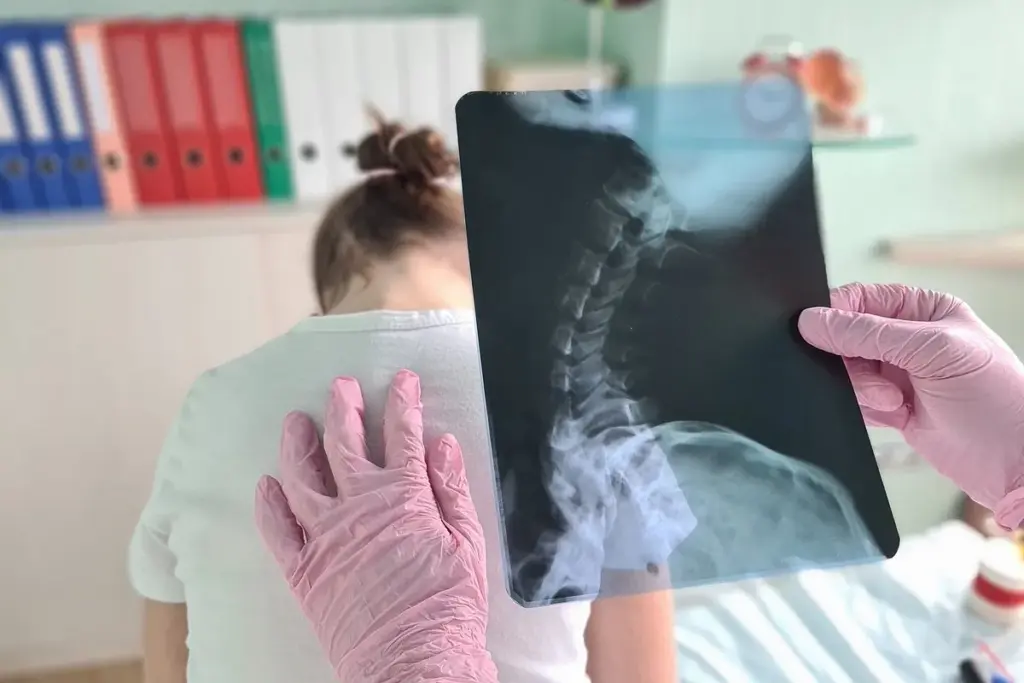
Learning to read ankylosing spondylitis X-ray results is key for early diagnosis and tracking the disease. Ankylosing spondylitis is a chronic condition that affects the spine, leading to stiffness and chronic back pain.
At Liv Hospital, we stress the need to understand X-ray findings. These images help spot changes in the spine and sacroiliac joints. By looking at these images, doctors can see signs of the disease that grow over time. This allows for early diagnosis and treatment.
Key Takeaways
- Understanding X-ray results is essential for diagnosing ankylosing spondylitis.
- X-rays help detect structural changes in the spine and sacroiliac joints.
- Early diagnosis enables timely treatment and effective disease monitoring.
- Liv Hospital provides expert diagnosis and multidisciplinary healthcare.
- Accurate interpretation of X-ray findings is critical for patient care.
Understanding Ankylosing Spondylitis and Diagnostic Imaging

To understand ankylosing spondylitis diagnosis, we must first know what the disease is. It’s a chronic condition that mainly affects the spine. Other joints can also get involved. It causes inflammation in the spinal joints, leading to severe pain and discomfort.
What Is Ankylosing Spondylitis?
Ankylosing spondylitis (AS) is a type of arthritis. It belongs to a group called spondyloarthritis. Over time, it can cause the vertebrae to fuse, leading to a loss of spinal mobility. The exact cause is unknown but is thought to be a mix of genetics and environment. Early diagnosis is key to manage symptoms and prevent damage.
Symptoms of AS vary among patients. Common ones include lower back pain and stiffness, worse after rest. As the disease progresses, it can cause a stooped posture and reduced mobility. Knowing these symptoms helps in seeking the right tests, like X-rays.
Why X-rays Are the Gold Standard for Diagnosis
X-rays are the top choice for diagnosing and monitoring AS. They’re great for seeing the spine and sacroiliac joints, where AS often shows up. X-rays can show the changes AS causes, like syndesmophytes and sacroiliitis.
X-rays are good for showing bony changes and disease progression. This info helps doctors assess the disease’s severity and treatment success. Conventional radiography is used to spot structural changes like erosions and sclerosis in the sacroiliac joints.
Limitations of Radiographic Detection
While X-rays are great for AS diagnosis, they have limits. They struggle to detect early sacroiliitis and small changes in the spine. In the early stages, X-rays might not show much, making diagnosis hard. They also miss soft tissue involvement, like inflammation.
Experts say X-rays can’t catch early inflammatory changes and soft tissue issues well. So, X-rays are used with other imaging like MRI for a full disease assessment.
In summary, understanding AS and its diagnosis through X-rays is complex. It involves knowing both the strengths and weaknesses of radiographic imaging. By combining X-ray results with clinical evaluation, doctors can make better diagnoses and treatment plans.
How to Interpret Ankylosing Spondylitis X-Ray Findings

Understanding ankylosing spondylitis X-ray findings is key. We look at how the disease affects the sacroiliac joints and spine. Specific changes on X-rays show if the disease is present and how it’s progressing.
Examining Sacroiliac Joint Involvement
The sacroiliac joints are often the first to show signs of ankylosing spondylitis. We see subchondral sclerosis and erosions early on. These can lead to the joints narrowing and eventually fusing together.
- Sacroiliac Joint Changes:Sclerosis and erosions
- Joint space narrowing
- Ankylosis
Identifying Spinal Manifestations
Ankylosing spondylitis also affects the spine, causing specific changes. Early signs include squaring of vertebral bodies and Romanus lesions or shiny corner signs. As the disease gets worse, we see syndesmophytes and bamboo spine formation.
- Early Spinal Changes:Squaring of vertebral bodies
- Romanus lesions or shiny corner signs
- Late Spinal Changes:Syndesmophytes formation
- Bamboo spine
Knowing how to read these X-ray findings is vital. It helps doctors diagnose and manage ankylosing spondylitis. By spotting these changes, they can see how severe the disease is and track its progress.
Recognizing Early vs. Late Stage Ankylosing Spondylitis X-Ray Results
It’s key to know the differences in early and late-stage ankylosing spondylitis on X-rays for better care. We can track how this condition progresses with X-ray images. This is very important.
Early Radiographic Indicators
In the early stages, X-rays might show only slight signs. We look for sacroiliitis, which is inflammation in the sacroiliac joints. This can appear as widened or narrowed joints, or even erosions or sclerosis on X-rays.
A study in a well-known medical journal says early sacroiliitis detection is vital for quick treatment.
Other early signs include:
- Sclerosis or erosion of the sacroiliac joints
- Joint space narrowing or widening
- Minimal syndesmophyte formation
Advanced Stage Radiographic Features
At later stages, X-rays show clearer changes. We see ankylosis of spinal facet joints, syndesmophytes, and calcification of ligaments, known as the “dagger sign.”
The modified Stoke Ankylosing Spondylitis Spine Score (mSASSS) helps evaluate how the disease progresses. It looks at erosions, sclerosis, and syndesmophytes in the spine.
| Radiographic Feature | Early Stage | Late Stage |
| Sacroiliitis | Sclerosis or erosion | Ankylosis |
| Syndesmophytes | Minimal formation | Pronounced formation |
| Spinal Mobility | Minimal restriction | Significant restriction |
The table shows how ankylosing spondylitis changes from early to late stages. It’s clear why regular checks are so important.
Knowing these differences helps doctors create better treatment plans. This improves how we manage ankylosing spondylitis.
Conclusion: Beyond X-Rays in Ankylosing Spondylitis Diagnosis
X-rays are key in diagnosing ankylosing spondylitis. They help see the sacroiliac joint and the disease’s progression. But, other imaging methods are also important.
MRI is seen as the best tool for spotting early signs of SpA. It shows inflammation and damage without using radiation. This makes diagnosing ankylosing spondylitis more complete.
Diagnosing ankylosing spondylitis needs a mix of methods. This includes X-rays and other imaging. It helps doctors understand the disease fully.
Using these tools, doctors can create better treatment plans. This improves patients’ lives and outcomes.
FAQ’s:
What are the typical X-ray findings in ankylosing spondylitis?
Typical X-ray findings include sacroiliitis, syndesmophytes, vertebral squaring, and eventual spinal fusion.
How do X-rays help in diagnosing ankylosing spondylitis?
X-rays reveal structural changes in the sacroiliac joints and spine that confirm chronic inflammation and disease progression.
What is the role of sacroiliac joint X-ray in ankylosing spondylitis diagnosis?
Sacroiliac X-rays are crucial for detecting joint erosion, sclerosis, and fusion, which are key diagnostic features of AS.
Can X-rays detect early-stage ankylosing spondylitis?
X-rays often cannot detect early-stage AS because structural changes may not yet be visible.
How do MRI scans complement X-rays in ankylosing spondylitis diagnosis?
MRI can detect early inflammation, bone marrow edema, and soft tissue changes before X-ray-visible structural damage occurs.
What are the limitations of using X-rays for ankylosing spondylitis diagnosis?
X-rays have low sensitivity in early disease, cannot detect soft tissue inflammation, and may miss subtle sacroiliac changes.
How often should X-rays be taken for ankylosing spondylitis monitoring?
X-ray frequency depends on disease severity and progression, typically every 1–3 years, guided by a rheumatologist.
Can CT scans be used as an alternative to X-rays for ankylosing spondylitis diagnosis?
Yes, CT scans provide detailed bone images, but they are less preferred for routine monitoring due to higher radiation exposure.
References:
National Center for Biotechnology Information. Evidence-Based Medical Insight. Retrieved from https://pubmed.ncbi.nlm.nih.gov/17024459/



 Departments
 Related Videos
 Our Doctors
 News
News