


Imagine losing your sight in an instant without any warning or physical pain. This terrifying experience is what medical experts often call a stroke of the eye. We want you to understand how central retinal artery occlusion symptoms manifest so you can save your vision.
This critical condition happens when a sudden blockage stops blood flow to your eye. Every second is vital because the delicate tissue depends on constant oxygen to survive. We view this situation as a major medical emergency that requires a visit to a stroke center.
Most patients feel no physical discomfort when the vision loss occurs. You might notice a dark curtain falling over your sight within seconds. Recognizing crao symptoms early can lead to much better outcomes for your long-term health.
If you experience these signs, please seek professional help immediately. We are here to support your journey toward recovery and specialized care. Quick action remains the most important factor in protecting your ability to see.
Key Takeaways
- Sudden, painless vision loss requires immediate medical evaluation.
- Treat any abrupt sight changes as a vascular emergency.
- Every second counts when restoring blood flow to the eye.
- Transfer to a stroke center provides the best chance for recovery.
- The condition often mimics a dark shadow blocking the field of view.
- Early recognition of symptoms helps prevent permanent damage.
Understanding the Nature of Central Retinal Artery Occlusion

It’s important to know about Central Retinal Artery Occlusion (CRAO) to spot its signs early. CRAO is a serious condition that needs quick action to avoid permanent eye damage.
Defining CRAO and Its Impact on Vision
Central Retinal Artery Occlusion happens when blood flow to the retina is blocked. This can be due to an embolus causing occlusion or thrombus formation, vasculitis, traumatic vessel wall damage, or spasm. This blockage severely hampers the retina’s function, leading to sudden vision loss in one eye without pain.
The central retinal artery supplies blood to the retina’s inner layers. If it gets blocked, it can cause irreversible damage if not treated fast.
CRAO can severely impair vision. It affects the inner retinal layers, causing ischemia and damage to photoreceptors. This damage can be permanent if the blockage isn’t fixed quickly.
Risk Factors and Underlying Health Conditions
Several factors increase the risk of CRAO. These include older age, male gender, smoking, hypertension, obesity, diabetes, hyperlipidemia, cardiovascular disease, and coagulopathy. Knowing these risk factors helps in preventive care and early detection.
| Risk Factor | Description | Association with CRAO |
| Hypertension | High blood pressure | Increases the risk of vascular occlusion |
| Diabetes | Metabolic disorder affecting blood sugar levels | Contributes to vascular disease and occlusion |
| Smoking | Habit of inhaling smoke from burning tobacco | Damages vascular health and increases occlusion risk |
| Cardiovascular Disease | Conditions affecting the heart and blood vessels | Associated with increased risk of emboli and occlusion |
Knowing the risk factors and their link to CRAO helps in early detection and management. People with these risk factors should be aware of CRAO symptoms. They should seek medical help right away if they lose vision suddenly.
Identifying Key Symptoms of Occlusion Retinal Artery
Spotting CRAO symptoms early is key to treating it. We’ll look at the main signs of retinal artery occlusion. These signs can greatly affect your vision.
Sudden Painless Vision Loss
Sudden painless vision loss is a key sign of CRAO. People often notice a sudden drop in their vision. This loss is painless, unlike other eye problems that hurt.
Visual Field Defects and Light Perception
Vision loss can vary in CRAO. Some see nothing in their entire field of vision. Others with BRAO might see only half of it. But, if the cilioretinal artery is spared, vision can stay quite good, even 20/20.
Visual field defects can really change someone’s life. How much of the field is affected depends on the occlusion and the retina area.
| Type of Occlusion | Symptoms | Visual Impact |
| CRAO | Sudden painless vision loss | Severe vision loss across the entire visual field |
| BRAO | Hemifield defect | Partial vision loss, affecting one half of the visual field |
| Cilioretinal Artery Sparing | Variable vision loss | Potential for relatively preserved central vision |
Diagnostic Procedures and Clinical Evaluation
To diagnose Central Retinal Artery Occlusion (CRAO), doctors use many tools and methods. These help them understand the retina’s condition well.
Fundoscopy in CRAO Diagnosis
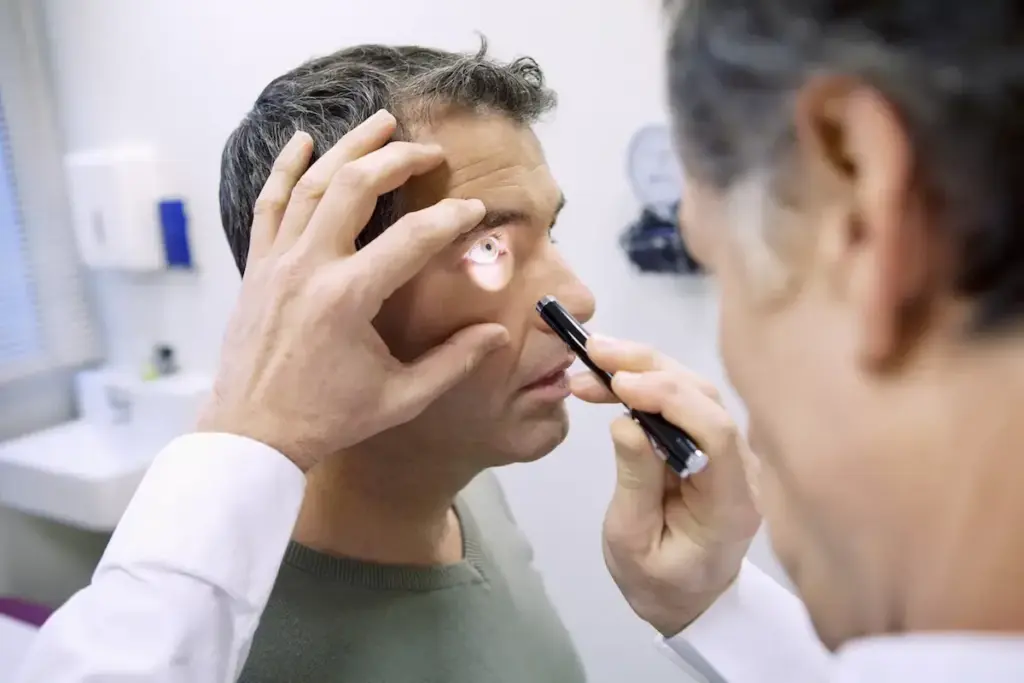
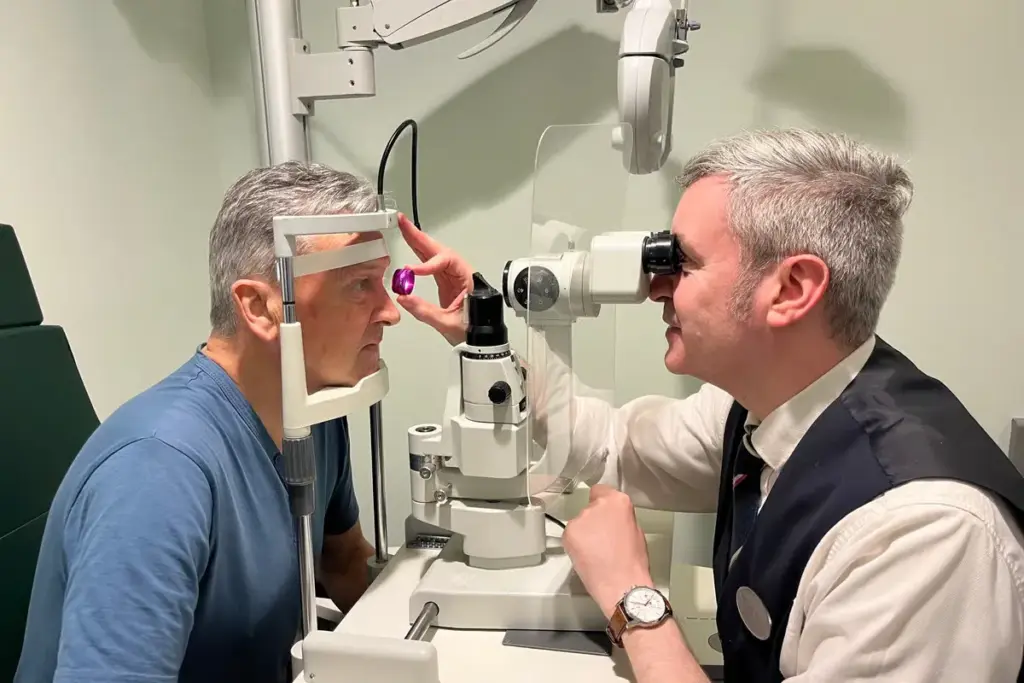
Fundoscopy is key for CRAO diagnosis. It lets doctors see the retina directly. CRAO fundoscopy shows signs like retinal whitening and a cherry red spot in the fovea. This spot is due to the choroidal circulation that’s not affected.
The retina’s look during fundoscopy gives doctors clues about CRAO. This helps them decide what to do next.
Advanced Imaging and Diagnostic Tests
There are more tests for CRAO than just fundoscopy. These include:
- Optical Coherence Tomography (OCT) to check retinal layer thickness and look for ischemia signs.
- Fluorescein angiography to see how well the retina’s blood vessels are working and find blockages.
- Electroretinography (ERG) to measure the retina’s electrical activity. This shows how CRAO affects its function.
| Diagnostic Test | Purpose in CRAO Diagnosis |
| Fundoscopy | Direct visualization of retinal changes, such as whitening and cherry red spot. |
| OCT | Assessment of retinal layer thickness and detection of ischemic changes. |
| Fluorescein Angiography | Evaluation of retinal vascular perfusion and identification of occlusions. |
| ERG | Measurement of retinal electrical activity to assess functional impact. |
Conclusion
Central retinal artery occlusion (CRAO) is a serious eye condition. It can greatly affect your vision. We’ve covered what CRAO is, its causes, symptoms, and how doctors diagnose it.
Seeing a doctor right away is key if you think you have CRAO. Symptoms include sudden vision loss and blind spots. Tests like CRAO fundoscopy help doctors confirm the diagnosis.
While treatments for CRAO are limited, acting fast is important. It might help save some of your vision. Knowing the risks and health issues linked to CRAO can help prevent it.
It’s vital to get medical help and imaging tests quickly if you suspect CRAO. This can help manage the condition better.
FAQ
What is the meaning of the CRAO medical abbreviation and what does it entail?
CRAO stands for Central Retinal Artery Occlusion. It’s often called a “stroke of the eye.” It happens when the main artery to the retina gets blocked. This stops oxygen and nutrients from reaching the retina.
We treat CRAO as a medical emergency. The retina needs blood flow to survive. Without it, vision loss can happen quickly, even in hours.
What are the primary central retinal artery occlusion symptoms to watch for?
The main symptom of CRAO is sudden, painless vision loss in one eye. People often describe it as a “curtain” falling or a “blackout.” Unlike other eye problems, CRAO doesn’t cause pain, redness, or discharge.
So, even if the eye looks normal, it’s important to seek help.
How do we identify a CRA occlusion during a clinical exam?
We use CRAO fundoscopy to diagnose it. This lets us see the back of the eye. In CRAO, the retina looks pale or milky due to swelling.
A “cherry-red spot” in the macula is a key sign. It shows the eye needs immediate care.
What are the most common risk factors for an artery occlusion in the eye?
Eye artery occlusions often link to health issues. We see them in people with high blood pressure, diabetes, and heart problems. These conditions can cause a clot to block the eye’s artery.
Is a right artery occlusion treated differently than one in the left eye?
At places like Johns Hopkins Medicine, treatment for CRAO doesn’t change based on the eye. Our main goal is to restore blood flow and check the heart and carotid arteries. This is because CRAO shares stroke risk factors.
What is the difference between central artery occlusion symptoms and branch retinal artery symptoms?
CRAO symptoms mean total or near-total vision loss in one eye. Branch occlusions affect only part of the vision. But, both need urgent treatment to protect sight and find the cause of the blockage.
What diagnostic tools are used to evaluate a central artery occlusion eye event?
We use CRAO fundoscopy first. Then, we do OCT to check swelling and Fluorescein Angiography to see blood flow. These tests help us understand the severity and plan for the patient’s long-term health.
Why is “what is CRAO” such a critical question for those with cardiovascular risks?
Knowing about CRAO can save lives. The eye shows us the body’s vascular health. A CRAO warning sign can mean a high risk for stroke or heart attack. Recognizing CRAO early helps manage health and prevent more problems.
References
National Center for Biotechnology Information. Evidence-Based Medical Insight. Retrieved from https://www.ncbi.nlm.nih.gov/books/NBK470354/


 Departments
 Related Videos
 Our Doctors
 News
News


