Choosing between an MRI scan and a CT scan can be confusing. But knowing their differences helps patients make better choices. At Liv Hospital, we focus on your well-being and use the latest technology. We make sure each scan is tailored to your needs.
Diagnostic imaging is key in healthcare. Both MRI and CT scans are important tools, but they work differently. Is MRI scan and CT scan the same? A CT scan uses X-rays, while an MRI uses strong magnets and radio waves.
Key Takeaways
- CT scans use X-rays to create detailed images, often used for emergency situations.
- MRIs utilize magnetic fields and radio waves, ideal for soft tissue imaging.
- The choice between MRI and CT scan depends on the specific medical condition.
- Both scans have their own set of advantages and are considered safe.
- Understanding the difference helps patients make informed decisions about their care.
Understanding Medical Imaging Technologies
Medical imaging is key in today’s healthcare. It gives vital information for diagnosis and treatment. Let’s explore MRI and CT scans within the larger medical imaging world.
The Evolution of Diagnostic Imaging
Diagnostic imaging has changed a lot. Wilhelm Conrad Röntgen discovered X-rays in 1895. Now, we have MRI and CT scans. Technology has made imaging faster and more detailed, helping doctors treat patients better.
CT scans came out in the 1970s, and MRI in the 1980s. These technologies keep getting better. They improve image quality and make scans faster and more comfortable for patients.
The Role of Medical Imaging in Modern Healthcare
Medical imaging is essential in today’s healthcare. It helps doctors see inside the body. This lets them find problems, track diseases, and plan treatments.
It’s used for many things, like finding cancer, checking the brain, and looking at heart problems. It’s also key in emergency care. It helps doctors quickly check and treat serious injuries.
- Supports diagnosis and treatment planning
- Monitors disease progression and response to treatment
- Guides minimally invasive procedures
- Enhances patient care and outcomes
Knowing how medical imaging works helps doctors make better choices. As imaging tech gets better, we’ll see new ways to diagnose and treat diseases.
Is MRI Scan and CT Scan the Same?

MRI and CT scans are used for different reasons. They work in different ways. This means they can’t be used the same way.
Basic Technological Differences
CT scans use X-rays to see inside the body. X-ray technology is great for bones and lungs. MRI scans, on the other hand, use magnetic fields and radio waves. They are better at showing soft tissues.
Let’s look at how each technology makes images.
How Each Technology Creates Images
CT scans use an X-ray machine that moves around the body. It takes pictures from many angles. Then, these pictures are put together to show detailed cross-sections.
MRI scans use a strong magnetic field and radio waves. They align hydrogen atoms in the body. This creates detailed images.
Here’s a comparison of how MRI and CT scans create images:
| Characteristics | CT Scan | MRI Scan |
| Imaging Technology | X-rays | Magnetic fields and radio waves |
| Best for Visualizing | Bones, lungs, and internal injuries | Soft tissues, organs, and neurological details |
| Scan Time | Typically faster, often just a few minutes | Can be longer, sometimes up to an hour |
Knowing the differences is key to choosing the right test. CT scans are fast and good for emergencies. MRI scans are better for soft tissues, like the brain and spinal cord.
How CT Scans Work
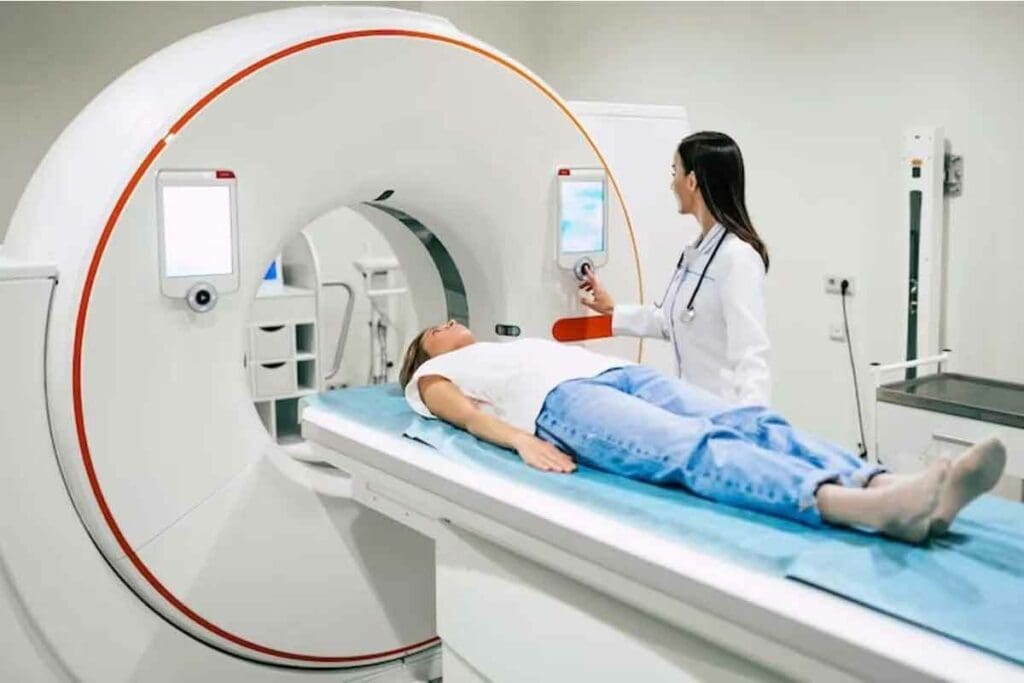
CT scans are key in modern medicine. They use X-ray technology to show detailed images inside the body. This helps doctors make accurate diagnoses and treatment plans for many health issues.
X-ray Technology Explained
At the core of CT scans is X-ray technology. It uses X-ray beams to take pictures of the body’s inside parts. X-rays are a kind of electromagnetic radiation that goes through soft tissues but gets blocked by denser materials like bone. This lets X-rays show differences between various tissues, helping us see inside the body.
“The principle behind X-ray technology is simple yet powerful,” say medical imaging experts. “By measuring how X-rays get blocked as they go through the body, we can make detailed pictures of what’s inside.”
The CT Scanning Process
The CT scanning process mixes X-ray tech with smart computer programs. During a scan, the patient lies on a table that moves into a doughnut-shaped scanner. The scanner moves around the patient, sending out X-rays that go through the body and are caught by sensors on the other side.
The data from the sensors is turned into detailed images by advanced computer programs. These images show what’s inside the body, helping doctors diagnose many health problems.
One big plus of CT scans is how fast they are. They can quickly give diagnoses, which is very helpful in emergencies. This makes them a vital tool in urgent care, where fast action is key.
Understanding how CT scans work helps us see the tech behind modern imaging. As imaging tech keeps getting better, CT scans stay a key part of diagnosing patients.
How MRI Scans Work
MRI scans are a big step forward in medical imaging. They use magnetic fields and radio waves to show the body’s inside parts clearly. This tech helps doctors see soft tissues and organs without harmful radiation.
Magnetic Fields and Radio Waves
MRI scans rely on strong magnetic fields and radio waves. A patient is placed in a big magnet during the scan. This magnet aligns hydrogen nuclei in the body.
Then, radiofrequency pulses are used to change these nuclei. When they go back to their original state, they send signals. The MRI machine catches these signals to make detailed images.
This tech lets MRI see soft tissues better than CT scans. It’s great for checking the brain, spine, and joints, among other things.
The MRI Scanning Process
Getting an MRI scan involves a few steps. First, the patient lies on a table that moves into the MRI machine. The technologist controls the machine from another room.
The patient must stay very quiet and not move during the scan. This helps get clear images. The scan’s length depends on what’s being scanned and the type of scan.
Some scans might need a contrast agent to see things better. This helps doctors see more clearly what’s going on inside the body.
| Aspect | CT Scan | MRI Scan |
| Imaging Technology | Uses X-rays | Uses magnetic fields and radio waves |
| Primary Use | Bone imaging, acute bleeding | Soft tissue imaging, neurological conditions |
| Radiation Exposure | Yes | No |
It’s important to know the differences between MRI and CT scans. MRI scans are better for soft tissues and some conditions. They are a key tool in today’s medicine.
What Does an MRI Show That a CT Doesn’t?
MRI scans are different from CT scans because they show soft tissues clearly. This is great for finding problems in soft tissues.
Superior Soft Tissue Visualization
MRI scans are known for showing soft tissues well. CT scans are better for bones and dense areas. MRI is good for seeing organs, tendons, and soft tissues. This helps find issues like torn ligaments, herniated discs, and tumors.
In muscle and bone imaging, MRI shows how bad injuries are. It helps doctors decide how to treat them. MRI also shows the brain and spinal cord clearly.
Detecting Subtle Abnormalities
MRI is great at finding small changes in tissues. This is key for spotting multiple sclerosis, cancers, and neurodegenerative diseases early. MRI can see these changes that CT scans might miss.
MRI helps doctors find diseases early, when they are easier to treat. This is a big plus of MRI over CT scans.
Neurological Applications
MRI is the top choice for brain and spinal cord imaging. It can find many neurological problems, like stroke, tumors, infections, and demyelinating diseases.
MRI’s detailed images are key for planning brain surgeries and tracking diseases. For example, MRI helps find brain tumors’ exact location and size. This is important for surgery and checking treatment success.
| Diagnostic Feature | MRI | CT Scan |
| Soft Tissue Visualization | Excellent | Limited |
| Detecting Subtle Abnormalities | Highly Sensitive | Moderately Sensitive |
| Neurological Applications | Preferred Modality | Useful in Emergencies |
When CT Scans Are Preferred
CT scans are often the first choice in many medical situations, including emergencies. They are faster than MRI and are usually easier to get. This makes them perfect for urgent cases.
Emergency Situations
In emergency rooms, speed and efficiency are key. CT scans are usually the first choice because they quickly show injuries and serious conditions. This is very important in trauma cases where time is critical.
Bone Imaging and Fracture Detection
CT scans are the best for seeing bones and finding fractures. They give clear pictures of bones, helping doctors spot complex fractures and injuries. This is very helpful in orthopedic emergencies and after injuries.
Detecting Acute Bleeding and Trauma
CT scans are great at finding acute bleeding and trauma. They quickly spot hemorrhages and injuries that need quick treatment. Their ability to find fresh blood makes them essential in emergency care.
To sum up, while MRI has its benefits, CT scans are better for emergencies, bone checks, finding fractures, and spotting bleeding and trauma. This is because they are fast, easy to get, and very accurate.
Clinical Applications: The Difference Between CT Scan and MRI
Both MRI and CT scans are key in modern medicine. They serve different purposes in various medical fields. We’ll look at what each modality is best for in different situations.
Brain and Neurological Imaging
MRI is top for brain and neurological scans because it shows soft tissues well. It’s great for spotting tumors, stroke, and diseases like Alzheimer’s. MRI’s skill in finding small issues is a big help for brain doctors and surgeons.
CT scans are better for quick checks in emergencies, like after a head injury. They can spot bleeding and breaks. But, they don’t show soft tissue details like MRI does.
Abdominal and Pelvic Imaging
For the belly and pelvis, both CT and MRI are used. CT scans are good for checking injuries, finding tumors, and helping with procedures. CT’s quickness and easy access are big pluses for urgent cases.
MRI is better for looking at liver spots, the biliary system, and complex pelvic issues. It’s safer because it doesn’t use radiation, making it great for when you need to take more pictures.
Musculoskeletal Applications
MRI is the go-to for soft tissue injuries like sprains and tears. It shows cartilage and soft tissues well, perfect for osteoarthritis diagnosis.
CT scans are better for bones, spotting fractures and bone problems. They’re used a lot in orthopedics and trauma for bone details.
Knowing how MRI and CT scans work helps doctors choose the best scan for each patient. This ensures the right care for each person’s needs.
Safety Considerations for Both Imaging Methods
When we look at CT and MRI scans, safety is key. Both have changed how we diagnose diseases. But, they also have safety issues that everyone needs to know about.
Radiation Exposure in CT Scans
CT scans use X-rays to see inside the body. They are useful but expose patients to radiation. The dose from a CT scan is more than a regular X-ray. It’s important to think about the benefits and risks of CT scans, mainly for kids and young adults who are more sensitive to radiation.
CT scanners aim to use the least amount of radiation needed. New technology helps lower radiation without losing image quality.
Magnetic Field Risks in MRI
MRI scans use magnetic fields and radio waves. The main safety worry is metal implants or objects reacting to the magnetic field. People with metal implants, like pacemakers, might not get MRI scans because of this risk.
Before an MRI, patients are checked for metal implants. MRI places follow strict rules to keep the area safe from metal objects that could move in the magnetic field.
Contraindications for Each Method
CT and MRI scans have things they can’t do. For CT scans, contrast agents can be a problem for those with kidney issues or allergies. MRI can’t be done for people with certain metal implants.
MRI scans are hard for those with claustrophobia because of the scanner’s design. Some MRI places have open or wide-bore scanners to help. It’s vital for patients to talk to their doctor about any worries or health issues before a scan.
Knowing the safety and what can’t be done with CT and MRI scans helps make better choices. This is true for both patients and doctors.
Conclusion: Making Informed Decisions About Medical Imaging
Knowing the differences between MRI and CT scans is key to making smart choices about medical imaging. We’ve looked at how each technology works, what they’re used for, and their safety.
The question of whether is MRI scan and CT scan the same can be answered by looking at their strengths. MRI scans give clearer images of soft tissues and areas behind bones. CT scans are often used in emergencies, like checking for strokes.
When deciding between MRI and CT scans, it’s important to think about the benefits and risks. CT scans use radiation, which can slightly increase cancer risk. MRI scans, on the other hand, aren’t safe for people with certain metal implants.
In the end, choosing between MRI and CT scans depends on the patient’s needs and the situation. Knowing the differences helps doctors pick the best imaging method. This ensures patients get the right diagnosis and treatment.
FAQ
What is the main difference between an MRI and a CT scan?
MRI scans use magnetic fields and radio waves. CT scans use X-rays to create images.
Are MRI and CT scans the same?
No, they are not the same. They are different tools for medical imaging, each with its own uses.
What can an MRI show that a CT scan cannot?
MRI scans are better at showing soft tissues and finding small problems. They are great for the brain and nervous system.
When are CT scans preferred over MRI scans?
CT scans are better in emergencies, for bones, and finding bleeding fast. They are quick and useful.
Does a CT scan use magnets?
No, CT scans don’t use magnets. They use X-rays to see inside the body.
Is a CT scan magnetic?
No, CT scans are not magnetic. They use X-ray technology.
What are the safety considerations for MRI and CT scans?
CT scans use radiation. MRI scans use strong magnets. Both have things you can’t have inside you, like metal implants for MRI.
Can anyone undergo an MRI or CT scan?
Not everyone can have these scans. Some metal implants stop you from having an MRI. Other things, like contrast agents, can also stop you from having either scan.
What is the difference between a CT scan and an MRI in terms of clinical applications?
CT scans are good for emergencies, bones, and finding bleeding fast. MRI scans are better for soft tissues, brain, and muscles.
How do I know which imaging test is right for me?
It depends on your health issue and what your doctor thinks you need. They will decide between an MRI or CT scan for you.
References
- Weinstock, D. M., et al. (2022). Magnetic Resonance Imaging Versus Computed Tomography for Diagnostic and Treatment Planning in Orthopedic Care: A Review. .https://pmc.ncbi.nlm.nih.gov/articles/PMC9305220/