

Knowing about kidney health is key, and a MAG III renal scan is vital for diagnosing kidney issues. This test checks renal perfusion and excretion. It helps doctors spot blockages, check kidney function, and see if drainage is normal or not.
At Liv Hospital, we follow top international standards to correctly read renal scan results. This helps us make treatment plans that fit each patient. By understanding what a MAG III renal scan shows, both patients and doctors can make better choices about treatment.
Key Takeaways
- Understanding the role of MAG III renal scan in evaluating kidney function.
- Interpreting normal vs. abnormal results from a renal scan.
- The significance of renal perfusion and excretion in kidney health.
- How Liv Hospital’s protocols ensure accurate diagnosis and treatment.
- The importance of personalized treatment decisions based on renal scan results.
What You Need to Know About MAG III Renal Scan Procedures

The MAG III renal scan is a test that shows how well the kidneys work. It’s a nuclear medicine test that helps find problems like blockages or kidney issues. This test is key for checking kidney function.
Definition and Purpose of Nuclear Medicine Kidney Imaging
The MAG III renal scan uses a tiny amount of radioactive tracer. It’s injected into the blood and taken up by the kidneys. This lets doctors see how well the kidneys work and drain.
A top nuclear medicine expert, says, “The MAG III scan is great for finding and treating kidney problems.” It’s used to check for blockages, high blood pressure, and how well a transplanted kidney works.
Patient Preparation and Test Duration
Getting ready for a MAG III scan is easy. Drink lots of water before the test. You might need to stop some medicines that could mess up the results. The test usually takes 30 minutes to an hour, but can take longer with a Lasix challenge.
While being scanned, you must stay very quiet. The tech will help you get into the right position and watch from another room.
What to Expect During the Procedure
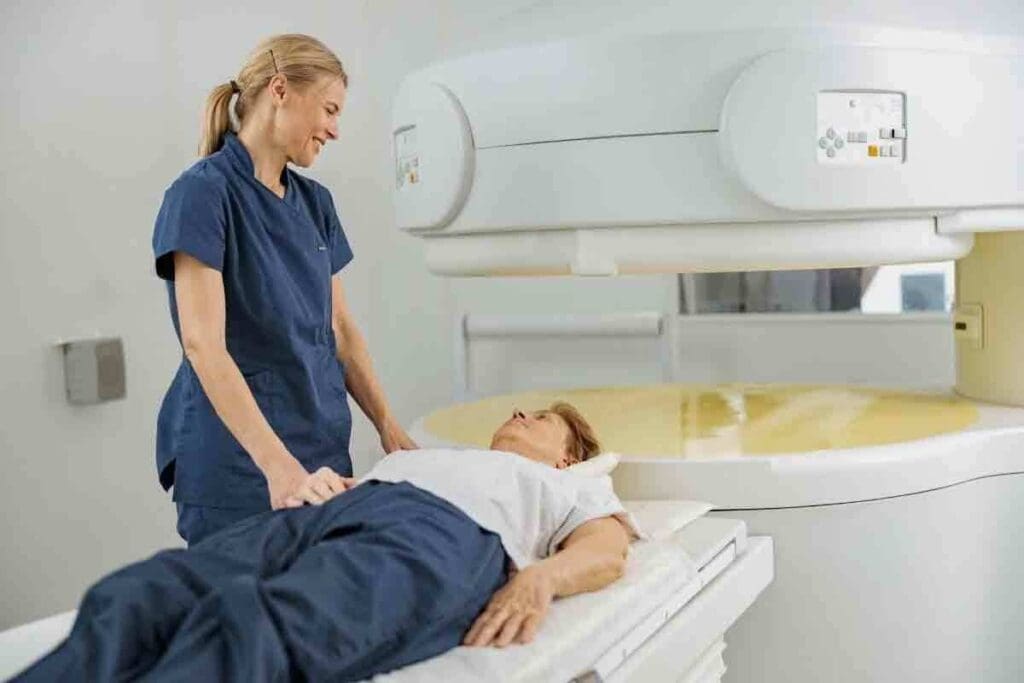
For the scan, you’ll lie on a table and the camera will be placed over your kidneys. The tracer is injected into your vein. The camera then takes pictures of the tracer moving through your kidneys.
At times, Lasix is given to see how well the kidneys can drain the tracer. A medical journal notes, “Lasix helps tell if the urinary tract is blocked or not.”
The MAG III renal scan is a safe and important test for kidney health. Knowing what to expect can help you feel more at ease during the test.
Key Insight #1: How MAG III Evaluates Renal Perfusion
Understanding how MAG III evaluates renal perfusion is key to reading renal scan results right. The MAG III renal scan is a top-notch tool for checking kidney function. It looks at blood flow to the kidneys.
The Perfusion Phase Explained
The perfusion phase is the first part of the MAG III scan. Here, the radiopharmaceutical is given, and how the kidneys take it in is watched. This stage is vital for seeing if blood flows well to the kidneys, helping doctors spot any problems.
Normal Perfusion Patterns
In a normal MAG III scan, the perfusion phase shows both kidneys taking in the radiopharmaceutical evenly and quickly. This means the kidneys are working well. The curve of how the tracer is taken in should go up fast, showing it gets to the kidney’s tissue well.
Identifying Reduced or Asymmetric Perfusion
Problems with renal perfusion show up as less or uneven uptake of the radiopharmaceutical. Less perfusion might mean issues like kidney artery narrowing or vascular disease. Uneven uptake could point to kidney disease on one side or other problems.
As a top expert in nuclear medicine says,
“The assessment of renal perfusion is a cornerstone in the diagnosis and management of various kidney diseases.”
So, getting the perfusion phase right is key for helping patients next steps.
By looking closely at renal perfusion with the MAG III scan, doctors can learn a lot about kidney health. They can spot issues early, which helps patients get better faster.
Key Insight #2: Assessing Split Renal Function
Understanding split renal function is key when looking at MAG III renal scan results. The MAG III scan shows how much each kidney contributes to overall kidney function. This is vital for diagnosing and treating kidney problems.
How Differential Function is Calculated
Differential renal function, or split function, is found by measuring MAG III tracer uptake in each kidney. This is done during the scan’s initial phases. By comparing the uptake, we see how each kidney works. This helps spot any uneven kidney function.
Normal Range for Split Function
In healthy people, each kidney should function between 45% to 55%. Any deviation from this range could mean a problem. For example, if one kidney doesn’t work as well, it might be due to blockage or damage.
Clinical Significance of Asymmetric Function
Asymmetric renal function means one kidney works a lot more or less than the other. This can point to serious issues like kidney artery narrowing or blockages. Knowing this helps doctors find the cause and decide on the right treatment.
By using MAG III scans to check split renal function, doctors can better care for patients with kidney disease. This can lead to better health outcomes for these patients.
Key Insight #3: Understanding Drainage Patterns in MAG III Renal Scan Results
Drainage patterns in MAG III renal scans are key to understanding kidney function and possible blockages. After Lasix, these patterns help figure out if there’s a blockage or if the delay is not due to a blockage.
Normal Excretion Timeframes
In a normal MAG III renal scan, the tracer should leave the kidneys in 20-30 minutes after Lasix. Knowing these timeframes helps us spot any unusual patterns. We look at the time-activity curves to see how fast the tracer leaves the kidneys.
Delayed Drainage: What It Means
Delayed drainage means the tracer isn’t leaving as it should. This could be because of a block in the urinary tract. Seeing delayed drainage means we need to look closer to find out why. The Lasix test helps us tell if the delay is due to a blockage or not.
Quantitative Criteria for Abnormal Retention
We use specific rules to measure abnormal retention, like the half-time (T1/2) of tracer clearance. A T1/2 over 20 minutes usually means there’s a big blockage. These rules help us standardize how we read MAG III renal scans. They help us clearly see if there’s a problem and how serious it is.
Grasping these drainage patterns and what they mean is key for correct diagnosis and treatment of kidney problems. The insights from MAG III renal scans, with Lasix, are very helpful. They guide doctors in making the right decisions for patients.
Key Insight #4: The Lasix Renal Scan Protocol and Interpretation
Understanding the Lasix renal scan protocol is key to reading MAG III renal scan results right. The Lasix challenge, which uses furosemide, is a big part of the renal scintigraphy process.
Purpose of Furosemide Administration
Furosemide is given during the MAG III scan to test the kidneys. It checks if they can clear the tracer. This is vital to see if any blockage is causing the issue.
Using furosemide helps tell apart blockages from other problems. This gives doctors important info for making treatment plans.
Normal Response to Lasix Challenge
A normal response to Lasix means the kidneys clear the tracer well after furosemide. This is shown by a quick drop in the tracer from the renal pelvis. A normal renalgram shows a fast decline after Lasix, meaning no big blockage.
Abnormal Patterns After Lasix Administration
Abnormal patterns after Lasix can point to kidney issues. Some common ones are:
- Delayed washout: Shows possible blockage
- Asymmetric response: Means one kidney isn’t working right
- No response: Can mean severe blockage or kidney damage
These odd patterns are key in spotting and treating kidney problems. The Lasix challenge info is super helpful for planning treatment for patients getting nuclear medicine renal scan tests.
Key Insight #5: Analyzing Time-Activity Curves in Renography
Renography uses time-activity curves to check how well the kidneys work. These curves show how the kidney takes in, holds, and gets rid of the tracer.
Components of a Normal Renogram Curve
A normal renogram curve has three parts: the perfusion, uptake, and excretion phases. The perfusion phase shows a quick rise as the tracer reaches the kidney. Then, the uptake phase keeps rising as the kidney takes in more tracer. Lastly, the excretion phase goes down as the tracer is released into urine.
Abnormal Curve Patterns and Their Meaning
Abnormal curves can point to kidney issues. For example, a delayed peak or a prolonged excretion phase might mean there’s an obstruction or the kidney isn’t working right. An asymmetric curve between the kidneys could mean one kidney is sick or there’s high blood pressure in the kidneys.
Knowing these abnormal patterns is key for making the right diagnosis and treatment plan. A lasix renogram, which uses furosemide to make more urine, can help figure out if the delay is due to blockage or not.
Quantitative Measurements for Result Interpretation
Quantitative measurements from the curves help us understand renography results better. Things like the time to peak activity (Tmax) and the half-time of excretion (T1/2) give us clear data on kidney function. These numbers help doctors see how bad the kidney problem is and if it’s getting worse or better.
By looking at the curves and these numbers, we get a full picture of how the kidneys work and drain. This helps doctors make better choices for treatment.
Key Insight #6: MAG III vs. DTPA Scan: Differences and Clinical Applications
MAG III and DTPA scans are used in nuclear renal imaging. They serve different purposes and have unique properties. Knowing these differences helps choose the right test for each clinical scenario.
Tracer Properties and Physiological Differences
The main difference between MAG III and DTPA is in their tracer properties. MAG III is secreted by the renal tubules. DTPA is filtered by the glomeruli. This affects their use in clinical settings.
MAG III is great for checking renal function in patients with low GFR. DTPA is used for GFR measurement because it’s filtered by the glomeruli.
When DTPA is Preferred for GFR Measurement
DTPA is best for GFR measurement because it’s mainly filtered by the glomeruli. This makes it accurate for assessing glomerular filtration. It’s key in patients with chronic kidney disease or those getting a kidney transplant.
“The use of DTPA for GFR measurement provides a reliable assessment of renal function, especially in patients where accurate GFR is critical for clinical decision-making.” – A nuclear medicine specialist
Complementary Information from Both Nuclear Renal Tests
DTPA is great for GFR measurement, but MAG III shows renal tubular function and drainage. Using both tests together gives a full picture of renal function and disease.
| Characteristics | MAG III | DTPA |
| Primary Mechanism | Tubular secretion | Glomerular filtration |
| Clinical Use | Evaluating renal function, especially in impaired GFR | GFR measurement, assessing glomerular function |
| Advantages | Less dependent on GFR, useful in renal impairment | Accurate GFR measurement |
In conclusion, MAG III and DTPA scans have their own strengths. They are suited for different clinical needs. Understanding their differences helps healthcare providers make better choices. This improves diagnostic accuracy and patient care.
Key Insight #7: Recognizing Pathological Findings in Complex Cases
The MAG III renal scan helps us spot problems in complex kidney cases. It gives us key information for diagnosis. This advanced imaging method reveals issues that other tests might miss.
Hydronephrosis and Obstruction Patterns
The MAG III renal scan is great for finding hydronephrosis and blockages. We look at the scan to see if there are obstructions and how bad they are. This helps us plan the right treatment.
Signs of hydronephrosis include slow drainage and more activity in the renal pelvis. Obstructions show up as a slow tracer excretion. This means there’s a block in the urinary tract.
Renovascular Hypertension Findings
Renovascular hypertension can also be checked with the MAG III renal scan. It looks at how well the kidneys are working and if there’s a problem with the renal arteries. This helps find the cause of high blood pressure.
The scan shows how well each kidney is working. Unequal function between the kidneys might mean a blood flow problem.
Renal Transplant Evaluation
The MAG III renal scan is key for checking on kidney transplants. It helps see how the transplant is doing, find any problems, and keep an eye on the kidney’s health.
Congenital Anomalies in Pediatric Patients
In kids, the MAG III renal scan helps find and track kidney and urinary tract birth defects. It gives us important information on how the kidneys are working and draining. This helps manage these conditions.
Birth defects like ureteropelvic junction obstruction can be spotted and followed with the MAG III renal scan. This lets us act quickly and treat them properly.
Common Causes of Abnormal MAG III Renal Scan Results
The MAG III renal scan is a key tool for diagnosing kidney issues. But it can show abnormal results for many reasons. These include blockages, narrowed arteries, and diseases affecting the kidney tissue. Knowing these causes helps doctors make the right diagnosis and treatment plan.
Urinary Tract Obstruction
Urinary tract obstruction is a main reason for abnormal scan results. It happens when something blocks the flow of urine. This blockage can slow down urine flow, as seen on the MAG III scan.
The lasix renal scan uses furosemide (Lasix) to check how well the kidney responds. This helps find out how bad the blockage is.
Many things can cause urinary tract obstruction. These include stones, tumors, or birth defects. Finding out what’s causing the blockage is key to treating it right.
Renal Artery Stenosis
Renal artery stenosis is another big reason for abnormal scan results. It’s when the arteries leading to the kidneys get too narrow. This can reduce blood flow to the kidneys, seen during the scan.
The scan can spot uneven blood flow between the kidneys. This might mean there’s a problem with the arteries. More tests, like angiography, might be needed to confirm this.
Vesicoureteral Reflux
Vesicoureteral reflux (VUR) is when urine flows back up from the bladder into the kidneys. This can cause problems on the MAG III scan, mainly during the drainage phase. It can also raise the risk of infections and damage to the kidneys.
The scan can show if VUR is present by spotting unusual urine flow. The scan’s findings help doctors manage VUR better.
Parenchymal Disease
Parenchymal disease affects the kidney’s working tissue. Conditions like pyelonephritis or chronic kidney disease can cause abnormal scan results. These diseases can harm kidney function and change how the scan looks.
The nuclear renal scan, including the MAG III scan, helps understand kidney function. It’s useful for tracking how these diseases affect the kidneys.
In summary, many things can cause abnormal MAG III scan results. These include blockages, narrowed arteries, reflux, and diseases. Knowing these causes is vital for correct diagnosis and treatment. The renal scan Lasix protocol is important for checking some of these conditions.
Clinical Decision-Making Based on Renal Scan Findings
Renal scan results are key in deciding treatment for kidney issues. The data from a MAG III renal scan helps doctors make the best decisions for patient care.
When to Consider Surgical Intervention
Surgery might be needed based on a MAG III renal scan. For example, if the scan shows big blockages or severe swelling, surgery could help. Key signs for surgery include:
- Severe or complete urinary tract blockage
- Big swelling in the kidney with poor function
- Recurring infections because of kidney shape issues
These problems can cause lasting damage if not fixed quickly. So, it’s important to quickly understand the scan results to see who needs surgery.
Indications for Additional Imaging
More imaging might be needed after a MAG III renal scan. This is true when the scan is unclear or more details are needed for treatment. Common reasons for more imaging are:
- Thought to be high blood pressure from kidney issues
- Complex kidney shapes
- Scan results that are unclear or not sure
Tests like CT urography or MRI can give more info. This helps doctors make better plans for treatment.
Follow-up Protocols for Abnormal Results
Patients with odd MAG III renal scan results need close follow-up. Follow-up plans might include:
- Regular kidney function tests
- More MAG III scans to watch for changes
- Checking how the patient feels and how the kidneys are working
These follow-up steps help make sure patients get the right care. They also help catch any changes in their condition fast.
In summary, the results from a MAG III renal scan are very important for making treatment choices. Knowing when to suggest surgery, when more tests are needed, and how to follow up helps doctors give the best care to patients with kidney problems.
Conclusion: Putting Your MAG III Renal Scan Results in Context
Understanding your MAG III renal scan results is key to your kidney health. We’ve looked at what these results mean, from normal to abnormal. This scan, often paired with a Lasix scan, shows how well your kidneys work and if there are problems.
A normal scan with Lasix means your kidneys are working right. But, if the results are not normal, you might need more tests. Renal scintigraphy, which includes MAG III scans, is a powerful tool. It helps doctors see how your kidneys are doing and find any issues.
Knowing what your MAG III scan results mean helps you and your doctor make better choices. Whether the results are good or not, this information is vital. It helps keep your kidneys healthy and deals with any problems quickly.
FAQ
What is a MAG III renal scan?
A MAG III renal scan is a test that checks how well your kidneys work. It uses a special dye called MAG III to see how your kidneys drain.
How does a MAG III renal scan differ from a DTPA scan?
MAG III and DTPA scans both check kidney function. But MAG III focuses on how well the kidneys filter waste, even when they’re not working well. DTPA, on the other hand, looks at how well the kidneys filter through the blood.
What is the purpose of the Lasix challenge during a MAG III renal scan?
The Lasix challenge tests how well your kidneys can get rid of the dye. It helps doctors figure out if there’s a blockage or not.
What are normal results for a MAG III renal scan?
Normal results show that both kidneys work the same and get rid of the dye quickly. This means your kidneys are working well together.
What does delayed drainage on a MAG III renal scan indicate?
Delayed drainage might mean there’s a blockage in your urinary tract. But the Lasix challenge helps doctors know for sure.
How is split renal function assessed during a MAG III renal scan?
Doctors compare how much dye each kidney takes in. This tells them if one kidney is working better than the other.
What are the clinical implications of asymmetric renal function?
If one kidney works better than the other, it could mean there’s a problem. This might need more tests or close watching.
Can a MAG III renal scan diagnose renovascular hypertension?
A MAG III scan can suggest renovascular hypertension. It might show if one kidney is not working as well as the other.
How is a MAG III renal scan used in renal transplant evaluation?
The scan checks how well the new kidney is working. It helps find any problems like blockages or damage.
What are the common causes of abnormal MAG III renal scan results?
Abnormal results can be due to blockages, narrowed arteries, reflux, or kidney disease.
When should surgical intervention be considered based on MAG III renal scan findings?
Surgery might be needed if there’s a big blockage, one kidney is much weaker, or if the scan shows other serious problems.
What follow-up protocols are recommended for patients with abnormal MAG III renal scan results?
After an abnormal scan, patients might need more tests, kidney function checks, or regular doctor visits. This depends on the problem found.
References
- Banker, H., Sheffield, E. G., & Cohen, H. L. (2023). Nuclear Renal Scan. In StatPearls. NCBI Bookshelf. https://www.ncbi.nlm.nih.gov/books/NBK562236/
- Taylor, A. T., Nally, J., Aurell, M., et al. (2018). SNMMI Procedure Standard / EANM Practice Guideline for Diuretic Renal Scintigraphy in Adults With Suspected Upper Urinary Tract Obstruction. Seminars in Nuclear Medicine, 48(4), S1–S35. https://pmc.ncbi.nlm.nih.gov/articles/PMC6020824/
- Taylor, A. T., Schuster, D. M., & Alazraki, N. (2017). 99mTc-MAG3: Baseline and Furosemide Imaging in Suspected Renal Obstruction. Radiology. https://pubs.rsna.org/doi/full/10.1148/radiol.2017152311