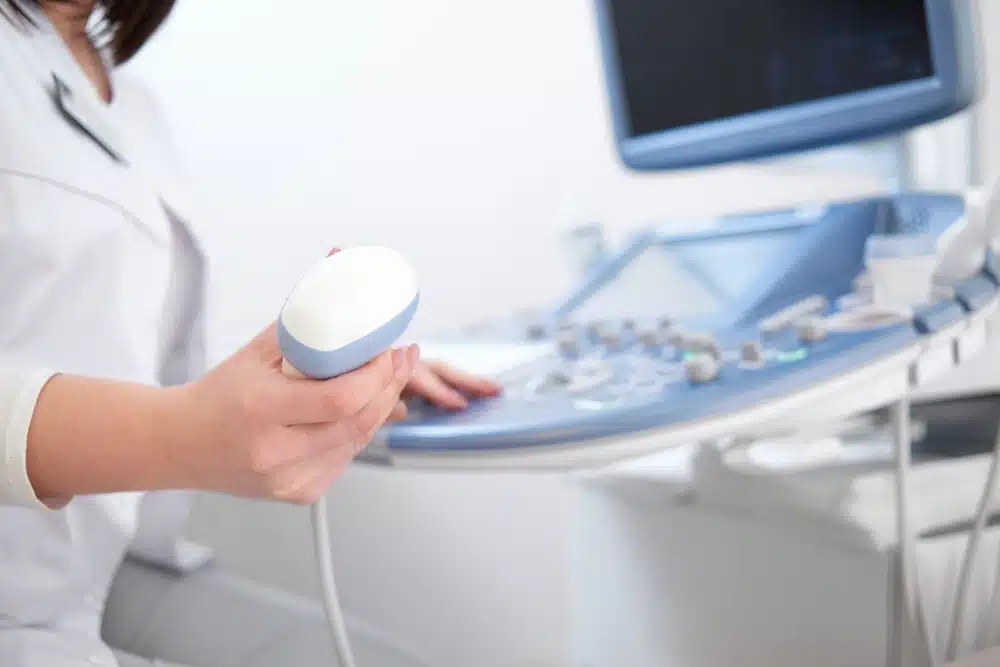
4D Breast Ultrasound represents a significant evolution in sonographic imaging technology, transitioning from traditional flat, two-dimensional (2D) slice imaging to dynamic, volumetric visualization. While 2D ultrasound produces a single, flat cross-section of tissue, 4D technology captures volume data in real-time. This means the system acquires a three-dimensional block of tissue data and adds the element of time, allowing for live motion observation or the ability to navigate through the stored volume of breast tissue after the patient has left the exam room.
The primary purpose of this technology is to overcome the limitations of standard mammography, particularly in women with dense breast tissue. In traditional mammograms, dense glandular tissue appears white, and cancerous lesions also appear white, creating a “masking effect” that can hide abnormalities. 4D Breast Ultrasound solves this by using sound waves instead of radiation, allowing it to easily distinguish between dense tissue and potential tumors. It serves as a critical supplemental screening tool, designed to catch cancers that might otherwise go undetected in standard screenings, while also providing a “coronal view” a surgical perspective of the breast anatomy that standard handheld ultrasound cannot generate.
How the 4d Breast Ultrasound Works?
The functionality of 4D Breast Ultrasound relies on advanced acoustic physics and high-speed computer processing. The process does not involve ionizing radiation (X-rays) but instead uses high-frequency sound waves to map the internal structure of the breast.
Volumetric Data Acquisition
Unlike a standard ultrasound probe that sends a thin beam of sound into the body to create a single slice, the 4D transducer houses a motorized mechanism or a matrix of crystals. When placed on the breast, this transducer sweeps mechanically across the target area, sending and receiving thousands of sound pulses per second.
- Emission: The transducer emits high-frequency sound waves that travel through the skin and breast tissue.
- Echo Return: These waves bounce off boundaries between different tissues (e.g., fluid, fat, gland, mass). The “echoes” return to the probe.
- Data Processing: The system’s computer processes the timing and strength of these returning echoes. Instead of plotting them on a flat X-Y axis, it builds a volumetric dataset (voxels).
Multiplanar Reconstruction (MPR)
Once the volume is captured, the system creates a 3D model. The defining feature of this mechanism is the ability to generate a “Coronal Plane” view.
- Standard View: Traditional ultrasound sees the breast from top-to-bottom or side-to-side.
- Coronal View: The 4D system allows the radiologist to view the breast from the front to back, layer by layer, essentially looking at the breast as if opening a book. This view is crucial because it highlights the spiculation (star-like patterns) often associated with malignant tumors, which can remain hidden in other views.
Real-Time Elastography integration
Many 4D systems integrate elastography, a technique that assesses the stiffness of tissue. Malignant tumors tend to be harder and stiffer than healthy tissue. The 4D mechanism maps this stiffness in real-time, providing a color-coded overlay that helps distinguish between benign cysts (soft) and potentially concerning solid masses (stiff).
Clinical Advantages and Patient Benefits
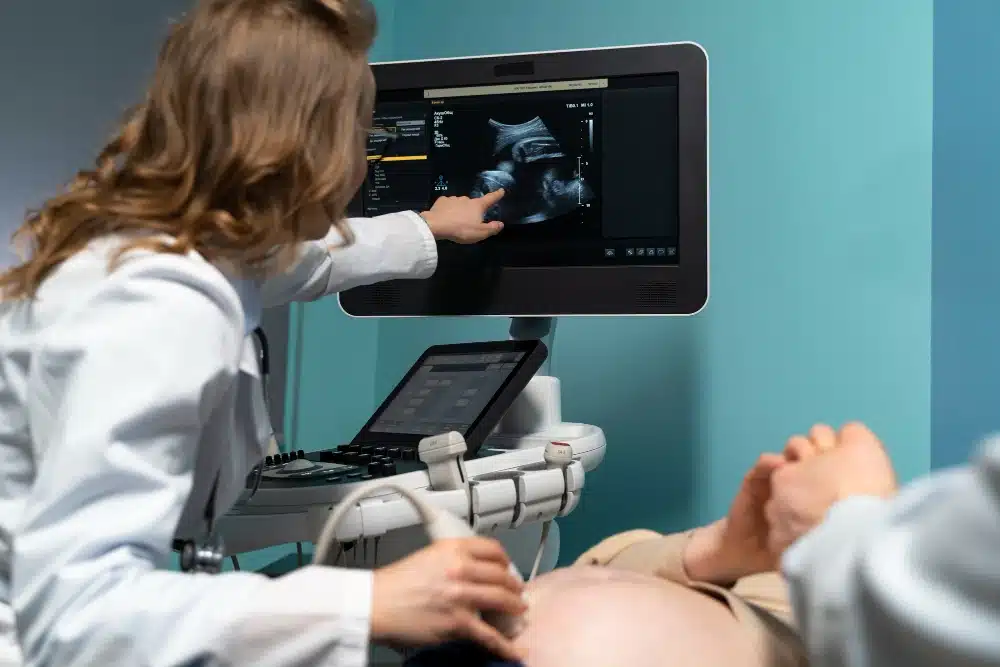
The shift to 4D volumetric imaging offers distinct clinical advantages over traditional methods, directly impacting diagnostic accuracy and the patient’s physical experience.
Enhanced Detection in Dense Breasts
The most significant benefit is for women with heterogeneously dense or extremely dense breast tissue (approximately 40-50% of the female population).
- Contrast Capability: Ultrasound is unaffected by tissue density. It renders masses dark (hypoechoic) against the lighter background of glandular tissue, making detection significantly easier than on a mammogram.
- Reduction of False Negatives: By visualizing the breast in volumes, the technology reduces the chance of a tumor hiding between tissue layers, effectively lowering the rate of missed cancers.
The Coronal View Advantage
The coronal plane provided by 4D ultrasound offers a unique anatomical perspective.
- Surgical Planning: Surgeons utilize this view to understand the exact position and extension of a mass relative to the chest wall and nipple, allowing for more precise surgical planning.
- Pattern Recognition: Specific retraction patterns or architectural distortions in the tissue, which are strong indicators of carcinoma, are often only visible in this frontal plane.
Patient Comfort and Radiation Safety
- No Compression: Unlike mammography, which requires firm compression of the breast to spread tissue out, 4D ultrasound requires only light contact with the skin. This makes the procedure painless and highly acceptable for patients with sensitive breasts or implants.
- Zero Radiation: The technology relies entirely on sound waves. This makes it completely safe for pregnant women, breastfeeding mothers, and young patients (under 40) who require imaging but should avoid X-ray exposure.
- Reduced Callbacks: By providing a more complete picture during the initial scan, 4D ultrasound can help characterize a lesion immediately, potentially reducing the anxiety-inducing need for patients to return for additional views.
Targeted Medical Fields and Applications For 4d Breast Ultrasound
4D Breast Ultrasound is utilized across several specialized departments, serving as a bridge between screening, diagnosis, and treatment planning.
Breast Radiology and Imaging
- Supplemental Screening: It is the standard of care for supplemental screening in asymptomatic women with dense breast tissue following a normal mammogram.
- Diagnostic Work-up: For patients who feel a lump that cannot be seen on a mammogram, 4D ultrasound provides the definitive visualization to confirm or rule out a mass.
Surgical Oncology
- Tumor Staging: Oncologists use the volumetric data to accurately measure the size and volume of a tumor before starting chemotherapy (neoadjuvant therapy).
- Response Monitoring: By comparing 4D volumes over time, doctors can precisely assess if a tumor is shrinking in response to treatment.
Interventional Radiology
- Biopsy Guidance: The technology is used to guide needles for biopsies. The real-time 4D visualization ensures the needle targets the most suspicious part of the lesion, improving the accuracy of the tissue sample.
Plastic and Reconstructive Surgery
- Implant Integrity: It is an excellent tool for evaluating breast implants. It can detect intracapsular or extracapsular ruptures (leaks) and silicone migration without the need for an MRI.
The Patient Experience of 4d Breast Ultrasound
The procedure for a 4D Breast Ultrasound is designed to be non-invasive, quiet, and comfortable.
Preparation and Positioning
No fasting or special preparation is required. The patient enters a private exam room and undresses from the waist down, putting on a gown. The patient lies face up (supine) on an examination table. To ensure the breast tissue is evenly distributed, a wedge sponge may be placed under the shoulder of the side being examined, and the arm is raised above the head.
The Scanning Process
- Coupling Agent: A warm, hypoallergenic ultrasound gel is applied to the breast. This eliminates air pockets between the transducer and the skin, ensuring sound waves travel efficiently.
- Scanning: The technologist uses a specialized broad-bandwidth transducer. Unlike the small, pen-like probe of standard ultrasound, this probe may be larger to capture wider volumes. It is moved systematically across the breast.
- Sensation: The patient feels only the cool sensation of the gel and the smooth movement of the probe. There is no pinching or squeezing.
- Duration: The scan typically takes between 15 to 20 minutes for a complete bilateral (both breasts) examination.
Post-Procedure
Once the images are acquired, the gel is wiped off. Because the scan is non-invasive and requires no sedation, patients can dress and return to their normal daily activities immediately. The radiologist then reviews the captured volumetric data on a specialized workstation.
Safety and Precision Standards
4D Breast Ultrasound operates under rigorous safety protocols to ensure diagnostic reliability and patient well-being.
Non-Ionizing Radiation Protocol
The absolute absence of ionizing radiation classifies this technology as safe for unlimited frequency of use. This allows physicians to monitor benign cysts or fibroadenomas every few months to check for changes without exposing the patient to cumulative radiation risks associated with CT or mammography.
Artifact Reduction Algorithms
High-end 4D systems employ “Speckle Reduction Imaging” (SRI) and “Compound Imaging.”
- Clarity: These software algorithms filter out visual “noise” or graininess that is inherent to ultrasound physics.
- Edge Definition: They enhance the borders of tissues and masses, preventing the blurring that can lead to misdiagnosis.
Operator Standardization
One of the historical challenges of ultrasound is that it is “operator dependent” meaning the quality of the diagnosis depends on the hand of the person holding the probe. 4D volumetric scanning helps standardize this. By capturing a full volume of data rather than just the pictures the operator chooses to snap, the technology ensures that the entire breast architecture is recorded. This allows a second radiologist to review the full scan later, ensuring a “second pair of eyes” can verify the diagnosis, minimizing human error and missed pathologies.