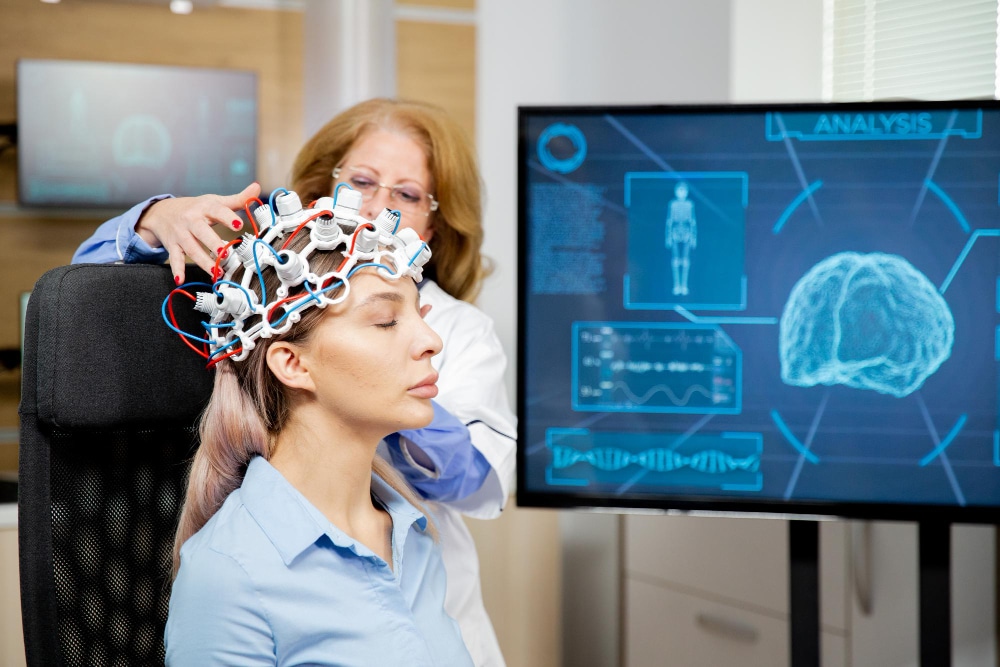
Electroencephalography (EEG) is a non-invasive neurophysiological monitoring method designed to record the electrical activity of the brain. It functions as a real-time observation tool for the central nervous system, capturing the continuous ionic current flows within the neurons of the brain. While imaging technologies like MRI or CT scans provide a static picture of the brain’s structure (anatomy), an EEG provides a dynamic readout of the brain’s function (physiology). It answers the critical question of “how” the brain is working at any given millisecond.
The primary purpose of EEG is to detect abnormalities in the brain’s electrical wave patterns. It solves the diagnostic problem of “invisible” neurological conditions. Many disorders, such as epilepsy or metabolic encephalopathy, do not show physical tumors or lesions on a scan. The brain tissue looks normal, but the electrical firing is chaotic. EEG makes this invisible activity visible. It is the gold standard for diagnosing seizure disorders, classifying seizure types, and differentiating between genuine epileptic events and non-epileptic conditions (such as fainting or psychogenic attacks). Furthermore, it serves as a vital monitoring tool for assessing brain function in comatose patients, determining the depth of anesthesia, and evaluating sleep disorders.
How the EEG Technology Works
The human brain consists of billions of nerve cells called neurons. These cells communicate with each other through tiny electrical impulses. Even when a person is asleep, this electrical activity remains constant, creating distinctive wave patterns. The EEG technology amplifies and translates these microscopic signals into a readable graph.
Electrode Application
The process begins with the placement of small metal discs, known as electrodes, onto the patient’s scalp.
- Conductivity: These electrodes do not emit electricity; they only receive it. A conductive paste or gel is used to ensure a strong connection between the skin and the metal disc, allowing the faint electrical signals from the brain to bridge the gap to the wire.
- The 10-20 System: Technologists place the electrodes at specific, standardized locations across the head (frontal, temporal, parietal, and occipital lobes). This mapping system ensures that the activity recorded can be traced back to a specific region of the brain.
Signal Amplification and Differential Recording
The electrical potential generated by a single neuron is tiny, measured in microvolts.
- Amplification: The electrodes are connected to a differential amplifier. This device boosts the strength of the incoming signal by thousands of times without distorting the pattern, making it strong enough to be digitized.
- Difference Calculation: The machine does not just measure raw electricity; it measures the difference in voltage between two points on the scalp. This comparison allows the system to filter out background noise (like heartbeats or muscle movements) and isolate the true brainwave activity.
Digitization and Display
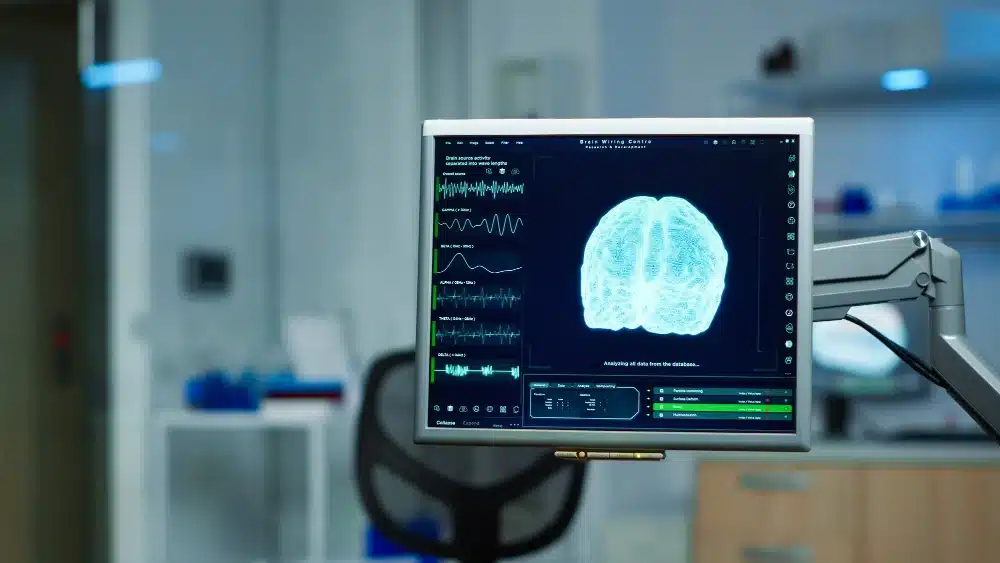
The amplified signals are converted into digital data and displayed on a computer monitor as a series of wavy lines, known as “channels.” Each line represents the activity of a specific area of the brain over time.
- Frequency Bands: The software categorizes these waves based on their speed (frequency). For example, fast “Beta” waves indicate alert concentration, while slow “Delta” waves are characteristic of deep sleep. Sudden, sharp spikes in this rhythm are the hallmarks of seizure activity.
Clinical Advantages and Patient Benefits
EEG offers unique diagnostic capabilities that cannot be replicated by structural imaging, providing distinct benefits in terms of safety, temporal resolution, and non-invasiveness.
Unmatched Temporal Resolution
The most significant clinical advantage of EEG is its speed. MRI and PET scans take seconds or minutes to capture an image. EEG captures changes in brain activity in milliseconds.
- Real-Time Tracking: This millisecond precision allows physicians to see the exact moment a seizure begins, how it spreads across the brain, and how it stops. It provides a frame-by-frame analysis of neural events that other technologies simply miss.
Zero Radiation and Non-Invasive Safety
EEG is a completely passive technology.
- Safety Profile: Unlike CT scans or PET scans, EEG involves absolutely no exposure to ionizing radiation. It does not introduce any radioactive tracers or contrast dyes into the body. This makes it safe for unlimited repeated use, which is essential for patients requiring long-term monitoring, such as neonates (newborns) or pregnant women.
- Painless Experience: The procedure involves no needles, incisions, or pain. The electrodes sit on the surface of the skin, making it a stress-free experience for pediatric patients or those with sensory sensitivities.
Ambulatory Capabilities
Modern EEG technology has moved beyond the hospital bed. “Ambulatory EEG” allows patients to wear a portable recorder at home for 24 to 72 hours.
- Natural Environment Data: This captures brain activity during a patient’s normal daily routine eating, sleeping, and working. This increases the likelihood of capturing a seizure event that might not occur during a short, 30-minute clinic appointment, leading to a more accurate diagnosis.
Targeted Medical Fields and Applications
While EEG is the primary tool of Neurology and Epileptology, its utility extends into critical care, sleep medicine, and psychiatry.
Neurology (Epilepsy Management)
- Seizure Classification: It determines whether seizures are focal (starting in one spot) or generalized (involving the whole brain). This distinction dictates which medication will be effective.
- Pre-Surgical Evaluation: For patients with drug-resistant epilepsy, high-density EEG helps pinpoint the exact “seizure focus” to determine if surgical removal of that tissue is a viable cure.
Intensive Care (Neuro-ICU)
- Coma Prognosis: Continuous EEG (cEEG) is used to monitor comatose patients. It detects “subclinical seizures” seizures happening inside the brain without visible shaking of the body which can cause permanent brain damage if untreated.
- Brain Death Confirmation: It serves as an ancillary test to confirm the absence of brain electrical activity in medico-legal determinations of brain death.
Sleep Medicine
- Polysomnography: EEG is a core component of sleep studies. By tracking the transition between sleep stages (REM vs. Non-REM), it helps diagnose disorders like narcolepsy, insomnia, and parasomnias (abnormal movements during sleep).
Neurosurgery (Intraoperative Monitoring)
- Functional Protection: During complex brain or spine surgeries, EEG monitoring tracks the integrity of neural pathways while the patient is under anesthesia. If the signals change, the surgeon is alerted immediately to adjust their approach before permanent damage occurs.
The Patient Experience of EEG
The EEG procedure is straightforward and designed to minimize patient anxiety.
Preparation
Patients are advised to arrive with clean, dry hair, free of sprays or gels, as these can block the electrical signals. They should usually continue taking their prescribed medications unless instructed otherwise. In “sleep-deprived EEG” protocols, patients may be asked to stay awake most of the night before the test to increase the stress on the brain, making it easier to provoke and record abnormalities.
The Setup
- Measurement: The technologist measures the head to mark the precise spots for the electrodes.
- Application: The scalp may be gently scrubbed with a mild abrasive to remove dead skin cells and ensure a good connection. The electrodes are then attached using a sticky, water-soluble paste. The sensation is merely cold and sticky; there is no pain.
- Duration: Setup typically takes 20 to 30 minutes.
The Recording Phase
The patient relaxes in a reclining chair or bed.
- Resting State: For the majority of the test, the patient simply lies still with eyes closed.
- Activation Procedures: To check for specific reflex epilepsies, the patient may be asked to perform simple tasks:
- Hyperventilation: Breathing deeply and rapidly for a few minutes.
- Photic Stimulation: Looking at a strobe light flashing at different speeds.
- Sleep: Attempting to nap.
These actions can change brain chemistry slightly or stimulate the visual cortex, potentially triggering the abnormal waves the doctor is looking for. The total recording time is usually 20 to 40 minutes.
Post-Procedure
The electrodes are removed, and the paste is washed out of the hair with warm water. The patient can drive home and return to normal activities immediately. There are no side effects or recovery time.
Safety and Precision Standards
EEG is a low-risk procedure governed by strict technical standards to ensure data integrity and patient safety.
Electrical Safety
Even though the device connects to the patient, it is electrically isolated. Modern EEG machines possess advanced isolation transformers and optical coupling systems that prevent any surge of power from ever reaching the patient. The current flow is strictly one-way: from the patient to the machine.
Artifact Rejection Protocols
The main challenge in EEG is “artifacts” signals that look like brainwaves but actually come from muscle tension, eye blinking, or electrical interference from other devices.
- Filtration: Advanced digital filters are applied to remove mains frequency noise (50/60 Hz).
- Technologist Training: Certified EEG technologists are trained to recognize artifact patterns on the screen in real-time. They annotate the recording (e.g., “patient coughed,” “patient moved arm”), ensuring that the reading neurologist does not mistake a muscle twitch for a seizure spike.
Impedance Checks
Before and during the recording, the system performs “impedance checks.” It measures the resistance between the skin and the electrode. If the resistance is too high, the signal will be noisy and unreliable. The system alerts the technologist to re-apply paste or adjust the electrode until the connection meets the precise standard (typically below 5,000 ohms), ensuring medical-grade data accuracy.