


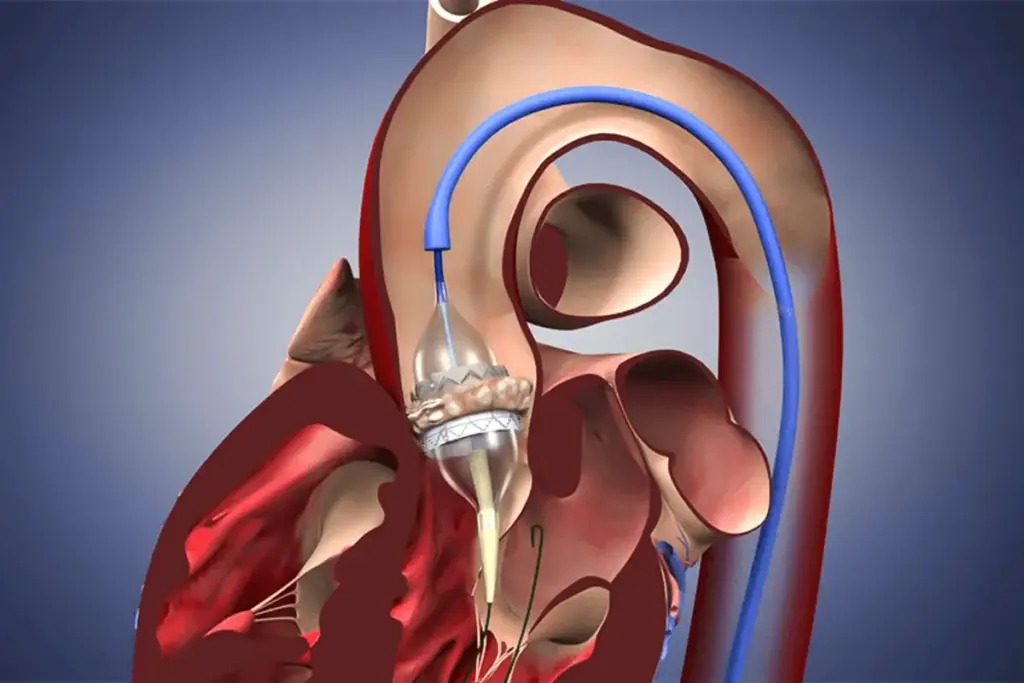
Transcatheter mitral valve repair (TMVr) is a new, less invasive way to fix mitral regurgitation. This condition makes the mitral valve leak because it doesn’t close right.
How does a mitral replacement valve work? Discover the amazing procedure details and why this is a brilliant choice for heart repair.
We do this treatment in a special lab under general anesthesia. It usually takes 3–4 hours. A catheter is put through the femoral vein to get to the heart. Then, a device like MitraClip clips the valve leaflets together to stop the leak.
Studies, like the COAPT trial, show TMVr can really help. It can make heart failure symptoms and hospital stays much less. This makes TMVr a great option for those with severe mitral regurgitation.
Key Takeaways
- TMVr is a minimally invasive procedure for treating mitral regurgitation.
- The procedure is performed under general anesthesia and guided by echocardiography and fluoroscopy.
- A specialized device like MitraClip is used to repair the mitral valve.
- Clinical trials have demonstrated significant reductions in heart failure hospitalizations and mortality.
- TMVr offers a promising alternative for patients with severe mitral regurgitation.
Understanding Mitral Regurgitation and the Need for Intervention

Mitral regurgitation is when the mitral valve leaks, which is a serious health issue. It happens when the valve doesn’t close right, letting blood flow back. We’ll look at what this means and the treatment options.
What is Mitral Regurgitation?
Mitral regurgitation is when the mitral valve doesn’t shut tight. This lets blood flow back into the heart. It can raise heart pressure, leading to heart failure. How bad it is can vary, with some having mild symptoms and others facing serious problems.
Prevalence and Impact on Global Health
Over 2 million people worldwide have mitral regurgitation, making it a big health issue. It can be caused by aging, heart attacks, and birth defects. It can really affect your life, causing symptoms like shortness of breath and tiredness.
Conventional Treatment Options vs. Minimally Invasive Approaches
Traditionally, doctors have used surgery to fix mitral regurgitation. This works but comes with risks. A newer method, transcatheter mitral valve repair (TMVr), is less risky. TMVr means less recovery time and fewer complications, making it a good choice for many. Choosing between these options depends on the patient’s health and how bad the mitral regurgitation is.
Every patient is different, and the right treatment depends on their situation. Knowing when to replace the mitral valve is key to choosing the best treatment.

What is Transcatheter Mitral Valve Repair (TMVr)?
TMVr is a new way to fix mitral regurgitation without big surgery. This problem happens when the mitral valve doesn’t close right, letting blood leak back. TMVr is a less invasive option compared to traditional surgery.
Definition and Basic Principles
TMVr uses a catheter to fix the mitral valve without open-heart surgery. It uses imaging like echocardiography and fluoroscopy to guide it. The main goal is to lessen mitral regurgitation, making the heart work better and easing symptoms.
Evolution of TMVr Technology
TMVr technology has grown a lot over time. Early devices were simple, but now they’re more advanced. These updates have made TMVr safer and more effective.
MitraClip and Other TMVr Devices
The MitraClip is a well-known TMVr device. It clips the mitral valve leaflets to cut down on leakage. Other devices are being tested in trials, giving more choices for treating mitral regurgitation.
Device | Description | Clinical Status |
|---|---|---|
MitraClip | Clips mitral valve leaflets to reduce regurgitation | Approved and widely used |
Other TMVr Devices | Various mechanisms to repair or replace the mitral valve | In clinical trials or development |
As TMVr tech gets better, patients with mitral regurgitation will see better results. It’s important to compare TMVr with treatments like MitraClip to find the best choice for each patient.
Patient Selection and Pre-Procedure Evaluation
TMVr’s success depends on choosing the right patients and a thorough check before starting. We focus on finding the best candidates for this treatment. This careful selection helps reduce risks and increase benefits.
Ideal Candidates for TMVr
Those with severe mitral regurgitation and high surgical risks are good candidates for TMVr. Patients with severe symptoms or who haven’t improved with medicine are often chosen. We look at the patient’s health, how bad the mitral regurgitation is, and any other health issues.
Characteristics | Ideal Candidates |
|---|---|
Mitral Regurgitation Severity | Severe |
Surgical Risk | High |
Symptoms | Significant |
Diagnostic Imaging Requirements
Imaging is key in checking the mitral valve’s shape and function. Echocardiography helps us see how bad mitral regurgitation is. We use other images too to make sure we have all the information.
Risk Assessment and Multidisciplinary Heart Team Approach
A team of doctors, including cardiologists and surgeons, is essential for TMVr. They work together to weigh the risks and benefits for each patient. They look at the patient’s health, the mitral valve disease, and the procedure’s risks. For more details, patients can check patient guides on TMVr preparation and what to expect.
“A multidisciplinary approach ensures that we consider all aspects of a patient’s condition, leading to more informed decision-making and better outcomes.” -Multidisciplinary Heart Team
The Mitral Replacement Valve Procedure: Step-by-Step
Starting the TMVr procedure, the first step is to prepare the patient under general anesthesia. This sets the stage for a successful intervention.
Preparation and Anesthesia
The TMVr procedure starts with thorough preparation. This includes giving the patient general anesthesia to keep them comfortable. This is key to reduce stress and help the medical team work better.
Vascular Access Through the Femoral Vein
After the patient is anesthetized, the next step is to get vascular access through the femoral vein. This is a small, less invasive way to put in a catheter. The catheter will be guided to the heart using fluoroscopic guidance.
Navigation to the Heart
With vascular access in place, the catheter is then navigated to the heart. It will play a key role in the TMVr procedure. This navigation is done under real-time fluoroscopic imaging for accuracy.
Transseptal Puncture Technique
A key moment in the TMVr procedure is the transseptal puncture technique. This involves making a controlled puncture in the interatrial septum. It allows access to the left atrium, making it possible to deploy the TMVr device.
Completing these steps is vital for the TMVr procedure’s success. It shows the importance of precision and expertise in percutaneous mitral valve repair.
Performing the TMVr Procedure
TMVr involves careful steps for success. It needs precision and uses advanced tech like the MitraClip device.
Positioning the Delivery System
The first step is to position the delivery system. This means guiding the MitraClip through the femoral vein and into the left atrium. Getting it right is key for the procedure’s success.
Grasping the Mitral Valve Leaflets
Next, the delivery system is used to grasp the mitral valve leaflets. The MitraClip creates a double orifice valve to reduce mitral regurgitation. It’s all about precision here.
Clip Deployment and Assessment
After grasping, the MitraClip is deployed and checked with echocardiography. This check is vital to see if the mitral regurgitation is reduced. Adjustments can be made if needed.
Multiple Clip Placement When Necessary
Sometimes, one clip isn’t enough. The procedure allows for multiple clips. This flexibility is a big plus for tailoring treatment to each patient.
Step | Description | Key Considerations |
|---|---|---|
1. Positioning the Delivery System | Navigating the MitraClip device to the left atrium | Accurate positioning under fluoroscopic and echocardiographic guidance |
2. Grasping the Mitral Valve Leaflets | Capturing both leaflets with the MitraClip device | Precise control to ensure proper grasping |
3. Clip Deployment and Assessment | Deploying the MitraClip and assessing its effectiveness | Echocardiographic assessment to determine reduction in mitral regurgitation |
4. Multiple Clip Placement | Placing additional clips as necessary | Flexibility to tailor treatment to individual patient needs |
Imaging Guidance During TMVr
Imaging guidance is key to the success of Transcatheter Mitral Valve Repair (TMVr) procedures. Advanced imaging helps navigate the mitral valve’s complex anatomy. It ensures the device is placed precisely.
Role of Echocardiography
Echocardiography is vital for TMVr imaging. It gives detailed images of the mitral valve’s anatomy and function. This allows for real-time assessment during the procedure.
Transesophageal Echocardiography (TEE)
Transesophageal Echocardiography (TEE) is very useful. It gives high-resolution images of the mitral valve from behind. This close view helps see the valve’s anatomy and function clearly.
3D Echocardiography Applications
3D echocardiography adds to our understanding of the mitral valve. It offers a full view of the valve structure. This helps place devices more accurately.
Fluoroscopic Guidance
Fluoroscopy is also critical for TMVr imaging. It shows the catheter and device placement in real-time. This ensures they are placed correctly through the vascular system.
Integration of Imaging Modalities
Combining echocardiography and fluoroscopy gives a complete imaging solution for TMVr. This approach improves safety and effectiveness. It provides a detailed and dynamic view of the mitral valve and surrounding structures.
Imaging Modality | Primary Use in TMVr | Benefits |
|---|---|---|
Echocardiography (TEE) | Detailed mitral valve anatomy and function assessment | High-resolution imaging, real-time assessment |
3D Echocardiography | Comprehensive view of mitral valve structure | Enhanced understanding of valve anatomy, accurate device placement |
Fluoroscopy | Catheter and device placement guidance | Real-time visualization, accurate navigation |
Post-Procedure Care and Recovery
The time after TMVr is key for the best results and to avoid problems. We make a detailed care plan for each patient.
Immediate Post-Procedure Monitoring
Right after TMVr, patients are watched closely in the lab and then in a recovery area. We work to keep them stable and manage any symptoms.
Hospital Stay Duration
Most patients leave the hospital a few days after TMVr. How long they stay depends on how they do and their health.
Medication Management
Patients get the right meds to avoid issues like blood clots or heart infections. We choose the meds based on each patient’s needs and health history.
Follow-up Protocol
We have a plan for follow-ups to check on patients, make changes if needed, and handle any problems. This includes regular visits and tests to see how well the TMVr worked.
Follow-up Component | Description | Timeline |
|---|---|---|
Initial Follow-up | Assessment of immediate post-procedure recovery | 1-2 weeks |
Clinical Evaluation | Evaluation of symptoms and functional status | 1, 6, and 12 months |
Echocardiography | Assessment of mitral valve function and regurgitation | 1, 6, and 12 months |
Following a strict care and follow-up plan helps improve patient results and life quality after TMVr.
Clinical Outcomes and Evidence for TMVr
Research on Transcatheter Mitral Valve Repair (TMVr) has shown its effectiveness. It has provided valuable insights into its benefits.
The COAPT Trial Results
The COAPT trial was a key study. It showed TMVr’s benefits for patients with heart failure and mitral regurgitation.
Key findings included fewer heart failure hospitalizations and better survival rates.
Reduction in Heart Failure Hospitalizations
TMVr has been shown to lower heart failure hospitalizations. This is a common issue with mitral regurgitation.
This decrease is due to better mitral valve function. It also reduces ventricular overload.
Mortality Benefits
The COAPT trial also found TMVr’s mortality benefits. There was a significant drop in all-cause mortality.
This survival improvement is a key benefit of TMVr. It greatly enhances patient outcomes.
Quality of Life Improvements
TMVr also improves patients’ quality of life. It reduces hospitalizations and mortality, and it makes patients feel better.
Patients report better function and fewer symptoms. This improves their overall well-being.
Comparison with Transcatheter Mitral Valve Replacement
TMVr is often compared to Transcatheter Mitral Valve Replacement (TMVR). TMVR is another treatment for mitral regurgitation.
Aspect | TMVr | TMVR |
|---|---|---|
Procedure Complexity | Less invasive | More complex |
Valve Function | Repairs native valve | Replaces native valve |
Clinical Evidence | Strong evidence from COAPT trial | Ongoing studies |
In conclusion, TMVr has shown significant benefits. These include fewer heart failure hospitalizations, better survival rates, and improved quality of life.
Conclusion: The Future of Transcatheter Mitral Valve Repair
Transcatheter mitral valve repair has become a key treatment for mitral regurgitation. As technology gets better, TMVr’s role in medicine will grow. Research and development will likely make this procedure even more effective and available to more people.
The future of TMVr is bright, thanks to new device technology and better imaging. This makes the procedure more precise and effective. As more evidence comes in, TMVr will play a bigger part in treating mitral regurgitation and improving patient results.
TMVr has the power to cut down on heart failure hospital stays and improve life quality. It’s a less invasive option compared to traditional surgery. As we look ahead, improving TMVr techniques will be key in shaping the future of mitral valve treatment.
FAQ
What is transcatheter mitral valve repair (TMVr)?
TMVr is a new way to fix a heart problem. It’s a small procedure that helps the mitral valve work right. This stops leakage and improves heart health.
How is TMVr performed?
TMVr happens in a special lab under deep sleep. A thin tube is put in a vein and guided to the heart. Then, a device clips the valve to fix it.
What are the benefits of TMVr compared to conventional surgical mitral valve repair or replacement?
TMVr is less invasive than open-heart surgery. It means less recovery time and fewer risks. It’s great for those at high risk for surgery.
What is the MitraClip device?
The MitraClip is a TMVr tool. It clips the mitral valve to stop leakage. It’s put in through a vein in the leg.
How is patient selection done for TMVr?
Doctors pick the right patients for TMVr. They look at who’s at high risk for surgery. A team of experts uses heart scans to decide.
What is the role of imaging guidance during TMVr?
Heart scans are key during TMVr. They show the valve’s shape and how it works. This helps place the device safely and accurately.
What are the clinical outcomes of TMVr?
Studies show TMVr helps a lot. It reduces heart failure symptoms and hospital stays. It also improves life quality and might lower death rates.
How does TMVr compare to transcatheter mitral valve replacement (TMVR)?
TMVr and TMVR are both new ways to treat heart valve problems. TMVr fixes the valve, while TMVR replaces it. The choice depends on the patient’s condition.
What is the recovery process like after TMVr?
After TMVr, patients are watched closely. They then go to a recovery area. The stay is short, and they get medicine to prevent problems. A follow-up plan is set to check on them.
What are the indications for mitral valve replacement or repair?
Replacing or repairing the mitral valve is needed for serious problems. The choice depends on how bad the problem is and the patient’s health.
References
New England Journal of Medicine. Evidence-Based Medical Insight. Retrieved from https://www.nejm.org/doi/full/10.1056/NEJMoa1806640


