

The nerves in the foot and ankle are very complex. They have thousands of nerve endings. These come from the sciatic nerve and spread out in the lower leg. They help with movement and feeling.
At Liv Hospital, we know how important it is to understand this complex anatomy. It helps us diagnose and treat foot and ankle problems well. The ankle joint is more than just a simple hinge. It has many nerves working together to help us move.
Knowing how nerves are spread out is key to treating foot and ankle issues. It makes sure patients get the care they need.
Key Takeaways
- The nerves of the foot and ankle are derived from the sciatic nerve.
- Complex anatomy is key for movement and feeling.
- Understanding nerve distribution is vital for diagnosis and treatment.
- The ankle joint is more complex than a simple hinge joint.
- Many nerves work together to help us move in the foot and ankle.
Anatomical Overview of Foot and Ankle Innervation

The foot and ankle have a complex system of nerves. These nerves come from the sciatic nerve. This system is key for the foot and ankle’s movement and feeling.
Sciatic Nerve Origin and Division
The sciatic nerve starts from the L4-S3 spinal roots. It forms from the common peroneal and tibial nerves. As it goes down the leg, it splits into two main parts: the tibial nerve and the common fibular nerve.
This split is important. It marks the start of the nerves going to the foot and ankle.
The tibial nerve leads to the medial and lateral plantar nerves. These nerves are vital for the foot’s flexor muscles and the feeling on the bottom of the foot.
General Nerve Distribution Patterns
The nerves in the foot and ankle follow certain patterns. The tibial nerve mainly covers the bottom of the foot. The common fibular nerve splits into the superficial and deep fibular nerves. These cover the top of the foot.
| Nerve | Branch | Function |
| Sciatic Nerve | Tibial Nerve | Motor and Sensory Innervation to the plantar aspect |
| Sciatic Nerve | Common Fibular Nerve | Sensory Innervation to the dorsal aspect |
| Tibial Nerve | Medial and Lateral Plantar Nerves | Motor innervation to flexor muscles and sensory innervation to the sole |
Knowing these patterns is key for diagnosing and treating foot and ankle nerve issues.
Major Nerves of the Foot and Ankle
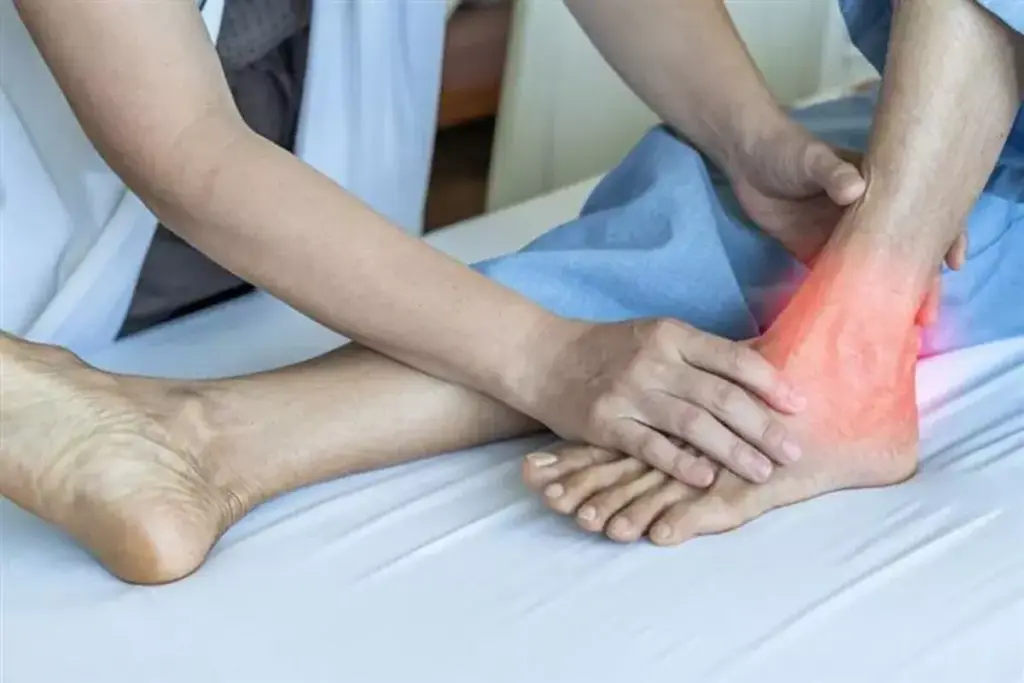
The nerves in the foot and ankle are key for movement and feeling. Knowing about them is vital for doctors and nurses. They help in diagnosing and treating foot and ankle problems.
Tibial Nerve and Its Branches
The tibial nerve comes from the sciatic nerve. It controls the foot’s muscles and feels sensations. It splits into the medial and lateral plantar nerves.
The medial plantar nerve helps the muscles on the inside of the foot. It also feels sensations on the inside of the foot and the first three toes. The lateral plantar nerve works on the outside of the foot. It feels sensations on the outside of the foot and the last two toes.
Common Fibular Nerve Branches
The common fibular nerve splits into the deep fibular nerve and the superficial fibular nerve. The deep fibular nerve helps the foot’s extensor muscles. It also feels sensations on the first web space. The superficial fibular nerve feels sensations on the top of the foot, except the first web space.
| Nerve | Motor Innervation | Sensory Innervation |
| Medial Plantar Nerve | Abductor hallucis, flexor digitorum brevis, first lumbrical | Medial two-thirds of the sole, medial three and a half toes |
| Lateral Plantar Nerve | Remaining intrinsic muscles of the foot | Lateral third of the sole, lateral one and a half toes |
| Deep Fibular Nerve | Extensor musculature of the foot | First web space |
| Superficial Fibular Nerve | Dorsum of the foot, except first web space |
Additional Important Nerves
The saphenous nerve feels sensations on the foot’s inside. The sural nerve feels sensations on the foot’s outside and the little toe. For more info, check NCBI’s anatomy guide.
Knowing the foot and ankle’s nerve system is key for treating problems. By understanding the major nerves, we can better help with foot and ankle issues.
Functional Aspects of Foot and Ankle Nerves
The nerves in our feet and ankles are key for movement and feeling. They help us move and feel our surroundings. This is important for everyday life.
Motor Innervation Patterns
The muscles in our feet are split into two groups: intrinsic and extrinsic. The intrinsic muscles, which control fine movements, get their nerve supply from the tibial nerve. The tibial nerve splits into two, the medial and lateral plantar nerves. These nerves supply the muscles inside the foot.
For example, the medial plantar nerve helps muscles like the abductor hallucis. The lateral plantar nerve helps muscles like the abductor digiti minimi. This setup lets us move our toes and foot in detailed ways.
Sensory Distribution
The nerves in our feet also handle feeling. The sensory nerves of the foot, like the superficial and deep peroneal nerves, saphenous nerve, and sural nerve, cover different parts of the foot. They help us feel touch, pressure, and vibrations.
The superficial peroneal nerve covers the top of the foot. The deep peroneal nerve is for the first web space. The sural nerve is on the outside, and the saphenous nerve is on the inside. This detailed nerve distribution of the foot helps us understand our surroundings.
In summary, the nerves in our feet and ankles are important for movement and feeling. Knowing about these nerves helps doctors treat foot and ankle problems.
Conclusion
We’ve looked into the complex world of nerves in the foot and ankle. These nerves are key to how our lower limbs work. They form a detailed network that lets us feel and move.
Knowing the foot nerve map and the nerves in the foot and toes is key. It helps doctors diagnose and treat foot and ankle problems.
The ankle’s anatomy is made up of many parts, like nerves, muscles, and blood vessels. Understanding these helps doctors treat patients better. This knowledge is important for top-notch healthcare, supporting patients from around the world.
In short, the nerves in our feet and ankles are essential for our foot’s function. By understanding this complex network, we can give better care to our patients.
FAQ:
What is the role of the sciatic nerve in foot and ankle innervation?
The sciatic nerve is a key nerve. It splits into several branches. These branches help control and feel sensations in the foot and ankle.
What are the major branches of the sciatic nerve?
The sciatic nerve splits into two main branches. The tibial and common fibular nerves. These nerves then branch out further to cover different parts of the foot and ankle.
What is the function of the tibial nerve in the foot?
The tibial nerve and its branches, like the medial and lateral plantar nerves, help control muscles and feel sensations in the foot.
What areas of the foot are innervated by the common fibular nerve?
The common fibular nerve and its branches, like the deep and superficial fibular nerves, cover specific areas of the foot. They provide both motor and sensory functions.
What is the role of the saphenous nerve in the foot and ankle?
The saphenous nerve is responsible for feeling sensations on the medial side of the foot and ankle.
How do the nerves of the foot and ankle control muscle movement?
The nerves, including the tibial and common fibular nerves, control muscle movement. They do this by providing motor innervation to the foot’s muscles.
What is the distribution pattern of sensory nerves in the foot?
Sensory nerves in the foot, from branches of the tibial and common fibular nerves, follow a specific pattern. They cover different areas of the foot.
Can nerve damage in the foot and ankle cause numbness or pain?
Yes, nerve damage can lead to numbness, pain, or other feelings of disturbance. This depends on where and how severe the damage is.
How is the anatomy of foot and ankle nerves relevant to diagnosis and treatment?
Knowing the anatomy of foot and ankle nerves is key for diagnosing and treating issues. It helps pinpoint the exact cause of symptoms.
References:
JAMA Network. Evidence-Based Medical Insight. Retrieved from
https://jamanetwork.com/journals/jama/fullarticle/190875