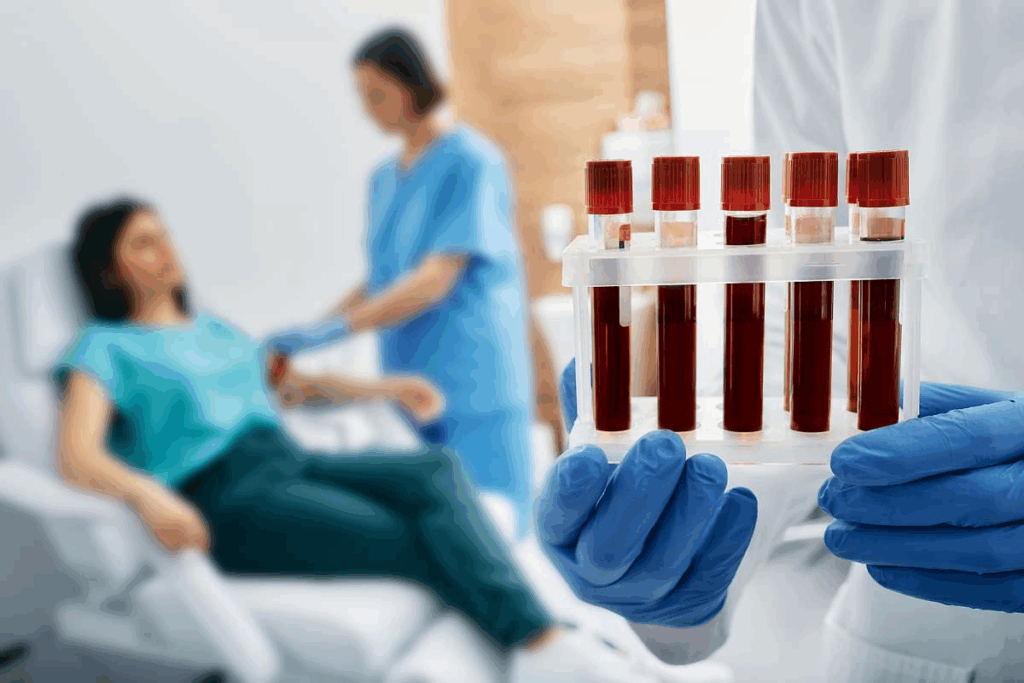
Diagnosing polycystic ovary syndrome is tricky because of its complex symptoms. We use detailed blood tests to check hormone and metabolic levels. This helps doctors confirm if someone has PCOS.
These tests look at hormones like testosterone, LH, FSH, and AMH, and metabolic markers. Knowing about these blood tests for PCOS helps patients work better with their doctors. This way, they can manage their condition well.
Pcos blood results
- Comprehensive blood tests are key for diagnosing polycystic ovary syndrome.
- Blood tests check hormone and metabolic levels.
- Understanding test results helps patients work well with their healthcare providers.
- Liv Hospital’s patient-centered approach supports individuals in managing their condition.
- Blood tests look at hormone levels, including testosterone and AMH.
Understanding PCOS and the Importance of Blood Testing

Understanding PCOS and its diagnosis is key to managing it well. Blood tests are a big part of this. PCOS is a complex disorder that affects women of childbearing age. It causes irregular periods, high levels of male hormones, and polycystic ovaries.
What is Polycystic Ovary Syndrome?
PCOS is a disorder that affects a woman’s health in many ways. It impacts her reproductive, metabolic, and heart health. It’s marked by hyperandrogenism, trouble with ovulation, and polycystic ovaries seen on ultrasound. The exact cause is not known, but it’s thought to be a mix of genetics and environment.
The Three Pillars of PCOS Diagnosis
The diagnosis of PCOS uses the Rotterdam criteria. It looks for at least two of three things: irregular ovulation, high male hormones, and polycystic ovaries on ultrasound. Blood tests are key to confirm the diagnosis by checking hormone and metabolic levels.
- Oligoanovulation: Irregular or absent ovulation, often shown as irregular periods.
- Hyperandrogenism: High levels of male hormones, leading to symptoms like hirsutism, acne, and baldness.
- Polycystic Ovary Morphology: Seeing many small cysts on the ovaries by ultrasound.
Why Laboratory Testing is Critical
Laboratory testing is vital to rule out other conditions that might look like PCOS. It helps confirm the diagnosis. The main blood tests for PCOS include:
| Test | Purpose |
|---|---|
| Testosterone Measurement | To check for high male hormones |
| LH and FSH Levels | To see if hormone balance is off |
| AMH Levels | To check ovarian reserve and follicle count |
| SHBG | To look at sex hormone-binding globulin levels |
| TSH | To check thyroid function |
| Glucose Metabolism Tests | To check insulin resistance and glucose use |
The Endocrine Society says, “PCOS is a complex disorder that needs a detailed diagnostic approach.” Blood tests are a key part of this, giving important info for treatment plans.
“The diagnosis of PCOS is not just about identifying the condition; it’s about understanding the individual’s unique presentation and developing a personalized treatment plan.”— Medical Expert, Endocrinologist
How to Prepare for PCOS Blood Tests
Knowing how to prepare for PCOS blood tests is key. It helps make sure your test results are right. This is important for your doctor to make a good diagnosis.
Optimal Timing During Your Menstrual Cycle
The timing of your PCOS blood tests is very important. The best time is usually between days 2 and 5 of your cycle. This is when hormone tests like FSH and LH are most accurate.
Talk to your doctor about your cycle. They can tell you the best time for your tests. Some tests need different timing, and your doctor will guide you based on your needs.
Fasting Requirements for Accurate Results
Some tests need you to fast for accurate results. Fasting means not eating or drinking (except water) for 8 to 12 hours. This is key for tests on glucose and insulin, as eating can change these levels.
- Fasting Plasma Glucose Test: You need to fast to measure your blood glucose after not eating overnight.
- Oral Glucose Tolerance Test (OGTT): You fast, then drink a glucose drink, and your blood glucose is checked at set times.
It’s important to follow your doctor’s fasting instructions. This ensures your test results are reliable.
Medications That May Affect Test Results
Some medications can change your PCOS blood test results. Tell your doctor about all medicines, supplements, and vitamins you’re taking. This includes:
- Hormonal contraceptives, which can change hormone levels
- Insulin-sensitizing drugs, which can affect glucose levels
- Corticosteroids, which can change hormone levels
Your doctor might ask you to stop some medicines before your test. Or they’ll consider them when looking at your results.
By understanding these points and following your doctor’s advice, you can make sure your PCOS blood tests are done right. This gives you the best information for your diagnosis and treatment.
Primary Hormonal Markers in PCOS Blood Results
Understanding the hormonal markers of PCOS is key for accurate diagnosis and treatment. PCOS, or Polycystic Ovary Syndrome, is a complex disorder that affects women of reproductive age. Blood tests are used to check several hormonal markers.
The Diagnostic Triad of PCOS
The diagnosis of PCOS is based on at least two criteria. These include clinical and biochemical signs of hyperandrogenism, ovulatory issues, and polycystic ovary morphology. Blood tests are vital for identifying biochemical hyperandrogenism.
The main hormonal markers include:
- Testosterone levels
- LH and FSH levels
- Anti-Müllerian Hormone (AMH)
- Sex Hormone-Binding Globulin (SHBG)
How Hormonal Imbalances Manifest in Bloodwork
Hormonal imbalances in PCOS show up in blood tests in different ways. Common findings are high testosterone levels, an altered LH/FSH ratio, and high AMH levels. These imbalances help diagnose PCOS and understand its severity.
| Hormone | Typical Finding in PCOS | Clinical Significance |
|---|---|---|
| Testosterone | Elevated | Hyperandrogenism |
| LH/FSH Ratio | Altered (often elevated) | Ovulatory dysfunction |
| AMH | Elevated | Indicator of ovarian reserve |
When to Get Comprehensive Hormone Testing
Comprehensive hormone testing is recommended when PCOS is suspected. This includes irregular menstrual cycles, signs of hyperandrogenism, and ultrasound findings. It’s also key for monitoring and adjusting treatment plans.
It’s important to talk to a healthcare provider about when and what tests are needed. This depends on individual needs and symptoms.
Testosterone and Androgen Testing: The Key PCOS Indicators
Diagnosing PCOS often involves testing for testosterone and androgens. These tests help spot hyperandrogenism, a key PCOS trait. Symptoms include hirsutism, acne, and male-pattern baldness. By checking testosterone and androgens, doctors can see the hormonal imbalances in PCOS.
Total Testosterone Measurement
Measuring total testosterone is key in diagnosing PCOS. It shows the overall testosterone level in the blood. High levels of total testosterone are linked to hyperandrogenism in PCOS patients.
Table: Total Testosterone Levels in PCOS
| Category | Normal Range | PCOS Range |
|---|---|---|
| Total Testosterone | 2-45 ng/dL | Often >45 ng/dL |
Free Testosterone Levels
Free testosterone levels are also important. They show the testosterone not bound to proteins in the blood. This active testosterone can cause PCOS symptoms.
Other Androgens: DHEA-S and Androstenedione
Doctors also check DHEA-S and androstenedione. These hormones help understand androgen levels in PCOS. They play a part in hyperandrogenic symptoms.
Table: Other Androgens in PCOS
| Androgen | Normal Range | Clinical Significance |
|---|---|---|
| DHEA-S | 35-430 mcg/dL | Elevated levels may indicate adrenal androgen excess |
| Androstenedione | 0.3-3.3 ng/mL | High levels contribute to hyperandrogenism |
Gonadotropin Hormones: Understanding LH and FSH Tests
Testing LH and FSH levels is key in diagnosing PCOS. These hormones control the menstrual cycle and ovulation. In PCOS, their balance is often off, causing ovulation problems.
The Significance of the LH:FSH Ratio
The LH:FSH ratio is important in PCOS diagnosis. Women with PCOS usually have higher LH levels than FSH. This imbalance shows hormonal issues typical of PCOS.
When LH and FSH Results Indicate PCOS
High LH levels can stop ovulation in PCOS. Not all PCOS cases have an abnormal LH:FSH ratio. But, it’s a good sign when it does.
Limitations of Gonadotropin Testing
The LH:FSH ratio is helpful but not perfect. Many things can change LH and FSH levels. A full check is needed for a sure PCOS diagnosis.
To understand LH and FSH levels better, let’s look at a comparison:
| Hormone | Normal Levels | PCOS Levels |
|---|---|---|
| LH | 2-10 IU/L | Often elevated, >10 IU/L |
| FSH | 3-12 IU/L | Typically normal or low |
| LH:FSH Ratio | Normally around 1:1 | Often >2:1 |
In summary, knowing about LH and FSH levels and their ratio is key in diagnosing PCOS. These tests help understand the hormonal side of the syndrome, even if they’re not the only signs.
Anti-Mullerian Hormone (AMH): A Modern PCOS Biomarker
PCOS diagnosis has been greatly improved with the use of Anti-Mullerian Hormone (AMH) as a biomarker. AMH is a protein made by the ovaries. It’s higher in women with PCOS, showing more small follicles in the ovaries.
Ovarian Follicle Count and AMH Levels
AMH levels show how many follicles are in the ovaries. In PCOS, there are more small follicles, leading to higher AMH levels. This makes AMH a key tool in diagnosing PCOS and understanding its severity.
Key Points about AMH in PCOS:
- Elevated AMH levels are common in PCOS due to the increased number of small antral follicles.
- AMH is a useful marker for ovarian reserve.
- High AMH levels can indicate a higher number of follicles, which is a characteristic feature of PCOS.
Interpreting Elevated AMH Levels
When looking at AMH levels, it’s important to consider the whole picture. High AMH levels can mean PCOS, but they can also show up in other conditions. So, AMH levels should be looked at with other signs of PCOS.
| AMH Level | Possible Indication |
|---|---|
| Normal | Normal ovarian reserve |
| Elevated | PCOS, high ovarian reserve |
| Low | Low ovarian reserve, potentially indicating diminished ovarian function |
AMH as a Predictor of PCOS Severity
Studies show that AMH levels can also show how severe PCOS is. Higher AMH levels are linked to more severe symptoms, like more insulin resistance and higher androgen levels. So, AMH helps not just in diagnosing but also in understanding how severe the condition might be.
Knowing about AMH levels and what they mean can help doctors create better treatment plans for women with PCOS. This can improve their care and management of the condition.
Sex Hormone-Binding Globulin (SHBG) Assessment
SHBG levels give us important clues about hormone balance in women with PCOS. SHBG is a protein that holds onto sex hormones like testosterone and estrogen. This makes them not available for use in the body.
The Role of SHBG in Hormone Regulation
SHBG is key in controlling free sex hormones in our bodies. It binds to testosterone and estrogen, affecting their balance. This balance is vital for normal hormone function.
Why SHBG is Typically Low in PCOS
In PCOS, SHBG levels are usually lower than they should be. This drop is linked to insulin resistance, common in PCOS patients. Low SHBG levels mean more free testosterone, leading to symptoms like hirsutism and acne.
How SHBG Affects Free Testosterone Levels
SHBG levels affect how much free testosterone we have. When SHBG is low, more testosterone is free. This can make PCOS symptoms worse. So, checking SHBG levels is key to understanding PCOS hormonal imbalances.
- Low SHBG levels are linked to more free testosterone.
- Checking SHBG is vital for grasping PCOS-related hormonal imbalances.
- SHBG levels offer insights into the severity of PCOS symptoms.
By looking at SHBG levels in a PCOS blood test, doctors can better understand hormone issues in women with PCOS. This knowledge is essential for creating effective treatment plans that tackle hormonal imbalances.
Thyroid Function Tests: Ruling Out Similar Conditions
Thyroid problems can look like PCOS, making tests key for diagnosis. These tests help us tell PCOS apart from thyroid issues. This ensures we get the right treatment.
TSH and Free T4 Measurement
We check thyroid function with TSH and Free T4 tests. TSH comes from the pituitary gland and tells the thyroid to make hormones. These hormones are T4 and T3.
High TSH and low Free T4 mean you might have hypothyroidism. This is when your thyroid doesn’t make enough hormones. On the other hand, low TSH and high Free T4 suggest hyperthyroidism. This is when your thyroid makes too many hormones.
Thyroid Antibody Testing
Thyroid antibody tests are vital for finding autoimmune thyroiditis. This includes Hashimoto’s thyroiditis and Graves’ disease. These happen when your immune system attacks your thyroid by mistake.
Testing for thyroid antibodies like TPOAb or TgAb shows an immune attack on your thyroid.
Differentiating Thyroid Disorders from PCOS
Telling thyroid problems from PCOS is important. Both can cause irregular periods, weight changes, and tiredness.
Thyroid tests help us figure out the difference. For example, thyroid issues can cause period problems that might seem like PCOS.
Glucose Metabolism and Insulin Resistance Markers
We use several key tests to assess glucose metabolism in PCOS patients. These tests give us valuable insights into their insulin sensitivity and resistance.
Fasting Plasma Glucose Test
The fasting plasma glucose test is a key test for glucose metabolism. It measures blood glucose levels after an overnight fast, usually 8-12 hours. This test helps identify those with impaired fasting glucose or diabetes.
Normal levels are below 100 mg/dL. Levels between 100-125 mg/dL show impaired fasting glucose. A level of 126 mg/dL or higher indicates diabetes.
Oral Glucose Tolerance Test (OGTT)
The OGTT is another important test for glucose metabolism. It measures blood glucose levels after drinking a glucose-rich beverage, with 75 grams of glucose. This test checks how well the body can manage blood sugar levels after a glucose challenge.
We check glucose levels at different times, usually 1 and 2 hours after drinking the glucose. This test helps diagnose impaired glucose tolerance and diabetes.
HbA1c Measurement
HbA1c is a marker of average blood glucose levels over the past 2-3 months. It measures the percentage of glucose-bound hemoglobin in red blood cells. HbA1c gives a long-term view of glucose control.
An HbA1c level below 5.7% is normal. Levels between 5.7-6.4% indicate prediabetes. A level at or above 6.5% suggests diabetes.
HOMA-IR and Other Insulin Sensitivity Indices
HOMA-IR (Homeostatic Model Assessment for Insulin Resistance) is a calculated index that assesses insulin resistance. It is based on fasting glucose and insulin levels. Other indices, like the Quantitative Insulin Sensitivity Check Index (QUICKI), also provide insights into insulin sensitivity.
These tests help us understand the degree of insulin resistance, which is often linked to PCOS. Higher HOMA-IR values mean greater insulin resistance.
Comprehensive Guide to Interpreting Your PCOS Blood Results
Understanding your PCOS blood test results is key for accurate diagnosis and treatment. It’s important to know about hormonal and metabolic markers. Also, knowing how PCOS phenotypes affect lab values is vital.
Normal vs. Abnormal Reference Ranges
When looking at PCOS blood results, knowing normal and abnormal ranges is essential. These ranges come from healthy people, but results can vary. Factors like age, ethnicity, and lab techniques play a role.
For example, testosterone levels are important in PCOS diagnosis. High testosterone is common in PCOS. But, the normal range can differ between labs. It’s important to look at the value and how it compares to the range.
How Different PCOS Phenotypes Affect Lab Values
PCOS is diverse, and different phenotypes show different lab values. There are four main PCOS phenotypes:
- Hyperandrogenism, ovulatory dysfunction, and polycystic ovaries
- Hyperandrogenism and polycystic ovaries
- Hyperandrogenism and ovulatory dysfunction
- Ovulatory dysfunction and polycystic ovaries
Each phenotype has its own hormonal and metabolic profiles. For instance, women with the hyperandrogenic phenotype often have higher testosterone and androgens.
Common Patterns in PCOS Blood Work
While results can vary, some patterns are common in PCOS blood work. These include:
| Test | Common Finding in PCOS | Clinical Significance |
|---|---|---|
| Testosterone | Elevated | Hyperandrogenism |
| LH:FSH Ratio | Increased | Hypothalamic-pituitary-ovarian axis dysregulation |
| AMH | Elevated | Indicator of ovarian reserve |
| Fasting Insulin | Elevated | Insulin resistance |
When to Seek a Second Opinion
If you’re unsure about your PCOS blood test results, getting a second opinion is a good idea. This is important if:
- Your symptoms don’t match your test results
- You have a complex medical history
- You’re considering fertility treatment
By understanding your PCOS blood test results and working with your healthcare provider, you can create a treatment plan that meets your needs. This can improve your health outcomes.
Additional Blood Tests for Complete PCOS Evaluation
Diagnosing PCOS requires more than just basic tests. Additional blood tests give a deeper look at the condition. They help doctors understand metabolic and heart risks better. This leads to better treatment plans.
Prolactin Levels
Prolactin is a hormone from the pituitary gland. It’s key for milk production and reproductive health. High prolactin levels can be linked to PCOS, but it’s not a main sign. Testing for prolactin helps rule out other conditions with similar symptoms.
17-Hydroxyprogesterone
17-Hydroxyprogesterone (17-OHP) is a hormone checked for congenital adrenal hyperplasia (CAH). CAH can look like PCOS. High 17-OHP levels might mean CAH, which is important for those with high androgens or a family history of CAH.
Lipid Profile Assessment
A lipid profile checks different types of cholesterol and triglycerides. Women with PCOS often have bad cholesterol levels. This test helps spot heart risks and guides how to improve health.
Inflammatory and Cardiovascular Markers
PCOS is linked to inflammation and heart disease risk. Tests for inflammation and heart health are added. These tests show the heart’s health and help prevent problems.
Adding these tests to diagnosis helps doctors understand PCOS better. This way, they can manage PCOS and related health issues more effectively.
Conclusion: Next Steps After Your PCOS Diagnosis
Getting a PCOS diagnosis is just the start of your journey. It’s important to know what to do next to manage your symptoms and health risks.
Creating a treatment plan that fits you is key. This might include changing your diet and exercising more. You might also need hormonal treatments to balance your cycles and lower androgen levels.
It’s also vital to tackle metabolic and heart health risks. This means keeping an eye on your blood sugar and insulin levels. You should also manage your cholesterol and inflammation markers.
With your healthcare team, you can make a plan that works for you. This way, you can manage PCOS well and improve your health. Knowing what to do after a PCOS diagnosis helps you take charge of your health and make smart choices about your care.
FAQ
What blood tests are used to diagnose PCOS?
To diagnose PCOS, doctors use several blood tests. These include tests for testosterone, LH and FSH levels, and anti-Mullerian hormone (AMH). They also check for sex hormone-binding globulin (SHBG), thyroid-stimulating hormone (TSH), and glucose metabolism tests.
What is the significance of the LH:FSH ratio in PCOS diagnosis?
The LH:FSH ratio is important in PCOS. It shows if LH levels are higher than FSH. This helps doctors understand hormonal imbalances in PCOS.
How does anti-Mullerian hormone (AMH) relate to PCOS?
AMH levels are high in PCOS. This is because of more small follicles in the ovaries. Knowing how to read AMH levels is key for diagnosing and treating PCOS.
What is the role of sex hormone-binding globulin (SHBG) in PCOS?
SHBG helps control free sex hormones in the body. In PCOS, SHBG levels are often low. This leads to more free testosterone.
Why are thyroid function tests important in PCOS diagnosis?
Thyroid issues can look like PCOS symptoms. Testing TSH and free T4 levels is important. Thyroid antibody tests can also show autoimmune thyroiditis.
How is insulin resistance assessed in PCOS?
Doctors use fasting plasma glucose, OGTT, and HbA1c tests to check glucose handling. They also use insulin sensitivity indices to understand insulin resistance better.
What additional blood tests can provide a more complete understanding of PCOS?
Tests for prolactin, 17-hydroxyprogesterone, lipid profiles, and inflammatory markers are useful. They give insights into metabolic and cardiovascular risks related to PCOS.
How should I prepare for PCOS blood tests?
Preparing for PCOS blood tests is important. Consider the best time during your cycle, follow fasting instructions, and know how medications might affect the tests.
What are the next steps after receiving a PCOS diagnosis?
After a PCOS diagnosis, understanding what to do next is key. This includes making lifestyle changes, using hormonal treatments, and managing metabolic and cardiovascular risks.
Can PCOS be diagnosed solely through blood tests?
Blood tests are important for diagnosing PCOS, but not the only factor. A full diagnosis also involves clinical evaluation and imaging studies. Blood tests help show hormonal and metabolic markers, but a diagnosis is based on a mix of clinical, lab, and imaging findings.
What is the importance of interpreting PCOS blood results correctly?
Understanding PCOS blood results is critical. It requires knowing normal and abnormal ranges for different markers. Recognizing patterns in PCOS blood work is essential.
References
National Center for Biotechnology Information. PCOS Diagnosis: Blood Tests for Hormonal and Metabolic Evaluation. Retrieved from https://pubmed.ncbi.nlm.nih.gov/26526754/